
Chef Juliette
John Dory (St. Pierre)
John Dory has the delicacy of sole and the firmness of turbot. A light flouring, a quick butter sauté, and nut-brown beurre noisette show exactly why looks never mattered.
A cooking platform built around craft, culture, and the stories behind what we eat.
Created by Chef Juliette
Based on No. 1524, Poularde Toulousaine, from Le Guide Culinaire (1907) by Auguste Escoffier
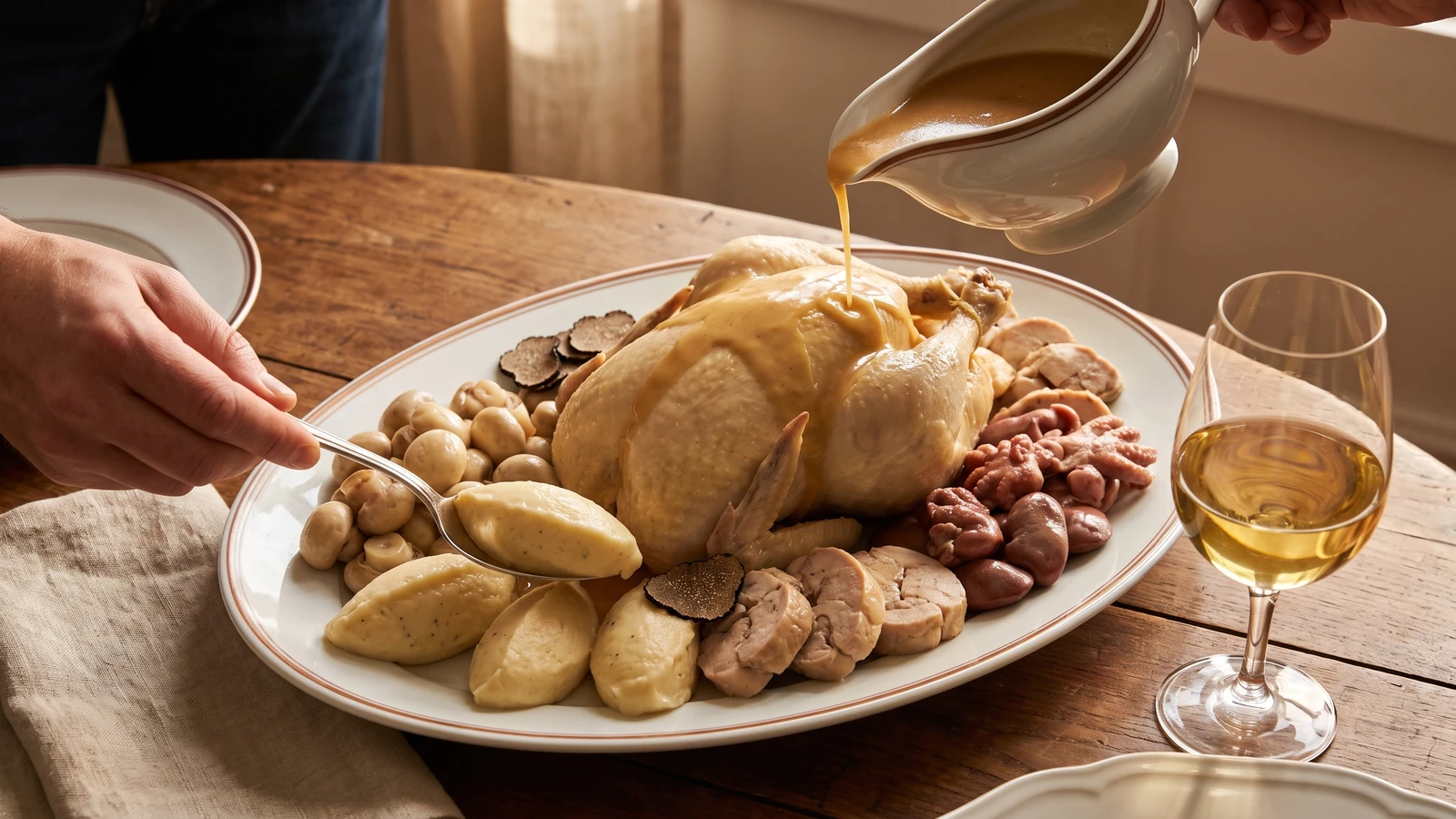
A pale, generous celebration bird surrounded by mousseline quenelles, sweetbreads, cocks' combs and kidneys, mushrooms, and truffle, all held together by the quiet gloss of sauce Allemande.
Poularde Toulousaine (poached pullet with the white Toulouse garnish) teaches a severe and useful lesson: pale food must never be pale in flavor. The one true thing to know before touching a pan is that every component cooks gently and separately, so the pullet stays succulent, the garnish stays distinct, and the sauce remains ivory. Whiteness here is control, not timidity.
The original entry assumed a saucier tending the Allemande, stock never off the fire, and several hands poaching Mousselines, sweetbreads, cocks' combs, kidneys, and mushrooms in parallel. At home, one measured pot of good chicken stock does every job in sequence, a food processor replaces pounding the chicken by hand, and pre-cleaned combs and kidneys spare you the work of a specialist. The brigade's parallel pans were scaffolding and can go. The white poach, fine chicken forcemeat, offal garnish, mushroom essence, and liaison-finished sauce are the dish and stay. No salamander is needed, because nothing should bronze. This is the full garnish scaled for four: one cook, one stove, one evening.
The Poularde Toulousaine arrives glossy and abundant, with its pale garnishes gathered around the bird in generous heaps and black truffle providing the only dark note. The moment that decides it comes when the yolks and cream enter the sauce Allemande. Keep it below a simmer; if it turns, ça se rattrape, and the method shows you how.
The garnish à la Toulousaine belongs to the classical French service table and bears Toulouse's name through the southwest's reputation for fine poultry, offal cookery, and truffles. Its established vocabulary is white and abundant: quenelles, poached sweetbreads, cocks' combs and kidneys, button mushrooms, and black truffle under sauce Allemande. It is often mistaken for a rustic Toulouse household dish, but it is a grand-kitchen codification that carried regional abundance into formal poultry service.
Quantity
1, 3½ to 4 pounds (1.6 to 1.8 kg)
giblets removed
Quantity
8 cups (1.9 L / 1.9 kg), plus cold water as needed to cover
homemade or good purchased
Quantity
1 medium
peeled and halved
Quantity
1
white part only, thoroughly washed
Quantity
1 stalk
Quantity
1
Quantity
1 tablespoon (15 ml / 9 g), plus more as needed
Quantity
12 ounces (340 g)
Quantity
4, about 4 ounces (115 g)
pre-cleaned, blanched, and peeled
Quantity
8, about 2 ounces (55 g)
trimmed
Quantity
8 ounces (225 g)
very cold and cut into small cubes
Quantity
1
Quantity
¾ cup (180 ml / 180 g)
very cold
Quantity
1 teaspoon (5 ml / 5 g)
Quantity
¼ teaspoon (1.25 ml / 0.5 g)
Quantity
12 ounces (340 g)
stems separated and sliced, heads left whole
Quantity
2 tablespoons (30 ml / 28 g)
Quantity
2 tablespoons (30 ml / 30 g)
divided
Quantity
1 cup (240 ml / 240 g)
Quantity
4 tablespoons (60 ml / 57 g)
Quantity
¼ cup (60 ml / 30 g)
Quantity
2½ cups (600 ml / 600 g)
Quantity
2
Quantity
½ cup (120 ml / 120 g)
Quantity
1, about 1 ounce (28 g)
fresh or preserved, thinly sliced
Quantity
to taste
| Ingredient | Quantity |
|---|---|
| whole poularde or plump young hengiblets removed | 1, 3½ to 4 pounds (1.6 to 1.8 kg) |
| unsalted chicken stockhomemade or good purchased | 8 cups (1.9 L / 1.9 kg), plus cold water as needed to cover |
| yellow onionpeeled and halved | 1 medium |
| leekwhite part only, thoroughly washed | 1 |
| celery | 1 stalk |
| bouquet garni of parsley stems, thyme, and bay | 1 |
| kosher salt | 1 tablespoon (15 ml / 9 g), plus more as needed |
| veal sweetbreads | 12 ounces (340 g) |
| cocks' combspre-cleaned, blanched, and peeled | 4, about 4 ounces (115 g) |
| cocks' kidneystrimmed | 8, about 2 ounces (55 g) |
| boneless, skinless chicken breastvery cold and cut into small cubes | 8 ounces (225 g) |
| large egg white | 1 |
| heavy cream for the chicken mousselinevery cold | ¾ cup (180 ml / 180 g) |
| fine salt for the chicken mousseline | 1 teaspoon (5 ml / 5 g) |
| ground white pepper for the chicken mousseline | ¼ teaspoon (1.25 ml / 0.5 g) |
| small white button mushroomsstems separated and sliced, heads left whole | 12 ounces (340 g) |
| unsalted butter for the mushrooms | 2 tablespoons (30 ml / 28 g) |
| fresh lemon juicedivided | 2 tablespoons (30 ml / 30 g) |
| strained chicken poaching liquid for the mushroom essence | 1 cup (240 ml / 240 g) |
| unsalted butter for the sauce Allemande | 4 tablespoons (60 ml / 57 g) |
| plain flour | ¼ cup (60 ml / 30 g) |
| hot strained chicken poaching liquid for the sauce Allemande | 2½ cups (600 ml / 600 g) |
| large egg yolks | 2 |
| heavy cream for the liaison | ½ cup (120 ml / 120 g) |
| whole black trufflefresh or preserved, thinly sliced | 1, about 1 ounce (28 g) |
| fine salt and ground white pepper | to taste |
Put the sweetbreads in a bowl, cover them generously with cold water, and refrigerate for 2 hours, changing the water twice. This draws away blood that would cloud their color and taste. Keep the cocks' combs and kidneys chilled while you work; all offal remains refrigerated until its pan is ready.
Set the poularde breast-side up in a snug 6-quart pot. Add the stock and enough cold water to cover the bird by about 1 inch (2.5 cm), then bring the liquid up slowly. Skim carefully as the first foam rises. Add the onion, leek, celery, bouquet garni, and kosher salt, then hold the liquid between 175°F and 185°F (80°C and 85°C), with only an occasional movement at the surface. Poach for 60 to 75 minutes, until the thickest parts of both breast and thigh register at least 165°F (74°C) without touching bone. If the liquid begins to boil, pull the pot partly off the heat and add a small glass of cold water. Ça se rattrape. Lift out the bird, cover it loosely, and strain the liquid. Reserve 3½ cups (840 ml / 840 g) of the clearest liquid for the mushroom essence and sauce.
Drain the soaked sweetbreads and cover them with fresh cold water in a saucepan. Bring just to a simmer, blanch for 5 minutes, then transfer them to ice water. Peel away the outer membrane and any coarse tubes without tearing the lobes. Place them between two trays with a 2-pound (900 g) weight on top for 20 minutes. Meanwhile, cover the prepared cocks' combs with strained poaching liquid and simmer them very gently for 35 to 45 minutes, until tender. Add the pressed sweetbreads for the final 15 minutes and the kidneys for the final 8 minutes, cooking the kidneys to 165°F (74°C). Lift each component out as it becomes tender. Boiling toughens the sweetbreads and can split the combs, so keep the surface quiet.
Chill the food-processor bowl and blade, and set a mixing bowl over ice. Process the cold chicken with the fine salt and white pepper until it becomes smooth and tacky. Add the egg white and process only until absorbed. With the motor running, pour in the cold cream gradually, stopping as soon as the mixture is smooth and glossy. This mousseline is a cream-lightened fine forcemeat, and cold is what holds its emulsion together. Press it through a fine sieve into the bowl over ice. If it turns grainy or greasy, stop, chill it for 15 minutes, then pulse in 1 tablespoon of cold cream. Ça se rattrape. Poach a teaspoonful as a seasoning test and correct the salt before shaping.
Heat a wide pan of strained poaching liquid to 175°F (80°C). Dip two tablespoons in hot water and use them to mould the mousseline into 12 small oval quenelles, working with about 2 tablespoons of mixture for each. Lower them into the liquid as they are shaped. Poach without boiling for 8 to 10 minutes, turning once, until they feel lightly springy and reach 165°F (74°C) at the center. If the first quenelle spreads, chill the mixture for 20 minutes before continuing. Lift the cooked quenelles onto a lightly buttered tray and cover them.
Melt 2 tablespoons of butter in a shallow saucepan without coloring it. Add the mushroom heads and sliced stems, 1 tablespoon of the lemon juice, and 1 cup of reserved poaching liquid. Cover the surface with a cartouche, a round of parchment laid directly over the mushrooms, and simmer gently for 6 to 8 minutes. Remove the heads as soon as they are tender and still very white. Continue cooking the stems and liquid until reduced to about ½ cup (120 ml / 120 g), then strain. This is the essence de champignons, or mushroom essence, that gives the Allemande its depth. Do not brown the mushrooms; color here is not flavor, it is a mistake.
Melt 4 tablespoons of butter in a 3-quart saucepan. Stir in the flour and cook this roux blanc, or white roux, over low heat for 2 minutes without allowing it to color. Whisk in the 2½ cups of hot poaching liquid a little at a time, followed by the mushroom essence. Bring to the gentlest simmer and cook for 15 minutes, whisking at first and then stirring often, until the sauce is smooth and lightly coats a spoon. Skim any foam or fat from the surface. If lumps appear, whisk firmly and pass the sauce through a fine sieve before continuing.
Whisk the egg yolks with the ½ cup of cream in a heatproof bowl. Whisk in a ladleful of the hot sauce, then a second, before returning the mixture to the saucepan. This liaison, an egg-yolk-and-cream binding, gives sauce Allemande its ivory body and gloss. Stir continuously over low heat until the sauce reaches 165°F (74°C) and naps the back of a spoon, meaning it leaves a clean trail when crossed with a finger. Never let it simmer after the liaison enters. Add the remaining tablespoon of lemon juice, then season with fine salt and white pepper. If the sauce begins to speckle, remove it from the heat and strain it immediately. If it separates, whisk 1 tablespoon of cold cream in a clean warm pan, then add the broken sauce gradually, a spoonful at a time. Ça se rattrape.
Slice the poached sweetbreads across the lobes into pieces about ½ inch (1.25 cm) thick. Warm the sweetbread slices, cocks' combs, kidneys, mushroom heads, and quenelles separately or in careful batches in a little remaining poaching liquid held below a simmer. Drain each component thoroughly. If the poularde has cooled, lower it back into hot poaching liquid for 8 to 10 minutes, keeping the liquid between 160°F and 170°F (71°C and 77°C), then drain it very well. Warm the truffle slices only for a few seconds in a spoonful of sauce Allemande; prolonged heat steals their perfume.
Set the whole poularde on a heated oval platter and snip away any trussing string. Spoon enough sauce Allemande over the bird to coat it completely, allowing a little to pool beneath. Arrange the garnish around it in distinct, generous heaps: three quenelles per guest, slices of sweetbread, the cocks' combs and kidneys, and the white mushroom heads. Lay the truffle slices among the pale garnishes as the single dark accent. Pour the remaining sauce Allemande into a warmed sauceboat and serve it separately, exactly as the source directs. Carve the bird at the table. À table!
1 serving (about 650g)
Culinary guides, cultural storytelling, and the editorial depth that makes cooking meaningful.
Discover Culinary ExplorerChef Juliette
John Dory has the delicacy of sole and the firmness of turbot. A light flouring, a quick butter sauté, and nut-brown beurre noisette show exactly why looks never mattered.

Chef Juliette
Fresh haddock proves its delicacy in the meunière pan: a fine flour crust, moist pearly flakes, and beurre noisette sharpened with lemon and parsley, ready from one skillet in half an hour.

Chef Juliette
Éperlans à l’Anglaise turns small fish into a lesson in disciplined coating: boned smelts under a close, crisp crumb, pan-fried in clarified butter and finished with bright, half-melted maître d’hôtel butter.

Chef Juliette
Tiny smelts, shallot, mushrooms, white wine, gratin sauce, and fine bread raspings meet a fierce oven, where the fish must turn tender in the same breath the buttered crust bronzes.