
Chef Juliette
John Dory (St. Pierre)
John Dory has the delicacy of sole and the firmness of turbot. A light flouring, a quick butter sauté, and nut-brown beurre noisette show exactly why looks never mattered.
A cooking platform built around craft, culture, and the stories behind what we eat.
Created by Chef Juliette
Based on No. 1622, Suprêmes de Volaille Villeroy, from Le Guide Culinaire (1907) by Auguste Escoffier
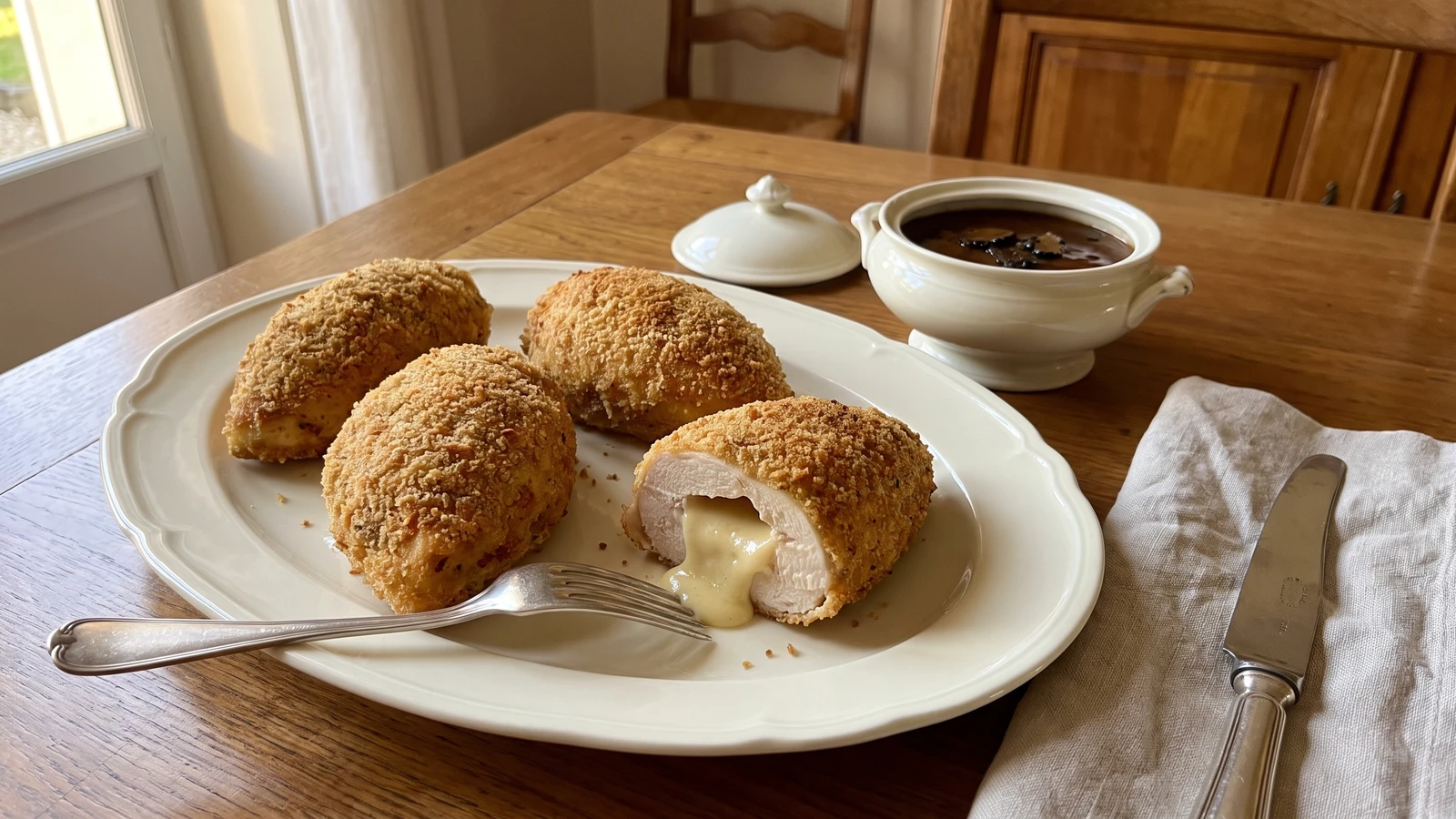
Part-poached chicken breasts wear a cold-set coat of Sauce Villeroy, then an anglaise crust fried deep gold; cut one and the sauce turns molten, while truffled Périgueux waits apart.
Suprêmes de Volaille Villeroy (chicken breast fillets enclosed in Villeroy sauce, crumbed, and fried) teaches that a crust is architecture. Before you touch a pan, know this: the Sauce Villeroy must set cold into an unbroken coat, because frying fat can crisp a shell but cannot mend a gap.
The classical service kitchen assumed a saucier keeping Villeroy and Périgueux ready, a stockpot never off the fire, cold trays waiting, and a fryer already at heat. The salamander has no work here. At home, four even suprêmes, prepared sauces, a refrigerator tray, and a heavy saucepan do the same job. The brigade's holding arrangements and extra hands are scaffolding and can go. The partial poach, the cold-set sauce, the panure à l'anglaise (a flour, egg, and fine-crumb casing), and the Périgueux served apart are the dish, and they stay. One cook, one stove, one evening.
When it is right, the crust is close and deep gold, the chicken remains tender, and a pale layer of Villeroy turns molten between the two. Périgueux waits in its sauceboat so every bite keeps its crisp shell. Chill each coated suprême until the sauce feels firm, dry, and unbroken beneath your finger. That is the step that decides the dish.
Suprêmes de Volaille Villeroy belongs to the Parisian grand-kitchen canon, where the courtly Villeroy name came to describe a practical technique: a reduced sauce set around delicate food beneath a protective crust. The method passed naturally into cuisine bourgeoise because nearly all the work could be completed before guests sat down, leaving only the frying for service. Though Périgueux points toward the truffles of Périgord, this formula keeps its dark sauce separate, never tucked inside the coating or poured over the crisp crust.
Quantity
4, about 5½ oz (155 g) each
trimmed to an even ¾-inch (2 cm) thickness
Quantity
1 teaspoon (5 ml / 6 g)
Quantity
¼ teaspoon (1.25 ml / 0.5 g)
Quantity
2 tablespoons (30 ml / 28 g)
Quantity
2 cups (480 ml / 480 g)
Quantity
2 cups (480 ml / about 520 g)
warmed just enough to flow
Quantity
¾ cup (180 ml / 95 g)
Quantity
1 cup (240 ml / about 245 g) Anglaise (for Egg-and-bread-crumbing) (No. 174)
Quantity
2½ cups (600 ml / 250 g)
Quantity
8 cups (1.9 L / about 1.75 kg)
for frying
Quantity
1½ cups (360 ml / about 390 g)
| Ingredient | Quantity |
|---|---|
| chicken suprêmestrimmed to an even ¾-inch (2 cm) thickness | 4, about 5½ oz (155 g) each |
| fine salt | 1 teaspoon (5 ml / 6 g) |
| finely ground white pepper | ¼ teaspoon (1.25 ml / 0.5 g) |
| unsalted butter | 2 tablespoons (30 ml / 28 g) |
| light chicken stock | 2 cups (480 ml / 480 g) |
| prepared Sauce Villeroywarmed just enough to flow | 2 cups (480 ml / about 520 g) |
| plain flour | ¾ cup (180 ml / 95 g) |
| Anglaise (for Egg-and-bread-crumbing) | 1 cup (240 ml / about 245 g) Anglaise (for Egg-and-bread-crumbing) (No. 174) |
| fine dry white breadcrumbs | 2½ cups (600 ml / 250 g) |
| refined sunflower or peanut oilfor frying | 8 cups (1.9 L / about 1.75 kg) |
| prepared Sauce Périgueux | 1½ cups (360 ml / about 390 g) |
Trim the suprêmes into neat ovals and place each between two sheets of parchment. Press the thick end gently with a flat pan until every piece is about ¾ inch (2 cm) thick. Even thickness matters more than perfect shape, because the final frying must heat the centre before the crumb darkens. Season both sides with the salt and white pepper, then leave them for 15 minutes while you butter the poaching pan and chill a parchment-lined tray.
Rub a wide sauté pan with half the butter, arrange the suprêmes in one layer, and add enough chicken stock to come halfway up their sides. Dot them with the remaining butter, cover, and bring the liquid just below a simmer. Poach gently for about 4 minutes, turn, then cook for another 3 to 5 minutes, until the centres reach 150°F (66°C). Move the pan off the heat and keep it covered for 3 minutes, making certain the centres remain at or above 150°F (66°C). This measured hold is the home kitchen's safety-minded equivalent of the source's partial poach: the chicken remains short of its final 165°F (74°C), but it can pass through the necessary cold-setting stage safely. Never let the stock boil, or the outside toughens before the centre is ready.
Lift the suprêmes onto a rack, blot every surface dry, and let them stand for 5 minutes. Bring the prepared Sauce Villeroy to about 105 to 115°F (41 to 46°C), warm enough to fall in a thick ribbon but never hot enough to run like cream. Reserve about ⅓ cup (80 ml / 85 g) in a clean bowl for repairs. Dip each suprême into the remaining sauce, spooning it over any bare place, then lift it carefully onto the chilled tray. Aim for an even coat about ⅛ inch (3 mm) thick. Refrigerate uncovered for 45 to 60 minutes, until the Villeroy is firm and no longer tacky. If it slips, the chicken was wet or the sauce too warm. Blot the bare patch, chill both chicken and reserved sauce for 10 minutes, then patch it. Ça se rattrape. Discard any sauce left in the dipping dish.
Arrange the flour, Anglaise (for Egg-and-bread-crumbing) (No. 174), and fine breadcrumbs in three shallow dishes. Dust each cold suprême lightly but completely with flour and shake away the excess. Coat it in the Anglaise, then lay it in the crumbs and press gently with cupped hands, sealing the sides as carefully as the broad faces. Flour gives the egg preparation something to grip, while the fine crumb forms the dense crust that checks the escape of the Villeroy. Return the breaded suprêmes to the cold for 15 minutes.
Heat the Sauce Périgueux gently until glossy and hot, without letting it boil, then transfer it to a warmed, covered sauceboat. Set a rack over a sheet pan and heat the oven to 350°F (180°C) as insurance. Pour the frying oil into a heavy 4 to 5-quart pot, filling it no more than halfway, and bring it to 360°F (182°C). The source asks for very hot frying fat; a thermometer gives one cook the control a permanently tended fryer once supplied.
Lower two suprêmes into the oil and fry for 4 to 6 minutes, turning once, while keeping the fat between 345 and 355°F (174 and 180°C). The crust should become an even, deep gold and the chicken must reach 165°F (74°C) at its thickest point. Lift each piece with a wire skimmer and drain it on the rack, never on a flat bed of paper that softens the underside. If the crust colours before the centre is ready, lift the suprême and finish it on the rack in the oven until it reaches temperature. Ça se rattrape. If a pinhole leaks, do not prod it; turn the breach upward until the surrounding crust sets, then drain it that side up.
Rest the suprêmes for 2 minutes, just long enough for the crust to settle. Arrange them on a warm oval platter in a loose crown with their tapered ends pointing inward. Bring the Sauce Périgueux separately and spoon it beside each portion only after the crust is cut, never over the whole platter. The knife should meet crisp crumb first, then molten Villeroy, then tender chicken. À table!
1 serving (about 400g)
Culinary guides, cultural storytelling, and the editorial depth that makes cooking meaningful.
Discover Culinary ExplorerChef Juliette
John Dory has the delicacy of sole and the firmness of turbot. A light flouring, a quick butter sauté, and nut-brown beurre noisette show exactly why looks never mattered.

Chef Juliette
Fresh haddock proves its delicacy in the meunière pan: a fine flour crust, moist pearly flakes, and beurre noisette sharpened with lemon and parsley, ready from one skillet in half an hour.

Chef Juliette
Éperlans à l’Anglaise turns small fish into a lesson in disciplined coating: boned smelts under a close, crisp crumb, pan-fried in clarified butter and finished with bright, half-melted maître d’hôtel butter.

Chef Juliette
Tiny smelts, shallot, mushrooms, white wine, gratin sauce, and fine bread raspings meet a fierce oven, where the fish must turn tender in the same breath the buttered crust bronzes.