
Chef Juliette
John Dory (St. Pierre)
John Dory has the delicacy of sole and the firmness of turbot. A light flouring, a quick butter sauté, and nut-brown beurre noisette show exactly why looks never mattered.
A cooking platform built around craft, culture, and the stories behind what we eat.
Created by Chef Juliette
Based on No. 1619, Suprêmes de Volaille Valençay, from Le Guide Culinaire (1907) by Auguste Escoffier
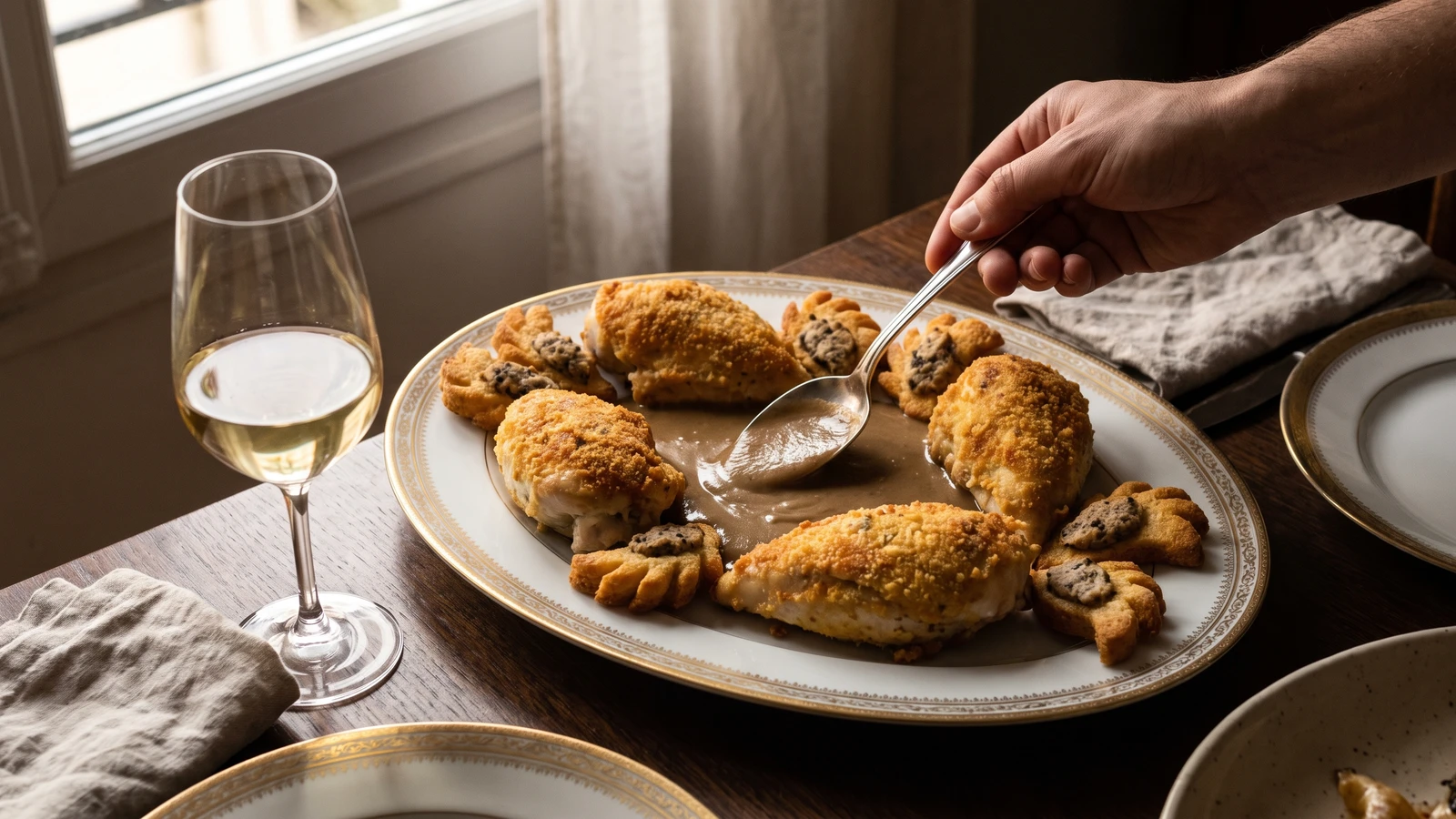
A lesson in elegant containment: chicken suprêmes hold cold truffle-bound Allemande beneath a crisp panure à l’anglaise, then meet mushroom purée and two tender truffled croûtons apiece.
Suprêmes de Volaille Valençay (truffle-stuffed chicken breasts with truffled croûtons and mushroom purée) teaches containment. The chicken must hold a rich filling, the panure à l’anglaise must become a close golden shell, and every component must arrive together without losing its character. The one true thing to know before touching the pan is this: the Allemande filling must be reduced until nearly paste-like, then chilled completely. Warm, flowing sauce escapes. Cold filling stays where you put it.
The original entry assumed a saucier on staff, chicken stock never off the fire, fine forcemeat already waiting, and enough hands to cut and garnish eight cocks’ comb croûtons while the suprêmes cooked. It asks for no salamander, only a moderate oven to set the forcemeat. At home, a small saucepan makes exactly enough Allemande, a food processor replaces the pounding and sieving of the forcemeat, and the broad chicken breasts sold today finish in the oven after browning in butter so the crumb does not burn before the centers cook. The dedicated sauce station was brigade scaffolding and can go. The truffle dice, reduced Allemande, panure à l’anglaise, two forcemeat croûtons per suprême, and mushroom purée are the dish, and they stay.
When it lands correctly, the platter gives you three textures at once: crisp golden chicken, tender truffled forcemeat, and mushroom purée with the soft gloss of cream and butter. Reduce the Allemande until a spatula leaves a clean trail across the saucepan, then chill it. If it softens before stuffing, put it back in the cold. Ça se rattrape. One cook, one stove, one evening.
Suprêmes de Volaille Valençay belongs to the codified grand-kitchen repertoire, its name pointing to Valençay in Berry, where the château table gave the town a lasting association with polished French service. The truffle-bound Allemande, panure à l’anglaise, truffled forcemeat croûtons, and mushroom purée show how the classical kitchen built contrast from related flavors rather than piling on decoration. It is not a farmhouse chicken dish from Berry; it traveled from formal dining rooms to ambitious home tables because its components can be prepared separately and reunited at service.
Quantity
4 (about 24 oz / 680 g total)
Quantity
3 tablespoons (45 ml / 28 g)
drained, cut into very small dice, and divided
Quantity
1 tablespoon (15 ml / 14 g)
Quantity
1 tablespoon (15 ml / 8 g)
Quantity
½ cup (120 ml / 120 g)
Quantity
2 tablespoons (30 ml / 30 g)
Quantity
1
Quantity
1 teaspoon (5 ml / 5 g)
Quantity
½ cup (120 ml / 115 g)
cubed and thoroughly chilled
Quantity
1
Quantity
⅓ cup (80 ml / 80 g)
thoroughly chilled
Quantity
4 slices (about 4 oz / 115 g total)
crusts removed
Quantity
3 tablespoons (45 ml / 42 g)
Quantity
½ cup (120 ml / 60 g)
Quantity
½ cup (120 ml / 120 g) Anglaise (for Egg-and-bread-crumbing) (No. 174)
prepared and chilled
Quantity
1½ cups (360 ml / 150 g)
not panko
Quantity
¼ cup (60 ml / 55 g)
Quantity
2 tablespoons (30 ml / 28 g)
Quantity
6 cups (1.4 L / 450 g)
thinly sliced
Quantity
1 (about 3 tablespoons / 45 ml / 40 g)
finely chopped
Quantity
2 tablespoons (30 ml / 28 g)
Quantity
½ cup (120 ml / 120 g)
Quantity
½ cup (120 ml / 120 g)
Quantity
1 teaspoon (5 ml / 5 g)
Quantity
2 teaspoons (10 ml / 12 g)
divided
Quantity
½ teaspoon (2.5 ml / 1 g)
divided
| Ingredient | Quantity |
|---|---|
| boneless, skinless chicken breast halves | 4 (about 24 oz / 680 g total) |
| fresh or preserved black truffledrained, cut into very small dice, and divided | 3 tablespoons (45 ml / 28 g) |
| unsalted butter for the Allemande | 1 tablespoon (15 ml / 14 g) |
| plain flour for the Allemande | 1 tablespoon (15 ml / 8 g) |
| strong chicken stock for the Allemande | ½ cup (120 ml / 120 g) |
| heavy cream for the Allemande | 2 tablespoons (30 ml / 30 g) |
| large egg yolk | 1 |
| fresh lemon juice for the Allemande | 1 teaspoon (5 ml / 5 g) |
| raw chicken tenderloin meatcubed and thoroughly chilled | ½ cup (120 ml / 115 g) |
| large egg white | 1 |
| heavy cream for the forcemeatthoroughly chilled | ⅓ cup (80 ml / 80 g) |
| firm white sandwich breadcrusts removed | 4 slices (about 4 oz / 115 g total) |
| unsalted butter for frying the croûtons | 3 tablespoons (45 ml / 42 g) |
| plain flour for coating the suprêmes | ½ cup (120 ml / 60 g) |
| Anglaise (for Egg-and-bread-crumbing)prepared and chilled | ½ cup (120 ml / 120 g) Anglaise (for Egg-and-bread-crumbing) (No. 174) |
| fine dry breadcrumbsnot panko | 1½ cups (360 ml / 150 g) |
| clarified butter for cooking the suprêmes | ¼ cup (60 ml / 55 g) |
| unsalted butter for basting the suprêmes | 2 tablespoons (30 ml / 28 g) |
| button or cremini mushroomsthinly sliced | 6 cups (1.4 L / 450 g) |
| large shallotfinely chopped | 1 (about 3 tablespoons / 45 ml / 40 g) |
| unsalted butter for the mushroom purée | 2 tablespoons (30 ml / 28 g) |
| strong chicken stock for the mushroom purée | ½ cup (120 ml / 120 g) |
| heavy cream for the mushroom purée | ½ cup (120 ml / 120 g) |
| fresh lemon juice for the mushroom purée | 1 teaspoon (5 ml / 5 g) |
| fine saltdivided | 2 teaspoons (10 ml / 12 g) |
| ground white pepperdivided | ½ teaspoon (2.5 ml / 1 g) |
Melt 1 tablespoon butter in a small heavy saucepan over medium-low heat. Stir in 1 tablespoon flour and cook this roux for 2 minutes without letting it color. Whisk in ½ cup chicken stock by small additions, scraping into the corners, then simmer for 6 to 8 minutes until the sauce is very thick and a spatula drawn across the bottom leaves a path that stays open. Whisk the yolk with 2 tablespoons cream, temper it with a spoonful of the hot sauce, then stir it back into the pan over the gentlest heat. Keep stirring for 1 minute without boiling. If the liaison begins to look grainy, take the pan off the heat and whisk in a teaspoon of cold stock; pass it through a fine sieve if needed. Ça se rattrape. Off the heat, add 1 teaspoon lemon juice, 2 tablespoons of the truffle dice, ⅛ teaspoon salt, and a pinch of white pepper. Spread the Allemande on a cold plate, cover its surface, and chill for at least 25 minutes, until firm.
Dry the suprêmes and trim any loose edges. With a small sharp knife, cut a deep pocket through the thick side of each breast, keeping the other three sides intact. Divide the cold Allemande among the pockets, about 1 heaped tablespoon per breast, and press the openings closed. If a pocket tears, cover the hole with a thin piece of chicken trimming and press it firmly into place. Season the outsides with ¾ teaspoon salt and ⅛ teaspoon white pepper, then chill the stuffed suprêmes seam-side down for 20 minutes. Cold filling and cold chicken are what make the later crust a seal rather than decoration.
Chill the food-processor bowl and blade if the kitchen is warm. Pulse the cold chicken tenderloin meat with ¼ teaspoon salt and a pinch of white pepper until it becomes smooth and tacky. Add the egg white and process only until absorbed. With the machine running, add all but 1 tablespoon of the cold cream in a thin stream. The forcemeat should be glossy, close, and soft enough to hold a dome. If it turns oily at the edge, stop immediately, chill the bowl for 10 minutes, then pulse in the reserved cold cream. Fold in the remaining 1 tablespoon truffle dice. Poach a teaspoonful in barely simmering water until cooked through, taste it, and correct the seasoning.
Heat the oven to 325°F (165°C). Cut each bread slice in half and shape the eight pieces into small cocks’ combs, each about 2½ inches (6 cm) long: make a curved outer edge and cut three shallow notches along it. Exact heraldry is unnecessary, but keep the pieces equal so they cook together. Melt 3 tablespoons butter in a wide pan over medium heat and fry the croûtons on both sides until evenly golden. Transfer them to a parchment-lined baking sheet.
Divide the forcemeat over the eight fried croûtons, shaping each portion into a smooth dome with a teaspoon dipped in cold water. Bake for 12 to 16 minutes, until the forcemeat feels resilient and reaches 165°F (74°C) at the center. Keep it pale and tender. If the domes color before their centers are cooked, cover them loosely with foil. Set the finished croûtons aside in a warm place, then raise the oven to 350°F (175°C).
Melt 2 tablespoons butter in a wide saucepan over medium heat. Add the shallot and cook for 2 minutes without coloring. Add the mushrooms, ½ teaspoon salt, and ⅛ teaspoon white pepper. Cook uncovered, stirring often, until the mushrooms collapse and their liquid has evaporated, 10 to 12 minutes. Add ½ cup stock and reduce until only a few spoonfuls remain, then add ½ cup cream and simmer gently for 5 minutes. Blend until very smooth, return the purée to the pan, and stir in 1 teaspoon lemon juice. It should mound softly while still flowing from a spoon. If loose, reduce it gently; if tight, loosen it with a spoonful of stock. Hold it covered over very low heat.
Set out the coating ingredients in three shallow dishes: the ½ cup flour, the prepared Anglaise (for Egg-and-bread-crumbing) (No. 174), and the fine breadcrumbs. Dust each chilled suprême lightly with flour and shake away the excess. Coat it completely in the Anglaise, let the excess drain, then press it into the crumbs so no damp patches remain. Lay the breaded suprêmes on a rack for 10 minutes. This short rest lets the panure adhere. If a bald patch appears, press on a few more crumbs before the chicken reaches the butter.
Heat half the clarified butter in a heavy 12-inch (30 cm) skillet over medium-high heat until bright and fluid. Cook two suprêmes at a time, leaving room around them, for about 3 minutes on the first side and 2 minutes on the second, until the panure is deep butter-gold. Lower the heat, add 1 tablespoon whole butter, and baste for 1 minute. Transfer the suprêmes to a rack set over a baking sheet and repeat with the remaining clarified and whole butter. Finish all four in the 350°F (175°C) oven for 7 to 12 minutes, until the center of the chicken and its filling reaches 165°F (74°C). If the crumbs darken too quickly in the pan, move the chicken to the rack at once and let the oven finish the cooking. If a little filling finds a pinhole, turn that opening upward and leave it undisturbed. Rest the suprêmes for 5 minutes.
Spoon the mushroom purée into the center of a warmed round or oval platter. Arrange the four suprêmes around it as a crown, with their tapered ends pointing inward. Set two forcemeat-topped croûtons beside each suprême, following the outer curve of the platter. Bring it to the table at once, while the panure is crisp and the purée still carries its butter sheen. À table!
1 serving (about 425g)
Culinary guides, cultural storytelling, and the editorial depth that makes cooking meaningful.
Discover Culinary ExplorerChef Juliette
John Dory has the delicacy of sole and the firmness of turbot. A light flouring, a quick butter sauté, and nut-brown beurre noisette show exactly why looks never mattered.

Chef Juliette
Fresh haddock proves its delicacy in the meunière pan: a fine flour crust, moist pearly flakes, and beurre noisette sharpened with lemon and parsley, ready from one skillet in half an hour.

Chef Juliette
Éperlans à l’Anglaise turns small fish into a lesson in disciplined coating: boned smelts under a close, crisp crumb, pan-fried in clarified butter and finished with bright, half-melted maître d’hôtel butter.

Chef Juliette
Tiny smelts, shallot, mushrooms, white wine, gratin sauce, and fine bread raspings meet a fierce oven, where the fish must turn tender in the same breath the buttered crust bronzes.