
Chef Juliette
John Dory (St. Pierre)
John Dory has the delicacy of sole and the firmness of turbot. A light flouring, a quick butter sauté, and nut-brown beurre noisette show exactly why looks never mattered.
A cooking platform built around craft, culture, and the stories behind what we eat.
Created by Chef Juliette
Based on No. 1609, Suprêmes de Volaille Orly, from Le Guide Culinaire (1907) by Auguste Escoffier
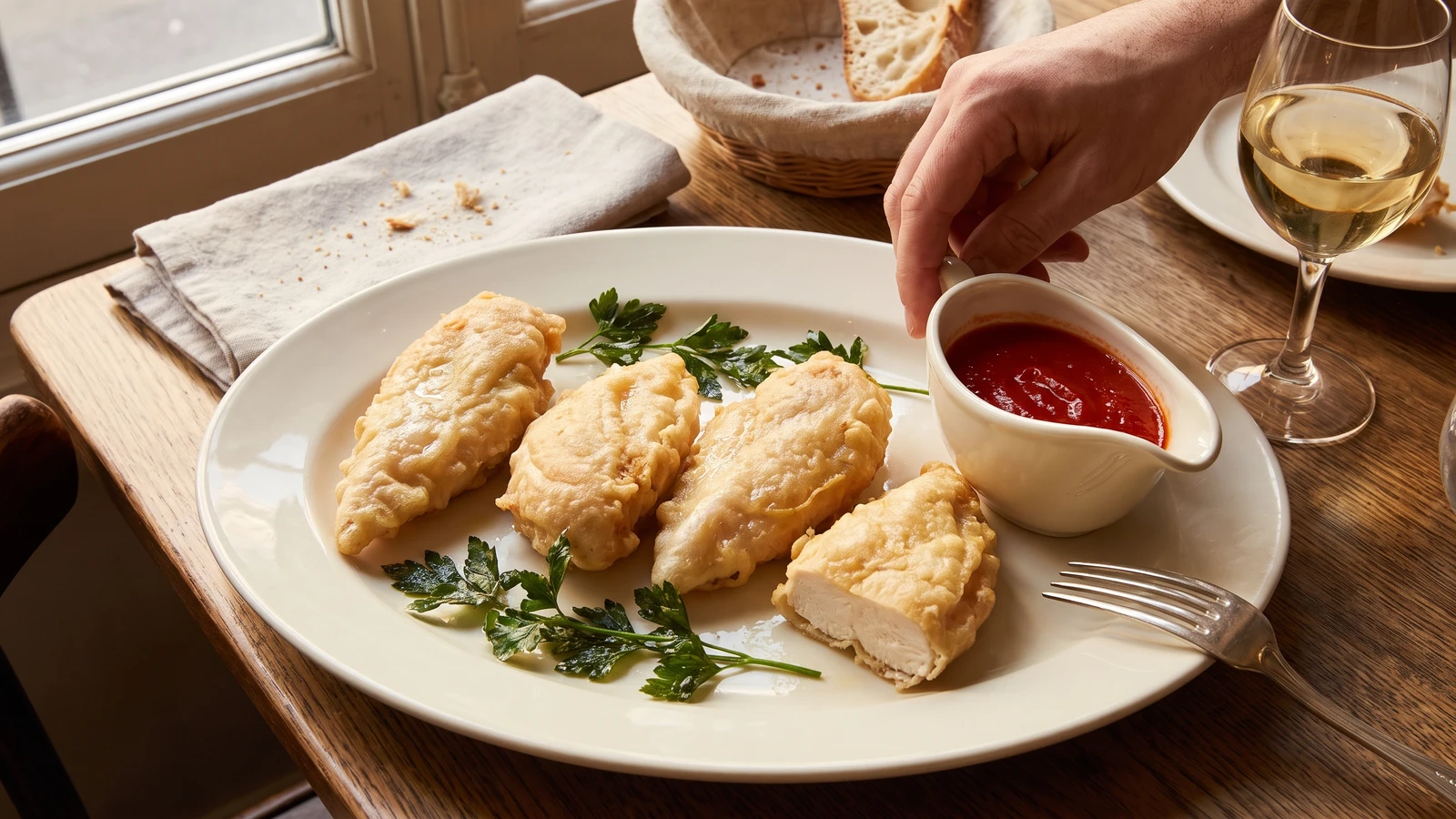
Marinated chicken suprêmes in a light, crisp batter, fried hard and fast, then brought to the table with green fried parsley and a smooth tomato sauce served separately.
Suprêmes de Volaille Orly (marinated chicken breast fillets in light batter) teaches one uncompromising principle: batter clings to a dry surface and cooks cleanly only in properly hot fat. Get those two things right and each suprême emerges crisp and pale gold, with juicy white meat beneath, fried parsley beside it, and a smooth sauce tomate (tomato sauce) waiting in its own boat.
The original directions assumed a saucier holding the sauce, another cook minding a broad vat of frying fat, and small poultry breasts that cooked through almost as soon as their batter colored. At home, a saucepan makes the sauce, a thermometer governs a heavy pot, and four modern breasts are shaped to an even ⅝-inch thickness so the meat and coating finish together. No stockpot simmering all day and no salamander are needed. The napkin-lined platter and brigade-sized fryer were service scaffolding; a wire rack and a deep home pot replace them honestly. The hour-long marinade, thorough drying, light batter, quick frying, green parsley, and sauce served apart are the dish itself, so they stay.
Dry the chicken as though the success of dinner depends upon it, because here it does. If the batter begins sliding away, stop before the chicken reaches the oil. Ça se rattrape, and the method tells you precisely how.
Suprêmes de Volaille Orly belongs to the Parisian classical table, where the term Orly came to identify delicately battered, fried fillets accompanied by tomato sauce. It traveled from grand dining rooms into bourgeois kitchens because the essential method needed no elaborate equipment, only careful frying and sauce prepared separately. Orly does not mean chicken simmered in tomato sauce: the contrast between crisp batter and sauce served alongside is the preparation's defining point.
Quantity
4 small fillets (about 1 lb 5 oz / 600 g total)
trimmed and shaped to an even ⅝-inch / 1.5 cm thickness
Quantity
2 tablespoons (30 ml / 30 g) Cooked Marinade for Venison (No. 168)
fully cooled
Quantity
2 tablespoons (30 ml / 27 g)
for marinating
Quantity
1 tablespoon (15 ml / 15 g)
Quantity
1 medium onion (about 1 cup / 240 ml / 120 g)
very finely sliced
Quantity
1 large bunch (about 60 g)
stalks reserved for the marinade and leafy sprigs washed and dried thoroughly
Quantity
1 can (14 oz / 1¾ cups / 415 ml / 400 g)
Quantity
3 tablespoons (45 ml / 42 g)
divided
Quantity
½ small onion (about ½ cup / 120 ml / 60 g)
finely chopped
Quantity
1
Quantity
1 small sprig
Quantity
1 cup (240 ml / 120 g)
Quantity
1
separated
Quantity
⅔ cup (160 ml / 160 g)
Quantity
1 tablespoon (15 ml / 14 g)
Quantity
6 cups (1.4 L / about 1.3 kg)
Quantity
2 teaspoons (10 ml / 12 g)
divided
Quantity
¼ teaspoon (1 ml / 0.6 g)
divided
| Ingredient | Quantity |
|---|---|
| boneless, skinless chicken breast suprêmestrimmed and shaped to an even ⅝-inch / 1.5 cm thickness | 4 small fillets (about 1 lb 5 oz / 600 g total) |
| Cooked Marinade for Venisonfully cooled | 2 tablespoons (30 ml / 30 g) Cooked Marinade for Venison (No. 168) |
| olive oilfor marinating | 2 tablespoons (30 ml / 27 g) |
| fresh lemon juice | 1 tablespoon (15 ml / 15 g) |
| yellow onion for the marinadevery finely sliced | 1 medium onion (about 1 cup / 240 ml / 120 g) |
| flat-leaf parsleystalks reserved for the marinade and leafy sprigs washed and dried thoroughly | 1 large bunch (about 60 g) |
| whole peeled tomatoes with juice | 1 can (14 oz / 1¾ cups / 415 ml / 400 g) |
| unsalted butterdivided | 3 tablespoons (45 ml / 42 g) |
| yellow onion for the sauce tomatefinely chopped | ½ small onion (about ½ cup / 120 ml / 60 g) |
| bay leaf | 1 |
| thyme | 1 small sprig |
| plain flour | 1 cup (240 ml / 120 g) |
| large eggseparated | 1 |
| very cold sparkling water | ⅔ cup (160 ml / 160 g) |
| neutral oil for the batter | 1 tablespoon (15 ml / 14 g) |
| neutral high-heat frying oil | 6 cups (1.4 L / about 1.3 kg) |
| fine sea saltdivided | 2 teaspoons (10 ml / 12 g) |
| ground white pepperdivided | ¼ teaspoon (1 ml / 0.6 g) |
If any fillet is thicker than ⅝ inch / 1.5 cm, place it between sheets of baking paper and press or tap it gently to an even thickness. Season the chicken with ½ teaspoon of the salt, then arrange it in a shallow nonreactive dish with the Cooked Marinade for Venison (No. 168), olive oil, lemon juice, sliced onion, and parsley stalks. Turn each piece until lightly coated, cover, and refrigerate for exactly 1 hour, turning once halfway through. The lemon should perfume and lightly season the surface, not begin changing the breast's texture through a long soak.
While the chicken marinates, melt 2 tablespoons of the butter in a small saucepan over medium-low heat. Add the chopped onion and a pinch of salt, then cook gently for 5 minutes until soft and translucent, without browning. Crush in the tomatoes with their juice, add the bay leaf, thyme, and a pinch of white pepper, and simmer uncovered for 20 to 25 minutes, stirring occasionally, until concentrated but still pourable. Remove the herbs, blend or press the sauce through a fine sieve, then whisk in the remaining tablespoon of cold butter. If the sauce is thin, reduce it a few minutes longer; if it has tightened too far, loosen it with a spoonful of hot water. Hold it warm over the lowest heat.
Put the flour, ¾ teaspoon salt, and most of the remaining white pepper in a bowl. Whisk the egg yolk with the cold sparkling water and tablespoon of neutral oil, then pour this gradually into the flour, whisking only until no dry pockets remain. A few small lumps do no harm; relentless whisking develops gluten and makes the coating tough. Let the batter rest for 20 minutes while the chicken finishes marinating. Keep the egg white cold for the final fold.
Set a wire rack over a rimmed tray. Pour the frying oil into a heavy pot, leaving at least 3 inches / 7.5 cm of empty space above it, and heat to 365°F / 185°C. Lift the chicken from the marinade, scrape away every strand of onion and parsley, and dry both sides thoroughly with clean kitchen towels or absorbent paper. Leave the pieces uncovered on a separate clean rack for 5 minutes while the oil finishes heating. Wet chicken steams beneath the batter and makes the coating slide, so take this drying seriously.
Make certain the leafy parsley sprigs are completely dry. Lower a small handful into the hot oil with a spider, keeping your hands well back, and fry for 5 to 8 seconds, just until crisp and brilliantly green. Lift it immediately to the draining rack and repeat. Damp parsley makes hot oil spit violently; if a sprig feels wet, dry it again before it goes anywhere near the pot.
Whisk the cold egg white to soft peaks and fold it gently into the rested batter. Dip one suprême at a time, coating it completely, then let the excess fall back into the bowl. The batter should veil the chicken rather than bury it. If it slides away in sheets, stop. Ça se rattrape: scrape off the loose coating, dry the fillet again, dust it with the lightest film of flour taken from the batter bowl's edge, and recoat it. Lower no more than 2 pieces into the oil and fry at 350 to 360°F / 175 to 182°C for 5 to 6 minutes, turning once, until the coating is puffed and evenly golden and the chicken reaches 165°F / 74°C at its thickest point. Let the oil recover fully before the second batch. If the crust colors before the center is ready, transfer the piece to the rack and finish it for a few minutes in a 375°F / 190°C oven; the next fillet needs to be pressed thinner.
Drain each suprême on the rack for 2 minutes and season lightly with the remaining salt while the coating is still glossy. Arrange the four pieces on a warmed oval platter with the fried parsley in small bunches around them. Pour the sauce tomate into a warmed sauceboat and serve it separately, never over the crust. The old napkin caught excess fat but also trapped it beneath the chicken; the rack has already done the useful work. Bring both to the table at once. À table!
1 serving (about 270g)
Culinary guides, cultural storytelling, and the editorial depth that makes cooking meaningful.
Discover Culinary ExplorerChef Juliette
John Dory has the delicacy of sole and the firmness of turbot. A light flouring, a quick butter sauté, and nut-brown beurre noisette show exactly why looks never mattered.

Chef Juliette
Fresh haddock proves its delicacy in the meunière pan: a fine flour crust, moist pearly flakes, and beurre noisette sharpened with lemon and parsley, ready from one skillet in half an hour.

Chef Juliette
Éperlans à l’Anglaise turns small fish into a lesson in disciplined coating: boned smelts under a close, crisp crumb, pan-fried in clarified butter and finished with bright, half-melted maître d’hôtel butter.

Chef Juliette
Tiny smelts, shallot, mushrooms, white wine, gratin sauce, and fine bread raspings meet a fierce oven, where the fish must turn tender in the same breath the buttered crust bronzes.