
Chef Juliette
John Dory (St. Pierre)
John Dory has the delicacy of sole and the firmness of turbot. A light flouring, a quick butter sauté, and nut-brown beurre noisette show exactly why looks never mattered.
A cooking platform built around craft, culture, and the stories behind what we eat.
Created by Chef Juliette
Based on No. 1598, Suprêmes de Volaille Financière, from Le Guide Culinaire (1907) by Auguste Escoffier
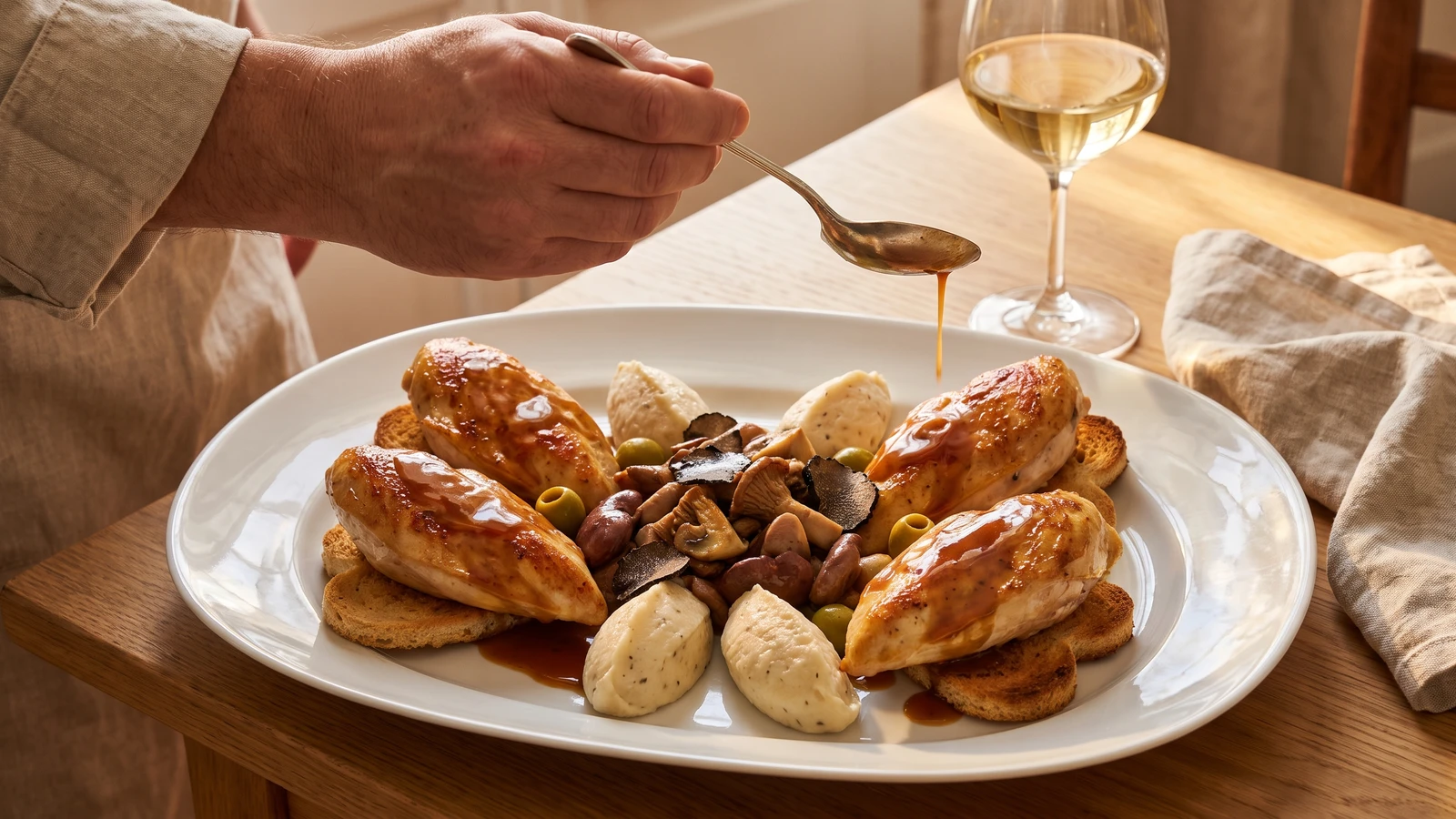
Golden chicken suprêmes on butter-fried croûtons encircle quenelles, mushrooms, cocks' combs, truffle, and olives, all coated in glossy sauce financière: a lesson in timing, abundance, and disciplined service.
Suprêmes de Volaille Financière (sautéed chicken breasts with financière garnish) teaches that service is part of technique. The one true thing to know before touching a pan is this: every other component must be ready before the chicken meets the clarified butter. A suprême waits badly while quenelles, mushrooms, cocks' combs, truffle, olives, and sauce find their places.
The original entry assumed a saucier tending the reduction, a stockpot never off the fire, another pair of hands shaping quenelles, and a salamander available for last-second heat. Your kitchen needs two small saucepans, a low oven to warm the platter, and the referenced garnish and sauce prepared ahead. The order has changed because one cook cannot run several brigade stations at once; the intent has not. Those separate stations were scaffolding. The clarified-butter sauté, matching fried croûtons, complete financière garnish, and glossy coating of sauce are the dish, and they stay.
When it lands correctly, four bronze suprêmes rise around a generous center of ivory quenelles, dark truffle, green olives, and burnished mushrooms, with sauce pooling into the crisp croûtons beneath. One cook, one stove, one evening. The step that decides everything is the mise en place: have the sauce and garnish hot before you sauté the suprêmes.
Suprêmes de Volaille Financière belongs to the grand kitchens of Paris, where financière named a rich garnish rather than a regional style: chicken quenelles, mushrooms, cocks' combs and kidneys, truffle, olives, and truffle-scented demi-glace. The composition traveled among whole poulardes, vol-au-vent, and individual suprêmes because its purpose was abundance displayed with strict order, each costly morsel visible and properly sauced. The title invites stories about bankers, but its reliable culinary meaning is the expensive assembly on the platter, not the larder of Lyon, Normandy, or Provence.
Quantity
4, about 5 oz / 140 g each
trimmed to an even 3/4-inch (2 cm) thickness
Quantity
1 teaspoon (5 ml / 6 g)
Quantity
1/2 teaspoon (2.5 ml / 1 g)
Quantity
1/4 cup (60 ml / 55 g)
Quantity
4 slices, about 5 oz / 140 g total
cut into ovals matching the suprêmes
Quantity
3 tablespoons (45 ml / 43 g)
Quantity
1 home-scale prepared batch from Poularde à la Financière (No. 1474), enough for 4
Quantity
1 cup (240 ml / 250 g) from Poularde à la Financière (No. 1474)
Quantity
1/4 cup (60 ml / 60 g), only as needed
| Ingredient | Quantity |
|---|---|
| skinless, boneless chicken breast suprêmestrimmed to an even 3/4-inch (2 cm) thickness | 4, about 5 oz / 140 g each |
| fine sea salt | 1 teaspoon (5 ml / 6 g) |
| finely ground white pepper | 1/2 teaspoon (2.5 ml / 1 g) |
| clarified butter | 1/4 cup (60 ml / 55 g) |
| pain de miecut into ovals matching the suprêmes | 4 slices, about 5 oz / 140 g total |
| unsalted butter | 3 tablespoons (45 ml / 43 g) |
| financière garnish of chicken mousseline quenelles, grooved button-mushroom heads, cocks' combs and kidneys, truffle slices, and blanched olives | 1 home-scale prepared batch from Poularde à la Financière (No. 1474), enough for 4 |
| sauce financière prepared with truffle essence | 1 cup (240 ml / 250 g) from Poularde à la Financière (No. 1474) |
| unsalted chicken stock (optional) | 1/4 cup (60 ml / 60 g), only as needed |
Have the referenced garnish and sauce fully prepared before beginning this finishing recipe. Take the suprêmes from the cold for 20 minutes, heat the oven to 200°F (95°C), and place a 14-inch oval serving platter inside to warm. Set out two small saucepans, the croûtons, a ladle, and serving spoons. Once the chicken enters the skillet, nothing else should require chopping, measuring, or searching.
Trim each slice of pain de mie into an oval approximately matching one suprême. Melt the unsalted butter in a wide skillet over medium heat and fry the croûtons for about 2 minutes per side, until deep gold, crisp at the edges, and saturated with butter without becoming greasy. Transfer them to a wire rack. If they soften while waiting, return them to the dry skillet for 30 seconds per side just before plating. We don't apologize for butter.
Set the prepared garnish from Poularde à la Financière (No. 1474) in one small saucepan with 1/4 cup of its sauce. Cover and warm over the gentlest heat until the quenelles are hot through, reaching 165°F (74°C) at their centers. Warm the remaining sauce financière from Poularde à la Financière (No. 1474) separately until it flows in a glossy ribbon and naps the back of a spoon, then take both pans off the heat and cover them. Do not boil the garnish. If the sauce tightens into a paste, Ça se rattrape: whisk in unsalted chicken stock one tablespoon at a time. If it is thin, remove the garnish and reduce the sauce alone so the delicate pieces do not overcook.
Pat the suprêmes thoroughly dry. If one end is much thicker, flatten it gently between sheets of parchment until each breast is an even 3/4 inch (2 cm); even thickness is what lets the surface bronze before the center dries. Season both sides with the salt and white pepper immediately before cooking.
Heat a 12-inch heavy skillet over medium-high heat and add the clarified butter. When the surface shimmers, lay in all four suprêmes with space between them. Cook without shifting them for 3 to 4 minutes, until the undersides are richly golden, then turn and reduce the heat to medium. Baste with the clarified butter and cook for another 3 to 5 minutes, until the centers reach 162°F (72°C). If the exteriors color before the centers catch up, lower the heat and turn the breasts every 30 seconds. Lift them out, cover loosely, and rest for 3 minutes; confirm that carryover heat brings them to 165°F (74°C), returning them briefly to the skillet if necessary.
Remove the warm platter from the oven. Arrange the four croûtons as a crown, narrow ends pointing toward the center, and set one suprême on each in the same direction. Spoon the hot financière garnish generously into the middle, keeping the quenelles, mushroom heads, cocks' combs and kidneys, truffle, and olives visible rather than burying one beneath another. Coat the suprêmes and garnish with the hot sauce financière, letting a little pool into each croûton while its outer edge remains crisp. Serve at once. À table!
1 serving (about 300g)
Culinary guides, cultural storytelling, and the editorial depth that makes cooking meaningful.
Discover Culinary ExplorerChef Juliette
John Dory has the delicacy of sole and the firmness of turbot. A light flouring, a quick butter sauté, and nut-brown beurre noisette show exactly why looks never mattered.

Chef Juliette
Fresh haddock proves its delicacy in the meunière pan: a fine flour crust, moist pearly flakes, and beurre noisette sharpened with lemon and parsley, ready from one skillet in half an hour.

Chef Juliette
Éperlans à l’Anglaise turns small fish into a lesson in disciplined coating: boned smelts under a close, crisp crumb, pan-fried in clarified butter and finished with bright, half-melted maître d’hôtel butter.

Chef Juliette
Tiny smelts, shallot, mushrooms, white wine, gratin sauce, and fine bread raspings meet a fierce oven, where the fish must turn tender in the same breath the buttered crust bronzes.