
Chef Juliette
Poulets Sautés
The master sauté for poultry: jointed chicken coloured hard in clarified butter, cooked piece by piece to tenderness, then reunited with a pan sauce made from every bronze trace of fond.
A cooking platform built around craft, culture, and the stories behind what we eat.
Created by Chef Juliette
Based on No. 1561, Poulet Sauté Jurassienne, from Le Guide Culinaire (1907) by Auguste Escoffier
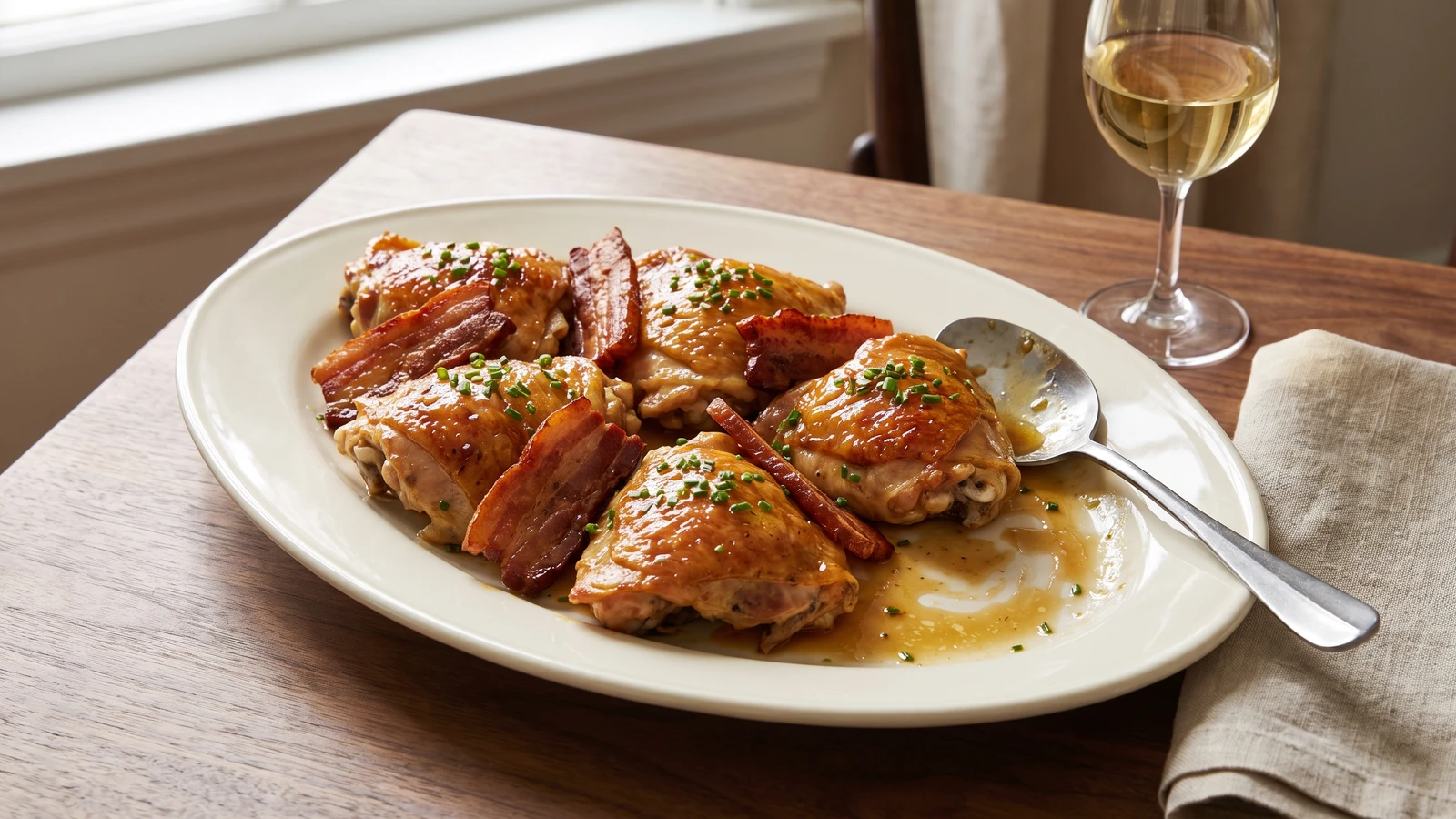
Poulet Sauté Jurassienne teaches the discipline of the pan: brown chicken in butter, fry fresh pork breast hard, pour off the excess fat, then let a light half-glaze carry every savory edge.
Poulet Sauté Jurassienne (Jura-style sautéed chicken) teaches one exact discipline: fat must build flavor, then leave the pan before the sauce arrives. Brown the chicken in butter, fry the fresh pork breast hard, and pour away three-quarters of the grease. Miss that last motion and the light half-glaze cannot cling; it slides beneath a greasy varnish.
The grand kitchen assumed a saucier on staff, stock never off the fire, light half-glaze waiting, and another pair of hands to fry the pork while the chicken cooked. It needed no salamander, and neither do you. For one cook, one stove, one evening, two ordinary skillets and a good prepared demi-glace loosened to a flowing half-glaze do the honest work. The brigade quantity is scaled to one chicken and four plates; the proportion of pork, the butter sauté, the draining, and the chive finish remain intact. Those are the dish. Separate sauce production was scaffolding for the brigade, so it goes.
When the Jurassienne is right, the chicken wears a bronze crust, the pork strips are crisp at their edges, and the sauce gleams rather than floats. Before you touch the pan, remember the motion that decides everything: tilt, spoon away the clear fat, and protect the brown fond beneath it.
Poulet Sauté Jurassienne belongs to the classical repertory of dishes named à la Jurassienne, linking the pan to the Jura through fresh pork rather than a heavy regional sauce. In grand kitchens, such geographical names often identified a garnish more precisely than a single household recipe, and here the signal is blanched fresh pork breast fried hard in butter, with no vin jaune, morels, or Comté. Its journey to the home table preserves that lean formula: chicken, pork, light half-glaze, and chives.
Quantity
1, about 3½ pounds (1.6 kg)
cut into 8 pieces and patted dry
Quantity
8 ounces (225 g), prepared according to Blanchings (No. 273)
cut into ¼-inch strips
Quantity
6 tablespoons (90 ml / 85 g)
divided
Quantity
⅓ cup plus 1 tablespoon (95 ml / 100 g)
warmed
Quantity
1 teaspoon (5 ml / 1 g)
finely chopped
Quantity
1¼ teaspoons (6 ml / 7 g)
Quantity
½ teaspoon (2.5 ml / 1 g)
Quantity
1 tablespoon (15 ml / 15 g)
| Ingredient | Quantity |
|---|---|
| whole skin-on chickencut into 8 pieces and patted dry | 1, about 3½ pounds (1.6 kg) |
| fresh pork breast (unsmoked pork belly)cut into ¼-inch strips | 8 ounces (225 g), prepared according to Blanchings (No. 273) |
| unsalted butterdivided | 6 tablespoons (90 ml / 85 g) |
| prepared light half-glaze saucewarmed | ⅓ cup plus 1 tablespoon (95 ml / 100 g) |
| fresh chivesfinely chopped | 1 teaspoon (5 ml / 1 g) |
| fine sea salt | 1¼ teaspoons (6 ml / 7 g) |
| freshly ground black pepper | ½ teaspoon (2.5 ml / 1 g) |
| hot water (optional) | 1 tablespoon (15 ml / 15 g) |
Season the dry chicken evenly with the salt and pepper, including the joint sides where seasoning is often missed. Warm the light half-glaze until it flows easily from a spoon, but do not boil it. Have the pork, butter, chives, serving platter, and a heatproof bowl for the rendered fat within reach; once the chicken is cooked, the finish moves quickly.
Melt 4 tablespoons (60 ml / 57 g) of the butter in a heavy 12-inch sauté pan over medium heat. When its foam subsides, lay in the chicken skin-side down, placing the thighs and drumsticks over the stronger heat. Work in two batches if the pieces cannot sit without touching. Brown the skin for 6 to 8 minutes without fussing with it, then turn and color the second side for 3 to 4 minutes. Return all the dark pieces to the pan, lower the heat, cover, and cook for 8 minutes. Add the breast pieces and wings, cover again, and continue for 8 to 12 minutes, turning once, until the breasts register 160°F (71°C) and the thighs and drumsticks reach 170 to 175°F (77 to 79°C). Remove each piece as it becomes ready; young chicken does not reward equal cooking times.
While the chicken finishes, melt the remaining 2 tablespoons (30 ml / 28 g) butter in a 10-inch skillet over medium-high heat. Add the fresh pork breast already prepared according to Blanchings (No. 273), spreading the strips in one layer. Fry hard for 7 to 10 minutes, turning as needed, until fully cooked, deeply bronzed, and crisp at the edges. Pale pork brings fat but little character, so give it real color without burning the butter.
Return the cooked chicken to the sauté pan and add the fried pork strips with their butter, following the source sequence. Warm them together for 30 seconds, then tilt the pan and spoon approximately three-quarters of the clear fat into the heatproof bowl, leaving only a thin film and every brown trace of fond. This draining is not brigade scaffolding; it is the dish. If some brown juices leave with the fat, let the bowl stand briefly, skim away the clear top layer, and return the dark juices to the pan. Ça se rattrape.
Set the pan over medium heat and pour in the warm light half-glaze. Swill it across the pan floor, scraping with a wooden spoon so the fond dissolves into the sauce, then turn the chicken once to give every piece a thin gloss. Cook for 1 to 2 minutes only; the bird is already done. If clear fat separates across the surface, lift out the chicken and spoon the fat away before boiling the sauce for 20 seconds. If the sauce tightens too far, loosen it with the hot water a teaspoon at a time.
Lift the chicken onto the warm platter. Take the pan off the heat, stir the chopped chives through the sauce and pork strips, then taste for seasoning. Pour the glossy sauce over the chicken, making sure the pork reaches every serving. Bring it to the table at once. À table!
1 serving (about 275g)
Culinary guides, cultural storytelling, and the editorial depth that makes cooking meaningful.
Discover Culinary ExplorerChef Juliette
The master sauté for poultry: jointed chicken coloured hard in clarified butter, cooked piece by piece to tenderness, then reunited with a pan sauce made from every bronze trace of fond.

Chef Juliette
A lesson in restraint: chicken gently stiffened in butter without browning, then cloaked in an ivory onion, brandy, cream, and velouté sauce sharpened with lemon, Madeira, and black truffle.

Chef Juliette
Golden chicken, a garlic-scented white-wine and tomatéd demi-glace sauce, and three Provençal garnishes kept distinct: Poulet Sauté Arlésienne teaches why aubergine and onion must fry separately to brown.

Chef Juliette
Poulet Sauté Armagnac teaches the pale sauté: tender chicken kept blond, then truffle, brandy, cream, and crayfish butter joined into a coral-gold sauce whose final rule is absolute, never boil it.