
Chef Juliette
John Dory (St. Pierre)
John Dory has the delicacy of sole and the firmness of turbot. A light flouring, a quick butter sauté, and nut-brown beurre noisette show exactly why looks never mattered.
A cooking platform built around craft, culture, and the stories behind what we eat.
Created by Chef Juliette
Based on No. 1519, Poularde Stanley, from Le Guide Culinaire (1907) by Auguste Escoffier
Poularde Stanley teaches refinement through repetition: poach the bird gently over curried onions, then sieve and reduce the velouté cullis twice until it turns ivory-smooth.
Poularde Stanley (stuffed pullet with curried onion cullis) teaches one exacting truth: smoothness is flavor made orderly. The chicken poaches gently over blanched onions with the smallest pinch of curry, then those onions and their cooking liquor become the sauce. Sieve twice. That second passage is not ceremony, it is the dish.
The original formula assumed a whole poularde large enough for a grand table, a saucier beside the stove, Velouté ready from a stockpot that never went cold, and a tammy cloth through which someone had time to rub the sauce twice. For four, a small plump chicken, a measured amount of Velouté, and a fine-mesh sieve do the same honest work. I cook the rice, mushrooms, and truffles before filling the bird because a young chicken finishes sooner than an old poularde, and raw stuffing would ask the breast meat to wait too long. The brigade quantities and obsolete cloth have gone; the gentle poach, the onion cullis, the original proportions, and both sievings remain.
Keep the poaching liquid at a tremble, never a boil, then reduce the cullis patiently after the first sieving. If it catches or tightens too far, ça se rattrape, and the method will show you how. One cook, one stove, one evening.
Poularde Stanley belongs to the cosmopolitan grand-kitchen repertory of Paris, where named garnitures often paired French sauce technique with curry, then regarded as an imported seasoning suitable for formal poultry dishes. Its distinction is not a fiery curry flavor but the classical treatment of onion: blanched, poached beneath the bird, passed into a cullis, joined with Velouté and cream, reduced, and passed once more. The rice, mushrooms, and truffles inside the poularde make it a generous table dish, while the twice-sieved sauce marks its journey from banquet cooking to the home dining room.
Quantity
1, about 3½ pounds (1.6 kg)
giblets removed
Quantity
½ cup (120 ml / 95 g)
rinsed
Quantity
¾ cup (180 ml / 115 g)
finely diced
Quantity
½ cup loosely packed (120 ml / 45 g)
cut in julienne-fashion
Quantity
1 tablespoon (15 ml / 14 g)
Quantity
3¼ cups loosely packed (770 ml / 510 g)
thinly sliced
Quantity
⅛ teaspoon (0.6 ml / 0.3 g)
Quantity
3 cups (710 ml / 710 g), plus more if needed
Quantity
⅔ cup (160 ml / 160 g)
Quantity
⅔ cup (160 ml / 160 g)
Quantity
⅓ cup (80 ml / 80 g)
Quantity
1½ teaspoons (7.5 ml / 9 g), divided, plus more to taste
Quantity
¼ teaspoon (1.25 ml / 0.6 g)
Quantity
2 tablespoons (30 ml / 28 g)
cut into small pieces
| Ingredient | Quantity |
|---|---|
| small plump whole chickengiblets removed | 1, about 3½ pounds (1.6 kg) |
| long-grain white ricerinsed | ½ cup (120 ml / 95 g) |
| cremini or button mushroomsfinely diced | ¾ cup (180 ml / 115 g) |
| fresh black truffle, or preserved black truffle with truffle peelingscut in julienne-fashion | ½ cup loosely packed (120 ml / 45 g) |
| unsalted butter for the stuffing | 1 tablespoon (15 ml / 14 g) |
| yellow onions prepared by Blanchings (No. 273)thinly sliced | 3¼ cups loosely packed (770 ml / 510 g) |
| mild curry powder | ⅛ teaspoon (0.6 ml / 0.3 g) |
| unsalted or lightly salted chicken stock | 3 cups (710 ml / 710 g), plus more if needed |
| Velouté | ⅔ cup (160 ml / 160 g) |
| heavy cream for reducing | ⅔ cup (160 ml / 160 g) |
| heavy cream for finishing | ⅓ cup (80 ml / 80 g) |
| fine sea salt | 1½ teaspoons (7.5 ml / 9 g), divided, plus more to taste |
| freshly ground white pepper | ¼ teaspoon (1.25 ml / 0.6 g) |
| cold unsalted butter for finishing the saucecut into small pieces | 2 tablespoons (30 ml / 28 g) |
Bring a small saucepan of salted water to a boil. Add the rinsed rice and cook until tender but still separate, about 10 to 12 minutes, then drain thoroughly and spread it on a plate to release excess moisture. This preliminary cooking is the necessary home adjustment: a young chicken poaches before raw rice can cook safely inside it.
Melt the stuffing butter over medium heat and add the mushrooms. Cook until they release their liquid, that liquid evaporates, and the edges begin to color, about 6 minutes. Fold in the rice and the truffle cut in julienne-fashion, meaning fine match-shaped strips, then season with ½ teaspoon of the salt and half the white pepper. Cool completely. The truffle should perfume the rice, not disappear into a mince.
Pat the chicken dry inside and out. Spoon the cooled stuffing loosely into the cavity, leaving room for the rice to settle, then secure the opening with kitchen twine and tie the legs together. Do not pack it hard. A compressed stuffing heats slowly and can force the breast to overcook before the center is safe.
Prepare the sliced onions by Blanchings (No. 273): lower them into a large pot of boiling water, return the water to the boil, and cook for 2 minutes to soften their pungency without cooking away their character. Drain, cool in cold water until barely lukewarm, then drain very well. This is not brigade scaffolding. Blanching keeps the finished cullis pale and gentle, so it stays.
Spread the blanched onions across the bottom of a snug, heavy pot and season them with the curry powder. Set the stuffed chicken breast-side up on top, then pour in enough stock to come about halfway up the bird, beginning with the measured 3 cups. Bring the liquid slowly to a bare tremble over medium heat. Cover with a lid and lower the heat at once.
Poach the chicken at the faintest tremble, turning it carefully onto one side after 20 minutes and onto the other side 20 minutes later. Continue until the thickest part of the thigh reaches 165°F (74°C) and the center of the stuffing also reaches 165°F (74°C), usually 60 to 75 minutes total. Never let the liquid boil. If it does, pull the pot off the heat, uncover it for a minute, and return it over a lower flame. Ça se rattrape before the breast tightens.
Lift the chicken onto a warm platter, tip any juices from its cavity back into the pot, and cover it loosely. Let it rest for 15 minutes while you finish the cullis. Skim the clear fat from the cooking liquor, but keep every onion and every spoonful of the savory liquid beneath it.
Simmer the onions and cooking liquor uncovered until the onions are completely soft and the liquid has reduced to about 2 cups, 12 to 18 minutes. Purée with an immersion blender, then rub the mixture firmly through a fine-mesh sieve into a clean saucepan. A tammy cloth served the old kitchen, but a sturdy fine sieve gives one cook the honest equivalent. Press patiently and scrape the smooth purée from the underside.
Whisk the Velouté and the ⅔ cup cream into the sieved onion cullis. Bring it to a gentle simmer and reduce, stirring often and scraping the corners, until it is thick enough to coat the back of a spoon in an opaque layer, about 10 to 15 minutes. If the base catches, do not scrape the scorched film into the sauce. Pour the clean upper portion into another pan and continue over lower heat. Ça se rattrape.
Pass the reduced cullis through the clean fine-mesh sieve a second time. Do not replace this with another spin of the blender. The blades can make the onion smooth, but only the sieve removes every fibrous trace; the second sieving is the whole refinement of Poularde Stanley.
Return the sauce to low heat and whisk in the final ⅓ cup cream. Warm it without boiling, then remove it from the heat and whisk in the cold butter a few pieces at a time. Taste and add the remaining salt and white pepper as needed. If the cullis has become too stiff, loosen it with hot stock one tablespoon at a time; if it is thin, simmer it briefly before adding the butter.
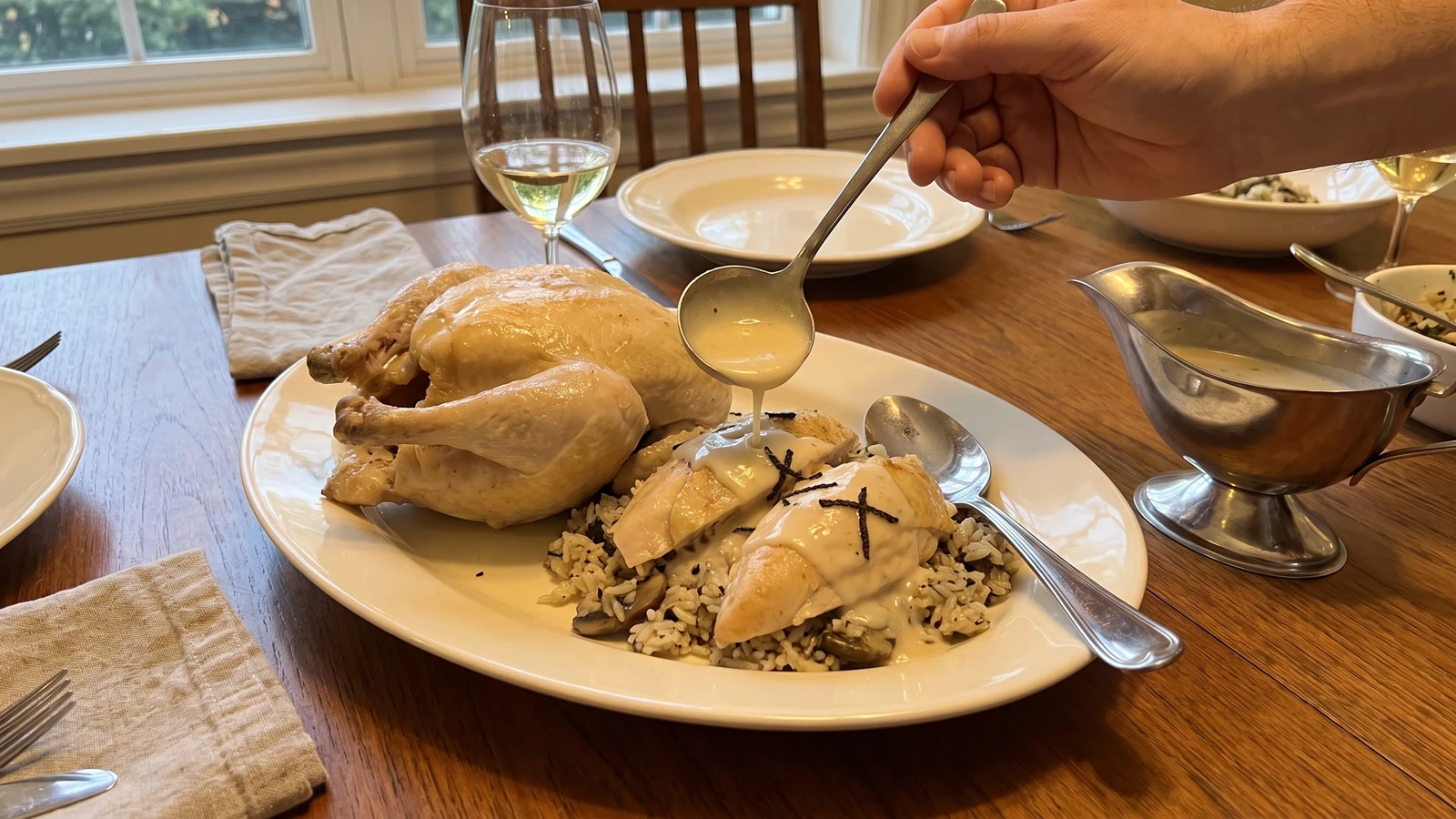
Remove the twine. Spoon the stuffing into a warmed serving dish, carve the chicken into breast and leg portions, and arrange them over the rice. Nap with enough cullis to glaze the meat and pool generously beneath it, then send the remaining sauce in a warm sauceboat. Serve at once. À table!
1 serving (about 550g)
Culinary guides, cultural storytelling, and the editorial depth that makes cooking meaningful.
Discover Culinary ExplorerChef Juliette
John Dory has the delicacy of sole and the firmness of turbot. A light flouring, a quick butter sauté, and nut-brown beurre noisette show exactly why looks never mattered.

Chef Juliette
Fresh haddock proves its delicacy in the meunière pan: a fine flour crust, moist pearly flakes, and beurre noisette sharpened with lemon and parsley, ready from one skillet in half an hour.

Chef Juliette
Éperlans à l’Anglaise turns small fish into a lesson in disciplined coating: boned smelts under a close, crisp crumb, pan-fried in clarified butter and finished with bright, half-melted maître d’hôtel butter.

Chef Juliette
Tiny smelts, shallot, mushrooms, white wine, gratin sauce, and fine bread raspings meet a fierce oven, where the fish must turn tender in the same breath the buttered crust bronzes.