
Chef Juliette
John Dory (St. Pierre)
John Dory has the delicacy of sole and the firmness of turbot. A light flouring, a quick butter sauté, and nut-brown beurre noisette show exactly why looks never mattered.
A cooking platform built around craft, culture, and the stories behind what we eat.
Created by Chef Juliette
Based on No. 1514, Poularde Rossini, from Le Guide Culinaire (1907) by Auguste Escoffier
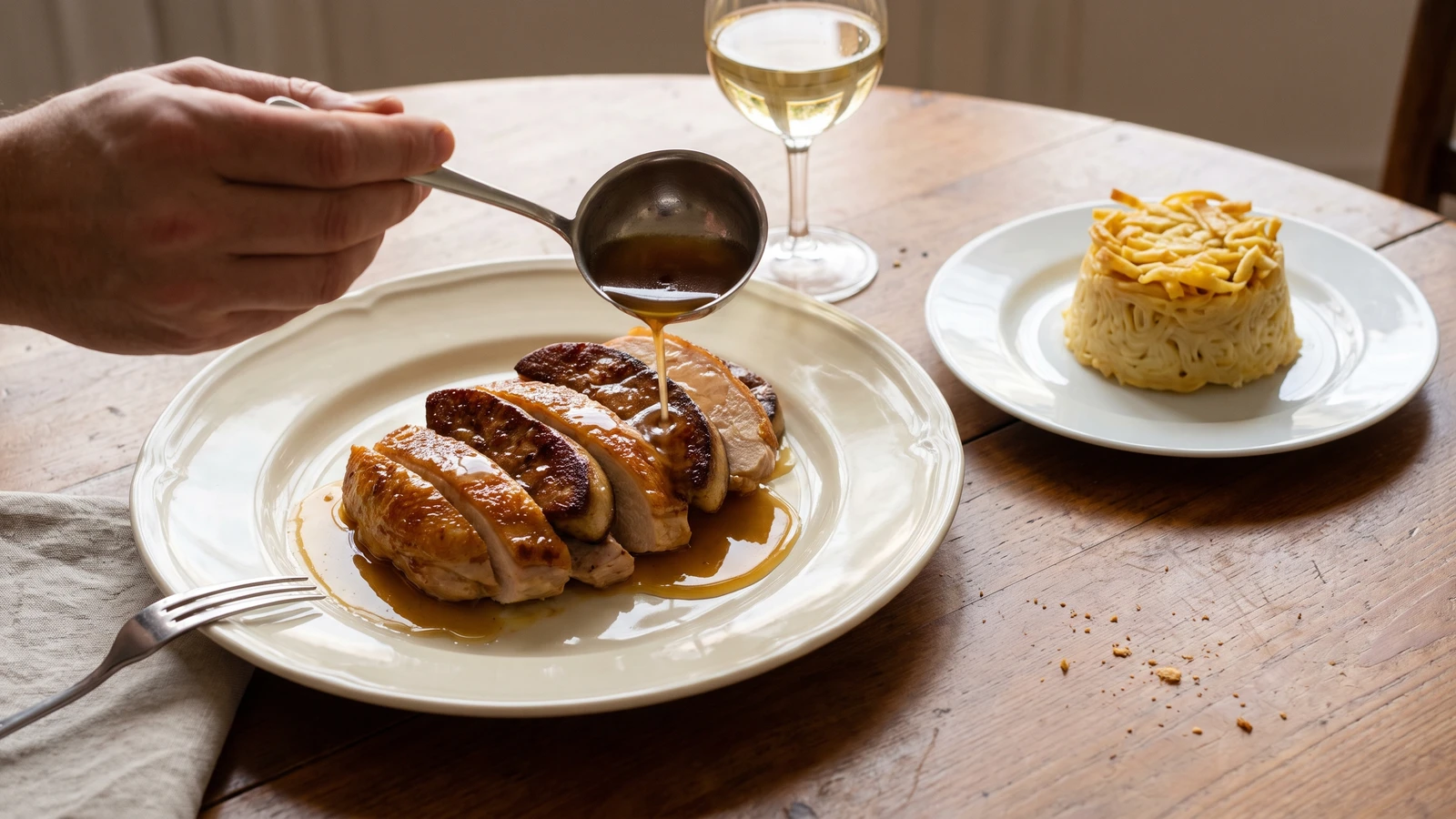
A crown of poêled chicken and hot-seared foie gras surrounds truffle-scented jus, with a molded timbale of buttered noodles alongside. The lesson is timing: arrange the chicken first, then sear the foie gras.
Poularde Rossini (butter-roasted poularde with foie gras and truffled jus) teaches the orchestration of a composed dish. The chicken must remain succulent, the concentrated jus must be hot and clear, and the foie gras must reach the platter seconds after leaving the pan. The one true thing to know before touching a pan is this: the chicken can wait briefly, but foie gras cannot.
The original service assumed a saucier on staff, a chicken stock never off the fire, and a salamander ready for last-minute color. This entry needs only the first two functions. At home, a covered casserole handles the poêlé, gently butter-roasted cooking, a saucepan concentrates good chicken stock, and one heavy skillet sears the foie gras. The brigade's passing and holding are scaffolding; the poêled bird, sliced suprêmes (breast fillets), strong truffled stock, foie gras, and separate noodle timbale are the dish and must stay. One poularde serves four generously. One cook, one stove, one evening.
The book's covering of raw noodles is translated by intent: a small portion of fresh egg noodles is sautéed in butter until cooked through and crisp, giving the timbale its proper contrast without asking anyone to eat raw egg dough. Have the warm platter, truffled jus, and noodle timbale completely ready before searing the foie gras. That fierce final minute decides Poularde Rossini.
Poularde Rossini belongs to Parisian grand cuisine, where dishes bearing the Rossini name honored the composer and celebrated gourmand through the pairing of foie gras and truffle. The designation is often mistaken for a garnish belonging only to tournedos, but the same luxurious grammar was applied to poultry, eggs, and other composed dishes. Here the poularde carries the treatment with particular grace: mild suprêmes frame the foie gras while concentrated chicken stock keeps the truffle tied to the bird.
Quantity
1, about 4½ lb (2 kg), poêled according to Poëlings (No. 250)
Quantity
8, about 8 oz (225 g)
cut ⅜ inch (1 cm) thick and kept very cold
Quantity
3 cups (710 ml / 720 g)
Quantity
2 tablespoons (30 ml / 30 g)
use truffle juice, not truffle oil
Quantity
12 oz (340 g)
divide, reserving 2 oz (55 g) raw
Quantity
5 tablespoons (75 ml / 70 g)
divide, clarifying 1 tablespoon for the foie gras
Quantity
1 teaspoon (5 ml / 6 g), plus more as needed
Quantity
¼ teaspoon (1.25 ml / 0.5 g)
| Ingredient | Quantity |
|---|---|
| whole poularde or large roasting chicken | 1, about 4½ lb (2 kg), poêled according to Poëlings (No. 250) |
| foie gras collopscut ⅜ inch (1 cm) thick and kept very cold | 8, about 8 oz (225 g) |
| unsalted, gelatin-rich chicken stock | 3 cups (710 ml / 720 g) |
| black truffle juice or truffle essenceuse truffle juice, not truffle oil | 2 tablespoons (30 ml / 30 g) |
| fine fresh egg noodlesdivide, reserving 2 oz (55 g) raw | 12 oz (340 g) |
| unsalted butterdivide, clarifying 1 tablespoon for the foie gras | 5 tablespoons (75 ml / 70 g) |
| fine sea salt | 1 teaspoon (5 ml / 6 g), plus more as needed |
| finely ground white pepper | ¼ teaspoon (1.25 ml / 0.5 g) |
Cook the poularde according to Poëlings (No. 250), using that preparation at home scale. The cited method governs the butter cooking, basting, matignon, and final coloring. Confirm that the thickest part of the breast reaches 165°F (74°C) and the thigh reaches at least 175°F (79°C), then rest the bird, loosely covered, for 15 minutes. Time it so the rest overlaps with the final work on the stock and noodles.
While the poularde cooks, bring the chicken stock to a lively simmer in a wide saucepan. Reduce it uncovered to 1¼ cups (300 ml), skimming any foam, until it tastes deeply of chicken and lightly coats a spoon without becoming sticky. This is a jus, not a thickened sauce. If it reduces too far, loosen it with hot water a tablespoon at a time. Ça se rattrape. Remove it from the heat, stir in the truffle juice, and adjust the salt and white pepper. Cover and keep it hot without boiling, since hard boiling drives off the truffle's aroma.
Bring a large pot of well-salted water to a boil. Cook 10 oz (285 g) of the fresh noodles until tender but still holding their shape, then drain them thoroughly. Toss at once with 3 tablespoons of the butter and a small pinch each of salt and white pepper. Pack them firmly into a warm, lightly buttered 4-cup timbale mold or deep bowl, cover, and hold in a warm place.
Separate the reserved raw noodle strands and cut them into manageable lengths. Melt 1 tablespoon of butter in a small skillet over medium heat, add the strands, and toss steadily until golden, crisp, and cooked through, about 4 minutes. Break one to check it: there should be no pale, floury center. If the butter darkens before the noodles crisp, lower the heat and keep them moving. Drain on a warm plate and reserve for the timbale.
Set a round serving platter in a low oven or rinse it with very hot water and dry it. Remove the legs and wings from the rested poularde and reserve them for another meal, then lift away the two suprêmes with their burnished skin intact. Slice each suprême diagonally into four thick, even pieces. Arrange the eight slices in an overlapping crown on the warm platter, leaving a narrow space between each for the foie gras. Cover loosely while you heat the pan.
Pat the cold foie gras collops dry and season them lightly with salt and white pepper. Heat a wide, heavy skillet until very hot, add the clarified tablespoon of butter, then lay in the foie gras without crowding. Sear for 30 to 40 seconds on the first side and 20 to 30 seconds on the second, just until deeply bronzed outside and warm within. Work in two batches if necessary. If the first collop slumps and sheds a pool of fat before browning, lift the remaining pieces back into the cold, drain the pan, and heat it more fiercely before trying again. Ça se rattrape.
Transfer each foie gras collop directly from the skillet into one of the spaces between the chicken slices, maintaining the alternating crown described by the dish. Pour the hot truffled chicken jus into the center of the crown, allowing a little to reach the chicken without drowning the crisp surface of the foie gras. The jus should gleam and pool freely; if it has tightened while waiting, loosen it with a spoonful of hot water before pouring.
Invert the buttered noodle timbale onto a separate warm serving plate. Cover its top generously with the butter-crisp raw noodle strands, keeping the contrast between the tender molded noodles and their crisp crown. Bring both dishes to the table immediately, serving each guest alternating slices of suprême and foie gras with plenty of truffled jus and a spoonful of noodles. À table!
1 serving (about 520g)
Culinary guides, cultural storytelling, and the editorial depth that makes cooking meaningful.
Discover Culinary ExplorerChef Juliette
John Dory has the delicacy of sole and the firmness of turbot. A light flouring, a quick butter sauté, and nut-brown beurre noisette show exactly why looks never mattered.

Chef Juliette
Fresh haddock proves its delicacy in the meunière pan: a fine flour crust, moist pearly flakes, and beurre noisette sharpened with lemon and parsley, ready from one skillet in half an hour.

Chef Juliette
Éperlans à l’Anglaise turns small fish into a lesson in disciplined coating: boned smelts under a close, crisp crumb, pan-fried in clarified butter and finished with bright, half-melted maître d’hôtel butter.

Chef Juliette
Tiny smelts, shallot, mushrooms, white wine, gratin sauce, and fine bread raspings meet a fierce oven, where the fish must turn tender in the same breath the buttered crust bronzes.