
Chef Juliette
John Dory (St. Pierre)
John Dory has the delicacy of sole and the firmness of turbot. A light flouring, a quick butter sauté, and nut-brown beurre noisette show exactly why looks never mattered.
A cooking platform built around craft, culture, and the stories behind what we eat.
Created by Chef Juliette
Based on No. 1510, Poularde de la Reine Anne, from Le Guide Culinaire (1907) by Auguste Escoffier
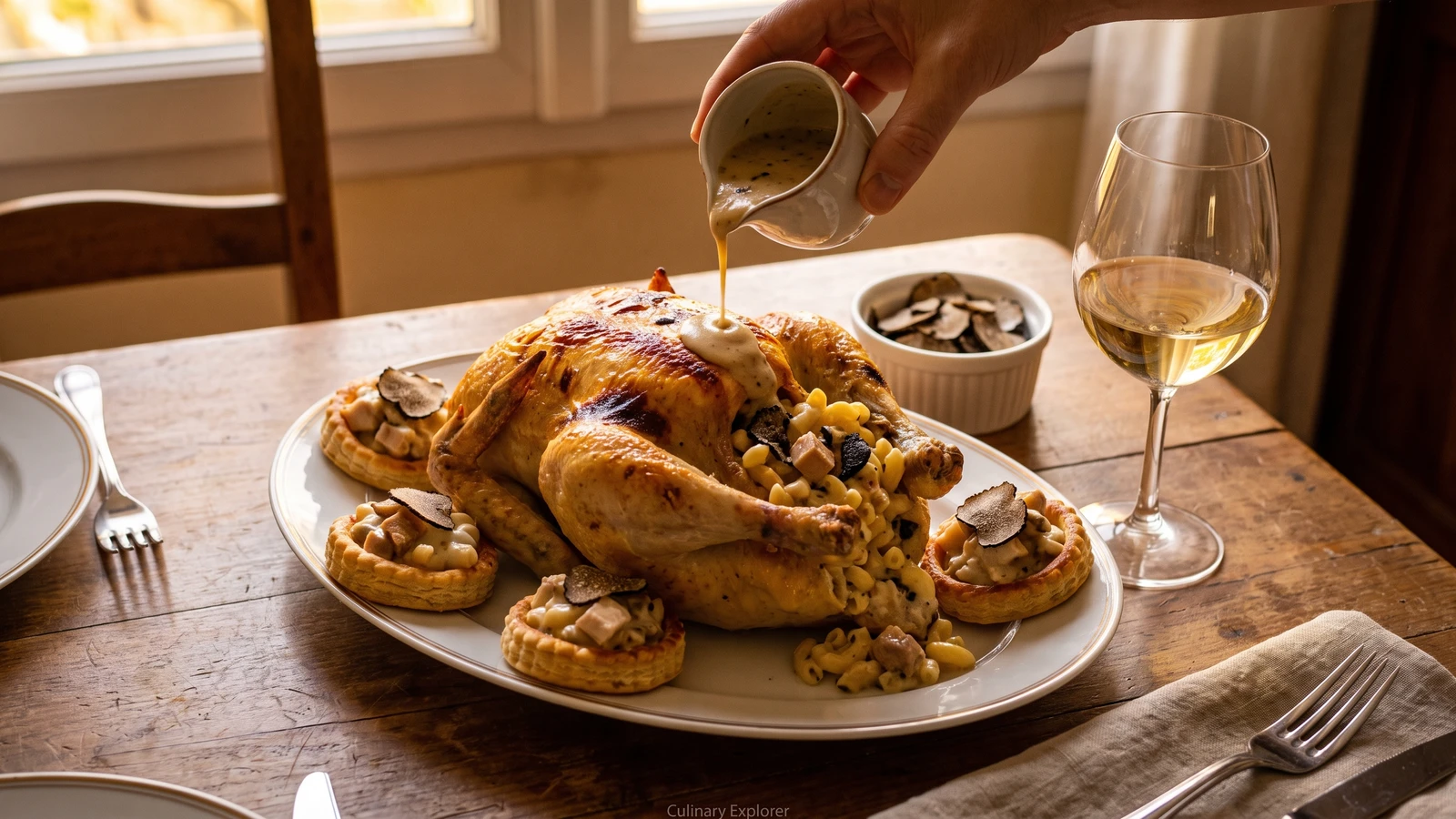
A butter-poêlé poularde becomes its own serving dish, packed with creamy macaroni, foie gras, and truffle, flashed beneath Mornay, then ringed with crisp tartlets and sliced suprêmes.
Poularde de la Reine Anne (butter-roasted pullet filled with creamed macaroni, foie gras, and truffle) teaches that grand presentation is mostly control of sequence. The poularde must be cooked and rested, the sauces ready, the tartlets filled, and the broiler fierce before the bird is opened. Once carved, the dish moves quickly.
The original assumed a saucier on staff, a stock never off the fire, a pastry station, and a salamander, then asked for cocks' combs, poultry kidneys, a low cushion, and a silver shell. For one cook, one stove, one evening, reduced unsalted chicken stock stands in for the stockpot, one saucepan makes Mornay and then Allemande, bought all-butter tartlet shells replace pastry-station labor, and the broiler replaces the salamander. The cushion is dropped and the silver shell becomes a warm ramekin, both are service scaffolding; cleaned cocks' combs and kidneys are so rarely sold that chicken liver and browned mushroom keep the offal-rich intent honestly. The poêlé poularde, foie gras, truffle, two sauces, and tartlet architecture are the dish, and they stay.
The one true thing is the glaze: Mornay must meet fully fierce heat for seconds, not a moderate oven for minutes. Slow heat loosens it until it slides into the macaroni; a fast glaze bronzes the surface while the filling remains creamy. Set every part within reach before the bird goes under.
Poularde de la Reine Anne belongs to the formal Parisian table, not to the larder of a particular province. Its royal name is an appellation of grande cuisine rather than proof that a queen ate it: poêled poultry, foie gras, truffle, macaroni, tartlets, and paired sauces announce a service built to display several kitchen stations at once. The composition carried the butter-based practice of poêling into formal dining by turning the carcass into a serving vessel and redistributing its suprêmes among the garnishes.
Quantity
1 bird, 4½ to 5 pounds (2 to 2.3 kg), cooked and kept warm according to Poëlings (No. 250)
Quantity
3 cups (720 ml / 720 g), reduced to 1½ cups (360 ml / 360 g)
Quantity
1 tablespoon plus 2 teaspoons (25 ml / 30 g)
divided
Quantity
¾ teaspoon (4 ml / 1.5 g)
divided
Quantity
1½ tablespoons (22 ml / 21 g)
Quantity
2½ tablespoons (37 ml / 20 g)
Quantity
1 cup (240 ml / 245 g)
reserve 2 tablespoons
Quantity
⅓ cup (80 ml / 40 g)
finely grated
Quantity
2 tablespoons (30 ml / 12 g)
finely grated
Quantity
3
divided, 1 for the Mornay and 2 for the Allemande
Quantity
1 small pinch
Quantity
1 cup (240 ml / 115 g)
Quantity
¾ cup (180 ml / 180 g)
Quantity
⅔ cup (160 ml / 100 g)
chilled and cut into small dice
Quantity
⅓ cup (80 ml / 40 g)
partly diced and partly thinly sliced
Quantity
4 shells, about 3 inches (7.5 cm) wide
Quantity
1 cup (240 ml / 170 g)
diced
Quantity
½ cup (120 ml / 70 g)
trimmed and cut into small dice
Quantity
1 cup (240 ml / 100 g)
cut into small dice
Quantity
1 tablespoon (15 ml / 14 g)
Quantity
2 tablespoons (30 ml / 28 g)
Quantity
3 tablespoons (45 ml / 24 g)
Quantity
½ cup (120 ml / 120 g)
reserve 2 tablespoons
Quantity
2 tablespoons (30 ml / 30 g)
the home equivalent of truffle essence
Quantity
1 tablespoon (15 ml / 15 g)
Quantity
1 tablespoon (15 ml / 14 g)
| Ingredient | Quantity |
|---|---|
| home-scaled poularde | 1 bird, 4½ to 5 pounds (2 to 2.3 kg), cooked and kept warm according to Poëlings (No. 250) |
| rich unsalted chicken stock | 3 cups (720 ml / 720 g), reduced to 1½ cups (360 ml / 360 g) |
| fine saltdivided | 1 tablespoon plus 2 teaspoons (25 ml / 30 g) |
| finely ground white pepperdivided | ¾ teaspoon (4 ml / 1.5 g) |
| unsalted butter for the Mornay | 1½ tablespoons (22 ml / 21 g) |
| all-purpose flour for the Mornay | 2½ tablespoons (37 ml / 20 g) |
| whole milkreserve 2 tablespoons | 1 cup (240 ml / 245 g) |
| Gruyèrefinely grated | ⅓ cup (80 ml / 40 g) |
| Parmesanfinely grated | 2 tablespoons (30 ml / 12 g) |
| large egg yolksdivided, 1 for the Mornay and 2 for the Allemande | 3 |
| freshly grated nutmeg | 1 small pinch |
| dry elbow macaroni | 1 cup (240 ml / 115 g) |
| heavy cream for the macaroni | ¾ cup (180 ml / 180 g) |
| cooked foie graschilled and cut into small dice | ⅔ cup (160 ml / 100 g) |
| fresh black truffle or drained preserved whole black trufflepartly diced and partly thinly sliced | ⅓ cup (80 ml / 40 g) |
| all-butter savory tartlet shells | 4 shells, about 3 inches (7.5 cm) wide |
| fully prepared cocks' combs and poultry kidneys (optional)diced | 1 cup (240 ml / 170 g) |
| chicken liverstrimmed and cut into small dice | ½ cup (120 ml / 70 g) |
| cremini mushroomscut into small dice | 1 cup (240 ml / 100 g) |
| unsalted butter for the tartlet garnish | 1 tablespoon (15 ml / 14 g) |
| unsalted butter for the Allemande | 2 tablespoons (30 ml / 28 g) |
| all-purpose flour for the Allemande | 3 tablespoons (45 ml / 24 g) |
| heavy cream for the Allemandereserve 2 tablespoons | ½ cup (120 ml / 120 g) |
| truffle juicethe home equivalent of truffle essence | 2 tablespoons (30 ml / 30 g) |
| fresh lemon juice | 1 tablespoon (15 ml / 15 g) |
| unsalted butter for the truffle ramekin | 1 tablespoon (15 ml / 14 g) |
Bring the unsalted chicken stock to a lively simmer in a wide saucepan and reduce it to 1½ cups (360 ml), skimming away any foam, about 20 to 25 minutes. Taste as it concentrates. If it begins to taste salty before reaching the mark, stop reducing; the roux will supply the missing body, while further reduction would only harden the salt. Transfer the stock to a measuring jug.
Mornay, the cheese-enriched white sauce, must be thick enough to cling during the final glaze. Melt its butter over medium-low heat, stir in its flour, and cook for 2 minutes without coloring. Whisk in the milk gradually, keeping 2 tablespoons cold in reserve, then simmer gently for 6 to 8 minutes until the sauce falls from the whisk in a broad ribbon. Remove it from the heat and whisk in the Gruyère, Parmesan, 1 egg yolk, nutmeg, a pinch of salt, and white pepper. Do not boil after adding the cheese. If it turns oily or grainy, pull it off the heat and whisk in the reserved cold milk a spoonful at a time. Ça se rattrape. Press buttered parchment directly against the surface and keep the Mornay warm.
Prepare the poularde using Poëlings (No. 250), scaled to the single 4½-to-5-pound bird. When cooked, let it rest for 20 minutes, then keep it loosely covered in a warm place while the sauces and garnishes come together. Tight foil softens the skin, and prolonged high heat dries the breast before it reaches the tartlets.
Allemande, a velouté finished with egg yolk and cream, supplies both the tartlet binding and the sauceboat. Melt its butter over medium-low heat, stir in its flour, and cook the pale roux for 2 minutes without browning. Whisk in the reduced stock gradually and simmer for 10 minutes, stirring often, until it coats the back of a spoon. Whisk 2 egg yolks with all but 2 tablespoons of the Allemande cream, temper them with three ladlefuls of hot sauce, then return the liaison, the yolk-and-cream finish, to the saucepan. Stir over very low heat until it reaches 160°F (71°C), but never let it boil. Add the lemon juice and truffle juice, then adjust the salt and white pepper. If the sauce begins to grain, remove it from the heat immediately, whisk in the reserved cold cream, and strain it. Hold it over barely warm water.
Begin the macaroni when the poularde is nearly done. Boil it in well-salted water until just short of tender, then drain thoroughly. In its empty saucepan, reduce the macaroni cream by about one-third, add the pasta, and toss over low heat until the cream clings between the tubes rather than pooling underneath. If it remains loose, cook it for another minute before adding the rich garnishes. Remove the pan from the heat and fold in the diced foie gras and most of the diced truffle, reserving 8 thin slices and about 1 tablespoon of truffle dice for serving. Taste for salt and white pepper. Keep it warm, never bubbling, or the foie gras will melt out.
Melt the tartlet butter in a skillet over medium-high heat and sauté the mushrooms until their liquid disappears and their edges brown. Add the chicken livers and cook until no raw center remains and they reach 165°F (74°C), then season lightly. Fold the liver and mushrooms into ½ cup (120 ml) of warm Allemande and spoon the garnish into the tartlet shells. If fully cleaned, cooked cocks' combs and poultry kidneys are available, use them in place of both liver and mushrooms, exactly as the original garnish directs.
Set the broiler to its highest heat before carving. Place the warm poularde breast-side up on a board and remove the two suprêmes, the breast fillets, in whole lobes, keeping them warm. With poultry shears and a short boning knife, remove the exposed breast and rib bones while leaving the back, legs, and wings connected, creating a stable cavity. Work with a folded towel because the bird will still be hot. If the shell cracks, do not dismantle it; set it at once in the shallow ovenproof platter, whose sides will brace it. Never apologize at your own table.
Spoon the creamed macaroni, foie gras, and truffle into the opened carcass, packing it gently without crushing the pasta. Rewarm the Mornay over low heat, loosening it with any reserved milk if necessary, then spread a generous layer over the macaroni from edge to edge. Divide each suprême crosswise into two thick portions, giving four pieces, and set one over the Allemande garnish in each tartlet. Brush the breast portions with a little warm Allemande so they remain glossy.
Set the filled poularde on its ovenproof platter 4 to 6 inches (10 to 15 cm) beneath the fully heated broiler. Glaze for 45 to 90 seconds, watching without interruption, until the Mornay bubbles at the edges and takes quick bronze patches across the top. Rotate the platter if one side colors first. Slow heat merely melts the sauce down into the macaroni; this fierce finish is the step that decides the dish.
Warm the reserved truffle slices and dice for 20 to 30 seconds in the finishing butter, just until glossy, then mound them in a small warmed ramekin behind the poularde, the honest home equivalent of the silver shell. Arrange the four suprême-topped tartlets around the bird and pour the remaining truffled Allemande into a warm sauceboat. Bring everything to the table immediately. À table!
1 serving (about 810g)
Culinary guides, cultural storytelling, and the editorial depth that makes cooking meaningful.
Discover Culinary ExplorerChef Juliette
John Dory has the delicacy of sole and the firmness of turbot. A light flouring, a quick butter sauté, and nut-brown beurre noisette show exactly why looks never mattered.

Chef Juliette
Fresh haddock proves its delicacy in the meunière pan: a fine flour crust, moist pearly flakes, and beurre noisette sharpened with lemon and parsley, ready from one skillet in half an hour.

Chef Juliette
Éperlans à l’Anglaise turns small fish into a lesson in disciplined coating: boned smelts under a close, crisp crumb, pan-fried in clarified butter and finished with bright, half-melted maître d’hôtel butter.

Chef Juliette
Tiny smelts, shallot, mushrooms, white wine, gratin sauce, and fine bread raspings meet a fierce oven, where the fish must turn tender in the same breath the buttered crust bronzes.