
Chef Juliette
John Dory (St. Pierre)
John Dory has the delicacy of sole and the firmness of turbot. A light flouring, a quick butter sauté, and nut-brown beurre noisette show exactly why looks never mattered.
A cooking platform built around craft, culture, and the stories behind what we eat.
Created by Chef Juliette
Based on No. 1501, Poularde Adelina Patti, from Le Guide Culinaire (1907) by Auguste Escoffier
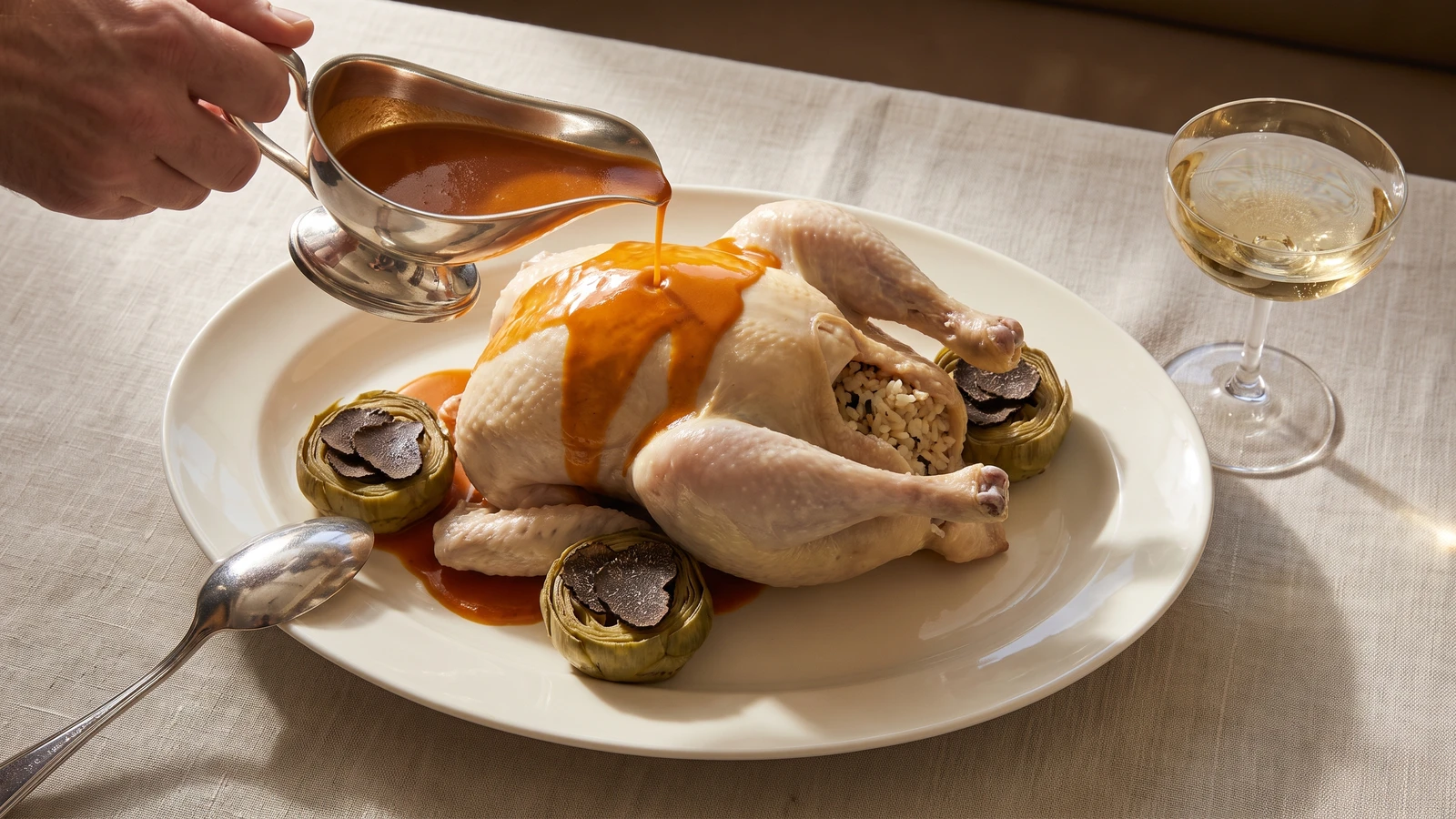
A plump poularde filled with rich pilaff, poached until tender, then cloaked in paprika sauce suprême and circled with glazed artichoke bottoms and truffle, a grand composition made calm for one home stove.
Poularde Adelina Patti (rice-stuffed poached pullet with paprika sauce suprême, a cream-finished velouté built from white stock and roux) teaches a severe and useful lesson: pale food is not timid food. The bird isn't browned. Its character comes from a gentle white-stock poach, a properly cooked roux, cream reduced to silk, and paprika awakened in butter.
The original assumed a saucier at the next range, white stock never off the fire, and spare hands to build a low display cushion beneath the bird. Your home equivalent is honest: one narrow pot, the poaching liquor divided between sauce and pale glaze, and a warm platter instead of the cushion. That cushion was brigade scaffolding and goes. The stuffed poach, sauce suprême, artichokes, truffle, and separate sauceboat are the dish and stay. No salamander belongs here, because the finish should gleam pale rather than brown. One cook, one stove, one evening.
When it is right, the poularde arrives ivory and glossy, the paprika lending warmth without muddying the sauce, while black truffle sits against the pale artichokes like lacquer. Know the one true thing before touching the pan: bloom the paprika gently in butter, never shake it raw into the sauce.
Poularde Adelina Patti belongs to the composed repertoire of Parisian grande cuisine, where dishes were named for celebrated performers; its namesake was the soprano Adelina Patti. Despite its Italian namesake, the method is wholly French: white-stock poaching, rich rice stuffing, sauce suprême, artichoke bottoms, and truffle arranged as a formal garnish. The dish reaches a home table by surrendering its decorative cushion and brigade labor while keeping the poach, the sauce, and the composed garnish intact.
Quantity
1 bird, 4 to 4½ pounds (1.8 to 2 kg)
giblets removed
Quantity
2 cups (480 ml / 400 g) Pilaff Rice (for the Stuffing of Fowls) (No. 2256)
prepared and chilled
Quantity
2 teaspoons (10 ml / 12 g)
divided
Quantity
½ teaspoon (2.5 ml / 1 g)
divided
Quantity
3 quarts (2.8 liters / 2.8 kg)
Quantity
5 tablespoons (75 ml / 70 g)
divided
Quantity
3 tablespoons (45 ml / 24 g)
Quantity
1 cup (240 ml / 240 g)
Quantity
1½ teaspoons (7.5 ml / 4 g)
not smoked
Quantity
4 fair-sized bottoms (about 7 ounces / 200 g)
drained
Quantity
1 small truffle (about 1 ounce / 28 g)
cut into 8 thin slices
| Ingredient | Quantity |
|---|---|
| poularde or plump young chickengiblets removed | 1 bird, 4 to 4½ pounds (1.8 to 2 kg) |
| Pilaff Rice (for the Stuffing of Fowls)prepared and chilled | 2 cups (480 ml / 400 g) Pilaff Rice (for the Stuffing of Fowls) (No. 2256) |
| fine sea saltdivided | 2 teaspoons (10 ml / 12 g) |
| ground white pepperdivided | ½ teaspoon (2.5 ml / 1 g) |
| unsalted or low-sodium white chicken stock | 3 quarts (2.8 liters / 2.8 kg) |
| unsalted butterdivided | 5 tablespoons (75 ml / 70 g) |
| plain flour | 3 tablespoons (45 ml / 24 g) |
| heavy cream | 1 cup (240 ml / 240 g) |
| sweet paprikanot smoked | 1½ teaspoons (7.5 ml / 4 g) |
| cooked artichoke bottomsdrained | 4 fair-sized bottoms (about 7 ounces / 200 g) |
| black trufflecut into 8 thin slices | 1 small truffle (about 1 ounce / 28 g) |
Pat the poularde dry inside and out. Season the cavity with ½ teaspoon of the salt and a little white pepper. Loosen the chilled Pilaff Rice (for the Stuffing of Fowls) (No. 2256) gently with a fork, keeping the finished preparation whole rather than adding anything further. Spoon it loosely into the main cavity, filling no more than two-thirds full so the rice can complete its cooking without splitting the bird. Close the cavity with a skewer or kitchen twine, truss the legs, and season the outside with another 1 teaspoon salt and a little white pepper. Stuff only when you are ready to poach.
Set the poularde breast-side up in a narrow stockpot and pour over enough white chicken stock to cover it. Bring the liquid gradually to a bare tremble over medium heat, skimming any pale foam as it rises, then lower the heat and partially cover. Poach without boiling for 75 to 90 minutes, turning the bird once if the breast rises above the stock. The liquid should register about 180 to 185°F (82 to 85°C). A rolling boil tightens the flesh and clouds the stock; if one begins, lower the heat immediately and add a small ladle of cool stock. Continue until the centre of the rice stuffing reaches 165°F (74°C) and the thickest part of the thigh reaches at least 165°F (74°C), preferably nearer 170°F (77°C).
Lift the poularde carefully, letting the stock drain from its cavity back into the pot. Transfer it to a warmed tray, cover loosely, and let it rest while you finish the garniture. Strain the poaching liquid through a fine sieve and skim away excess fat. Measure 3 cups (720 ml / 720 g) for the sauce and 1 cup (240 ml / 240 g) for the pale meat glaze; keep another cup nearby for warming the artichokes and correcting the sauce.
Melt 3 tablespoons of the butter in a saucepan over medium-low heat. Stir in the flour and cook for 2 minutes, stirring steadily, until the roux smells faintly nutty but remains pale. Whisk in the 3 cups of hot poaching liquid a little at a time, making the first addition slowly so the roux stays smooth. Simmer gently for 12 to 15 minutes, skimming as needed, then add the cream and reduce until the sauce coats the back of a spoon in an even veil. If it goes lumpy, pass it through the fine sieve; if it tightens too far, loosen it with reserved stock. A thin sauce needs reduction, not more flour.
Melt 1 tablespoon of the butter over low heat in a small pan. Remove it from the direct heat, stir in the paprika, and let it bloom for 20 to 30 seconds, just until its fragrance opens and the butter turns warm red-gold. Whisk this immediately into the velouté. If the paprika darkens or smells bitter, don't add it to the sauce. Discard that spoonful and begin again with fresh butter and paprika. Ça se rattrape. Simmer the sauce suprême very gently for 2 minutes, season with the remaining salt and white pepper as needed, then remove it from the heat and whisk in the final tablespoon of cold butter. Keep it warm without boiling.
Boil the reserved 1 cup of clear poaching liquid in a small saucepan until it reduces to about ¼ cup (60 ml / 60 g) and coats a spoon with a light, syrupy film. This is the home equivalent of the pale meat glaze once waiting beside the saucier's range. Keep it pale and savory; stop before it catches or caramelizes. If it becomes salty before it thickens, use a thinner coating rather than reducing it further.
Warm the artichoke bottoms gently for 4 to 5 minutes in a shallow pan with enough reserved poaching liquid to cover their bases. Drain them thoroughly and place two overlapping truffle slices in each hollow. Brush the truffle and the rim of each artichoke bottom with the pale meat glaze. Warm the truffle only through the artichoke; hard heat drives away the aroma you paid for.
Set the rested poularde directly on a warmed oval platter. The old low cushion supported the display, not the flavor, so the platter replaces it honestly. Spoon enough paprika sauce suprême over the bird to cloak it in a smooth, glossy layer, then arrange the four glazed artichoke bottoms around it. Pour the remaining sauce suprême into a warmed sauceboat and serve it separately, exactly as the composition requires. Carve the poularde at the table, spoon some rice stuffing beside each portion, and give every guest an artichoke bottom. À table!
1 serving (about 600g)
Culinary guides, cultural storytelling, and the editorial depth that makes cooking meaningful.
Discover Culinary ExplorerChef Juliette
John Dory has the delicacy of sole and the firmness of turbot. A light flouring, a quick butter sauté, and nut-brown beurre noisette show exactly why looks never mattered.

Chef Juliette
Fresh haddock proves its delicacy in the meunière pan: a fine flour crust, moist pearly flakes, and beurre noisette sharpened with lemon and parsley, ready from one skillet in half an hour.

Chef Juliette
Éperlans à l’Anglaise turns small fish into a lesson in disciplined coating: boned smelts under a close, crisp crumb, pan-fried in clarified butter and finished with bright, half-melted maître d’hôtel butter.

Chef Juliette
Tiny smelts, shallot, mushrooms, white wine, gratin sauce, and fine bread raspings meet a fierce oven, where the fish must turn tender in the same breath the buttered crust bronzes.