
Chef Juliette
John Dory (St. Pierre)
John Dory has the delicacy of sole and the firmness of turbot. A light flouring, a quick butter sauté, and nut-brown beurre noisette show exactly why looks never mattered.
A cooking platform built around craft, culture, and the stories behind what we eat.
Created by Chef Juliette
Based on No. 1493, Poularde Mireille, from Le Guide Culinaire (1907) by Auguste Escoffier
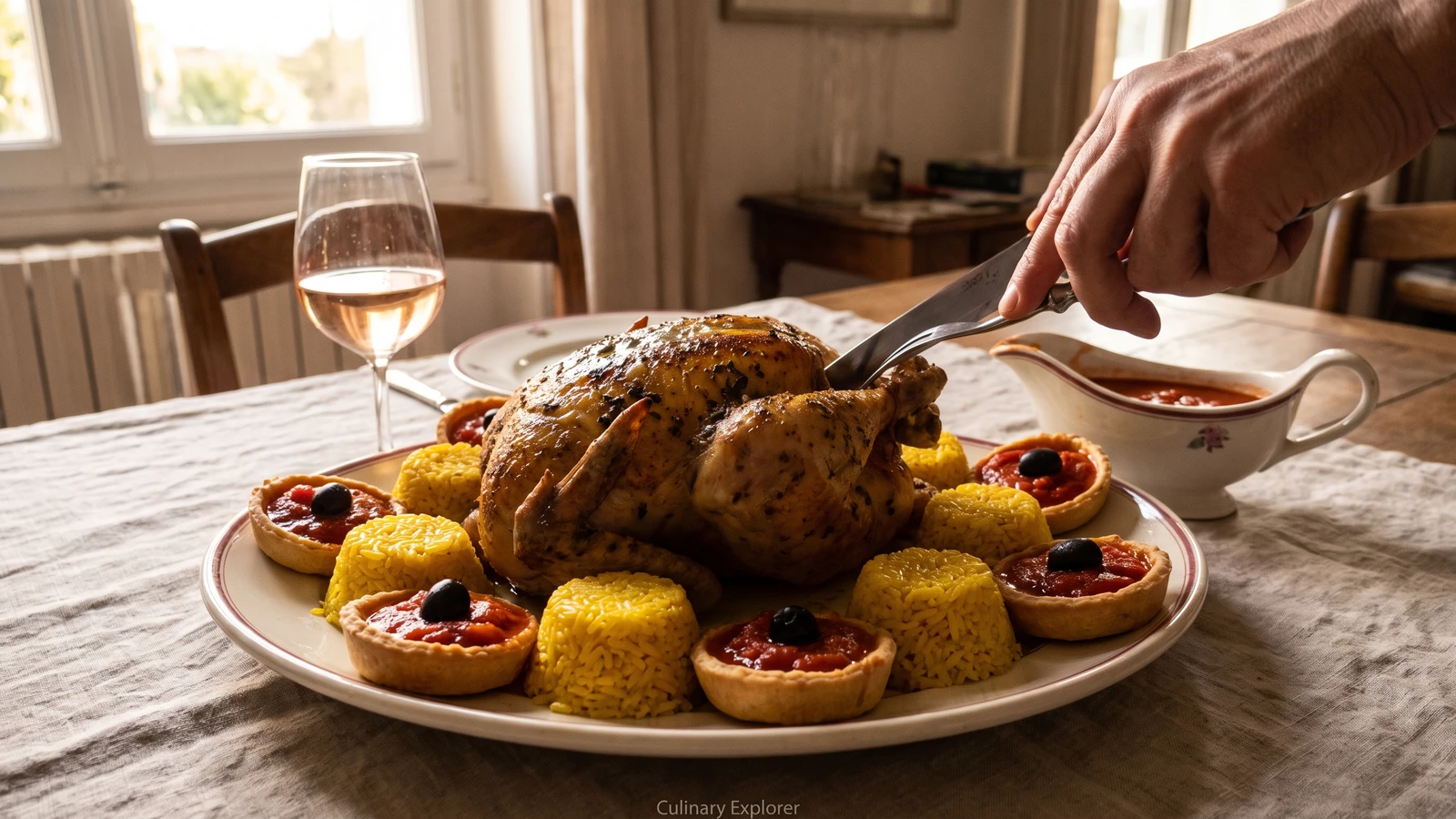
A butter-poêled poularde brought to the table in its southern classical dress: saffron rice timbales, buttery tomato tartlets, black olives, and a glossy tomato sauce served apart.
Poularde Mireille (chicken gently cooked in butter with saffron rice, tomato, and olives) teaches how contrast becomes harmony when every element keeps its character. Poêling (gentle covered oven cooking in butter) leaves the bird succulent and burnished, saffron perfumes the rice, tomato concassée (peeled, seeded, and roughly chopped tomato) brings acidity, and one black olive gives each tartlet its dark, salty point. Before you touch a pan, know this: saffron must bloom in warm stock. Dropped dry into rice, it gives yellow and very little perfume.
The original kitchen expected a saucier for the separate tomato sauce, stock never off the fire, rows of identical molds, and several hands filling tartlets while the poularde rested. At home, prepared tomato sauce, good chicken stock, four ramekins, four tartlet shells, and a heavy lidded cocotte do the work. No salamander is needed because the final colour belongs to Poëlings (No. 250). The garnish has been scaled to four rice timbales and four tartlets, enough to preserve the alternating ring without turning dinner into banquet service. One cook, one stove, one evening.
Perfectly identical molds are brigade scaffolding and can go. Gentle unmoistened poêling, properly bloomed saffron, tomatoes cooked in butter until their loose water is gone, and the alternating garnish are the dish itself, so they stay. Bloom the saffron before anything else; that small cup of golden stock decides whether the rice merely looks right or truly smells of Mireille.
Poularde Mireille belongs to the French classical dining-room repertoire, while its saffron, tomato, and black-olive garnish speaks in a distinctly Provençal register. Mireille is a Provençal name made emblematic by the region's literature, and classical kitchens translated that southern association into the formal arrangement of rice timbales and tartlets around a poêled bird. It is not a Provençal farmhouse roast, but a grand-kitchen composition that moved naturally to bourgeois dinner tables once one cook could prepare its small garnishes ahead.
Quantity
1 (about 4 1/2 lb / 2 kg)
thoroughly dried
Quantity
1 home-scale application Poëlings (No. 250), sufficient for 1 poularde
Quantity
1 tablespoon (15 ml / 18 g)
divided
Quantity
1 teaspoon (5 ml / 2 g)
divided
Quantity
1/4 teaspoon (1.25 ml / 0.15 g), plus an extra pinch for rescue if needed
Quantity
2 1/4 cups (540 ml / 540 g)
divided
Quantity
1 1/4 cups (300 ml / 250 g)
rinsed once and drained well
Quantity
8 tablespoons (120 ml / 113 g)
divided
Quantity
4 medium (about 1 1/2 lb / 680 g)
peeled and seeded
Quantity
4, each about 2 1/2 inches / 6 cm across
fully baked
Quantity
4
pitted
Quantity
1 1/2 cups (360 ml / 375 g)
| Ingredient | Quantity |
|---|---|
| poularde or plump roasting chickenthoroughly dried | 1 (about 4 1/2 lb / 2 kg) |
| Poëlings | 1 home-scale application Poëlings (No. 250), sufficient for 1 poularde |
| fine sea saltdivided | 1 tablespoon (15 ml / 18 g) |
| finely ground white pepperdivided | 1 teaspoon (5 ml / 2 g) |
| saffron threads | 1/4 teaspoon (1.25 ml / 0.15 g), plus an extra pinch for rescue if needed |
| warm chicken stockdivided | 2 1/4 cups (540 ml / 540 g) |
| long-grain white ricerinsed once and drained well | 1 1/4 cups (300 ml / 250 g) |
| unsalted butterdivided | 8 tablespoons (120 ml / 113 g) |
| ripe tomatoespeeled and seeded | 4 medium (about 1 1/2 lb / 680 g) |
| small plain tartlet shellsfully baked | 4, each about 2 1/2 inches / 6 cm across |
| fine black olivespitted | 4 |
| prepared smooth tomato sauce | 1 1/2 cups (360 ml / 375 g) |
Warm 1/4 cup (60 ml / 60 g) of the chicken stock until it feels hot but never boils. Crumble in the saffron, cover, and leave it for 15 minutes, until the liquid smells floral and turns deep gold. Reserve another 1/4 cup (60 ml / 60 g) stock for adjustments. If dry saffron has already gone into the rice and gives colour without scent, ça se rattrape: bloom the extra pinch in 2 tablespoons (30 ml / 30 g) of the reserved warm stock, fold it through the hot rice, cover, and wait 5 minutes.
Season the poularde inside and out with about two-thirds of the salt and half the white pepper, then carry out Poëlings (No. 250), scaled for this single bird. The referenced preparation governs the butter, vegetable bed, covered cooking, basting, and uncovered colouring, so it stays whole rather than being re-derived here. Begin checking the bird after about 70 minutes. The deepest part of the thigh must reach 165°F / 74°C, while the breast should be at least 160°F / 71°C and reach 165°F / 74°C during its covered rest. Do not moisten the vessel while the bird cooks; liquid would turn poêling into a white braise. If the vegetables threaten to burn first, lower the heat and transfer the poularde with the sound vegetables and butter to a clean warm vessel, leaving any blackened pieces behind.
When the poularde has about 35 minutes left, melt 2 tablespoons (30 ml / 28 g) butter in a saucepan. Add the drained rice and stir gently for 2 minutes, until each grain is coated and faintly translucent at its edge. Pour in the bloomed saffron stock and 1 3/4 cups (420 ml / 420 g) plain stock, then add 1 teaspoon (5 ml / 6 g) salt. Bring it to a bare simmer, cover tightly, and cook over the gentlest heat for 16 minutes. Remove it from the heat and leave it covered for 10 minutes. If the rice is firm and dry, sprinkle in reserved stock one tablespoon at a time; if wet, spread it in a wide warm pan for 2 minutes so the excess moisture escapes.
Butter four 1/2-cup ramekins or timbale molds with 1 tablespoon (15 ml / 14 g) butter. Fluff the rice, taste for seasoning, and pack it into the molds while warm, pressing firmly enough to remove gaps without crushing the grains. Cover and hold them warm. If a timbale sticks at service, run a thin knife around its edge and wrap the mold in a hot towel for 20 seconds. If it slumps, pack it again and let it stand for 5 minutes before the second attempt.
Concass the peeled and seeded tomatoes, cutting them into rough 1/2-inch / 1-cm pieces. Melt 3 tablespoons (45 ml / 42 g) butter in a wide sauté pan, add the tomatoes with the remaining salt and white pepper, and cook over medium-high heat for 8 to 12 minutes. Stir just often enough to prevent catching. They are ready when glossy and tender but still visibly chopped, with no watery puddle beneath them. If they release too much liquid, move them to the widest pan you own and let the water cook away; patience preserves the concassée better than thickener.
Brush the insides of the tartlet shells with 1 tablespoon (15 ml / 14 g) melted butter and warm them for 5 minutes in a moderate oven so their edges are crisp. Spoon the hot tomato concassée into each shell and set one pitted black olive on top. Fill them only just before dishing, since a tartlet left under wet tomato softens. If the shells have already softened, empty them carefully and return the unfilled shells to the oven for several minutes before refilling.
Warm the tomato sauce in a small saucepan until it holds a gentle simmer and coats a spoon lightly. If it is loose, reduce it uncovered; if it has tightened too far, add the reserved stock a spoonful at a time. Take it off the heat and whisk in the final 1 tablespoon (15 ml / 14 g) butter for a clear gloss, then pour it into a warm sauceboat. The sauce is served separately, exactly as the dish requires.
Rest the finished poularde, covered loosely, for 20 minutes. Set it whole on a warm oval platter, or carve it neatly and re-form the pieces if table carving would delay dinner. Unmold the four saffron rice timbales around it, alternating each with a tomato-filled tartlet so the ring reads gold, red, and black. Bring the tomato sauce alongside rather than pouring it over the crisp skin or garnishes. À table!
1 serving (about 690g)
Culinary guides, cultural storytelling, and the editorial depth that makes cooking meaningful.
Discover Culinary ExplorerChef Juliette
John Dory has the delicacy of sole and the firmness of turbot. A light flouring, a quick butter sauté, and nut-brown beurre noisette show exactly why looks never mattered.

Chef Juliette
Fresh haddock proves its delicacy in the meunière pan: a fine flour crust, moist pearly flakes, and beurre noisette sharpened with lemon and parsley, ready from one skillet in half an hour.

Chef Juliette
Éperlans à l’Anglaise turns small fish into a lesson in disciplined coating: boned smelts under a close, crisp crumb, pan-fried in clarified butter and finished with bright, half-melted maître d’hôtel butter.

Chef Juliette
Tiny smelts, shallot, mushrooms, white wine, gratin sauce, and fine bread raspings meet a fierce oven, where the fish must turn tender in the same breath the buttered crust bronzes.