
Chef Juliette
John Dory (St. Pierre)
John Dory has the delicacy of sole and the firmness of turbot. A light flouring, a quick butter sauté, and nut-brown beurre noisette show exactly why looks never mattered.
A cooking platform built around craft, culture, and the stories behind what we eat.
Created by Chef Juliette
Based on No. 1491, Poularde Marguerite de Savoie, from Le Guide Culinaire (1907) by Auguste Escoffier
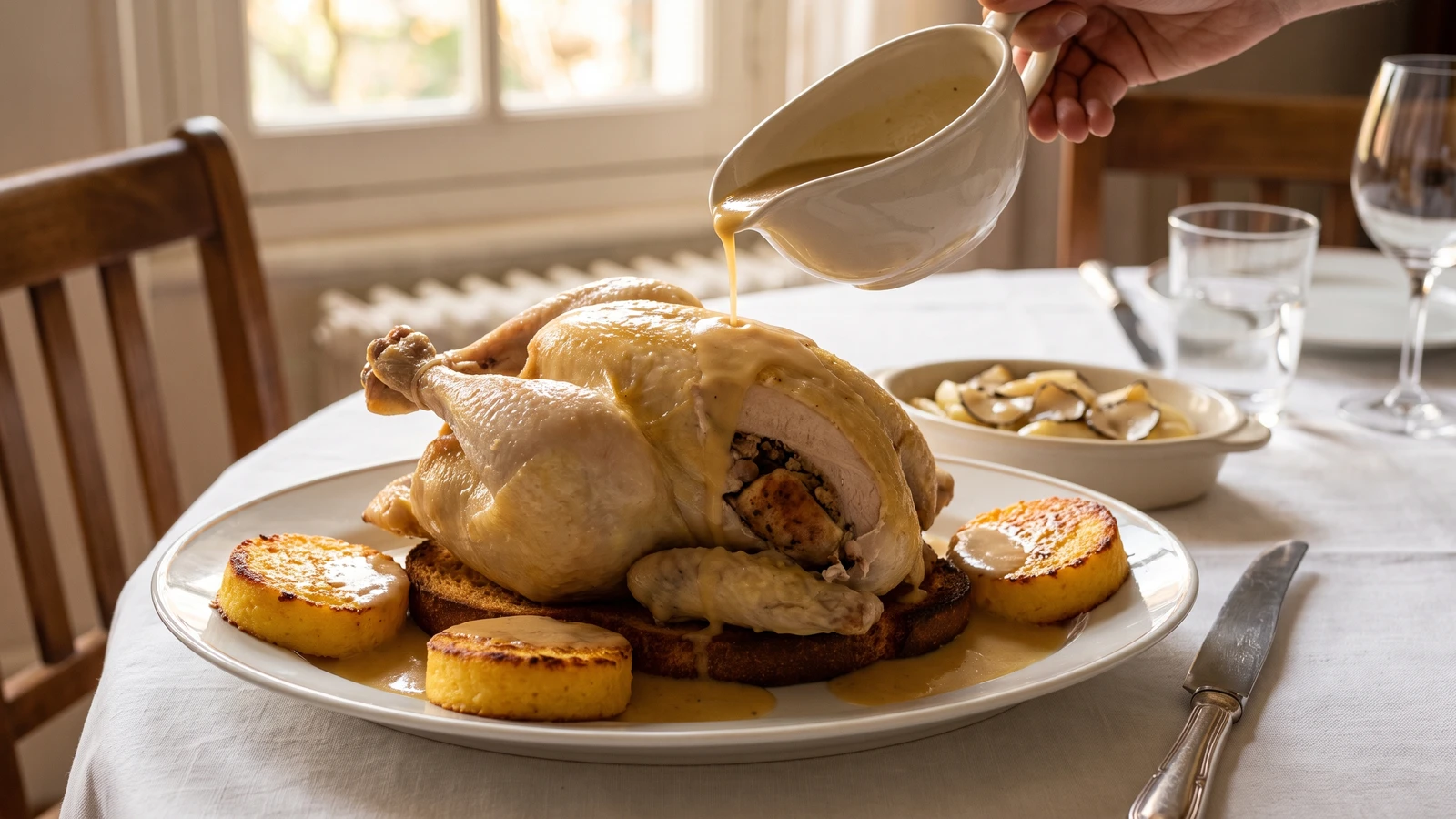
A quail-filled poularde braised in equal measures of Savoy wine and veal stock, served on fried bread with Parmesan-glazed polenta and a little dish of warm white Piedmont truffles.
Poularde Marguerite de Savoie (pullet filled with little birds and braised in Savoy wine) teaches that timing is part of technique. The Polenta (No. 2294) must be cold and firm before the bird goes into the pot, because a warm slab tears beneath the cutter and drinks the frying butter. That is the one true thing to know before you touch a pan.
At the table, the poularde rests on a low cushion of butter-fried bread, its pale-gold skin glossed with concentrated cooking liquor. Crisp polenta roundels make a generous ring around it, Parmesan bronzed across their tops, while white Piedmont truffles arrive separately in a little dish of butter and consommé. It is ceremonial food, certainly, but cooking well is not cooking fancy.
The original kitchen assumed ten larks, veal stock never off the fire, a saucier reducing the braising liquor, and a salamander ready while another pair of hands fried the polenta. Here, two farmed quail replace protected wild larks because they are larger and lawfully available; good unsalted veal stock replaces the perpetual stockpot, a covered cocotte handles the braise, and an ordinary broiler gives the Parmesan its quick glaze. The separate cooks were brigade scaffolding. The nested birds, equal measures of stock and Savoy wine, cold-set polenta, real butter, and truffle accompaniment are the dish, so they stay.
This is one cook, one stove, one evening. Make the Polenta (No. 2294) first, chill it until it offers clean resistance to the cutter, and only then begin the birds.
Poularde Marguerite de Savoie belongs to the named poulardes of French grande cuisine, but its map is Alpine: Savoy white wine on the French side, then polenta, Parmesan, and white Piedmont truffles across the mountains in territories long joined by the House of Savoy. The larks signal ceremonial abundance rather than a Savoyard farmhouse custom, while the preparation itself rests on French braising and sauce work. Modern cooks use farmed quail because wild larks are protected and absent from lawful markets in most places, preserving the nested-bird composition without pretending the substitution is invisible.
Quantity
3 cups (720 ml / 750 g)
made with whole milk as directed for this dish
Quantity
1 bird (4½ to 5 lb / 2 to 2.3 kg)
giblets removed and patted dry
Quantity
2 birds (about 9 oz / 250 g total)
oven-ready and patted dry
Quantity
2 teaspoons (10 ml / 12 g)
divided
Quantity
1 teaspoon (5 ml / 2 g)
divided
Quantity
2 tablespoons (30 ml / 28 g)
Quantity
2 cups (480 ml / 480 g)
Quantity
2 cups (480 ml / 480 g)
preferably Apremont or Les Abymes
Quantity
½ cup (120 ml / 60 g)
Quantity
½ cup (120 ml / 110 g)
for frying the bread and polenta
Quantity
1 round (about 6 inches / 15 cm across and ¾ inch / 2 cm thick; about 5 oz / 140 g)
Quantity
½ cup (120 ml / 45 g)
Quantity
2 tablespoons (30 ml / 28 g)
Quantity
2 tablespoons (30 ml / 16 g)
Quantity
2 oz / 55 g
brushed clean and thinly sliced
Quantity
1 tablespoon (15 ml / 14 g)
Quantity
¼ cup (60 ml / 60 g)
| Ingredient | Quantity |
|---|---|
| prepared Polenta (No. 2294)made with whole milk as directed for this dish | 3 cups (720 ml / 750 g) |
| fine poularde or plump young chickengiblets removed and patted dry | 1 bird (4½ to 5 lb / 2 to 2.3 kg) |
| small farmed quailoven-ready and patted dry | 2 birds (about 9 oz / 250 g total) |
| fine sea saltdivided | 2 teaspoons (10 ml / 12 g) |
| finely ground white pepperdivided | 1 teaspoon (5 ml / 2 g) |
| unsalted butter for frying the quail | 2 tablespoons (30 ml / 28 g) |
| unsalted veal stock | 2 cups (480 ml / 480 g) |
| dry white Savoy winepreferably Apremont or Les Abymes | 2 cups (480 ml / 480 g) |
| all-purpose flour for dredging | ½ cup (120 ml / 60 g) |
| clarified butterfor frying the bread and polenta | ½ cup (120 ml / 110 g) |
| dense country-bread cushion | 1 round (about 6 inches / 15 cm across and ¾ inch / 2 cm thick; about 5 oz / 140 g) |
| finely grated Parmesan | ½ cup (120 ml / 45 g) |
| softened unsalted butter for the beurre manié | 2 tablespoons (30 ml / 28 g) |
| all-purpose flour for the beurre manié | 2 tablespoons (30 ml / 16 g) |
| fresh white Piedmont trufflesbrushed clean and thinly sliced | 2 oz / 55 g |
| unsalted butter for the truffles | 1 tablespoon (15 ml / 14 g) |
| clear consommé | ¼ cup (60 ml / 60 g) |
Spread the prepared Polenta (No. 2294), made with whole milk as this dish requires, in a lightly moistened 8-inch / 20-cm square tray. Keep the layer an even 1 inch / 2.5 cm thick, smooth the surface, and let it cool before covering and chilling it for at least 2 hours. It must feel cold and solid from edge to centre. If the cutter drags or the first round bends, stop. Ça se rattrape: return the tray to the refrigerator for 30 minutes, or to the freezer for 10 minutes, rather than burying soft polenta beneath more flour.
Heat the 2 tablespoons of butter in a wide skillet until its foam subsides. Season the quail with a quarter of the salt and pepper, then fry them quickly on every side for 3 to 4 minutes, just until their skins turn golden while the centres remain underdone. Let them cool for 5 minutes. Season the poularde inside and out with another half of the salt and pepper, place the quail in its cavity, and truss the legs loosely. Cook it promptly once filled.
Heat the oven to 325°F / 165°C. Bring the veal stock and Savoy wine to a simmer in a heavy 6 to 7-quart cocotte, then lower in the filled poularde, breast upward. The liquid should reach roughly halfway up the bird. Cover closely and braise for 75 to 90 minutes, basting twice, until the deepest part of the thigh reaches at least 170°F / 77°C and a quail tested through the cavity reaches 165°F / 74°C. If the poularde is ready while the quail still lag behind, lift the quail out and finish them directly in the simmering liquor while the larger bird rests. Dry breast meat solves nothing, and the smaller birds are easily finished separately.
While the poularde braises, turn out the cold Polenta (No. 2294) and stamp it with a 1½-inch / 4-cm round cutter. You should have 14 to 18 roundels. Pat their surfaces dry and dredge them lightly in the flour, knocking off every loose trace; the coating should be a veil, not a crust. Cut the bread into a low oval or round cushion large enough to support the bird.
Heat enough clarified butter to cover the base of a broad skillet. Fry the bread cushion until deep gold on both sides, then drain it on a rack. Fry the polenta roundels in batches for 3 to 4 minutes per side, leaving space around each one, until their faces are crisp and butter-gold. If a roundel clings to the pan, do not scrape it loose; give it another 30 seconds and the formed crust will release. Arrange the rounds on a broiler-safe tray, sprinkle evenly with Parmesan, and broil 5 to 6 inches / 13 to 15 cm from the element for 1 to 2 minutes. This is the home salamander. Watch without looking away, because golden cheese becomes bitter in moments.
Transfer the poularde to a warm board and rest it for 20 minutes. Strain the cooking liquor into a saucepan, skim away excess fat, and boil it steadily until reduced to about 2 cups / 480 ml and full-flavoured without becoming salty. Knead the softened butter and flour together into a beurre manié, a smooth flour-butter paste. Whisk small pieces into the simmering liquor until it becomes nappant, thick enough to coat the back of a spoon while still pouring freely. Simmer for 3 minutes to cook the flour. If the sauce lumps, strain it; if it becomes too thick, loosen it with veal stock or water, one spoonful at a time. Ça se rattrape.
Put the sliced white Piedmont truffles, 1 tablespoon of butter, and the consommé in a small shallow pan. Warm them over the gentlest heat for 1 to 2 minutes, swirling until the butter melts into the consommé. Do not let the liquid boil or the truffles lose their perfume. If it begins bubbling, pull the pan from the heat at once and swirl in a teaspoon of cool consommé. Transfer everything to a warm vegetable dish.
Remove the trussing string and set the fried bread cushion on a low warm platter. Place the poularde on top, keeping the quail inside for the table carving, and spoon over just enough sauce to glaze the skin. Ring the bird closely with the Parmesan-glazed polenta roundels. Pour the remaining sauce into a warmed sauceboat and serve the truffles beside the platter in their own dish. Carve through poularde and quail so each guest receives some of both. À table!
1 serving (about 720g)
Culinary guides, cultural storytelling, and the editorial depth that makes cooking meaningful.
Discover Culinary ExplorerChef Juliette
John Dory has the delicacy of sole and the firmness of turbot. A light flouring, a quick butter sauté, and nut-brown beurre noisette show exactly why looks never mattered.

Chef Juliette
Fresh haddock proves its delicacy in the meunière pan: a fine flour crust, moist pearly flakes, and beurre noisette sharpened with lemon and parsley, ready from one skillet in half an hour.

Chef Juliette
Éperlans à l’Anglaise turns small fish into a lesson in disciplined coating: boned smelts under a close, crisp crumb, pan-fried in clarified butter and finished with bright, half-melted maître d’hôtel butter.

Chef Juliette
Tiny smelts, shallot, mushrooms, white wine, gratin sauce, and fine bread raspings meet a fierce oven, where the fish must turn tender in the same breath the buttered crust bronzes.