Culinary Explorer

A cooking platform built around craft, culture, and the stories behind what we eat.
Discover Culinary Explorer
Poularde Lady Curzon

Poularde Lady Curzon

Created by Chef Juliette

Based on No. 1486, Poularde Lady Curzon, from Le Guide Culinaire (1907) by Auguste Escoffier

Poularde Lady Curzon turns one careful poach into two rewards: tender rice-stuffed poultry and concentrated liquor for a glossy sauce Indienne, with cèpes gently bound in cream.

Main Dishes
French
Dinner Party
Special Occasion
35 min
Active Time
1 hr 55 min cook2 hr 30 min total
Yield4 servings

Poularde Lady Curzon (rice-stuffed poached pullet with sauce Indienne, a curry-scented poultry velouté) teaches one true thing before you touch the stove: the poaching pot is part of the sauce. Fit the bird snugly and its liquor comes out concentrated, savory, and ready to carry the curry and cream. Give it a cavernous stockpot and all that character wanders off into water.

The original recipe assumed prepared Pilaff Rice (for the Stuffing of Fowls) (No. 2256), a stockpot never off the fire, and a saucier ready to turn poultry velouté into sauce Indienne. For four people, one plump bird and one close-fitting cocotte do the work. The separate stock station and sauce station were brigade scaffolding, so they can go. The enriched rice, the barely trembling poach, and the sauce built from the bird's liquor are the dish, so they stay. There is no salamander finish to imitate because this poularde is coated, not browned. One cook, one stove, one evening.

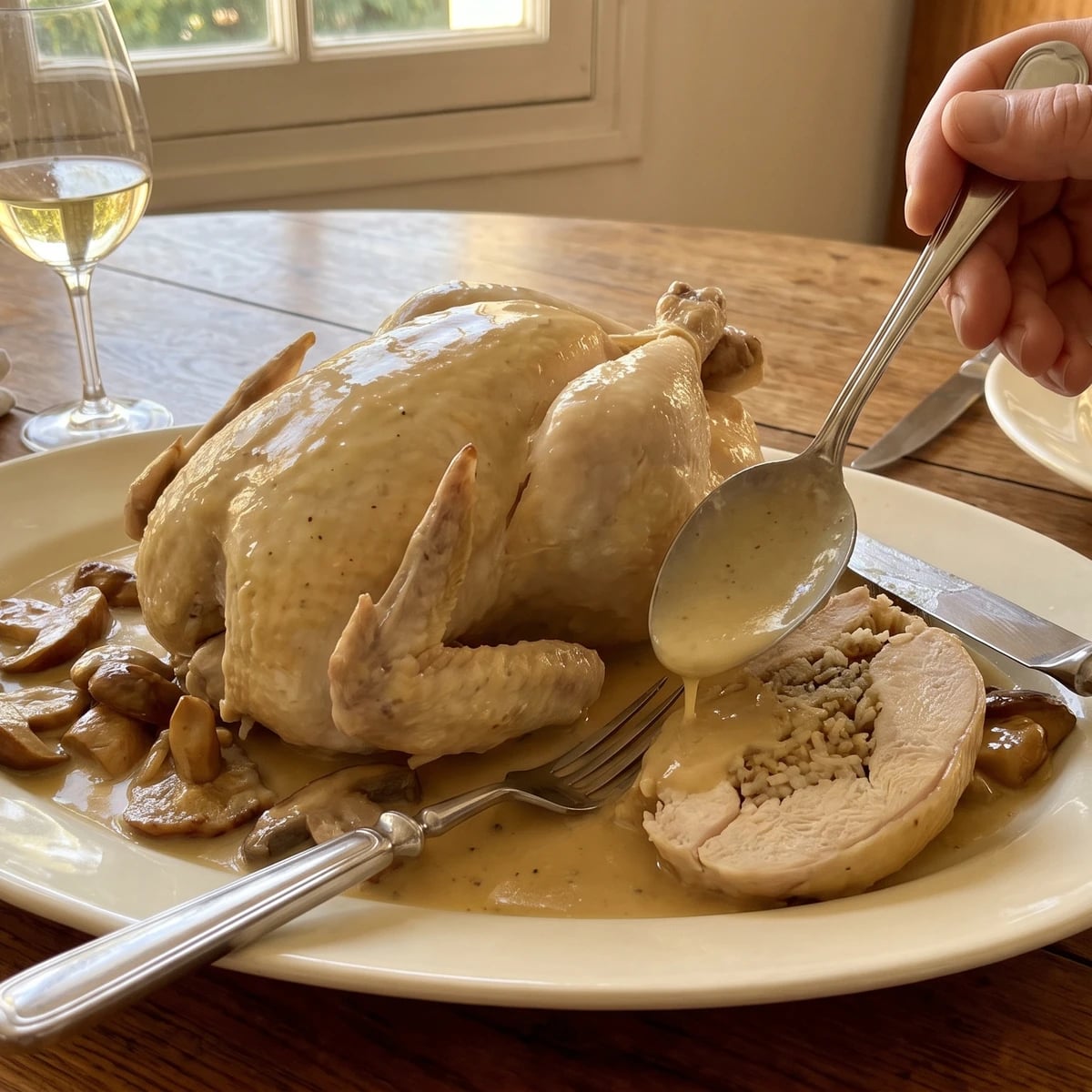
The finished bird arrives under an ivory-gold gloss, with fragrant rice inside and bronze cèpes held in cream beside it. The step that decides everything is the poach. Keep the liquid below a boil and the flesh remains tender while the rice finishes cooking; let it roll and both bird and sauce lose their delicacy.

Poularde Lady Curzon belongs to the cosmopolitan Parisian grand-kitchen repertory, not to any French regional farmhouse table. Its namesake was the American-born wife of the British viceroy in India, and sauce Indienne records a French kitchen's interpretation of curry as it traveled through Anglo-Indian and diplomatic dining. The choice of cèpes or cucumber in cream is telling: service could shift the garnish with the market while the stuffed, poached bird and its curry-scented sauce remained fixed.

The technique, the tradition, and the story behind every dish.

Discover Culinary Explorer

Ingredients

poularde or plump roasting chicken

Quantity

1 (4½ to 5 lb / 2 to 2.25 kg)

giblets removed

prepared Pilaff Rice (for the Stuffing of Fowls)

Quantity

1½ cups (355 ml / 330 g) Pilaff Rice (for the Stuffing of Fowls) (No. 2256)

cooled

fine sea salt

Quantity

2 teaspoons (10 ml / 12 g)

divided

finely ground white pepper

Quantity

1 teaspoon (5 ml / 2 g)

divided

unsalted or low-sodium chicken stock

Quantity

3 quarts (2.8 L / 2.8 kg), plus more if needed

unsalted butter

Quantity

8 tablespoons (120 ml / 113 g)

divided

yellow onion

Quantity

1 small (4 oz / 115 g)

finely chopped

mild curry powder

Quantity

1 tablespoon (15 ml / 7 g)

all-purpose flour

Quantity

¼ cup (60 ml / 30 g)

heavy cream

Quantity

1¼ cups (300 ml / 305 g)

divided

fresh lemon juice

Quantity

1 tablespoon (15 ml / 15 g)

fresh or frozen cèpes (Boletus edulis)

Quantity

4 cups (950 ml / 340 g)

thickly sliced

Equipment Needed

  • 5 to 6 quart (4.7 to 5.7 L) oval cocotte or deep pot that fits the bird snugly
  • Instant-read thermometer
  • Fine-mesh sieve
  • Heavy 3 quart (2.8 L) saucepan
  • Large broad skillet
  • Kitchen string or small poultry skewers

Instructions

  1. 1

    Stuff and truss

    Pat the poularde dry inside and out, without rinsing it. Season the cavity lightly with salt and white pepper, then spoon in the cooled Pilaff Rice (for the Stuffing of Fowls) (No. 2256). Fill the cavity loosely, leaving room for the rice to finish swelling; tamping it down gives you a dense stuffing and slows the heat from reaching its center. Close the opening with small skewers or kitchen string, truss the legs, and season the outside.

    The rice must be cool before it enters the raw bird. Warm stuffing holds the poultry too long in an unsafe temperature range, while tightly packed stuffing cooks unevenly.
  2. 2

    Poach at a tremble

    Choose a pot that leaves no more than about 1 inch (2.5 cm) around the bird. Warm the stock to just below a simmer, lower in the poularde breast-side up, and add enough hot stock to cover it. Bring the liquid back to a bare tremble, cover partly, and poach for 75 to 90 minutes. The tighter the pot, the more the liquor tastes of the bird. Do not let it boil: a rolling liquid tightens the flesh, tears the skin, and clouds the stock. If it does boil, lift the pot off the heat and add a small ladle of cold stock. Ça se rattrape. Return it over gentler heat. The poularde is ready when both the center of the stuffing and the thickest part of the thigh register at least 165°F (74°C).

  3. 3

    Capture the liquor

    Lift the poularde carefully onto a rack set over a tray, keeping it breast-side up. Tent it loosely and let it rest for 20 minutes. Strain the poaching liquor through a fine sieve, skim away excess surface fat, and measure 3 cups (710 ml) into a saucepan. Boil this down to 2½ cups (590 ml). This reduction replaces the brigade's separate poultry velouté: the foundation comes from the same bird, only concentrated enough to hold a sauce.

  4. 4

    Make sauce Indienne

    Melt 4 tablespoons (60 ml / 57 g) of the butter over medium-low heat. Add the onion and cook without coloring until completely soft, 6 to 8 minutes. Stir in the curry powder for 30 seconds, just until fragrant, then add the flour and cook this roux for 2 minutes. Whisk in the hot reduced poaching liquor a little at a time, scraping into the corners, and simmer gently for 12 to 15 minutes. Pass the sauce through a fine sieve, return it to the pan, and add ¾ cup (180 ml / 183 g) of the cream, reserving a spoonful for rescue. Simmer until it reaches nappe, coating the back of a spoon in a smooth veil. Off the heat, whisk in 2 tablespoons (30 ml / 28 g) cold butter and the lemon juice. If the sauce is lumpy, strain it again; if it is too thick, loosen it with hot poaching liquor. If the butter separates into greasy beads, take the pan off the heat and whisk in the reserved cold cream. Ça se rattrape.

  5. 5

    Cream the cèpes

    If using frozen cèpes, thaw and press them dry. Heat the remaining 2 tablespoons (30 ml / 28 g) butter in a broad skillet, add the mushrooms in one layer, and sauté over medium-high heat until their moisture has cooked away and their edges are deeply bronzed. Do this in batches if necessary; crowded cèpes stew and turn grey. Return them all to the pan, add the remaining ½ cup (120 ml / 122 g) cream, and simmer until it clings lightly to the mushrooms. Season with salt and white pepper.

  6. 6

    Coat and serve

    Remove the trussing string and blot the poularde lightly so the sauce will cling. Set it on a warm oval platter and spoon over enough sauce Indienne to coat the bird in a smooth, glossy layer. Arrange the cèpes in cream around it and send the remaining sauce to the table in a warm sauceboat. Carve the poularde at the table, giving each person tender meat, a spoonful of the enriched rice, cèpes, and plenty of sauce. À table!

Chef Tips

  • A true poularde is a young hen raised for especially tender, well-marbled flesh. If your butcher cannot supply one, use a plump roasting chicken of the same weight. Technique first, always; the snug poach matters more than an impressive label.
  • Test the bird against your pot before cooking. A 5 to 6 quart (4.7 to 5.7 L) oval cocotte is usually right. Too wide and you need a lake of stock, which gives you a weaker liquor and more reduction afterward.
  • Fresh cèpes are seasonal and expensive. Frozen cèpes are the classical pantry's honest answer and need no apology; thaw them thoroughly and drive off their water before adding cream.
  • For the source's cucumber alternative, replace the cèpes with 2 medium English cucumbers (about 1½ lb / 680 g). Peel, halve, seed, and cut them into thick batons, salt for 20 minutes, blot dry, then cook gently in butter before adding the cream. The result is paler and fresher, but remains entirely within the original dish.
  • Choose a fragrant mild curry powder, not one built chiefly for heat. Sauce Indienne should smell warmly of spice while still tasting first of poultry, butter, and cream.
  • Pour a dry Alsace Gewurztraminer or a full white Burgundy. Either has enough perfume and body for the curry, cream, foie gras, and truffle carried by the stuffing.

Advance Preparation

  • Prepare the Pilaff Rice (for the Stuffing of Fowls) (No. 2256) through the stage specified in its own entry up to 1 day ahead. Cool it quickly, cover, and refrigerate. Do not stuff the poularde until shortly before poaching.
  • The cèpes can be cleaned and sliced earlier the same day. Keep them covered in the refrigerator and sauté them close to serving so their texture remains distinct.
  • After poaching, the sauce Indienne can be made through the cream reduction up to 2 hours ahead. Cover its surface directly, reheat over gentle heat, then whisk in the final cold butter and lemon juice just before coating the bird.

Frequently Asked Questions

Nutrition Information

1 serving (about 675g)

Calories
1285 calories
Total Fat
89 g
Saturated Fat
43 g
Trans Fat
2 g
Unsaturated Fat
40 g
Cholesterol
385 mg
Sodium
1450 mg
Total Carbohydrates
41 g
Dietary Fiber
3 g
Sugars
6 g
Protein
78 g

Note: Chef personas and recipes are created with AI assistance. Cook with care: follow safe food-handling practices, check doneness with a thermometer when needed, and adapt for allergies and your kitchen.

Where cooking meets culture.

Culinary guides, cultural storytelling, and the editorial depth that makes cooking meaningful.

Discover Culinary Explorer

More from Poultry (Volaille)

Browse the full collection