
Chef Juliette
John Dory (St. Pierre)
John Dory has the delicacy of sole and the firmness of turbot. A light flouring, a quick butter sauté, and nut-brown beurre noisette show exactly why looks never mattered.
A cooking platform built around craft, culture, and the stories behind what we eat.
Created by Chef Juliette
Based on No. 1475, Poularde à la Gastronome, from Le Guide Culinaire (1907) by Auguste Escoffier
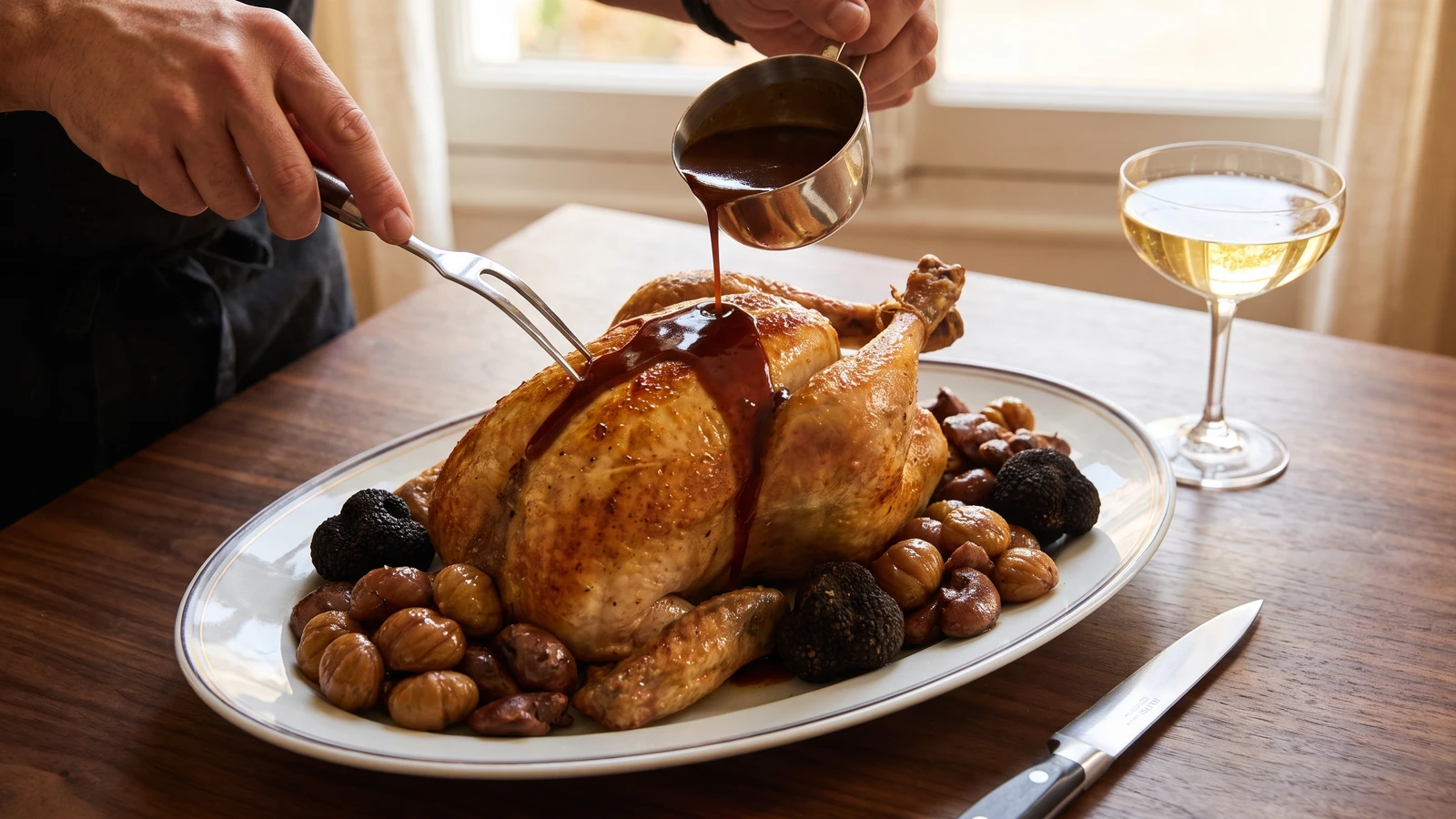
A butter-poêled pullet hides tender noodles, while whole truffles, glazed chestnuts, and cock kidneys circle the platter. The lesson is the sauce: reduce the Champagne deglazing liquor hard before the demi-glace.
Poularde à la Gastronome (a noodle-stuffed pullet butter-cooked with Champagne, truffles, glazed chestnuts, and cock's kidneys) teaches one severe, useful lesson: deglazing liquor is not yet sauce. The bird is poêlé, meaning gently cooked in butter in a covered vessel before browning. Once it comes out, swill the pan with Champagne and reduce that liquor hard before it touches the demi-glace. Join them too soon and you get volume without concentration.
The formula assumed a saucier at the next stove and brown veal stock never off the fire. The same kitchen kept a salamander for finishing, but this formula needs only the uncovered heat specified by Poëlings (No. 250); if the skin still needs colour, your broiler is the honest equivalent. A heavy lidded cocotte and good prepared veal demi-glace replace the always-on infrastructure. One pullet serves four, with four truffles, four chestnut heaps, and four small offal morsels around it. The separate saucier and service choreography are scaffolding. The noodle stuffing, butter-cooking, Champagne reduction, truffles, chestnuts, and measured garnish are the dish, so they stay.
Modern poultry counters rarely carry cock's kidneys, the classical kitchen name here for rooster testicles. Ask a specialist first; if none can be found, four trimmed chicken oysters provide the same mild, tender punctuation around the platter. It isn't an invisible substitution, but it preserves the intent better than strongly flavoured liver. Finished properly, the pullet is butter-gold, the chestnuts gleam, and the truffle-dark sauce waits separately in its boat. Reduce the swilling liquor until nearly syrupy before adding the demi-glace. That is the step that decides whether this tastes concentrated or merely expensive.
Poularde à la Gastronome belongs to the French grand table, particularly the composed poultry repertory codified in Parisian kitchens, rather than to a single regional farmhouse larder. Its Poëlings (No. 250) method preserves an earlier butter-cooking practice while dispensing with the heavy matignon coating, pork fat, and buttered paper once wrapped around large birds; Champagne, truffles, glazed chestnuts, and cock's kidneys then mark the dish as ceremonial. In classical kitchen vocabulary, a cock's kidney is a rooster testicle, not the dark lobed kidney fixed to the backbone, a distinction modern poultry counters have nearly erased.
Quantity
1 (4 to 4½ lb / 1.8 to 2 kg)
giblets removed
Quantity
1 home-scale preparation of Poëlings (No. 250), sized for 1 pullet
Quantity
1½ cups cooked (360 ml / 225 g), from about 4 oz / 115 g dried noodles
Quantity
5 tablespoons (75 ml / 71 g)
divided
Quantity
2 teaspoons (10 ml / 12 g)
divided
Quantity
1 teaspoon (5 ml / 2 g)
divided
Quantity
2 cups plus 1 tablespoon (500 ml / 500 g)
divided
Quantity
4 medium (about 2½ oz / 70 g)
wiped clean if fresh, drained if preserved
Quantity
2 cups (480 ml / 300 g)
Quantity
½ cup (120 ml / 120 g)
Quantity
1 teaspoon (5 ml / 4 g)
Quantity
4 (about 1 oz / 30 g)
membranes removed
Quantity
1 cup (240 ml / 240 g)
Quantity
2 tablespoons (30 ml / 30 g)
made from the reduced truffle-poaching Champagne
| Ingredient | Quantity |
|---|---|
| pullet or small roasting chickengiblets removed | 1 (4 to 4½ lb / 1.8 to 2 kg) |
| Poëlings | 1 home-scale preparation of Poëlings (No. 250), sized for 1 pullet |
| fine egg noodles | 1½ cups cooked (360 ml / 225 g), from about 4 oz / 115 g dried noodles |
| unsalted butterdivided | 5 tablespoons (75 ml / 71 g) |
| fine sea saltdivided | 2 teaspoons (10 ml / 12 g) |
| ground white pepperdivided | 1 teaspoon (5 ml / 2 g) |
| brut Champagnedivided | 2 cups plus 1 tablespoon (500 ml / 500 g) |
| whole black truffleswiped clean if fresh, drained if preserved | 4 medium (about 2½ oz / 70 g) |
| peeled cooked chestnuts | 2 cups (480 ml / 300 g) |
| unsalted chicken stock | ½ cup (120 ml / 120 g) |
| superfine sugar | 1 teaspoon (5 ml / 4 g) |
| cock's kidneys, meaning rooster testicles, or trimmed chicken oystersmembranes removed | 4 (about 1 oz / 30 g) |
| prepared real veal demi-glace | 1 cup (240 ml / 240 g) |
| truffle essencemade from the reduced truffle-poaching Champagne | 2 tablespoons (30 ml / 30 g) |
Heat the oven to 350°F (180°C) with a rack just below the centre. Have the home-scale Poëlings (No. 250) fully prepared before beginning; it is a separate canonical preparation, so this recipe reaches for it whole rather than rebuilding it here. Bring the pullet out of the cold for 30 minutes, wipe the truffles, and warm an oval serving platter and sauceboat.
Cook the noodles until tender but still resilient, then drain them very thoroughly. Toss the hot noodles with 2 tablespoons (30 ml / 28 g) butter, ¼ teaspoon (1 ml / 0.5 g) white pepper, and a small pinch taken from the measured salt. Let them cool until merely warm. Season the pullet inside and out, spoon exactly ½ lb (225 g) noodles loosely into the cavity, and truss the legs. Don't pack the noodles tight. They need room to swell and heat through, while a compressed stuffing slows the bird's cooking.
Set the stuffed pullet into the prepared Poëlings (No. 250) and cook it according to that method, without adding liquid. Begin checking after 1 hour 10 minutes. The finished skin should be evenly butter-gold, while the thickest part of the thigh and the centre of the noodle stuffing both reach 165°F (74°C), usually after 1 hour 20 minutes to 1 hour 35 minutes for this size. If the meat is ready but the stuffing is cool, remove the noodles to a buttered covered dish and finish them in the oven while the bird rests. If the temperatures are correct but the skin remains pale, give it 2 to 3 minutes under the broiler, watching constantly. That is all the professional salamander would have contributed.
While the pullet cooks, place the four truffles in the smallest saucepan that holds them comfortably and add 1½ cups (360 ml / 360 g) Champagne. Cover with a parchment circle and hold at the barest tremble for 12 to 15 minutes if the truffles are fresh, or 4 to 5 minutes if preserved. Lift them out and keep them covered. Reduce the poaching liquor steadily to 2 tablespoons (30 ml / 30 g); this concentrated liquor is the truffle essence required for the sauce. If it becomes too thick, loosen it with a spoonful of the remaining Champagne.
Put the chestnuts in a wide sauté pan with the stock, sugar, 2 tablespoons (30 ml / 28 g) butter, and a pinch of salt. Simmer gently until the stock has nearly disappeared, then roll the pan so the butter coats the chestnuts in a clear glaze. Stirring with a spoon breaks them; move the pan instead. If the glaze catches, add a tablespoon of stock and roll again. In a second small pan, melt the remaining 1 tablespoon (15 ml / 14 g) butter and sauté the cock's kidneys for 3 to 4 minutes, until lightly bronzed and cooked through. Chicken oysters need 5 to 7 minutes and must reach 165°F (74°C). Season lightly and hold both garnishes covered.
Transfer the cooked pullet to a board and rest it loosely covered for 20 minutes. Do not remove the butter from its cooking vessel yet. Pour the remaining ½ cup plus 1 tablespoon (140 ml / 140 g) Champagne directly into the vessel, set it over medium heat, and scrape every savoury trace from the bottom. Simmer the Champagne with the cooking bed and butter for 10 minutes, then strain it and carefully skim away the fat. Return the clear liquor to a small pan and reduce it hard to about 3 tablespoons (45 ml / 45 g), sharp-smelling and nearly syrupy. If it goes too far, pull it from the heat and whisk in a tablespoon of stock. Ça se rattrape. If it remains watery, keep reducing; don't ask the demi-glace to carry dilution.
Warm the veal demi-glace over gentle heat, then add the reduced swilling liquor and the 2 tablespoons (30 ml / 30 g) truffle essence. Simmer only until the sauce is nappé, meaning it coats the back of a spoon in a glossy film. Taste before adding salt, since both demi-glace and reduction concentrate seasoning. If the sauce tightens too far, loosen it with stock one spoonful at a time; if thin, reduce it briefly without the bird or garnishes. Pour it into the warm sauceboat and serve it separately, as the formula requires.
Set the whole poularde on the warm oval platter. Make four small, generous heaps of glazed chestnuts around it and alternate the four Champagne-cooked truffles with those heaps. Place one cock's kidney, or chicken oyster, in each interval between the chestnut heaps, beside a truffle. Leave the burnished skin uncovered by sauce. Carve at the table, serving the buttered noodles from the cavity with each portion and passing the Champagne demi-glace separately. À table!
1 serving (about 470g)
Culinary guides, cultural storytelling, and the editorial depth that makes cooking meaningful.
Discover Culinary ExplorerChef Juliette
John Dory has the delicacy of sole and the firmness of turbot. A light flouring, a quick butter sauté, and nut-brown beurre noisette show exactly why looks never mattered.

Chef Juliette
Fresh haddock proves its delicacy in the meunière pan: a fine flour crust, moist pearly flakes, and beurre noisette sharpened with lemon and parsley, ready from one skillet in half an hour.

Chef Juliette
Éperlans à l’Anglaise turns small fish into a lesson in disciplined coating: boned smelts under a close, crisp crumb, pan-fried in clarified butter and finished with bright, half-melted maître d’hôtel butter.

Chef Juliette
Tiny smelts, shallot, mushrooms, white wine, gratin sauce, and fine bread raspings meet a fierce oven, where the fish must turn tender in the same breath the buttered crust bronzes.