
Chef Juliette
John Dory (St. Pierre)
John Dory has the delicacy of sole and the firmness of turbot. A light flouring, a quick butter sauté, and nut-brown beurre noisette show exactly why looks never mattered.
A cooking platform built around craft, culture, and the stories behind what we eat.
Created by Chef Juliette
Based on No. 1472, Poularde à la Favorite, from Le Guide Culinaire (1907) by Auguste Escoffier
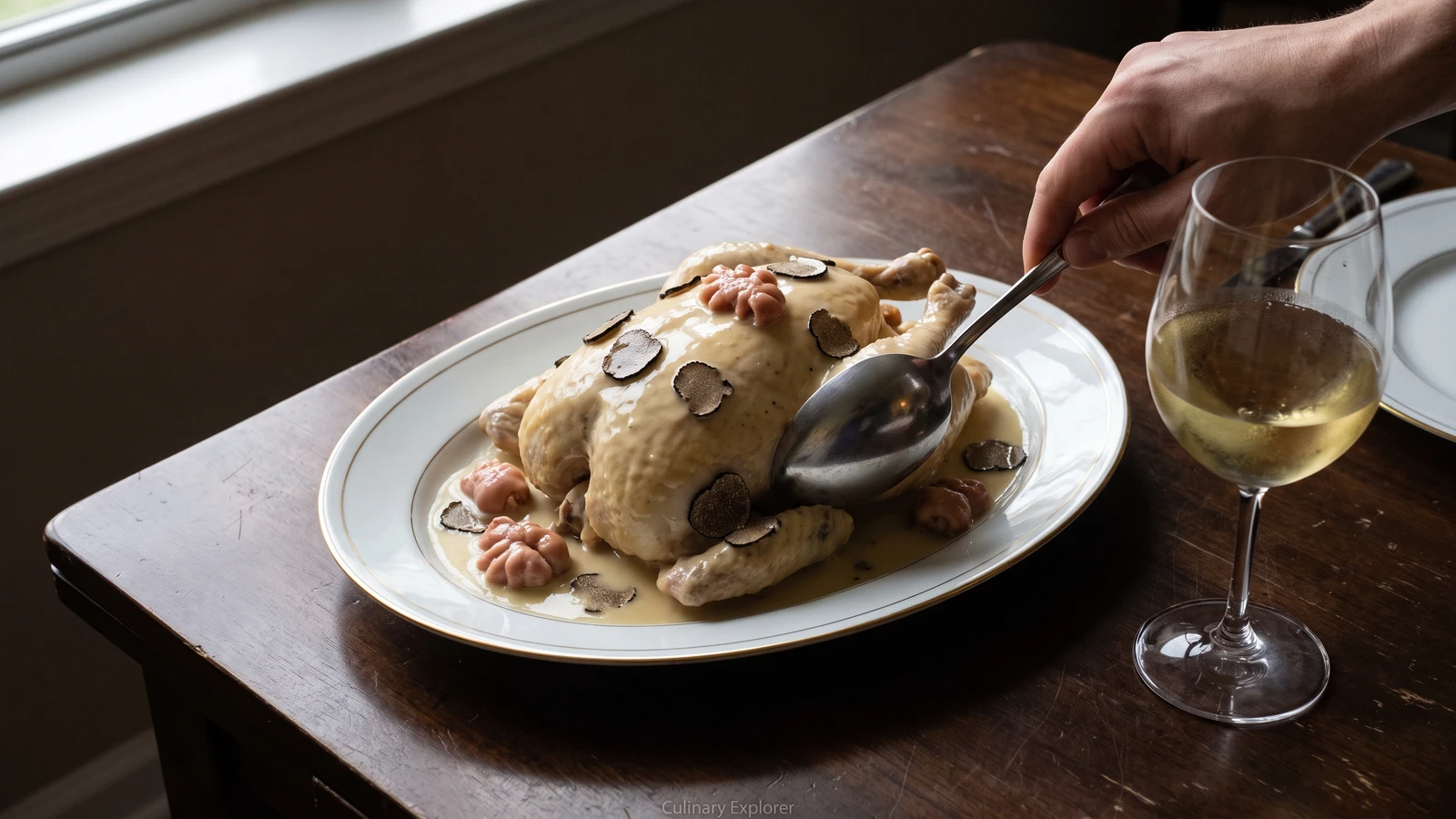
Poularde à la Favorite teaches the discipline of gentle heat: rice-stuffed poultry poached until succulent, sauce suprême kept silken, and its truffled cocks' comb garnish arranged generously around.
Poularde à la Favorite (rice-stuffed poached chicken with sauce suprême and a truffled garnish of cocks' combs and kidneys) teaches gentle heat twice. The bird must poach without tightening, and the cream-enriched sauce must simmer without boiling. That is the one truth to know before touching a pan.
The book's kitchen assumed a saucier on staff, chicken stock never off the fire, and a garnish station where cocks' combs and kidneys arrived cleaned and cooked. Your kitchen gets one narrow stockpot, one saucepan, good unsalted stock made or bought ahead, and prepared specialty poultry garnishes. We cut the brigade scaffolding, the separate stations and laborious cleaning of raw combs. We keep what is the dish: the referenced rice stuffing, the gentle poach, sauce suprême, truffle, and the exact garnish. It never depended on a salamander, so don't bronze its naturally pale skin. One cook, one stove, one evening.
The finished poularde should arrive whole, ivory sauce gleaming over the breast, black truffle against the pale surface, and the little garnishes gathered around like jewels with somewhere useful to be. Guard the bare simmer above everything else. Hard boiling toughens the bird and makes sauce suprême coarse and flat.
Poularde à la Favorite belongs to the Parisian grand-kitchen repertoire, where an à la title identified a composed garnish as precisely as a named sauce. Its identity lies in rice within the bird, sauce suprême over it, and cocks' combs, rognons de coq, and truffle around it, ingredients once kept ready by a dedicated garnish station. It is not a regional farmhouse chicken given a grand name; it is a formal service formula brought honestly to the home table by reducing the brigade, not the garnish.
Quantity
1 bird, about 4½ pounds (2 kg)
neck and giblets removed
Quantity
1 generous cup (240 ml / 225 g) Pilaff Rice (for the Stuffing of Fowls) (No. 2256)
prepared through its three-quarter cooking stage and kept warm, not hot
Quantity
10 cups (2.4 L / 2.4 kg)
Quantity
Up to 2 cups (480 ml / 480 g)
only if needed
Quantity
1 (about 4¼ oz / 120 g)
quartered
Quantity
1 (about 3½ oz / 100 g)
cut into large pieces
Quantity
1 rib (about 1½ oz / 45 g)
cut into large pieces
Quantity
1
Quantity
1 tablespoon (15 ml / 18 g)
divided
Quantity
1 teaspoon (5 ml / 2 g)
divided
Quantity
7 tablespoons (105 ml / 100 g)
divided
Quantity
¼ cup (60 ml / 30 g)
Quantity
1 cup (240 ml / 240 g)
reserve 1 tablespoon cold
Quantity
2 teaspoons (10 ml / 10 g)
Quantity
8 (about 4 oz / 115 g)
fully cleaned and cooked
Quantity
8 (about 3 oz / 85 g)
fully cleaned and cooked
Quantity
1 small truffle (about 1 oz / 28 g)
thinly sliced
| Ingredient | Quantity |
|---|---|
| poulardeneck and giblets removed | 1 bird, about 4½ pounds (2 kg) |
| Pilaff Rice (for the Stuffing of Fowls)prepared through its three-quarter cooking stage and kept warm, not hot | 1 generous cup (240 ml / 225 g) Pilaff Rice (for the Stuffing of Fowls) (No. 2256) |
| unsalted chicken stock | 10 cups (2.4 L / 2.4 kg) |
| water (optional)only if needed | Up to 2 cups (480 ml / 480 g) |
| small onionquartered | 1 (about 4¼ oz / 120 g) |
| medium carrotcut into large pieces | 1 (about 3½ oz / 100 g) |
| celerycut into large pieces | 1 rib (about 1½ oz / 45 g) |
| bouquet garni of parsley stems, thyme, and bay leaf | 1 |
| fine saltdivided | 1 tablespoon (15 ml / 18 g) |
| ground white pepperdivided | 1 teaspoon (5 ml / 2 g) |
| unsalted butterdivided | 7 tablespoons (105 ml / 100 g) |
| all-purpose flour | ¼ cup (60 ml / 30 g) |
| heavy creamreserve 1 tablespoon cold | 1 cup (240 ml / 240 g) |
| fresh lemon juice | 2 teaspoons (10 ml / 10 g) |
| prepared cocks' combsfully cleaned and cooked | 8 (about 4 oz / 115 g) |
| prepared cocks' kidneys, rognons de coqfully cleaned and cooked | 8 (about 3 oz / 85 g) |
| black trufflethinly sliced | 1 small truffle (about 1 oz / 28 g) |
Put the chicken stock, onion, carrot, celery, bouquet garni, half the salt, and half the white pepper into a narrow stockpot large enough to hold the poularde. Bring the liquid just to a simmer, then lower the heat while you prepare the bird. A narrow pot gives you proper depth without demanding the stockpot that never went cold in the old kitchen.
Season the cavity lightly with some of the remaining salt and white pepper. Spoon in the Pilaff Rice (for the Stuffing of Fowls) (No. 2256), prepared only three-quarters cooked as its own formula directs. Fill the cavity loosely, never packing it tight, because the rice must have room to finish cooking and absorb its cream inside the bird. Close the opening with two small skewers and tie the legs together with kitchen string. Stuff only when the poaching liquor is ready, then cook at once.
Lower the poularde breast-side up into the hot stock. The liquid should reach at least three-quarters of the way up the bird; add only as much measured water as needed. Cover the surface with a cartouche, a round of parchment, and leave the pot lid slightly ajar. Hold the liquid between 180 and 185°F (82 and 85°C), where it barely trembles, for 70 to 90 minutes. If the bird is not submerged, turn it carefully after 35 minutes. It is done when both the deepest part of the thigh and the centre of the rice reach 165°F (74°C). If the meat is ready but the rice is cooler, cover and continue gently. Never raise the heat to hurry it. Lift the poularde out, let it drain, and hold it loosely covered on a warm platter while you make the sauce.
Strain 4 cups (960 ml) of the poaching liquor through a fine sieve and skim away surface fat. Melt 3 tablespoons of the butter in a saucepan, stir in the flour, and cook this roux blond, a pale butter-and-flour foundation, for 2 minutes without letting it brown. Add the hot liquor gradually, whisking each addition smooth before the next. Simmer uncovered for 15 to 20 minutes, skimming as needed, until reduced by roughly one-third. Add all but the reserved tablespoon of cream and hold the sauce at the barest simmer for another 10 minutes, until it is nappant, thick enough to coat the back of a spoon in a smooth veil. A hard boil dulls sauce suprême flat. If it becomes lumpy, whisk firmly and strain it; if it catches, pour the clean sauce into a fresh pan without scraping the bottom. If excessive heat makes it look grainy, lift it from the stove and whisk in the reserved cold cream. Ça se rattrape. Off the heat, whisk in 3 more tablespoons of cold butter, one piece at a time, followed by the lemon juice. Taste and adjust the salt and white pepper.
Warm the prepared cocks' combs and rognons de coq in 1 cup (240 ml) of the remaining poaching liquor at a bare simmer for 6 to 8 minutes, then drain them thoroughly. Melt the final tablespoon of butter in a small pan, add the garnishes and ½ cup (120 ml) of sauce suprême, and turn them gently until glazed. Remove the pan from the heat and add the truffle slices for 30 seconds, just long enough to take off their chill without spending their perfume.
Remove the string and skewers, then settle the whole poularde on a warmed oval platter. Spoon sauce suprême over the breast and legs so it coats rather than buries the bird. Arrange the glazed cocks' combs, kidneys, and truffle slices generously around it, then serve the remaining sauce in a warmed sauceboat. Carve at the table and give each person some rice from the cavity, sauce, and a share of the garnish. À table!
1 serving (about 560g)
Culinary guides, cultural storytelling, and the editorial depth that makes cooking meaningful.
Discover Culinary ExplorerChef Juliette
John Dory has the delicacy of sole and the firmness of turbot. A light flouring, a quick butter sauté, and nut-brown beurre noisette show exactly why looks never mattered.

Chef Juliette
Fresh haddock proves its delicacy in the meunière pan: a fine flour crust, moist pearly flakes, and beurre noisette sharpened with lemon and parsley, ready from one skillet in half an hour.

Chef Juliette
Éperlans à l’Anglaise turns small fish into a lesson in disciplined coating: boned smelts under a close, crisp crumb, pan-fried in clarified butter and finished with bright, half-melted maître d’hôtel butter.

Chef Juliette
Tiny smelts, shallot, mushrooms, white wine, gratin sauce, and fine bread raspings meet a fierce oven, where the fish must turn tender in the same breath the buttered crust bronzes.