
Chef Juliette
John Dory (St. Pierre)
John Dory has the delicacy of sole and the firmness of turbot. A light flouring, a quick butter sauté, and nut-brown beurre noisette show exactly why looks never mattered.
A cooking platform built around craft, culture, and the stories behind what we eat.
Created by Chef Juliette
Based on No. 1471, Poularde à l’Estragon, from Le Guide Culinaire (1907) by Auguste Escoffier
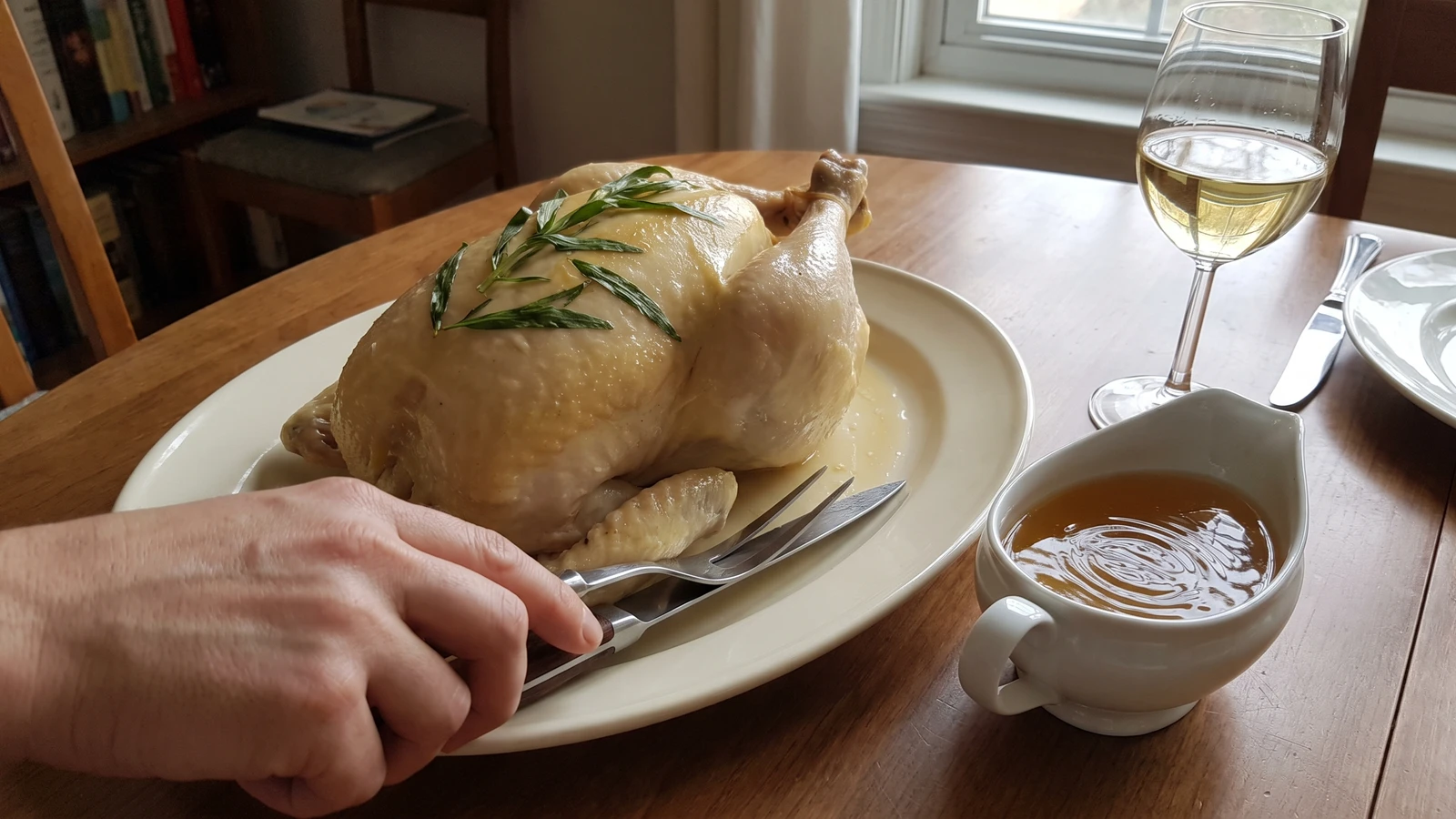
Poularde à l’Estragon asks for quiet heat, not complication: a whole tender bird, herb-green leaves across the breast, and its tarragon-rich cooking liquor reduced to a clear, generous sauce.
Poularde à l’Estragon (young hen poached with tarragon) teaches pocher, gentle cooking in liquid, and the one true thing is simple: poaching is not boiling. The bird must sit in liquor that barely trembles. Get that right and the breast stays succulent while five or six tarragon sprigs perfume the liquor from within; let it gallop and the meat tightens before the sauce has learned anything.
The original assumes a plump poularde, a stockpot never off the fire, a saucier to reduce the cooking liquor, and other hands to dish the bird and ready its tarragon leaves. At home, a 4-pound bird fits a snug stockpot and feeds four, unsalted stock from your freezer or a good carton replaces the perpetual stockpot, and a wide saucepan speeds the reduction so the poularde stays warm. The separate stations were brigade scaffolding and can go. The barely trembling poach, the bunch of tarragon in the liquor, the blanched spray across the breast, and the reduced liquor served separately are the dish and must stay. One cook, one stove, one evening.
At the table, the skin is pale and supple, the breast wears its green tarragon spray, and the clear sauce tastes concentrated without heaviness. Watch the liquid, not the clock. Holding it just below a simmer is the step that decides the whole dish.
Poularde à l’Estragon belongs to cuisine bourgeoise, prosperous French household cooking, and to the grand Parisian service table, where a fine fattened hen was poached whole and presented intact rather than cut into a fricassée, a pale stew. Tarragon’s anise brightness made it a favored partner for poultry, while reducing the poaching liquor produced a clear sauce without roux or cream. The blanched leaves across the breast were not mere ornament: they announced the same herb that had perfumed the bird from within.
Quantity
1 bird (4 to 4½ lb / 1.8 to 2 kg)
giblets removed
Quantity
6 cups (1.4 L / 1.4 kg)
Quantity
2 to 4 cups (475 to 950 ml / 475 to 950 g)
as needed to cover
Quantity
1 medium (about 1 cup / 150 g)
peeled and quartered
Quantity
1 medium (about ¾ cup / 100 g)
scrubbed and thickly sliced
Quantity
1 small (about 1 cup / 100 g)
rinsed and thickly sliced
Quantity
6
Quantity
1
Quantity
8
Quantity
5 to 6 sturdy sprigs (about ⅓ cup / 10 g)
tied into a bunch
Quantity
1 small spray (6 to 8 tarragon leaves) Blanchings (No. 273)
prepared from fresh tarragon
Quantity
½ teaspoon (2.5 ml / 3 g), plus more only after reduction
| Ingredient | Quantity |
|---|---|
| whole poularde or plump young chickengiblets removed | 1 bird (4 to 4½ lb / 1.8 to 2 kg) |
| unsalted chicken stock | 6 cups (1.4 L / 1.4 kg) |
| cold wateras needed to cover | 2 to 4 cups (475 to 950 ml / 475 to 950 g) |
| yellow onionpeeled and quartered | 1 medium (about 1 cup / 150 g) |
| carrotscrubbed and thickly sliced | 1 medium (about ¾ cup / 100 g) |
| leek, white and pale green partsrinsed and thickly sliced | 1 small (about 1 cup / 100 g) |
| parsley stems | 6 |
| bay leaf | 1 |
| black peppercorns | 8 |
| fresh tarragontied into a bunch | 5 to 6 sturdy sprigs (about ⅓ cup / 10 g) |
| Blanchingsprepared from fresh tarragon | 1 small spray (6 to 8 tarragon leaves) Blanchings (No. 273) |
| fine sea salt | ½ teaspoon (2.5 ml / 3 g), plus more only after reduction |
Remove any giblets and stray feathers, then pat the poularde dry. Do not soak or pre-blanch it; good poultry goes directly into cold stock so its full savor remains in the meat and cooking liquor. Season the cavity and skin with the measured salt, tuck the wing tips underneath, and tie the legs together without cinching the breast tightly.
Scatter the onion, carrot, leek, parsley stems, bay leaf, and peppercorns through a snug stockpot. Set the poularde breast-side up over this ordinary poaching garnish, add the unsalted stock, and pour in only enough cold water to cover the bird by about 1 inch. Submerge the tied bunch of five or six tarragon sprigs. If the bird floats, hold it beneath the surface with a small heatproof plate.
Bring the liquor up gradually over medium-low heat, skimming away the pale foam as it gathers. Once the liquid reaches 176 to 185°F (80 to 85°C), lower the heat and keep it there for 45 to 55 minutes; the surface should quiver with only an occasional lazy bubble. If it breaks into a boil, lift the pot from the burner at once. Ça se rattrape: wait until the bubbling stops, return it over the lowest heat, and continue gently. Turn the bird once if part of the breast remains exposed. It is ready when the thickest part of the thigh reaches 165°F (74°C) and the breast reaches 155 to 160°F (68 to 71°C).
Lift the poularde carefully, tip it over the pot so the cavity drains, and settle it breast-side up on a warmed oval platter. Remove the string and cover the bird loosely while it rests. Decorate the breast with the Blanchings (No. 273), arranging the leaves as one simple spray rather than scattering them. The garnish names the flavor already carried through the meat and liquor.
Skim excess fat from the cooking liquor, leaving a few golden eyes for flavor and sheen. Transfer the liquor with its tarragon and ordinary garnish to the widest saucepan you own, then boil it briskly until reduced to about 1½ cups (350 ml), usually 25 to 35 minutes. Only then strain it through a fine sieve. Taste after reduction, never before: if it is too strong or salty, loosen it with unsalted stock or water; if it tastes thin, return it to the pan for several minutes. Ça se rattrape. The finished sauce should be clear, amber, and concentrated, not thick or syrupy.
Warm a sauceboat with hot water, dry it, and fill it with the reduced tarragon liquor. Bring the poularde to the table whole, carve it there, and pass the sauce separately so each serving receives plenty. Pommes vapeur or plain rice will catch every spoonful without arguing with the tarragon. À table!
1 serving (about 275g)
Culinary guides, cultural storytelling, and the editorial depth that makes cooking meaningful.
Discover Culinary ExplorerChef Juliette
John Dory has the delicacy of sole and the firmness of turbot. A light flouring, a quick butter sauté, and nut-brown beurre noisette show exactly why looks never mattered.

Chef Juliette
Fresh haddock proves its delicacy in the meunière pan: a fine flour crust, moist pearly flakes, and beurre noisette sharpened with lemon and parsley, ready from one skillet in half an hour.

Chef Juliette
Éperlans à l’Anglaise turns small fish into a lesson in disciplined coating: boned smelts under a close, crisp crumb, pan-fried in clarified butter and finished with bright, half-melted maître d’hôtel butter.

Chef Juliette
Tiny smelts, shallot, mushrooms, white wine, gratin sauce, and fine bread raspings meet a fierce oven, where the fish must turn tender in the same breath the buttered crust bronzes.