
Chef Juliette
John Dory (St. Pierre)
John Dory has the delicacy of sole and the firmness of turbot. A light flouring, a quick butter sauté, and nut-brown beurre noisette show exactly why looks never mattered.
A cooking platform built around craft, culture, and the stories behind what we eat.
Created by Chef Juliette
Based on No. 1469, Poularde Édouard VII, from Le Guide Culinaire (1907) by Auguste Escoffier
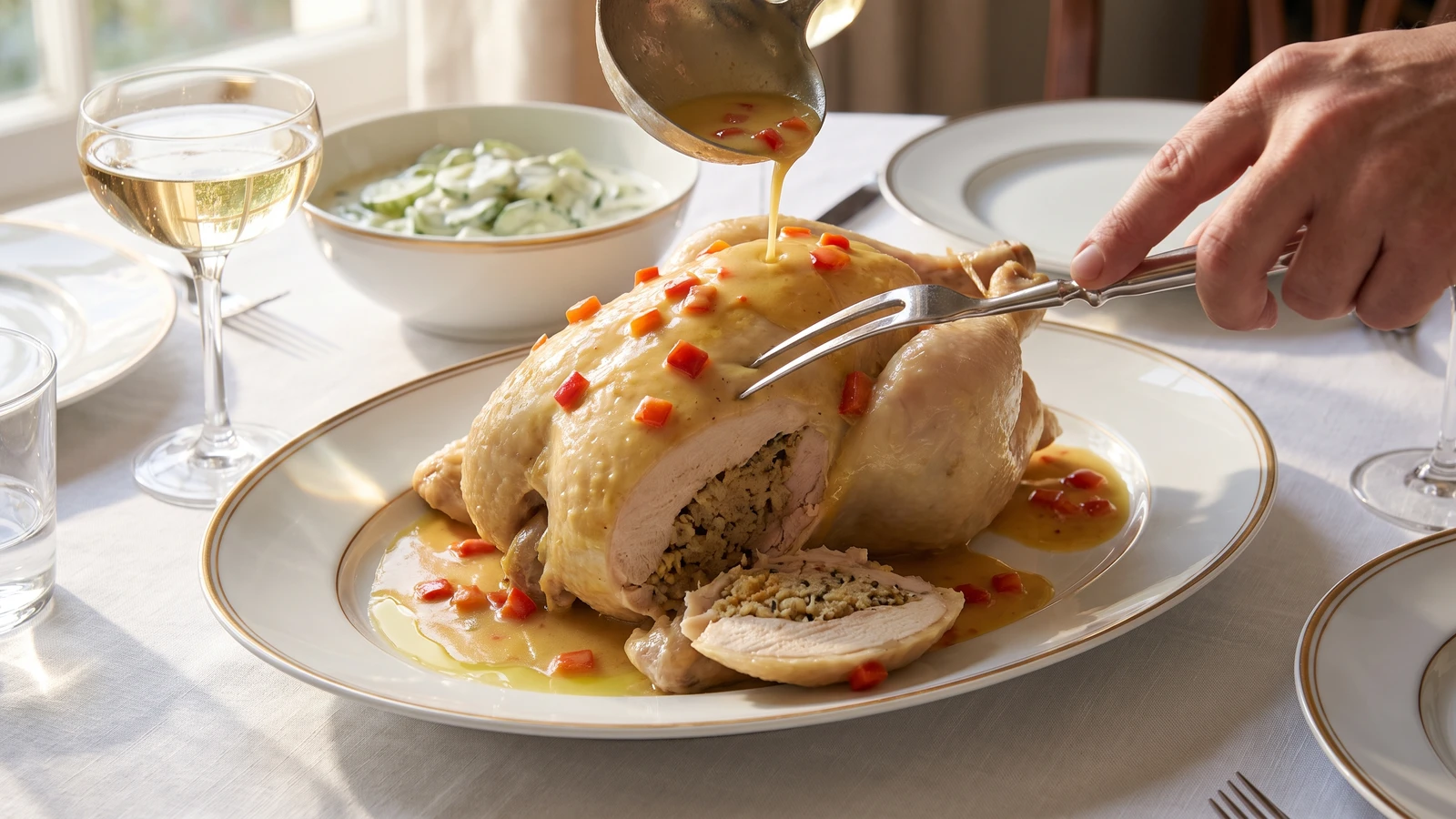
A pale-poached poularde carrying enriched pilaff rice, lacquered with glossy curry sauce and ruby capsicum, with creamed cucumbers beside it: grand-hotel ceremony translated for one cook and four hungry guests.
Poularde Édouard VII (a plump hen stuffed with pilaff rice, gently poached, and coated in curry sauce) teaches a disciplined contrast: the bird stays pale and tender while the sauce carries the colour and spice. One true thing matters before you touch a pan. Curry powder must meet warm butter before it meets stock. Stir it raw into a velouté, the roux-thickened stock sauce, and it tastes of dust; bloom it gently and its fragrance rounds into the cream.
The hotel kitchen assumed Pilaff Rice (for the Stuffing of Fowls) (No. 2256) already waiting, a saucier on staff, a white stock never off the fire, and enough hands to poach the bird while another cook finished the cucumbers. A salamander stood ready for browned finishes, but this poularde never went beneath it because colouration would betray the dish. At home, one snug stockpot provides both the poach and the sauce liquor, a thermometer replaces the brigade's practiced thumb, and the quantities come down to one bird for four with one imperial pint of sauce, preserving the book's two ounces of capsicum per pint. Holding pans and divided labour are scaffolding, so they go. The referenced rice, pale poach, butter-bloomed curry, exact capsicum ratio, and separate creamed cucumbers stay. They are the dish. One cook, one stove, one evening.
At the table, the ivory sauce gleams against the pale bird, ruby capsicum runs through it, and each carved slice brings its rice filling with it. The cucumbers arrive separately, soft but still themselves beneath their cream. Watch the curry as it blooms in the butter: fragrant and golden is right, dark and bitter is too far.
Poularde Édouard VII belongs not to a French region but to the French grand-hotel repertoire of London, where the Carlton Hotel created it for King Edward VII's coronation. Its curry and red capsicum suited the British ceremonial table for which it was composed, while the pale poaching, enriched pilaff, built sauce, and separately served cucumber garnish follow French brigade grammar. It entered the classical canon as a named hotel creation, not as a farmhouse or provincial dish.
Quantity
1 (about 4 to 4½ lb / 1.8 to 2 kg)
neck and giblets removed
Quantity
1½ cups (355 ml / 300 g) Pilaff Rice (for the Stuffing of Fowls) (No. 2256)
prepared through its three-quarters-cooked stage and chilled
Quantity
3 quarts (2.85 L / 2.85 kg)
Quantity
Up to 2 cups (475 ml / 475 g)
only if needed to cover the poularde
Quantity
1 medium (about 6 oz / 170 g)
quartered
Quantity
1 large (about 4 oz / 115 g)
cut into chunks
Quantity
1 stalk (about 2 oz / 55 g)
cut into chunks
Quantity
1
Quantity
4 sprigs
Quantity
6 tablespoons (90 ml / 85 g)
divided
Quantity
1 tablespoon (15 ml / 18 g)
divided
Quantity
1 teaspoon (5 ml / 2 g)
divided
Quantity
1 small (about 1 oz / 30 g)
finely minced
Quantity
1 tablespoon (15 ml / 7 g)
Quantity
¼ cup (60 ml / 30 g)
Quantity
1¼ cups (300 ml / 300 g)
divided
Quantity
2 teaspoons (10 ml / 10 g)
Quantity
⅓ cup (80 ml / 57 g)
thoroughly drained and cut into ¼-inch dice
Quantity
2 medium (about 1¼ lb / 570 g total)
peeled, halved lengthwise, seeded, and cut into ½-inch slices
| Ingredient | Quantity |
|---|---|
| small poularde or plump roasting chickenneck and giblets removed | 1 (about 4 to 4½ lb / 1.8 to 2 kg) |
| Pilaff Rice (for the Stuffing of Fowls)prepared through its three-quarters-cooked stage and chilled | 1½ cups (355 ml / 300 g) Pilaff Rice (for the Stuffing of Fowls) (No. 2256) |
| unsalted or low-sodium chicken stock | 3 quarts (2.85 L / 2.85 kg) |
| water (optional)only if needed to cover the poularde | Up to 2 cups (475 ml / 475 g) |
| yellow onionquartered | 1 medium (about 6 oz / 170 g) |
| carrotcut into chunks | 1 large (about 4 oz / 115 g) |
| celerycut into chunks | 1 stalk (about 2 oz / 55 g) |
| bay leaf | 1 |
| thyme | 4 sprigs |
| unsalted butterdivided | 6 tablespoons (90 ml / 85 g) |
| fine sea saltdivided | 1 tablespoon (15 ml / 18 g) |
| ground white pepperdivided | 1 teaspoon (5 ml / 2 g) |
| shallotfinely minced | 1 small (about 1 oz / 30 g) |
| mild curry powder | 1 tablespoon (15 ml / 7 g) |
| plain flour | ¼ cup (60 ml / 30 g) |
| heavy creamdivided | 1¼ cups (300 ml / 300 g) |
| fresh lemon juice | 2 teaspoons (10 ml / 10 g) |
| plain roasted red capsicumthoroughly drained and cut into ¼-inch dice | ⅓ cup (80 ml / 57 g) |
| English cucumberspeeled, halved lengthwise, seeded, and cut into ½-inch slices | 2 medium (about 1¼ lb / 570 g total) |
Have the Pilaff Rice (for the Stuffing of Fowls) (No. 2256) prepared through the three-quarters-cooked stage specified in its own entry and thoroughly chilled. Keep it cold until the moment of stuffing. This preparation remains a finished component, just as it did in the brigade kitchen, so do not rework or fully cook it here; it completes its cooking inside the poularde.
Dry the poularde inside and out, then season the cavity and skin with about 1 teaspoon of the salt and half the white pepper. Spoon in the Pilaff Rice (for the Stuffing of Fowls) (No. 2256) loosely, leaving room for the grains to swell. Never ram the cavity full. Fold the neck skin underneath, tie the legs together, and secure the wings close to the body with kitchen twine. Stuff immediately before cooking, never hours ahead, because warm poultry and rice must move directly to the pot.
Combine the chicken stock, onion, carrot, celery, bay leaf, and thyme in a snug stockpot. Bring them to a bare simmer for 10 minutes, then lower in the stuffed poularde, breast upward. The liquid should just cover it; add only as much of the measured water as necessary. Return the liquid slowly to 180 to 185°F (82 to 85°C), where the surface barely quivers, then cover partially and poach for 65 to 80 minutes. The centre of the rice must reach at least 165°F (74°C), and the deepest part of the thigh should reach 170°F (77°C) without the thermometer touching bone. If the liquid breaks into a boil, lift the pot off the heat and add a few spoonfuls of the water. Ça se rattrape. Let the temperature settle before returning the pot to low heat.
During the final 25 minutes of poaching, toss the cucumbers with 1 teaspoon of the salt and leave them in a colander for 15 minutes. Blot them thoroughly. Melt 2 tablespoons of the butter in a wide sauté pan, add the cucumbers, and cook over medium-low heat for about 5 minutes without browning. Add all but 2 tablespoons of the ¾ cup cream allocated to the cucumbers, season lightly with white pepper, and simmer gently until the cucumber is tender but still holds its shape and the cream clings to it, 6 to 8 minutes. If the cucumber releases enough water to thin the cream, lift out the pieces and reduce the liquid before returning them. If the cream looks greasy, remove the pan from the heat and stir in the reserved cold cream. Hold the garnish warm, separately.
Lift the cooked poularde onto a rack set over a warm platter and tent it loosely for 20 minutes. Strain the poaching liquor through a fine sieve and skim away surface fat. Measure 2¾ cups (650 ml / 650 g) of the liquor for the sauce, keeping another cup nearby for adjustments. The rest makes excellent soup, but it is no longer needed for this dish.
Melt the remaining 4 tablespoons of butter in a saucepan over medium-low heat. Add the shallot and cook until soft but completely pale, about 3 minutes. Stir in the curry powder and cook for 45 to 60 seconds, just until the butter smells rounded and fragrant. Do not let it darken. Add the flour and stir for 2 minutes to make a pale roux, then whisk in the measured poaching liquor a little at a time. Bring the velouté to a gentle simmer and cook for 8 to 10 minutes, whisking often, until the raw flour taste is gone. If it knots, take it off the heat, whisk vigorously, and pass it through the sieve. Do not pour it away. Ça se rattrape.
Pass the velouté through a fine sieve into a clean saucepan, then stir in the remaining ½ cup cream and the lemon juice. Simmer gently until the sauce is nappant, thick enough to coat the back of a spoon. Pour it into a heatproof measuring jug and check the volume. The finished sauce must measure 2⅜ cups (1 imperial pint / 570 ml); if there is more, reduce it further, and if there is less, loosen it with reserved poaching liquor. Fold in exactly ⅓ cup (80 ml / 57 g) of diced red capsicum, preserving the source ratio of two ounces per pint. Warm it for 1 minute without boiling, then correct the salt and white pepper.
Remove the twine and set the whole poularde on a warmed oval platter, breast upward. Spoon enough curry sauce over it to coat the bird generously, letting a little pool around the base, and send the remainder in a warm sauce boat. Bring the creamed cucumbers in their own serving dish, exactly as the original directs. Present the poularde whole, then carve it at the table and give each guest breast or leg meat, a spoonful of the rice stuffing, more sauce, and cucumbers alongside. À table!
1 serving (about 610g)
Culinary guides, cultural storytelling, and the editorial depth that makes cooking meaningful.
Discover Culinary ExplorerChef Juliette
John Dory has the delicacy of sole and the firmness of turbot. A light flouring, a quick butter sauté, and nut-brown beurre noisette show exactly why looks never mattered.

Chef Juliette
Fresh haddock proves its delicacy in the meunière pan: a fine flour crust, moist pearly flakes, and beurre noisette sharpened with lemon and parsley, ready from one skillet in half an hour.

Chef Juliette
Éperlans à l’Anglaise turns small fish into a lesson in disciplined coating: boned smelts under a close, crisp crumb, pan-fried in clarified butter and finished with bright, half-melted maître d’hôtel butter.

Chef Juliette
Tiny smelts, shallot, mushrooms, white wine, gratin sauce, and fine bread raspings meet a fierce oven, where the fish must turn tender in the same breath the buttered crust bronzes.