
Chef Juliette
John Dory (St. Pierre)
John Dory has the delicacy of sole and the firmness of turbot. A light flouring, a quick butter sauté, and nut-brown beurre noisette show exactly why looks never mattered.
A cooking platform built around craft, culture, and the stories behind what we eat.
Created by Chef Juliette
Based on No. 1464, Poularde Demidoff, from Le Guide Culinaire (1907) by Auguste Escoffier
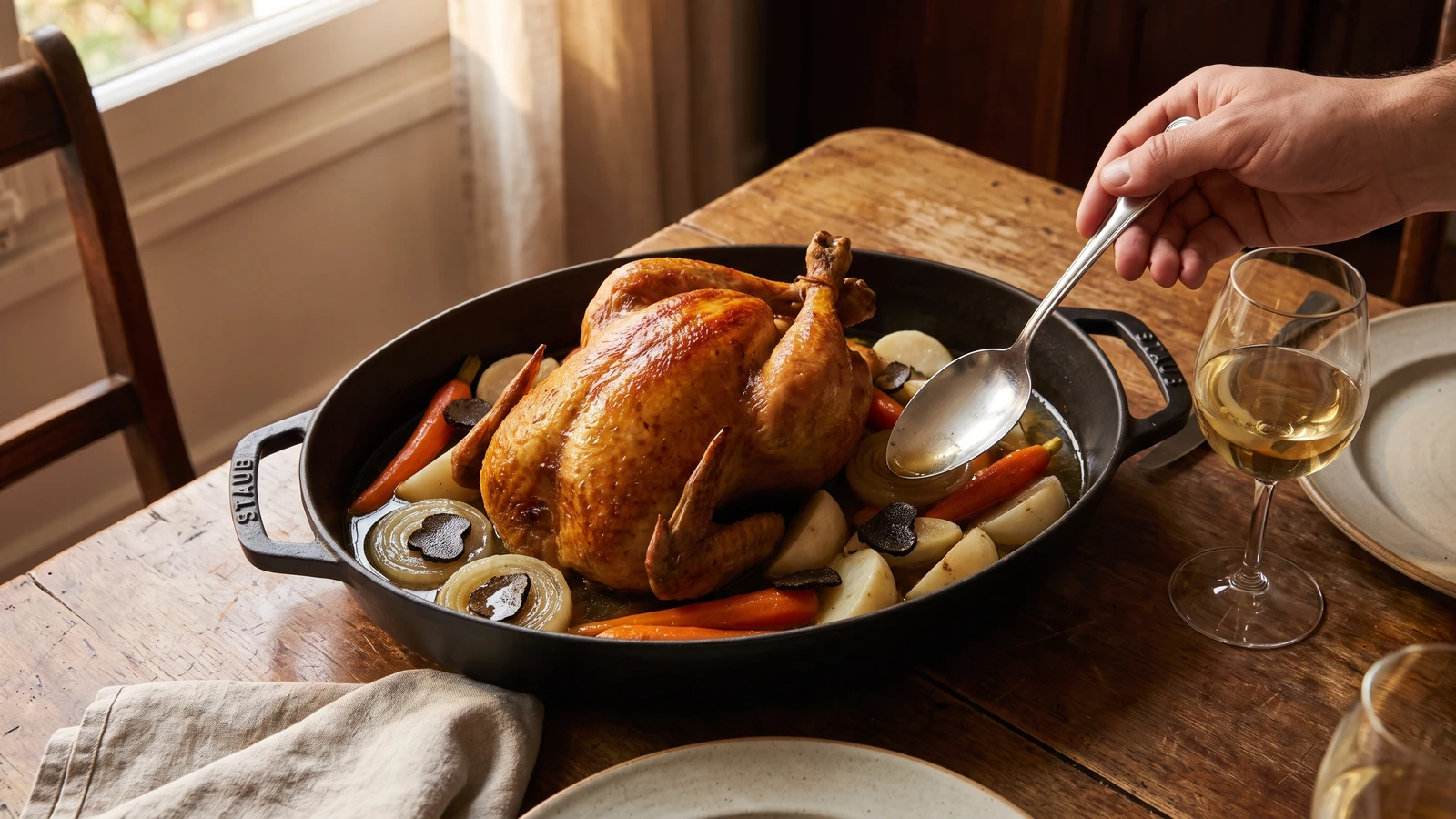
Poularde Demidoff makes poêlé clear: a butter-cooked pullet finished over crescent vegetables, then joined by black truffle and a little chicken stock, all brought to the table in its cocotte.
Poularde Demidoff (a butter-cooked pullet with crescent vegetables and black truffle) teaches the boundary between poêlé and braising. In poêlé, the bird cooks almost entirely in butter and its own juices; the stock enters only when the cooking is over. Add it early and the flesh may still be tender, but the concentrated savor this technique protects has changed.
The original formula assumed Poëlings (No. 250) already understood, a saucier beside a stockpot never off the fire, hands to groove every root, and a second cocotte for serving. It assumed no salamander, because nothing here is glazed or gratinéed. At home, one heavy cocotte can handle the cooking and the table, a small measure of gelatin-rich stock replaces the perpetual pot, and a paring knife makes the crescents. Moving the bird between identical vessels is brigade scaffolding and can go. The butter cooking, separately stewed garnish, late stock, and final degreasing are the dish and stay.
The source ratios already give a generous garnish for a pullet serving four, so they remain intact: carrots, turnips, onion, celery, and the full truffle finish. One cook, one stove, one evening. Before you touch the pan, remember the deciding step: no stock until the bird is done.
Poularde Demidoff belongs to the cosmopolitan grand cuisine of Parisian and aristocratic tables, where French cooks often named preparations for prominent patrons; Demidoff is the French spelling of the Russian Demidov name. Its title is Russian, but its grammar is entirely French: poêlé poultry, an en cocotte finish, formally cut vegetables, black truffles, and a carefully degreased jus. It entered the classical repertory as a named preparation rather than a regional specialty, so it should not be dressed with the flavors of Burgundy, Normandy, or Provence.
Quantity
1, from a whole 3½ to 4 lb (1.6 to 1.8 kg) pullet, prepared by Poëlings (No. 250)
Quantity
1¾ cups (415 ml / 225 g)
peeled and cut into grooved crescents
Quantity
1 cup (240 ml / 140 g)
peeled and cut into grooved crescents
Quantity
1¼ cups (300 ml / 140 g)
peeled and cut into thin roundels
Quantity
1¼ cups (300 ml / 140 g)
strings removed and evenly sliced
Quantity
6 tablespoons (90 ml / 85 g)
Quantity
1½ teaspoons (7.5 ml / 9 g)
divided
Quantity
½ teaspoon (2.5 ml / 1 g)
Quantity
½ cup (120 ml / 85 g)
brushed clean or drained, then cut into thin crescents
Quantity
⅓ cup plus 1 tablespoon (95 ml / 95 g)
| Ingredient | Quantity |
|---|---|
| three-quarters-cooked poëled pullet | 1, from a whole 3½ to 4 lb (1.6 to 1.8 kg) pullet, prepared by Poëlings (No. 250) |
| carrotspeeled and cut into grooved crescents | 1¾ cups (415 ml / 225 g) |
| turnipspeeled and cut into grooved crescents | 1 cup (240 ml / 140 g) |
| small onionspeeled and cut into thin roundels | 1¼ cups (300 ml / 140 g) |
| celery stalksstrings removed and evenly sliced | 1¼ cups (300 ml / 140 g) |
| unsalted butter | 6 tablespoons (90 ml / 85 g) |
| fine sea saltdivided | 1½ teaspoons (7.5 ml / 9 g) |
| freshly ground black pepper | ½ teaspoon (2.5 ml / 1 g) |
| fresh black truffles or whole preserved black trufflesbrushed clean or drained, then cut into thin crescents | ½ cup (120 ml / 85 g) |
| unsalted, gelatin-rich chicken stock | ⅓ cup plus 1 tablespoon (95 ml / 95 g) |
Cut the carrots and turnips into cylinders about 1 inch (2.5 cm) across. With a channel knife, or the tip of a small paring knife, score five or six shallow grooves down each cylinder; halve them lengthwise, then slice them ¼ inch (6 mm) thick to make fluted crescents. Cut the onions across into thin roundels and slice the celery evenly. Perfect carving belonged to the brigade. Even thickness is what matters at home, because every piece must become tender at the same moment.
Étuver means to stew gently in butter. Melt the butter in the cocotte over medium-low heat, then add the carrots, turnips, celery, 1 teaspoon of the salt, and the pepper. Turn everything through the butter, cover, and cook for 6 minutes without coloring. Add the onion roundels and continue covered for 6 to 8 minutes, until the vegetables are about half tender and shining with butter. If their edges begin to brown, lower the heat and add a spoonful of water; let that water evaporate before proceeding. Transfer the vegetables and every drop of their butter to a bowl.
In the same cocotte, prepare the pullet according to Poëlings (No. 250), stopping after its covered butter-cooking stage when the bird is three-quarters done. Do not perform the reference preparation's final stock work, because Poularde Demidoff receives its measured stock only at the finish. For a pullet of this size, begin checking after about 45 minutes: the skin should be set and lightly bronzed, with the breast near 140 to 145°F (60 to 63°C) and the thigh near 150 to 155°F (66 to 68°C). Continue directly to the next step. Partially cooked poultry is never a make-ahead stage.
Arrange the butter-stewed vegetables around the pullet rather than over its skin. Return the uncovered cocotte to a 350°F (180°C) oven and cook for 20 to 30 minutes, basting the bird once with the buttery juices, until the thickest part of the breast reaches 165°F (74°C) and the thigh reaches at least 170°F (77°C). Add no stock yet. If the bird finishes before the roots, lift it out to rest and cover the cocotte until they are tender; if the roots soften first, remove them with a slotted spoon and return them later. Ça se rattrape.
Lift the pullet onto a warm plate and rest it loosely covered for 10 to 15 minutes. Cut the truffles into thin crescents and add them to the cocotte with the chicken stock and remaining salt. Set the cocotte over medium-low heat and simmer gently for 10 minutes, turning the vegetables once and scraping the roasting glaze from the bottom without crushing the garnish. This contact lets the stock recover the aromas held in the butter. If the liquor remains watery, lift out the vegetables and reduce it alone for a minute or two until it lightly coats a spoon, then return them.
Let the cocotte stand for half a minute, tilt it slightly, and skim away the clear fat gathered on the surface. If small droplets refuse to collect, touch them lightly with the corner of a folded paper towel. The jus should gleam without wearing a cap of grease, while the vegetables retain their buttery sheen. Return the pullet to the center, arrange the vegetables and truffle crescents around it, and spoon over a little jus without drowning the bronzed skin. Bring the cocotte straight to the table and carve there. À table!
1 serving (about 400g)
Culinary guides, cultural storytelling, and the editorial depth that makes cooking meaningful.
Discover Culinary ExplorerChef Juliette
John Dory has the delicacy of sole and the firmness of turbot. A light flouring, a quick butter sauté, and nut-brown beurre noisette show exactly why looks never mattered.

Chef Juliette
Fresh haddock proves its delicacy in the meunière pan: a fine flour crust, moist pearly flakes, and beurre noisette sharpened with lemon and parsley, ready from one skillet in half an hour.

Chef Juliette
Éperlans à l’Anglaise turns small fish into a lesson in disciplined coating: boned smelts under a close, crisp crumb, pan-fried in clarified butter and finished with bright, half-melted maître d’hôtel butter.

Chef Juliette
Tiny smelts, shallot, mushrooms, white wine, gratin sauce, and fine bread raspings meet a fierce oven, where the fish must turn tender in the same breath the buttered crust bronzes.