
Chef Juliette
Pullets and Capons for Relevés
Three roads through the Paris poultry canon, poach, poêler, or braise, with one rule beneath them all: protect the breast with bacon while the legs cook, then turn the liquor into sauce.
A cooking platform built around craft, culture, and the stories behind what we eat.
Created by Chef Juliette
Based on No. 1462, Poularde Cussy, from Le Guide Culinaire (1907) by Auguste Escoffier
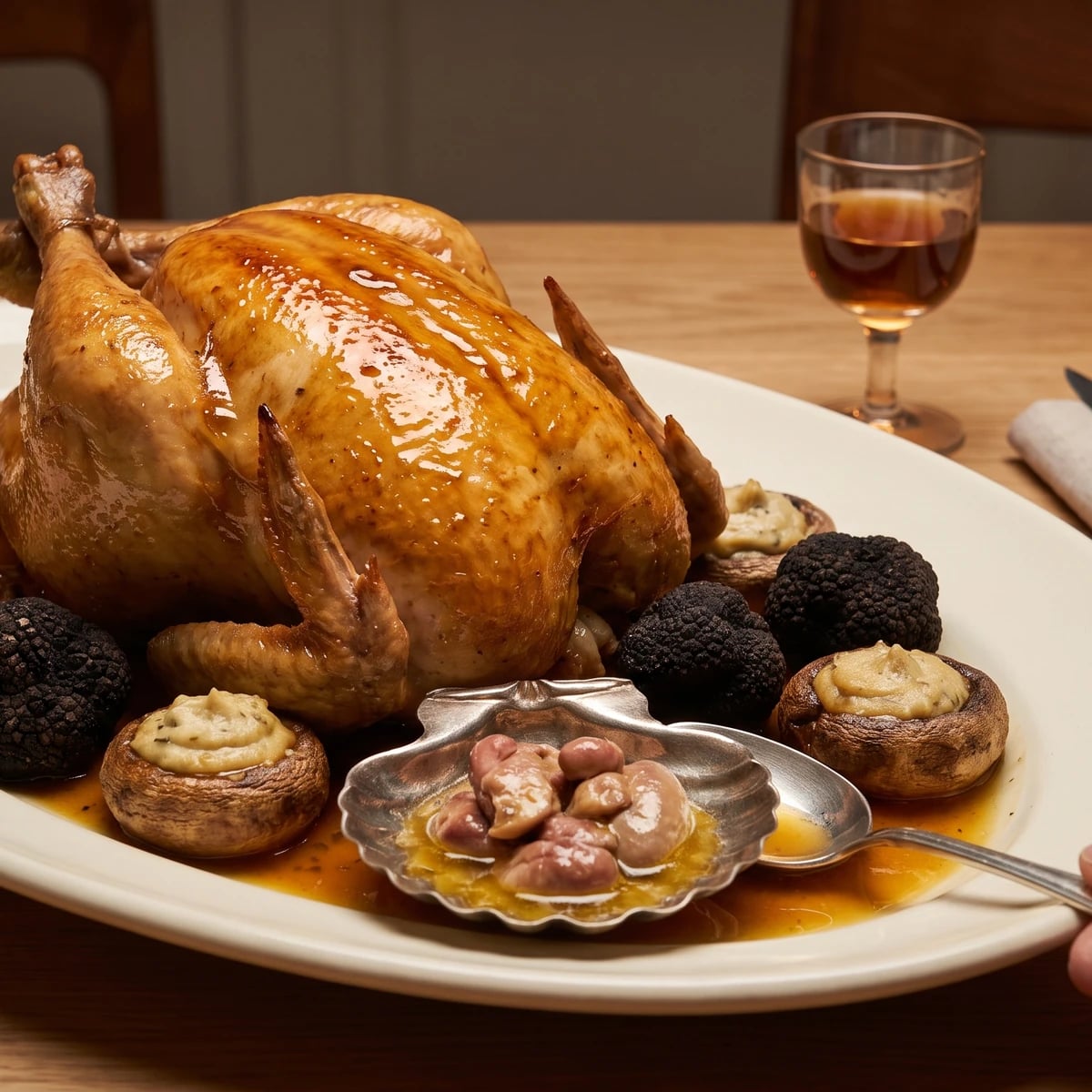
Poularde Cussy turns one careful braise into a celebration: burnished poultry, whole truffles, artichoke-filled mushroom caps, and buttered cockscombs, all gathered by a short, glossy Madeira sauce.
Poularde Cussy teaches the discipline of short moistening. The braising liquor is the finished sauce, so liquid should rise no higher than one third of the bird. Drown the poularde and you get broth that must boil while the meat waits; moisten sparingly and the fond, Madeira, poultry juices, and truffle perfume reduce naturally into one concentrated, gleaming sauce.
The original recipe assumed a saucier on staff, stock never off the fire, a salamander for the mushrooms, a silver shell, and spare hands to warm the cockscombs while the bird was dressed. This version scales the brigade platter to one 4-pound (1.8 kg) poularde for four. One cocotte builds the fond, braises the bird, and supplies the sauce; your broiler replaces the salamander, and a warmed ramekin stands in for silver. The separate sauce station and ceremonial serving piece are scaffolding. The Madeira-scented aromatic base, whole truffles, artichoke-filled mushrooms, and buttered cockscombs are the dish, so they stay. One cook, one stove, one evening.
Judge the braise by depth, not generosity. If the finished liquor is thin, let the poularde rest while you reduce it; if the buttered sauce turns greasy, pull it from the heat and whisk in a spoonful of cold stock. Ça se rattrape. The one step that matters before you touch the pan is simple: reserve some stock and keep the moistening short.
Poularde Cussy belongs to the ceremonial repertoire of Parisian grand kitchens rather than to any single regional larder. Cussy is a dedicatory name, not a French province, and the composition announces its formal table through whole truffles, braised poularde, artichoke purée, grilled mushrooms, and cockscombs presented in silver. It traveled into home kitchens through the classical manuals, where its practical lesson remains beneath the display: the braising liquor must be concentrated enough to become the sauce.
Quantity
1 (4 to 4½ lb / 1.8 to 2 kg)
Quantity
2 teaspoons (10 ml / 12 g)
divided
Quantity
½ teaspoon (2.5 ml / 1 g)
Quantity
12 tablespoons (180 ml / 170 g)
divided
Quantity
1 cup (240 ml / 240 g)
divided
Quantity
2 cups (480 ml / 480 g)
divided
Quantity
6 (about 3 oz / 90 g)
fresh or preserved, preserving liquid reserved
Quantity
3 cups (720 ml / 500 g)
thawed
Quantity
1 tablespoon (15 ml / 15 g)
Quantity
⅓ cup (80 ml / 80 g)
Quantity
6 (about 7 oz / 200 g)
stems removed
Quantity
12 (about 8 oz / 225 g)
cleaned, blanched, and fully cooked
| Ingredient | Quantity |
|---|---|
| whole poularde or plump roasting hen | 1 (4 to 4½ lb / 1.8 to 2 kg) |
| fine sea saltdivided | 2 teaspoons (10 ml / 12 g) |
| ground white pepper | ½ teaspoon (2.5 ml / 1 g) |
| unsalted butterdivided | 12 tablespoons (180 ml / 170 g) |
| Mirepoix (No. 228)prepared | 1 cup (240 ml / 220 g) |
| dry Madeira, preferably Sercial or Verdelhodivided | 1 cup (240 ml / 240 g) |
| unsalted chicken stockdivided | 2 cups (480 ml / 480 g) |
| small whole black trufflesfresh or preserved, preserving liquid reserved | 6 (about 3 oz / 90 g) |
| frozen artichoke bottomsthawed | 3 cups (720 ml / 500 g) |
| fresh lemon juice | 1 tablespoon (15 ml / 15 g) |
| heavy cream | ⅓ cup (80 ml / 80 g) |
| fine white mushroom capsstems removed | 6 (about 7 oz / 200 g) |
| large prepared cockscombscleaned, blanched, and fully cooked | 12 (about 8 oz / 225 g) |
Heat the oven to 325°F (165°C). Take the poularde from the cold 30 minutes before cooking, remove any giblets, and dry the skin thoroughly. Season inside and out with 1¼ teaspoons (6 ml / 7 g) of the salt and all the white pepper, then truss the legs close to the body so the bird cooks evenly. Wet skin cannot brown, and browning is the foundation of the sauce.
Put the artichoke bottoms in a saucepan with the lemon juice, ½ teaspoon (2.5 ml / 3 g) of the salt, and enough water to cover. Simmer gently until a knife passes through without resistance, 12 to 18 minutes. Drain very thoroughly, then return them to the dry pan over low heat for 2 minutes so excess water evaporates. Blend with 2 tablespoons (30 ml / 28 g) of the butter and the cream until smooth, then pass through a fine sieve. The purée must hold a soft mound inside a mushroom cap; if it slumps, stir it over low heat until it tightens. Keep it covered and warm.
Melt 3 tablespoons (45 ml / 43 g) of the butter in a heavy cocotte over medium heat. When the foam subsides, brown the poularde on the breast, both legs, and the back, turning carefully until the skin is a deep butter-gold, 10 to 14 minutes. Lift it to a plate. If the butter darkens before the bird colours, lower the heat and replace only the scorched fat; preserve every brown, not black, trace of fond on the pot floor.
Add the Mirepoix (No. 228) to the cocotte and cook it in the poultry fat for 4 minutes, stirring until its edges begin to colour. Pour in ¾ cup (180 ml / 180 g) of the Madeira and scrape the pot floor clean, then reduce by half. Return the poularde breast-side up and pour in only enough chicken stock to rise one third of the way up the bird, usually 1½ cups (360 ml / 360 g); reserve the rest. Add any reserved truffle preserving liquid. Cover and braise in the oven for 50 minutes.
Uncover the cocotte and nestle the whole truffles into the Madeira-scented Mirepoix (No. 228) and braising liquor around the poularde. Cover again and braise for 15 to 25 minutes, until the thickest part of the thigh reaches at least 165°F (74°C) without touching bone and the joint yields when moved. Lift the truffles to a warm plate, then transfer the poularde to a warmed platter and tent it loosely for 15 minutes.
While the poularde finishes, heat the broiler with a rack about 6 inches (15 cm) from the element. Melt 2 tablespoons (30 ml / 28 g) of the butter and brush it over the mushroom caps. Set them hollow-side down on a small tray and broil until bronzed at the edges, 3 to 4 minutes; turn and cook for another 2 minutes. Season with a pinch of the remaining salt. Spoon a generous mound of warm artichoke purée into each cap and hold them in the switched-off oven with the door slightly open. The broiler is your salamander here, fierce top heat without another piece of equipment.
Strain the braising liquor into a clean saucepan, pressing the Mirepoix lightly before discarding it, then skim away excess surface fat. Add the remaining ¼ cup (60 ml / 60 g) Madeira and boil steadily until about 1½ cups (360 ml) remain and the sauce coats the back of a spoon. Taste before adding the remaining salt. Take the pan off the heat and whisk in 3 tablespoons (45 ml / 43 g) cold butter, one piece at a time, until the sauce gleams. If it is thin, reduce it further before adding the butter; if it tightens too far, loosen it with reserved stock. If it turns greasy, whisk in 1 tablespoon (15 ml / 15 g) cold stock away from the heat. Ça se rattrape.
Melt 2 tablespoons (30 ml / 28 g) butter in a small pan over low heat. Add the prepared cockscombs and turn them gently for 5 to 7 minutes, just until hot and glossy. Do not fry them; they should remain tender and gelatinous. Warm a small silver shell if you own one, or a ¾-cup (180 ml) porcelain ramekin, and stack the cockscombs into a modest pyramid. The ramekin changes the serving vessel, not the garnish.
Spoon enough sauce over the poularde to lacquer its breast and legs, then pool the remainder around it without drowning the garnishes. Alternate the whole truffles with the artichoke-filled mushroom caps around the bird. Set the warm shell or ramekin of buttered cockscombs directly in front, bring the platter whole to the table, and carve there. Cooking well is not cooking fancy, but tonight it may certainly look magnificent. À table!
1 serving (about 650g)
Culinary guides, cultural storytelling, and the editorial depth that makes cooking meaningful.
Discover Culinary Explorer
Chef Juliette
Three roads through the Paris poultry canon, poach, poêler, or braise, with one rule beneath them all: protect the breast with bacon while the legs cook, then turn the liquor into sauce.

Chef Juliette
The service method that protects a grand poultry dish: carve the suprêmes in the kitchen, keep them in their liquor, rebuild the bird with pilaf, and send every guest a hot, complete plate.

Chef Juliette
The marshal’s poularde teaches gentle poaching: a rice-stuffed bird held at a bare tremble, then cloaked in sauce Albuféra and surrounded by truffle tartlets, tiny quenelles, mushrooms, and salted tongue.

Chef Juliette
Poularde Alexandra turns one poached bird into a small ceremony: truffle and tongue in the sliced suprêmes, feather-light mousseline beneath a bronzed Mornay coat, and buttered asparagus tartlets all around.