
Chef Juliette
John Dory (St. Pierre)
John Dory has the delicacy of sole and the firmness of turbot. A light flouring, a quick butter sauté, and nut-brown beurre noisette show exactly why looks never mattered.
A cooking platform built around craft, culture, and the stories behind what we eat.
Created by Chef Juliette
Based on No. 1457, Poularde Châtelaine, from Le Guide Culinaire (1907) by Auguste Escoffier
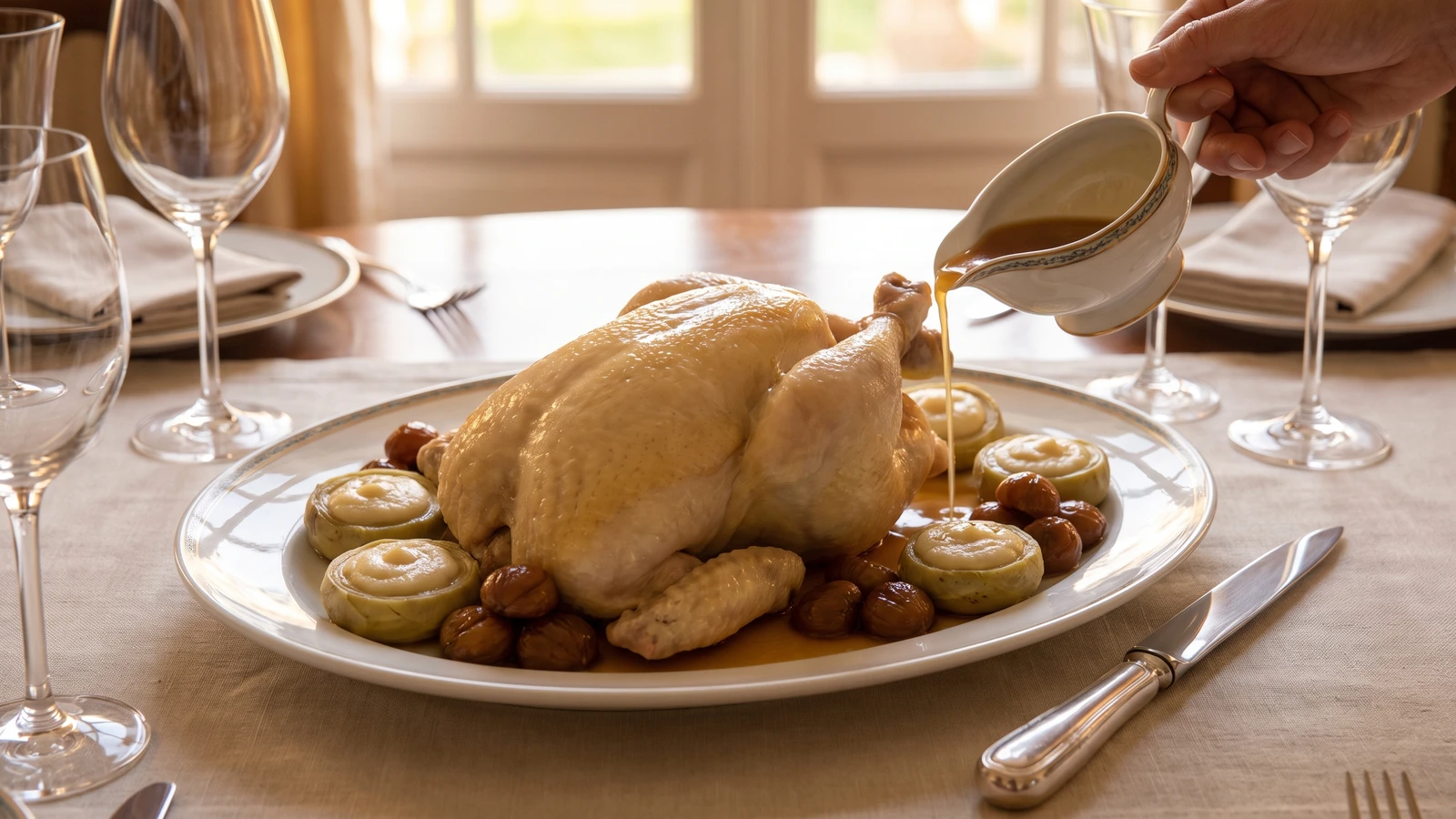
A pale, butter-gold poularde ringed with artichoke bottoms holding ivory Soubise and chestnuts glazed in consommé, with glossy poëling liquor beneath to gather everything into one generous platter.
Poularde Châtelaine (butter-poëled pullet with Soubise-filled artichokes and glazed chestnuts) teaches restraint. The bird must remain pale and succulent, its skin no darker than butter gold. Hold back the roasting instinct before you touch the pan; deep bronze would overwhelm the ivory Soubise, tender artichokes, and softly glazed chestnuts that define the dish.
The original kitchen assumed a saucier on staff, stock never off the fire, and enough hands to tend three garnishes while the bird cooked. It needed no salamander, because emphatic browning was never the goal. At home, the book's separate Poëlings (No. 250) remains the foundation: cook one plump bird by that method, reserve one cup of its liquor, and make the garnishes while it rests. Prepared artichoke bottoms and peeled cooked chestnuts replace the brigade's trimming work, not its flavor. One cook, one stove, one evening.
The scaffolding can go: no larding needle, hand-pounded onion purée, or cook stationed at each saucepan. What stays is the dish itself: gentle butter cooking, Soubise made without color, chestnuts simmered in consommé, and poëling liquor thickened only enough to coat a spoon. Guard the pale color from beginning to end. That is the step that decides everything.
Poularde Châtelaine belongs to the codified grand-kitchen repertoire centered in Paris, where a named garnish could turn a whole poularde into a formal composition for the table. Châtelaine is a title-name, not a regional claim: its identity lies in alternating artichoke bottoms filled with Soubise and chestnuts glazed in consommé. Its poêlé is often misunderstood too; here the word means gentle, covered cooking in butter over aromatics, never skillet frying.
Quantity
1, about 4 lb (1.8 kg)
fully cooked and rested
Quantity
1 cup (240 ml / 240 g)
Quantity
8, about 14 oz (400 g) drained
fresh, frozen, or preserved in water
Quantity
16 small, about 7 oz (200 g)
Quantity
1¾ cups (420 ml / 420 g)
divided
Quantity
1, about 9 oz (250 g)
very thinly sliced
Quantity
2 tablespoons (30 ml / 24 g)
Quantity
¼ cup (60 ml / 60 g)
Quantity
8 tablespoons (½ cup / 120 ml / 113 g)
softened and divided
Quantity
1 tablespoon (15 ml / 8 g)
Quantity
1½ teaspoons (7.5 ml / 9 g)
divided and adjusted to taste
Quantity
¼ teaspoon (1.25 ml / 0.6 g)
adjusted to taste
| Ingredient | Quantity |
|---|---|
| whole poularde or plump young chicken prepared according to Poëlings (No. 250)fully cooked and rested | 1, about 4 lb (1.8 kg) |
| poëling liquor reserved from Poëlings (No. 250) | 1 cup (240 ml / 240 g) |
| small artichoke bottomsfresh, frozen, or preserved in water | 8, about 14 oz (400 g) drained |
| peeled cooked chestnuts | 16 small, about 7 oz (200 g) |
| unsalted chicken consommédivided | 1¾ cups (420 ml / 420 g) |
| large yellow onionvery thinly sliced | 1, about 9 oz (250 g) |
| uncooked white rice | 2 tablespoons (30 ml / 24 g) |
| heavy cream | ¼ cup (60 ml / 60 g) |
| unsalted buttersoftened and divided | 8 tablespoons (½ cup / 120 ml / 113 g) |
| all-purpose flour | 1 tablespoon (15 ml / 8 g) |
| fine saltdivided and adjusted to taste | 1½ teaspoons (7.5 ml / 9 g) |
| ground white pepperadjusted to taste | ¼ teaspoon (1.25 ml / 0.6 g) |
Melt 3 tablespoons of the butter in a covered 2-quart saucepan over low heat. Add the onion and ¼ teaspoon of the salt, cover, and cook for 12 to 15 minutes, stirring occasionally, until completely tender but still ivory. Do not let the edges color. Stir in the rice and ¾ cup of the consommé, cover again, and hold at the barest simmer for 18 to 22 minutes, until the rice crushes readily between two fingers.
Transfer the onion and rice mixture to a blender, add the cream and a pinch of white pepper, and blend until perfectly smooth. Return the Soubise to its saucepan and keep it barely warm. It should hold a soft mound without becoming stiff. If it runs, reduce it gently while stirring; if it tightens or looks grainy, whisk in hot consommé one spoonful at a time and blend again. Ça se rattrape.
Melt 2 tablespoons of the butter in a wide saucepan over low heat. Set in the artichoke bottoms, hollow side up, add ¼ cup of the consommé and a small pinch of salt, then cover and cook gently for 8 to 10 minutes. Turn them once without damaging their rims. Uncover and let the liquid reduce until the artichokes wear a buttery glaze. If they begin to brown, add a spoonful of consommé and lower the heat at once; pale and tender is the object.
Put the chestnuts in a small saucepan with ½ cup of the consommé, 1 tablespoon of the butter, and a pinch of salt. Simmer barely for 8 to 12 minutes, swirling the pan rather than stirring, until the consommé reduces to a glossy coating. Chestnuts are fragile. If several break, don't discard them; group the pieces into small neat heaps between the artichokes. The garnish keeps its proper form and nothing is wasted.
When the poularde prepared according to Poëlings (No. 250) is cooked, transfer it breast side up to a warm platter and cover it loosely. Do not wrap it tightly, or the butter-gold skin softens in its own moisture. Rest it for 15 minutes while you finish the liquor and fill the artichokes.
Knead 1 tablespoon of the butter with the flour to make a smooth beurre manié. Bring the poëling liquor reserved from Poëlings (No. 250) to a gentle simmer, then whisk in the beurre manié a little at a time. Simmer for 3 to 5 minutes, until the liquor lightly naps the back of a spoon, then strain it. Off the heat, whisk in the final tablespoon of butter. If the sauce becomes pasty, loosen it with consommé by the spoonful; if small lumps appear, strain it again. Ça se rattrape. Taste for salt and white pepper.
Spoon a thin pool of the thickened poëling liquor beneath the poularde, keeping most of the sauce for the sauceboat. Fill each warm artichoke bottom generously with Soubise, then arrange them around the bird, alternating each with a small heap of glazed chestnuts. Bring the whole poularde to the table and carve it there, serving the remaining liquor separately. The platter should look abundant, not arranged with tweezers. À table!
1 serving (about 550g)
Culinary guides, cultural storytelling, and the editorial depth that makes cooking meaningful.
Discover Culinary ExplorerChef Juliette
John Dory has the delicacy of sole and the firmness of turbot. A light flouring, a quick butter sauté, and nut-brown beurre noisette show exactly why looks never mattered.

Chef Juliette
Fresh haddock proves its delicacy in the meunière pan: a fine flour crust, moist pearly flakes, and beurre noisette sharpened with lemon and parsley, ready from one skillet in half an hour.

Chef Juliette
Éperlans à l’Anglaise turns small fish into a lesson in disciplined coating: boned smelts under a close, crisp crumb, pan-fried in clarified butter and finished with bright, half-melted maître d’hôtel butter.

Chef Juliette
Tiny smelts, shallot, mushrooms, white wine, gratin sauce, and fine bread raspings meet a fierce oven, where the fish must turn tender in the same breath the buttered crust bronzes.