Culinary Explorer

A cooking platform built around craft, culture, and the stories behind what we eat.
Discover Culinary Explorer
Poularde Chanoinesse

Poularde Chanoinesse

Created by Chef Juliette

Based on No. 1456, Poularde Chanoinesse, from Le Guide Culinaire (1907) by Auguste Escoffier

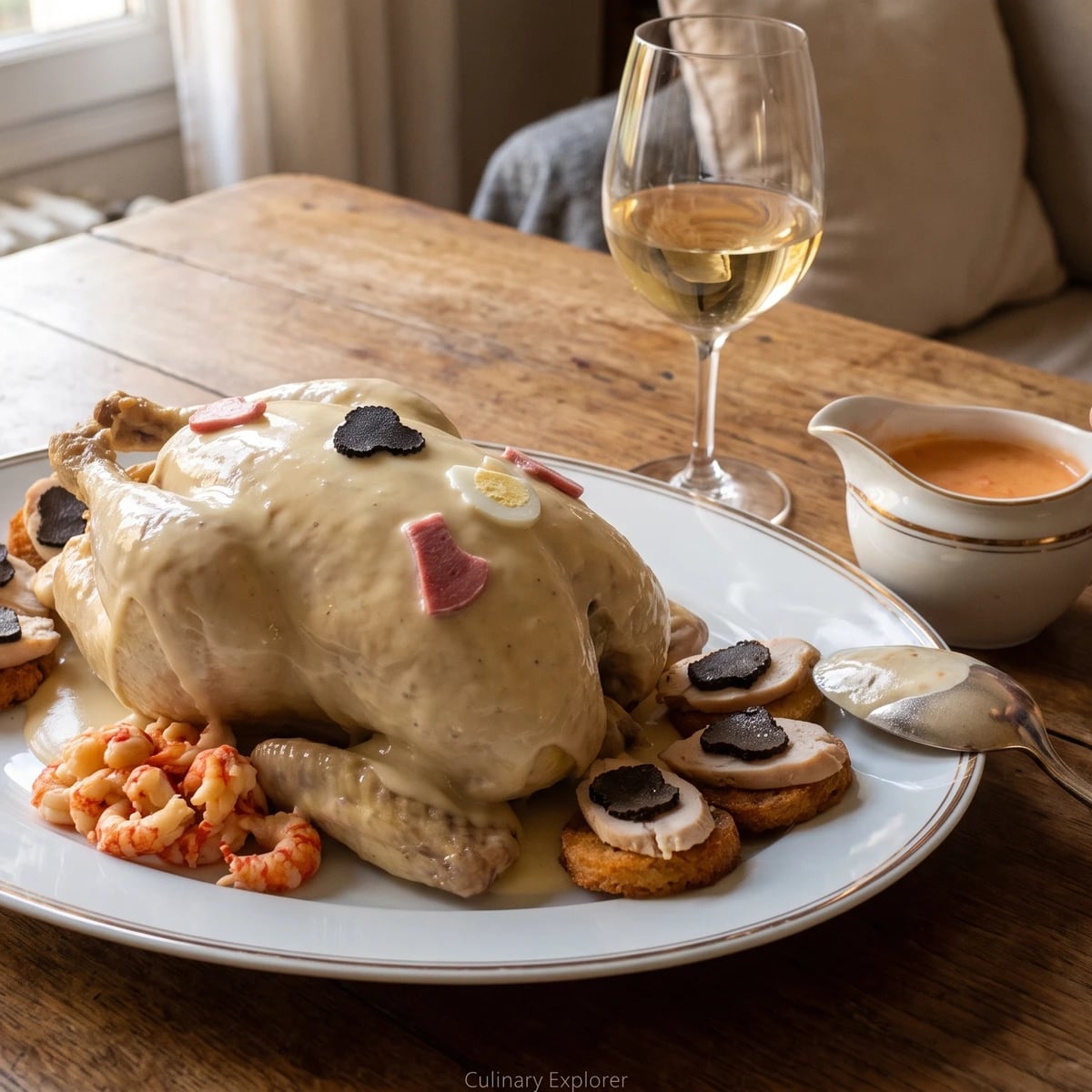
An ivory-coated Poularde Soufflée ringed with crayfish tails and butter-fried croûtons, each carrying suprême and truffle, with coral-tinted Mornay served separately for a grand dish made calmly at home.

Main Dishes
French
Dinner Party
Special Occasion
35 min
Active Time
25 min cook1 hr total
Yield4 servings

Poularde Chanoinesse (a soufflé-filled pullet with crayfish and truffled chicken-breast croûtons) teaches that composure, not complication, holds a ceremonial dish together. Its one true thing is cold: the mousseline forcemeat inside the Poularde Soufflée (No. 1518) must be cold when it enters the bird, or the filling loosens before its proteins can set and the reconstructed poularde will slump. That condition is the dish, not an ornament.

The classical service assumed Poularde Soufflée arriving from one station, stock never off the fire for its coating, a saucier holding Mornay, crayfish butter ready in the cold pantry, and several hands building the border. At home, the linked preparation remains whole, a roasting tin becomes its bain-marie, or hot-water bath, one saucepan makes the sauce, and an ordinary skillet fries the croûtons. A salamander adds nothing because this dish is poached and sauced, not gratinéed. The separate stations are scaffolding and may disappear; the cold forcemeat, reconstructed bird, alternating crayfish and croûtons, and crayfish-butter Mornay must stay.

When it reaches the table, the coating should gleam ivory around the rounded poularde, the crayfish should glow coral against butter-gold bread, and every croûton should carry its thin suprême and black cap of truffle. Prepare the whole border before the poularde is ready, but chill that forcemeat completely before it enters the bird. Everything else can wait; that cannot.

Poularde Chanoinesse belongs to the Parisian grand-kitchen repertory of named poulardes, where a recognized base preparation acquired a distinct identity through its garnish and accompanying sauce. Chanoinesse is the feminine word for a canoness, reflecting the canon's habit of giving formal dishes clerical or honorific names rather than proving any origin in a convent or one French region. Linked formulas carried such dishes from professional brigades to ambitious bourgeois tables, with Poularde Soufflée supplying the architecture and crayfish, truffle, croûtons, and Mornay defining this particular service.

The technique, the tradition, and the story behind every dish.

Discover Culinary Explorer

Ingredients

prepared Poularde Soufflée

Quantity

1, scaled to 4 servings (No. 1518)

with 8 thin collops of suprême reserved

medium whole cooked crayfish

Quantity

16

tails removed intact and shells reserved

unsalted butter for the crayfish butter

Quantity

6 tablespoons (90 ml / 85 g)

water

Quantity

¼ cup (60 ml / 60 g)

divided

firm white sandwich bread

Quantity

4 slices

cut into 8 small oval croûtons

clarified butter for frying

Quantity

3 tablespoons (45 ml / 42 g)

black truffle, fresh or preserved

Quantity

1 small

cut into 8 thin slices

unsalted butter for the roux

Quantity

2 tablespoons (30 ml / 28 g)

all-purpose flour

Quantity

2 tablespoons (30 ml / 16 g)

whole milk

Quantity

1¼ cups (300 ml / 305 g)

with 2 tablespoons reserved cold

Gruyère

Quantity

⅓ cup (80 ml / 35 g)

finely grated

Parmesan

Quantity

2 tablespoons (30 ml / 12 g)

finely grated

fine salt

Quantity

¼ teaspoon (1.25 ml / 1.5 g), plus more if needed

ground white pepper

Quantity

⅛ teaspoon (0.6 ml / 0.25 g)

freshly grated nutmeg

Quantity

1 small pinch

Equipment Needed

  • 40 to 45 cm oval serving platter
  • 2 litre heavy-bottomed saucepan
  • 25 cm skillet
  • Fine-mesh sieve
  • Deep roasting tin for the linked preparation's bain-marie
  • Instant-read thermometer
  • Small heated sauceboat

Instructions

  1. 1

    Ready the poularde

    Have the Poularde Soufflée (No. 1518) finished as its own entry directs, scaled for four and timed to be ready about fifteen minutes before service. When preparing that linked component, reserve eight thin collops of suprême, the breast fillet, before reconstructing the bird. Its mousseline forcemeat must remain refrigerator-cold; if it has softened or become glossy, spread it in a shallow chilled bowl and refrigerate it until firm before stuffing. Ça se rattrape. Keep the finished poularde warm while you complete the garnish, but do not leave it waiting longer than twenty minutes.

    Do not attempt to fold warm forcemeat into the bird. Chilling restores its body, while extra egg or flour would alter the fine texture and the proportions of the linked preparation.
  2. 2

    Make crayfish butter

    Set the sixteen intact tails aside in the cold. Break the reserved shells into coarse pieces, then melt the six tablespoons of butter in a small saucepan over medium-low heat. Add the shells and cook for eight minutes, pressing them firmly with a wooden spoon, until the butter turns coral and smells distinctly of crayfish without browning. Add three tablespoons of the measured water and simmer gently for five minutes. Strain through a fine sieve into a narrow bowl, pressing hard, then set the bowl over ice until the beurre d'écrevisse, or crayfish butter, separates and begins to firm. Spoon off two generous tablespoons for the Mornay.

    If the butter starts to brown, lower the heat and add the measured water at once. If the shells smell acrid, begin again; scorched shell fat has no honest rescue.
  3. 3

    Fry the croûtons

    Cut the bread into eight oval croûtons, small bread pieces fried in butter, each about five centimetres long. Heat the clarified butter in a wide skillet over medium heat and fry the croûtons on both sides until evenly butter-gold, crisp at the edges, and still substantial enough to carry the chicken. Drain them briefly on a clean towel and keep them uncovered so they remain crisp.

  4. 4

    Build the Mornay

    Melt the two tablespoons of butter in a small saucepan, add the flour, and stir for two minutes without allowing it to colour. This roux blanc, a pale butter-and-flour base, must cook long enough to lose its raw taste. Whisk in all but the reserved cold milk in three additions, smoothing each one before adding the next, then simmer gently for five minutes until the sauce nappes the spoon, coating it in a clean ivory layer. Remove the pan from the heat, whisk in the Gruyère and Parmesan, then add two tablespoons of crayfish butter a little at a time. Season with salt, white pepper, and nutmeg. Never boil the sauce after the cheese and crayfish butter enter. If it turns oily at the rim, set the pan in cool water and whisk in the reserved cold milk one spoonful at a time until the emulsion closes again.

    Hold the finished Mornay over barely warm water, not direct heat. It should remain fluid enough to pour in a broad ribbon, never thick enough to sit like paste.
  5. 5

    Warm the garnish

    Put the remaining tablespoon of measured water in a clean skillet and add the crayfish tails and reserved suprême collops. Cover and warm over the lowest heat for thirty to forty-five seconds, just until they lose their chill. Drain immediately. They are already cooked, and simmering would turn the crayfish firm and the delicate chicken dry.

  6. 6

    Build the border

    Transfer the warm Poularde Soufflée (No. 1518) to the centre of a heated oval platter, keeping its truffle-scented coating and decoration intact. Arrange eight small heaps of two crayfish tails around it, alternating each heap with a fried croûton. Place one warm collop of suprême on every croûton, then finish each collop with one thin slice of black truffle. Work neatly but promptly; this is generous food, not plating theater.

  7. 7

    Serve the sauce

    Pour the warm crayfish-butter Mornay into a heated sauceboat and serve it separately, exactly as the dish requires. Do not blanket the border before it reaches the table, because the croûtons must remain crisp and each guest should spoon the sauce over their own portion. Bring the poularde in whole, carve through the soft filling with a broad spoon, and give everyone crayfish, croûton, suprême, and truffle. À table!

Chef Tips

  • Buy whole cooked crayfish, fresh or frozen and properly thawed, because the tails supply the border and the shells supply the beurre d'écrevisse. Packaged tail meat gives you only half the dish.
  • A preserved whole black truffle is the classical pantry's honest answer when fresh truffles are not in season. Drain it well and slice it thinly. Truffle oil is perfume without substance and does not belong here.
  • The Mornay is deliberately served separately. Pouring it over the assembled border too early softens the croûtons and hides the careful alternation that defines Chanoinesse.
  • Use real butter, whole milk, Gruyère, and Parmesan. Fat substitutes cannot carry the shell flavour or hold the final emulsion. We don't apologize for butter.
  • Serve a dry, full-bodied Chardonnay, such as a white Burgundy with enough acidity to meet the cheese, foie gras, and crayfish without making the sauce feel heavy.

Advance Preparation

  • The time fields cover the Chanoinesse garnish and sauce once the Poularde Soufflée (No. 1518) is ready. Begin that linked preparation according to its own timing, then make the crayfish butter during its poaching period.
  • The beurre d'écrevisse can be made up to three days ahead, covered and refrigerated. Melt it only until soft enough to whisk into the Mornay.
  • The poularde may be reconstructed several hours before its final poaching if it is covered and kept thoroughly cold. This rest helps the forcemeat firm, but the finished dish should be timed close to service rather than reheated repeatedly.
  • The croûtons can be fried up to four hours ahead and kept uncovered at room temperature. Refresh them for two minutes in a moderate oven before topping them.

Frequently Asked Questions

Nutrition Information

1 serving (about 365g)

Calories
910 calories
Total Fat
68 g
Saturated Fat
32 g
Trans Fat
2 g
Unsaturated Fat
34 g
Cholesterol
295 mg
Sodium
825 mg
Total Carbohydrates
20 g
Dietary Fiber
1 g
Sugars
5 g
Protein
55 g

Note: Chef personas and recipes are created with AI assistance. Cook with care: follow safe food-handling practices, check doneness with a thermometer when needed, and adapt for allergies and your kitchen.

Where cooking meets culture.

Culinary guides, cultural storytelling, and the editorial depth that makes cooking meaningful.

Discover Culinary Explorer

More from Poultry (Volaille)

Browse the full collection