
Chef Juliette
Pullets and Capons for Relevés
Three roads through the Paris poultry canon, poach, poêler, or braise, with one rule beneath them all: protect the breast with bacon while the legs cook, then turn the liquor into sauce.
A cooking platform built around craft, culture, and the stories behind what we eat.
Created by Chef Juliette
Based on No. 1518, Poularde Soufflée, from Le Guide Culinaire (1907) by Auguste Escoffier
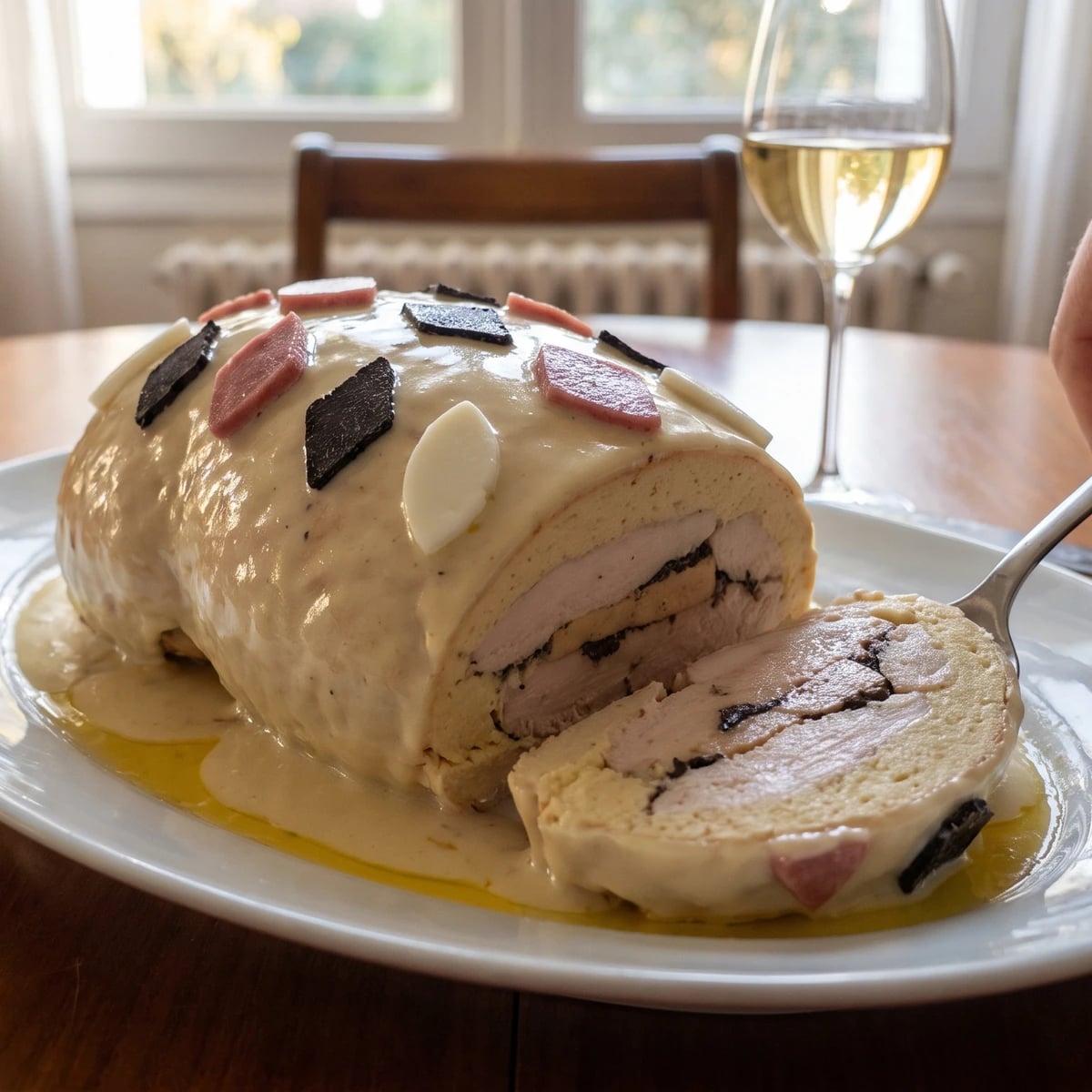
Poached poultry becomes architecture: tender suprêmes layered through foie-gras mousseline and truffle, shaped back into the bird, gently set over water, then veiled in glossy Allemande sauce.
Poularde soufflée (poached pullet reconstructed with a light chicken forcemeat) teaches one exacting truth: the mousseline must stay cold while you build it, and the finished bird must cook in moist, moderate heat. Warm forcemeat loses its fine structure. Dry oven heat cracks it open.
The source assumed a saucier on staff, poultry trimmings ready for forcemeat, a stockpot never off the fire, and, ideally, a steamer. A salamander has no work here, because browning would betray the preparation. At home, a chilled food processor replaces the pounding and sieving station, good chicken stock is concentrated after the first poach, and a covered roasting tin set as a bain-marie, a hot-water bath, supplies the steamer's gentle heat. For four, a small poularde replaces the brigade bird, while the book's mousseline and foie-gras quantities are halved and their ratio remains untouched.
The separate hands and permanent stockpot were brigade scaffolding. The first poach, the lifting of the suprêmes, the removal of the breast bones, the layered reconstruction, and the second moist poach are the dish itself and must stay. One cook, one stove, one evening. Keep the mousseline cold enough to feel firm from the processor through the final smoothing; that decides whether the Poularde soufflée slices like silk or slumps.
Poularde soufflée belongs to the Parisian grand-kitchen repertoire, where a whole bird could be disassembled, filled, patterned, and returned to the table looking untouched. It is not a true risen soufflé or a regional roast: soufflée describes the light mousseline replacing the breast cage and carrying layers of suprême, foie gras, and truffle. The preparation passed onto bourgeois celebration tables through the bain-marie, which lets a household oven reproduce the moist setting of a steamer while preserving the formal whole-bird presentation.
Quantity
1, about 3½ lb (1.6 kg)
giblets removed, wings tucked and legs tied
Quantity
8 cups (1.9 L / 1.9 kg)
use enough to cover the bird in a snug pot; reserve 2 cups (480 ml / 480 g) after poaching and reduce to 1½ cups (360 ml / 360 g) for the sauce
Quantity
5 oz (about 1 cup diced / 140 g)
diced and icy cold, for the chicken mousseline
Quantity
1½ teaspoons (7.5 ml / 9 g), plus more as needed
divided
Quantity
¼ teaspoon (1.25 ml / 0.6 g)
divided
Quantity
1
chilled, for the chicken mousseline
Quantity
⅓ cup (80 ml / 80 g)
icy cold, for the chicken mousseline
Quantity
2⅔ oz (about ⅓ cup / 75 g)
pressed through a fine sieve and chilled
Quantity
1 oz (about 3 tablespoons / 28 g), plus 1 tablespoon (15 ml / 15 g) preserving liquid
thinly sliced, preserving liquid reserved
Quantity
¾ oz (about 2 tablespoons / 20 g)
cut into small diamonds
Quantity
1
cut into small diamonds
Quantity
3 tablespoons (45 ml / 42 g)
divided between the dish and Allemande sauce
Quantity
2 tablespoons (30 ml / 16 g)
Quantity
½ cup (120 ml / 120 g)
for the Allemande sauce
Quantity
2
for the Allemande sauce
Quantity
2 teaspoons (10 ml / 10 g)
| Ingredient | Quantity |
|---|---|
| small poularde or plump young chickengiblets removed, wings tucked and legs tied | 1, about 3½ lb (1.6 kg) |
| well-seasoned chicken stockuse enough to cover the bird in a snug pot; reserve 2 cups (480 ml / 480 g) after poaching and reduce to 1½ cups (360 ml / 360 g) for the sauce | 8 cups (1.9 L / 1.9 kg) |
| boneless, skinless chicken breastdiced and icy cold, for the chicken mousseline | 5 oz (about 1 cup diced / 140 g) |
| fine sea saltdivided | 1½ teaspoons (7.5 ml / 9 g), plus more as needed |
| ground white pepperdivided | ¼ teaspoon (1.25 ml / 0.6 g) |
| large egg whitechilled, for the chicken mousseline | 1 |
| heavy creamicy cold, for the chicken mousseline | ⅓ cup (80 ml / 80 g) |
| plain bloc de foie graspressed through a fine sieve and chilled | 2⅔ oz (about ⅓ cup / 75 g) |
| preserved whole black trufflethinly sliced, preserving liquid reserved | 1 oz (about 3 tablespoons / 28 g), plus 1 tablespoon (15 ml / 15 g) preserving liquid |
| cooked salted beef tonguecut into small diamonds | ¾ oz (about 2 tablespoons / 20 g) |
| hard-cooked large egg whitecut into small diamonds | 1 |
| unsalted butterdivided between the dish and Allemande sauce | 3 tablespoons (45 ml / 42 g) |
| all-purpose flour | 2 tablespoons (30 ml / 16 g) |
| heavy creamfor the Allemande sauce | ½ cup (120 ml / 120 g) |
| large egg yolksfor the Allemande sauce | 2 |
| fresh lemon juice | 2 teaspoons (10 ml / 10 g) |
Tie the legs together, tuck the wings beneath the bird, and season the cavity lightly. Bring the chicken stock to a bare simmer in a snug pot, lower in the poularde breast-up, and keep the liquid between 175°F and 185°F (80°C and 85°C). It should tremble, never boil. Skim as needed and poach for 40 to 50 minutes, until the coolest part of the breast and inner thigh reaches 165°F (74°C). Lift the bird carefully onto a rimmed tray and let it cool until it can be handled. Reserve 2 cups (480 ml / 480 g) of the poaching stock for the sauce.
Chill the food-processor bowl and blade, then place the diced raw chicken in the freezer for 15 minutes. Process the chicken with ¾ teaspoon of the salt and half the white pepper until it forms a sticky paste. Add the chilled egg white and process until smooth, then add the icy cream in three additions, stopping to scrape the bowl. The mixture should remain glossy and distinctly cold. If it starts looking grainy or greasy, stop before adding more cream. Ça se rattrape: chill the bowl over ice for 10 minutes, then fold in the remaining cream by hand. Press the mousseline through a fine sieve, fold in the sieved foie gras, and keep the bowl over ice. Poach a teaspoonful in the reserved stock until cooked through, taste it, and correct the seasoning before proceeding.
Lay the cooled poularde breast-up. Lift away the breast skin so the finished mousseline can be smoothed and decorated, then use a narrow knife to raise the two suprêmes, the breast fillets, cleanly from the keel and ribs. With sturdy poultry shears, remove the keel and breast bones in sections while leaving the backbone, legs, and wings intact. Slice the suprêmes across the grain into pieces about ¼ inch (6 mm) thick. Butter a 2-quart (1.9 L) oval gratin dish with 1 tablespoon of the butter, settle the bird into it, and chill the opened bird and sliced breast for 15 minutes so no lingering warmth softens the mousseline.
Reserve several neat truffle slices for decoration. Spread one-third of the foie-gras mousseline across the empty breast cavity. Arrange alternating slices of suprême and truffle over it, keeping the pieces just apart so the mousseline can bind them. Add another layer of mousseline, then repeat the alternating suprême and truffle layer. Cover with the remaining mousseline and shape it into the full, rounded breast of the original bird. Smooth the surface with a small spatula dipped in cold water. Press firmly enough to eliminate air pockets, but do not compact the mousseline.
Arrange the reserved truffle, salted tongue, and hard-cooked egg-white diamonds over the smooth breast in a restrained pattern, pressing each piece just into the surface so it holds. Refrigerate the assembled Poularde soufflée for 20 minutes while the oven heats to 300°F (150°C). This final chilling is part of the technique, not idle waiting; the mousseline must enter the oven cold.
Set the oval dish inside a deep roasting pan and pour boiling water around it to reach halfway up the dish. Cover the roasting pan with a loose foil dome, crimping the edges without letting the foil touch the decoration. Poach in the oven for 40 to 50 minutes, replenishing the bain-marie with boiling water if needed, until the centre of the mousseline reaches 165°F (74°C). Steam sets it; dry oven heat cracks it open. If a fissure appears before the centre is cooked, lower the oven to 275°F (135°C), add more boiling water, and lay buttered parchment lightly over the exposed surface. Ça se rattrape: the crack will stop widening, and the Allemande will cover the fine line.
While the bird cooks, boil the reserved 2 cups (480 ml / 480 g) poaching stock until reduced to 1½ cups (360 ml / 360 g). Melt the remaining 2 tablespoons butter in a saucepan, stir in the flour, and cook this pale roux for 2 minutes without colouring it. Whisk in the reduced stock gradually and simmer for 8 to 10 minutes, until the velouté reaches nappe, coating the back of a spoon. If it remains thin, reduce it now; once the yolks enter, it must not boil. Reserve 1 tablespoon of the cream, then whisk the rest with the egg yolks. Temper this liaison, the yolk-and-cream thickening, with several spoonfuls of hot velouté before whisking it back into the saucepan. Cook over the gentlest heat until the Allemande thickens slightly, then remove it from the heat and add the lemon juice and reserved truffle liquid. If the sauce shows grains, strain it immediately. If it separates, whisk the reserved cold cream in a clean bowl and add the sauce back a spoonful at a time. Keep the finished Allemande warm over barely warm water.
Lift the gratin dish from the bain-marie and rest the Poularde soufflée for 10 minutes. Spoon a thin, even coat of truffle-scented Allemande sauce over the reconstructed breast, allowing the decoration to remain legible, and pool a little sauce around the bird. Serve it whole before cutting. Carve the raised breast crosswise into four thick slices so every portion shows mousseline, suprême, foie gras, and truffle; portion the leg and wing meat alongside and pass the remaining Allemande separately. À table!
1 serving (about 450g)
Culinary guides, cultural storytelling, and the editorial depth that makes cooking meaningful.
Discover Culinary Explorer
Chef Juliette
Three roads through the Paris poultry canon, poach, poêler, or braise, with one rule beneath them all: protect the breast with bacon while the legs cook, then turn the liquor into sauce.

Chef Juliette
The service method that protects a grand poultry dish: carve the suprêmes in the kitchen, keep them in their liquor, rebuild the bird with pilaf, and send every guest a hot, complete plate.

Chef Juliette
The marshal’s poularde teaches gentle poaching: a rice-stuffed bird held at a bare tremble, then cloaked in sauce Albuféra and surrounded by truffle tartlets, tiny quenelles, mushrooms, and salted tongue.

Chef Juliette
Poularde Alexandra turns one poached bird into a small ceremony: truffle and tongue in the sliced suprêmes, feather-light mousseline beneath a bronzed Mornay coat, and buttered asparagus tartlets all around.