
Chef Juliette
John Dory (St. Pierre)
John Dory has the delicacy of sole and the firmness of turbot. A light flouring, a quick butter sauté, and nut-brown beurre noisette show exactly why looks never mattered.
A cooking platform built around craft, culture, and the stories behind what we eat.
Created by Chef Juliette
Based on No. 1454, Poularde aux Champignons à Brun, from Le Guide Culinaire (1907) by Auguste Escoffier
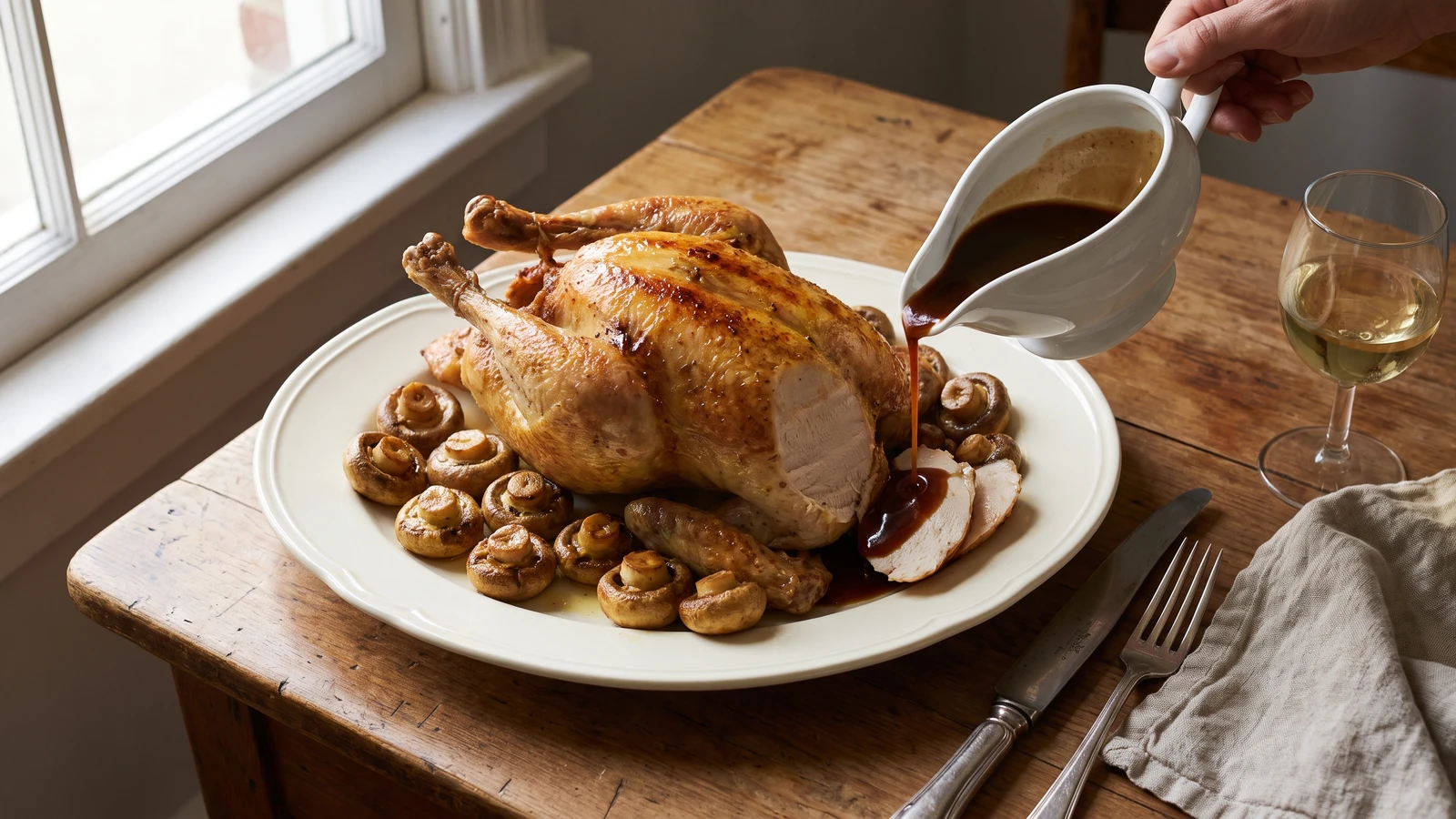
A poularde cooked poêlé until bronze, ringed with twenty mushroom caps, and served with Madeira demi-glace carrying every savour from the pan, then finished off heat with cold butter.
Poularde aux Champignons à Brun (butter-roasted pullet with mushrooms and Madeira demi-glace) teaches the difference between roasting in fat and braising in liquid. The poêlé, a covered butter roast, must remain unmoistened while the bird cooks. Add stock too early and you wash away the concentrated poultry savour that this sauce exists to collect.
The original assumed a saucier on staff, mushroom essence and Madeira demi-glace ready, a stock never off the fire, and enough hands to groove twenty mushroom caps while the bird cooked through Poëlings (No. 250). At home, a snug lidded casserole replaces the deep poëling vessel, a fine-mesh sieve replaces cloth straining, mushroom stems provide the essence, and a good prepared veal demi-glace supplies the honest foundation. The separate saucier and brigade quantities are scaffolding and can go. The dry cook, pan swill, twenty caps, and full two ounces of finishing butter must stay. No salamander is required; the poêlé gives the bird its own colour. One cook, one stove, one evening.
The pan swill and the final monter au beurre (finishing the sauce with cold butter) are the dish. If the reduction tightens, water loosens it; if the butter splits, begin again with cool water and rebuild it spoon by spoon. Ça se rattrape. The last step matters most: after the cold butter enters, the sauce never boils.
Poularde aux Champignons à Brun belongs to the Parisian grand-kitchen repertoire, where large poultry arrived at table with a formally arranged garnish and its reduced sauce served separately. The poêlé is often mistaken for pan-frying, but in this canon it means a gently covered butter roast, uncovered only to acquire colour. Mushroom essence and Madeira demi-glace carried the bird from roasting vessel to saucier's station, while bourgeois dining rooms preserved the same sequence in one casserole.
Quantity
1 bird, 4 to 4½ lb (1.8 to 2 kg)
neck and giblets removed and skin patted dry
Quantity
20, about 12 oz (340 g)
stems removed and reserved, caps grooved
Quantity
1¼ cups (300 ml / 300 g)
for the mushroom essence
Quantity
2 tablespoons (30 ml / 28 g)
for cooking the mushroom caps
Quantity
¼ imperial pint (142 ml / about 150 g)
Quantity
4 tablespoons (60 ml / 57 g)
cut into small cubes
Quantity
2 teaspoons (10 ml / 12 g)
Quantity
½ teaspoon (2.5 ml / 1 g)
| Ingredient | Quantity |
|---|---|
| whole poularde or plump young henneck and giblets removed and skin patted dry | 1 bird, 4 to 4½ lb (1.8 to 2 kg) |
| Poëlingssized for the poularde | 1 home-scale application (No. 250) |
| medium white button mushroomsstems removed and reserved, caps grooved | 20, about 12 oz (340 g) |
| filtered waterfor the mushroom essence | 1¼ cups (300 ml / 300 g) |
| unsalted butterfor cooking the mushroom caps | 2 tablespoons (30 ml / 28 g) |
| prepared Madeira demi-glace | ¼ imperial pint (142 ml / about 150 g) |
| cold unsalted buttercut into small cubes | 4 tablespoons (60 ml / 57 g) |
| fine salt | 2 teaspoons (10 ml / 12 g) |
| freshly ground black pepper | ½ teaspoon (2.5 ml / 1 g) |
Chop the reserved mushroom stems and place them in a small saucepan with the filtered water. Bring to a gentle simmer and cook uncovered for about 20 minutes, until the liquid measures 1 cup (240 ml). Strain through a fine-mesh sieve without forcing the solids through. This concentrated, unsalted mushroom essence replaces the stockpot preparation a brigade kept ready.
Season the cavity and skin with 1¾ teaspoons of the salt and all the pepper, then tuck the wings underneath and tie the legs together. Cook the seasoned poularde according to Poëlings (No. 250), scaled for a 4 to 4½ lb bird. Do not add stock, water, or wine while it cooks; poêling remains a roast, and premature liquid turns its concentrated flavour pale. The bird is ready when the breast reaches at least 165°F (74°C), the thigh reaches 170 to 175°F (77 to 79°C), and the skin is evenly bronze. Transfer it to a warm platter, cover loosely, and rest for 15 minutes. Leave the cooking butter, aromatic vegetables, and fond in the casserole.
While the poularde rests, melt the 2 tablespoons of butter in a wide skillet over medium heat. Add the grooved mushroom caps and the remaining ¼ teaspoon salt. Cook gently, turning once, until the caps are tender, lightly gilded, and still hold their shape, about 7 to 9 minutes. Cover and keep them warm off the heat.
Pour the mushroom essence into the poëling casserole before removing its cooking butter. Bring it to a gentle boil and scrape up the brown fond, leaving behind any truly black specks, which taste bitter rather than roasted. Simmer for 10 minutes so the essence can draw the poultry and vegetable savour from the butter. Strain into a clean saucepan, skim away the excess fat, then reduce the liquor to about ⅓ cup (80 ml). If the casserole caught in one place, ça se rattrape: scrape only the clean brown fond and leave the burnt patch untouched.
Add the reduced pan liquor to the ¼ imperial pint of Madeira demi-glace. Hold it at a lively simmer until the sauce is glossy and nappant, coating the back of a spoon without running off like broth, about 4 to 6 minutes. Taste before adding salt because prepared demi-glace can be assertive. If the sauce becomes too tight, loosen it with a tablespoon of warm water; if it remains thin, reduce it further now, before the finishing butter enters.
Take the saucepan completely off the heat. Whisk in the cold butter one cube at a time, adding the next only when the previous cube has disappeared, until the sauce is smooth, full-bodied, and reflective. Never boil it after this point or the butter separates. If it does split, ça se rattrape: place 1 tablespoon of cool water in a clean saucepan and whisk in the broken sauce a spoonful at a time until it comes together again.
Set the whole poularde on the warm platter and arrange the twenty mushroom caps in a close ring around it, five for each serving. Pour the Madeira demi-glace into a warm sauceboat and serve it separately, as the source directs, so the burnished bird remains visible and each portion receives its sauce at the table. Carve the breast across the grain, divide the legs at their joints, and serve at once. À table!
1 serving (about 350g)
Culinary guides, cultural storytelling, and the editorial depth that makes cooking meaningful.
Discover Culinary ExplorerChef Juliette
John Dory has the delicacy of sole and the firmness of turbot. A light flouring, a quick butter sauté, and nut-brown beurre noisette show exactly why looks never mattered.

Chef Juliette
Fresh haddock proves its delicacy in the meunière pan: a fine flour crust, moist pearly flakes, and beurre noisette sharpened with lemon and parsley, ready from one skillet in half an hour.

Chef Juliette
Éperlans à l’Anglaise turns small fish into a lesson in disciplined coating: boned smelts under a close, crisp crumb, pan-fried in clarified butter and finished with bright, half-melted maître d’hôtel butter.

Chef Juliette
Tiny smelts, shallot, mushrooms, white wine, gratin sauce, and fine bread raspings meet a fierce oven, where the fish must turn tender in the same breath the buttered crust bronzes.