
Chef Juliette
John Dory (St. Pierre)
John Dory has the delicacy of sole and the firmness of turbot. A light flouring, a quick butter sauté, and nut-brown beurre noisette show exactly why looks never mattered.
A cooking platform built around craft, culture, and the stories behind what we eat.
Created by Chef Juliette
Based on No. 1453, Poularde aux Céleris, from Le Guide Culinaire (1907) by Auguste Escoffier
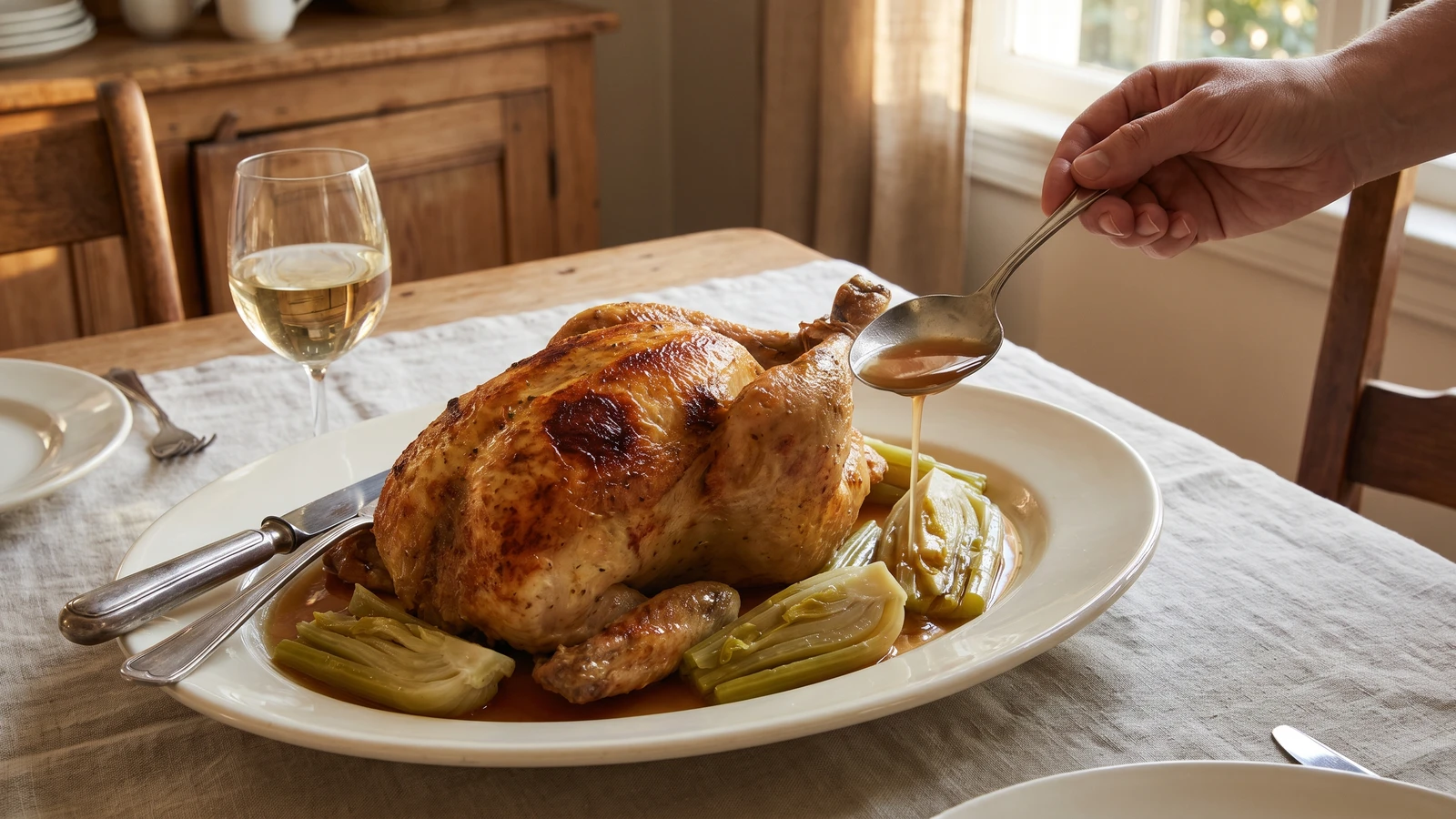
Poularde aux Céleris teaches the poêlé: butter-roasted poultry, strong veal stock added only near the finish, and celery made tender enough to drink the clear, carefully degreased cooking liquor.
Poularde aux Céleris (butter-roasted pullet with braised celery) teaches one uncompromising thing: the stock belongs at the close, not the beginning. The poêlé, a covered butter roast colored at the finish, must taste like roasting rather than pale braising. Add liquid too soon and you erase that distinction.
The original entry assumed a saucier to clear the cooking liquor, strong brown veal stock never off the fire, and enough hands to tend the bird and celery separately. It needed no salamander; uncovering the bird supplied its color. At home, a small covered roaster, one wide saucepan, a fine sieve, and a gravy separator replace that brigade scaffolding. The preparation is scaled to one poularde for four, while Poëlings (No. 250) remains whole in its own linked entry. One cook, one stove, one evening.
Keep what is the dish: butter cooking, the final stock baste, celery braised separately, and poëling liquor cleared of fat before it touches the garnish. If fat still freckles the surface, pause and separate it once more. Ça se rattrape. That clear liquor is the step that matters most.
Poularde aux Céleris belongs to the Parisian grand-kitchen canon, where a plump fattened hen could be paired with a formal vegetable garnish and carried whole to the table. Poêlé occupied a precise place between roasting and braising: the bird cooked chiefly in butter under cover, took its color late, and produced a concentrated liquor rather than a flour-thickened sauce. Celery is not merely an aromatic here; braised in substantial pieces, it becomes the dish's second subject and absorbs the poultry liquor at service.
Quantity
1 (about 4 lb / 1.8 kg)
Quantity
1 home-scaled application of Poëlings (No. 250), including its own butter and stock, sufficient for the poularde
Quantity
2 (about 2 lb / 900 g)
trimmed and quartered lengthwise into 8 intact bundles
Quantity
8 cups (1.9 L / 1.9 kg)
for blanching
Quantity
1 tablespoon plus 1 teaspoon (20 ml / 24 g)
divided
Quantity
3 tablespoons (45 ml / 43 g)
for braising the celery
Quantity
2½ cups (600 ml / 600 g), in addition to the stock required for Poëlings (No. 250)
divided
Quantity
½ teaspoon (2.5 ml / 1 g)
Quantity
1 cup (240 ml / 240 g) reserved from the same Poëlings (No. 250)
kept hot and thoroughly degreased
| Ingredient | Quantity |
|---|---|
| whole poularde or plump roasting chicken | 1 (about 4 lb / 1.8 kg) |
| referenced poëling preparation | 1 home-scaled application of Poëlings (No. 250), including its own butter and stock, sufficient for the poularde |
| large celery heartstrimmed and quartered lengthwise into 8 intact bundles | 2 (about 2 lb / 900 g) |
| waterfor blanching | 8 cups (1.9 L / 1.9 kg) |
| fine saltdivided | 1 tablespoon plus 1 teaspoon (20 ml / 24 g) |
| unsalted butterfor braising the celery | 3 tablespoons (45 ml / 43 g) |
| strong brown veal stockdivided | 2½ cups (600 ml / 600 g), in addition to the stock required for Poëlings (No. 250) |
| freshly ground white pepper | ½ teaspoon (2.5 ml / 1 g) |
| finished poëling liquorkept hot and thoroughly degreased | 1 cup (240 ml / 240 g) reserved from the same Poëlings (No. 250) |
Heat the oven to 325°F (165°C). Pat the poularde dry and prepare it for the linked poëling method. Trim the celery hearts without cutting away the root ends that hold the stalks together, remove any coarse strings, and cut the hearts lengthwise into eight neat bundles. Rinse between the stalks carefully; celery keeps grit in its folds with remarkable determination.
Bring the water to a boil with 1 tablespoon of the salt. Lower in the celery and blanch for 6 minutes, just until the raw rigidity begins to relax. Drain thoroughly. Blanching softens celery's harsher edge so the later braise tastes round and vegetal, but the bundles should still be firm enough to lift without bending apart.
Set the poularde to cook according to Poëlings (No. 250), scaling the linked preparation to this single bird and following it as a whole. Keep the extra ½ cup of veal stock out of the pan for now. This restraint is the principle of Poularde aux Céleris: early moisture turns poêlé into braising. Once the covered bird is in the oven, turn your attention to the celery.
Melt the butter in a wide covered sauté pan over medium-low heat. Lay in the celery bundles in one layer, season with the remaining teaspoon of salt and the white pepper, then add 2 cups of the veal stock. It should come roughly halfway up the celery rather than drown it. Cover and hold at the barest simmer for 30 to 40 minutes, turning once with two spoons, until a knife enters the thickest stalk without resistance. If the liquid disappears before the celery is tender, add hot stock or water a few spoonfuls at a time. If a smaller bundle softens early, lift it out and keep it covered. Ça se rattrape.
Warm the remaining ½ cup of veal stock. When Poëlings (No. 250) reaches its final uncovered coloring stage and the poularde is about 15 minutes from done, baste the bird with the stock a spoonful at a time, repeating every few minutes. The stock should glaze the skin and mingle with the cooking deposits, not flood the pan. If the skin begins to pale, stop adding stock and finish uncovered at 375°F (190°C) until the surface returns to a deep butter-gold bronze.
The poularde is ready when the thickest part of the breast reaches 165°F (74°C), the thigh reaches at least 170°F (77°C), and the leg moves freely in its joint. Transfer it to a warm platter, cover loosely, and rest for 15 to 20 minutes. Resting settles the juices and gives you time to finish the liquor without carving a bird that leaks onto the board.
Complete the cooking liquor exactly as directed in Poëlings (No. 250), then strain it through a fine-mesh sieve and reserve 1 cup. Let the liquor stand briefly before passing it through a gravy separator. It should be clear brown, concentrated, and glossy, with no greasy film. If small beads of fat remain, let it settle and separate it again. Ça se rattrape. A cloth strainer and a saucier's constant skimming were brigade scaffolding; careful settling and a separator give the home cook the same clean result.
Lift the tender celery from its braising pan with a slotted spoon and let each bundle drain for a moment. Keep the braising liquid for another sauce or soup, but do not pour it onto this platter; it would thin the poëling liquor and muddy its flavor. If the celery must wait, cover it loosely and keep it warm away from direct heat.
Set the whole poularde in the center of the warm platter and arrange the braised celery closely around it. Spoon enough hot, degreased poëling liquor over the celery to glaze every bundle, keeping the burnished poultry skin mostly uncovered. Send the remaining liquor in a warmed sauceboat and carve the bird at the table. À table!
1 serving (about 530g)
Culinary guides, cultural storytelling, and the editorial depth that makes cooking meaningful.
Discover Culinary ExplorerChef Juliette
John Dory has the delicacy of sole and the firmness of turbot. A light flouring, a quick butter sauté, and nut-brown beurre noisette show exactly why looks never mattered.

Chef Juliette
Fresh haddock proves its delicacy in the meunière pan: a fine flour crust, moist pearly flakes, and beurre noisette sharpened with lemon and parsley, ready from one skillet in half an hour.

Chef Juliette
Éperlans à l’Anglaise turns small fish into a lesson in disciplined coating: boned smelts under a close, crisp crumb, pan-fried in clarified butter and finished with bright, half-melted maître d’hôtel butter.

Chef Juliette
Tiny smelts, shallot, mushrooms, white wine, gratin sauce, and fine bread raspings meet a fierce oven, where the fish must turn tender in the same breath the buttered crust bronzes.