
Chef Juliette
John Dory (St. Pierre)
John Dory has the delicacy of sole and the firmness of turbot. A light flouring, a quick butter sauté, and nut-brown beurre noisette show exactly why looks never mattered.
A cooking platform built around craft, culture, and the stories behind what we eat.
Created by Chef Juliette
Based on No. 1448, Poularde Andalouse, from Le Guide Culinaire (1907) by Auguste Escoffier
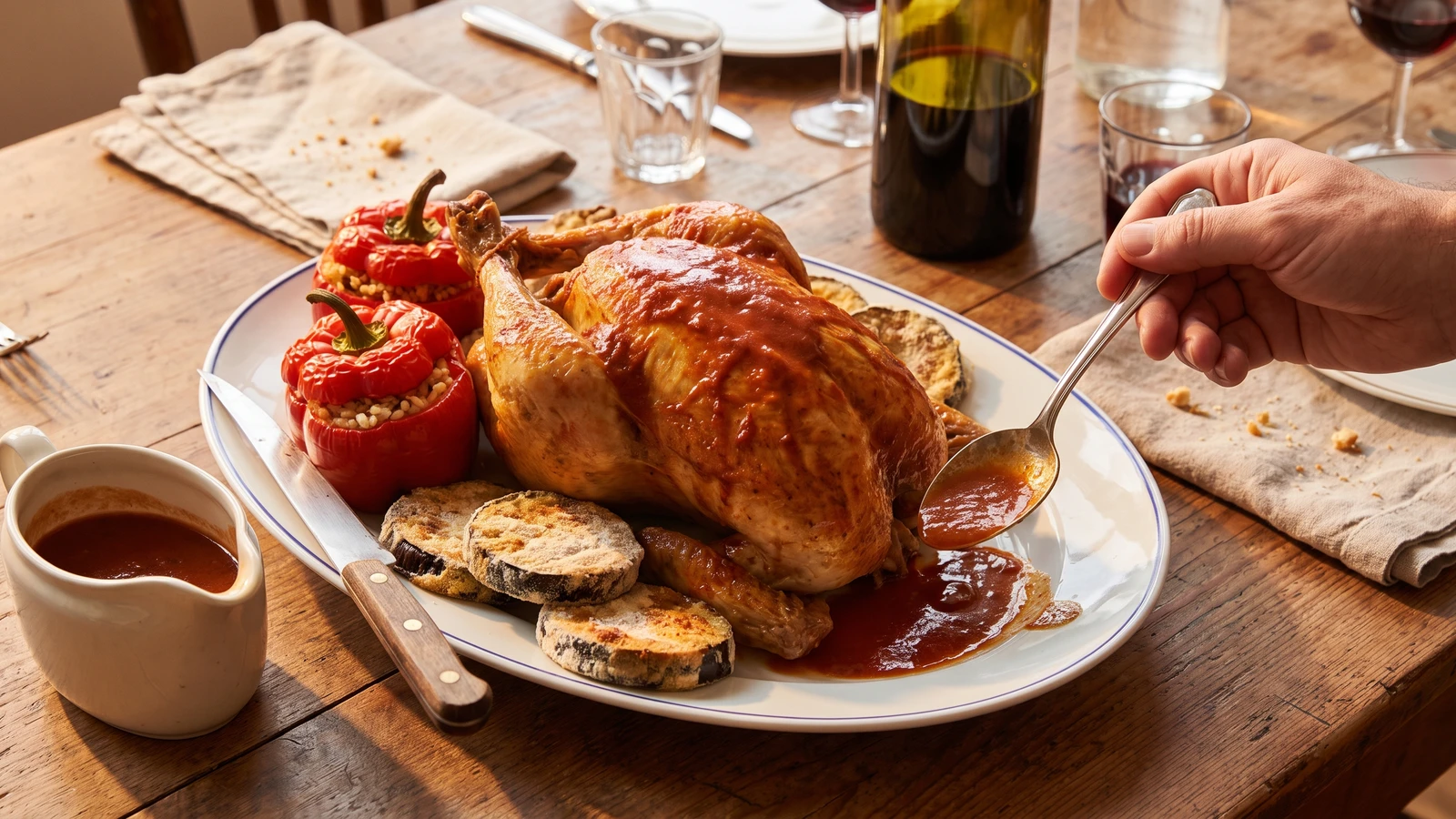
Poularde Andalouse teaches the border between poêling and braising: keep the bird unmoistened in butter, then marry its liquor with tomato demi-glace and flank it with rice-filled peppers and golden eggplant.
Poularde Andalouse (pullet gently butter-roasted under cover, with tomato demi-glace, rice-stuffed peppers, and eggplant) teaches one exact distinction: in a poêling, no stock touches the bird until its cooking is finished. Pour liquid into the casserole too early and it becomes a braise. The two are cousins, but they don't taste the same; poêling keeps the poultry's savour concentrated beneath bronzed skin.
The original expected a saucier on staff, a brown stockpot never off the fire, a salamander ready to colour the garnish, and enough hands to cook three elements at once. Your honest equivalents are a snug covered casserole, dependable prepared veal demi-glace, the oven for the peppers, and one orderly timetable. Building a full brown mother sauce tonight is brigade scaffolding and can go; the unmoistened poêling, the use of its liquor, the perceptibly tomatéd half-glaze, and the alternating garnish are the dish and must stay. One poularde serves four: one cook, one stove, one evening.
The finished bird comes to the table bronze and glossy, coated rather than drowned, with sweet red capsicums holding buttered rice and flour-dusted eggplant roundels browned in butter. Keep your nerve when the covered casserole looks as if it wants liquid. It doesn't. Protect that unmoistened cooking, and the rest is assembly.
Poularde Andalouse belongs to the Parisian classical table, where à l'Andalouse became a garnish name built from ingredients French cooks associated with southern Spain: tomatoes, sweet capsicums, rice, and eggplant. The arrangement traveled through grand kitchens as a precise service formula, the bird centered and the two garnishes alternating at its sides. It is not an Andalusian household chicken dish transplanted whole; it is French nomenclature using an Andalusian larder as its signal.
Quantity
1, 3½ to 4 lb (1.6 to 1.8 kg)
Quantity
4, about 1⅓ lb (600 g)
tops removed and seeds discarded
Quantity
¾ cup (180 ml / 150 g)
Quantity
1¼ cups (300 ml / 300 g), plus more as needed
for cooking the rice, blanching the peppers, and adjusting the sauce
Quantity
2 tablespoons (30 ml / 28 g)
divided
Quantity
1, about 1⅛ lb (500 g)
cut into ½-inch (1.25 cm) roundels
Quantity
½ cup (120 ml / 60 g)
for dredging
Quantity
4 tablespoons (60 ml / 57 g)
divided
Quantity
1¼ cups (300 ml / 300 g)
preferably unsalted or low-salt
Quantity
2 tablespoons (30 ml / 34 g)
Quantity
1 tablespoon (15 ml / 18 g)
divided
Quantity
½ teaspoon (2.5 ml / 1 g)
divided
| Ingredient | Quantity |
|---|---|
| whole poularde or young roasting chicken, prepared according to Poëlings (No. 250), cooking liquor reserved | 1, 3½ to 4 lb (1.6 to 1.8 kg) |
| small red bell pepperstops removed and seeds discarded | 4, about 1⅓ lb (600 g) |
| long-grain white rice | ¾ cup (180 ml / 150 g) |
| waterfor cooking the rice, blanching the peppers, and adjusting the sauce | 1¼ cups (300 ml / 300 g), plus more as needed |
| unsalted butter for the rice and peppersdivided | 2 tablespoons (30 ml / 28 g) |
| medium-large eggplantcut into ½-inch (1.25 cm) roundels | 1, about 1⅛ lb (500 g) |
| all-purpose flourfor dredging | ½ cup (120 ml / 60 g) |
| unsalted butter for sautéing the eggplantdivided | 4 tablespoons (60 ml / 57 g) |
| prepared pourable veal demi-glacepreferably unsalted or low-salt | 1¼ cups (300 ml / 300 g) |
| double-concentrated tomato paste | 2 tablespoons (30 ml / 34 g) |
| fine saltdivided | 1 tablespoon (15 ml / 18 g) |
| freshly ground black pepperdivided | ½ teaspoon (2.5 ml / 1 g) |
Prepare the poularde according to Poëlings (No. 250), scaled to the listed bird, and reserve both the cooked poultry and its finished poëling liquor. Add no stock, wine, or water while the covered bird cooks; that absence of added moisture is what separates poêling from braising. Begin checking the temperature after 55 minutes and continue until the thickest part of the breast reaches 165°F (74°C) and the thigh reaches at least 170°F (77°C). If a splash of liquid goes in by mistake, uncover the casserole and let it evaporate before covering again. Ça se rattrape, though the flavour will lean a little toward a braise. Rest the finished bird under a loose cover while you complete the garnish.
Rinse the rice until the water runs nearly clear, then drain it well. Bring the measured water to a boil with ½ teaspoon of the salt and 1 tablespoon of the butter. Stir in the rice once, cover tightly, and cook over the lowest heat for 14 minutes. Remove it from the heat and leave it covered for 10 minutes, then fluff with a fork and season with a little pepper. The grains should be tender and separate, not wet; if water remains at the bottom, spread the rice on a tray for five minutes before filling the peppers.
Bring a saucepan of water to a boil and season it with 2 teaspoons of the salt. Lower in the hollowed peppers and their tops, blanch for 4 minutes, then drain them upside down until no water remains inside. Brush the peppers with the remaining tablespoon of butter, fill them generously with the rice without packing it hard, and replace the tops slightly askew. Set them upright in a small baking dish and bake at 350°F (180°C) for 25 to 30 minutes, alongside the poularde if convenient, until tender but still able to hold their shape.
Season the eggplant roundels with the remaining salt and pepper immediately before cooking, then dredge them lightly in flour and shake off every loose trace. Melt half the butter in a wide skillet over medium heat and sauté the roundels in two uncrowded batches, adding the remaining butter for the second batch. Give them 3 to 4 minutes per side, until the edges are deep gold and the centers yield under a fork. Flour darkens quickly in butter; if black specks appear, wipe the pan clean before the next batch rather than carrying bitterness forward.
Whisk the tomato paste into the prepared demi-glace while both are still cool, then bring the mixture to a gentle simmer. Cook for 5 minutes, stirring along the bottom, until the sauce is brick-red, glossy, and distinctly tomatoed in both colour and flavour. This is tomatéd half-glaze, not a loose tomato sauce; the demi-glace must remain its backbone.
Whisk the reserved poëling liquor gradually into the tomatéd demi-glace and simmer until the sauce nappes, coating the back of a spoon in a smooth, glossy layer. Taste before adding salt, since prepared demi-glace can be assertive. If the sauce is thin, reduce it a little longer; if it tightens into a glaze, loosen it a tablespoon at a time with hot water. If a fatty sheen separates, whisk in a tablespoon of hot water, let the sauce settle briefly, and skim the excess butter from the surface.
Set the whole poularde in the center of a warm oval platter and spoon the sauce over it until the skin is evenly coated, leaving its bronze colour visible beneath the gloss. Arrange the stuffed capsicums and eggplant roundels in alternation along both sides, exactly as the garnish is meant to read. Spoon a little more sauce around the bird, never over the eggplant, and bring the remaining sauce separately. Carve at the table while the eggplant still has its browned edge. À table!
1 serving (about 650g)
Culinary guides, cultural storytelling, and the editorial depth that makes cooking meaningful.
Discover Culinary ExplorerChef Juliette
John Dory has the delicacy of sole and the firmness of turbot. A light flouring, a quick butter sauté, and nut-brown beurre noisette show exactly why looks never mattered.

Chef Juliette
Fresh haddock proves its delicacy in the meunière pan: a fine flour crust, moist pearly flakes, and beurre noisette sharpened with lemon and parsley, ready from one skillet in half an hour.

Chef Juliette
Éperlans à l’Anglaise turns small fish into a lesson in disciplined coating: boned smelts under a close, crisp crumb, pan-fried in clarified butter and finished with bright, half-melted maître d’hôtel butter.

Chef Juliette
Tiny smelts, shallot, mushrooms, white wine, gratin sauce, and fine bread raspings meet a fierce oven, where the fish must turn tender in the same breath the buttered crust bronzes.