Chef Juliette
Pullets and Capons for Relevés
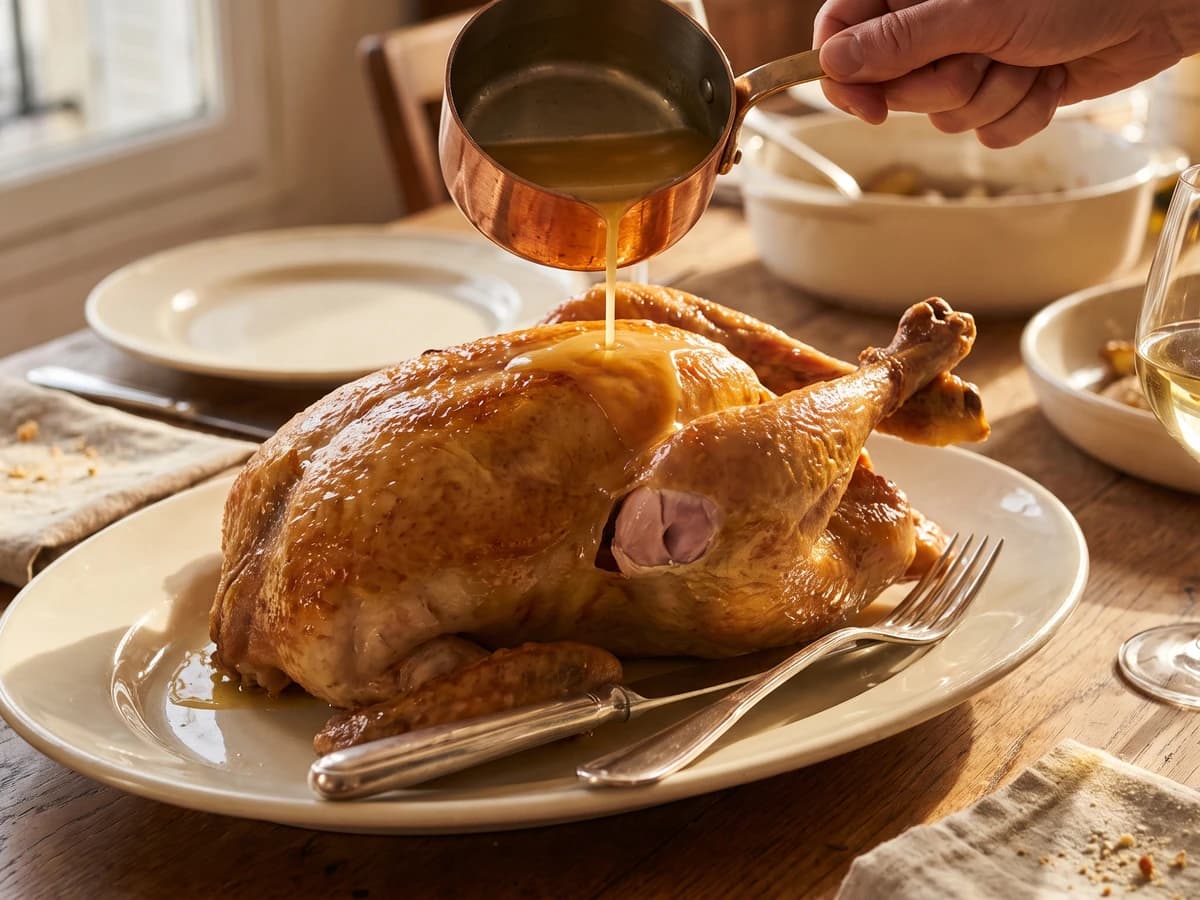
Three roads through the Paris poultry canon, poach, poêler, or braise, with one rule beneath them all: protect the breast with bacon while the legs cook, then turn the liquor into sauce.
A cooking platform built around craft, culture, and the stories behind what we eat.

Created by Chef Juliette
Based on No. 1447, Poularde Ambassadrice, from Le Guide Culinaire (1907) by Auguste Escoffier
A truffle-studded poularde, gently braised in Matignon, rebuilt over buttered asparagus, and coated with sauce suprême that clings in an ivory veil, with glazed lamb sweetbreads ringing the platter.
Poularde Ambassadrice (truffle-studded braised young hen with asparagus, sauce suprême, and glazed lamb sweetbreads) teaches one exacting lesson: luxury only works when structure remains visible. Before you touch a pan, know this: the sauce must be stiff enough to cling to every slice, yet fine enough to leave the bird, asparagus, and sweetbreads recognizably themselves.
The grand kitchen behind it assumed a saucier on staff, a stockpot never off the fire, a salamander ready beside service, and several hands to bone, slice, glaze, and carry the platter hot. The salamander is scaffolding here, because Ambassadrice is coated rather than gratinéed. For one cook, one stove, one evening, a lidded braiser replaces the braising station, damp cheesecloth replaces wide muslin, a paring knife replaces the larding needle, and the strained cooking liquor becomes the sauce's stock-rich foundation. The Matignon (No. 227), hot reconstruction, truffle, asparagus, sweetbreads, and sauce suprême stay. They are the dish.
When it is right, black truffle marks the pale breast, asparagus keeps its green bite, the sweetbreads wear a lacquered butter sheen, and the sauce settles over everything without turning the platter into an ivory puddle. Watch the sauce more closely than the clock. Its consistency decides the dish.
Poularde Ambassadrice belongs to the ceremonial Parisian table, where named garnitures identified the truffle, asparagus, sweetbread, and sauce architecture of a poultry relevé. The title does not claim a provincial origin; Ambassadrice is a grand-service name for an elaborate composition built around a whole bird. Its reconstruction is often mistaken for ornament alone, but the method traveled into formal home dining because it kept the breast hot, made service swift, and ensured each guest received both meat and garnish.
Quantity
1 bird, 4½ to 5 pounds (2 to 2.3 kg)
Quantity
2 ounces (55 g)
divided
Quantity
2½ teaspoons (12 ml / 15 g)
divided
Quantity
½ teaspoon (2.5 ml / 1 g)
Quantity
2 cups (475 ml / about 400 g) Matignon (No. 227)
Quantity
1 application of The Way to Serve Poultry Relevés Quickly and Hot (No. 1444)
Quantity
4 cups (950 ml / 960 g)
divided
Quantity
12 ounces (340 g)
Quantity
2 pounds (900 g)
trimmed into 2-inch tips, stalks reserved for another dish
Quantity
9 tablespoons (½ cup plus 1 tablespoon / 135 ml / 127 g)
divided
Quantity
¼ cup (60 ml / 30 g)
Quantity
¾ cup (180 ml / 180 g)
with 1 tablespoon reserved
Quantity
as needed
| Ingredient | Quantity |
|---|---|
| poularde or well-fleshed young hen | 1 bird, 4½ to 5 pounds (2 to 2.3 kg) |
| fresh black truffle or drained whole preserved black truffledivided | 2 ounces (55 g) |
| fine sea saltdivided | 2½ teaspoons (12 ml / 15 g) |
| finely ground white pepper | ½ teaspoon (2.5 ml / 1 g) |
| prepared Matignon | 2 cups (475 ml / about 400 g) Matignon (No. 227) |
| The Way to Serve Poultry Relevés Quickly and Hot | 1 application of The Way to Serve Poultry Relevés Quickly and Hot (No. 1444) |
| unsalted, gelatin-rich chicken stockdivided | 4 cups (950 ml / 960 g) |
| lamb sweetbreads | 12 ounces (340 g) |
| medium asparagustrimmed into 2-inch tips, stalks reserved for another dish | 2 pounds (900 g) |
| unsalted butterdivided | 9 tablespoons (½ cup plus 1 tablespoon / 135 ml / 127 g) |
| all-purpose flour | ¼ cup (60 ml / 30 g) |
| heavy creamwith 1 tablespoon reserved | ¾ cup (180 ml / 180 g) |
| cold water and ice | as needed |
Rinse the lamb sweetbreads and set them in a bowl of very cold water for 1 hour, changing the water twice. This draws out blood and gives the finished sweetbreads a clean, pale interior. Keep them cold while they soak, and prepare the poularde at the same time.
Dry the poularde thoroughly. Cut 1¼ ounces (35 g) of the truffle into short, narrow matchsticks. Using the tip of a paring knife, make small angled channels in the thickest parts of the breasts and thighs, then slip in the truffle without tearing broad openings in the flesh. Season the bird inside and out with 1½ teaspoons of the salt and half the white pepper. Let it stand for 30 minutes so the truffle begins perfuming the meat.
Heat the oven to 325°F (160°C). Dampen a large square of food-grade cheesecloth and wring it well. Spread half the prepared Matignon (No. 227) over its centre, set the poularde breast-side up on top, and cover the bird with the remaining Matignon. Draw the cheesecloth around it and tie it loosely with kitchen twine, keeping the vegetables against the skin. Set the packet in a lidded oval braiser and pour 3 cups (710 ml) of the chicken stock around it, not over it. Bring the liquid only to a bare simmer.
Cover the braiser and transfer it to the oven. Braise for 75 to 90 minutes, basting the packet twice, until the thickest parts of both breast and thigh register at least 165°F (74°C). The liquor should barely tremble. If it begins boiling hard, pull the pot from the oven, add a small ladle of cool stock, and lower the heat by 25°F (15°C). The bird has not failed, but a hard boil will tighten the flesh and cloud the sauce. Lift out the packet and rest it for 15 minutes, reserving every drop of cooking liquor.
While the poularde braises, drain the sweetbreads and place them in a saucepan of fresh cold water. Bring them slowly to a bare simmer, cook for 3 minutes, then transfer them to ice water. Peel away the outer membranes and trim any firm tubes or gristle. Press the sweetbreads between two trays with a few tins on top for 20 minutes, then divide them into eight neat pieces. Cut the remaining truffle into fine matchsticks and stud each piece. Melt 2 tablespoons (30 ml / 28 g) of the butter in a sauté pan, colour the sweetbreads lightly, and add the remaining 1 cup (240 ml) stock. Cover and braise gently for about 15 minutes, until firm and cooked through. Uncover, reduce the liquid, and baste until the sweetbreads carry a thin, glossy glaze. If the glaze catches before they are tender, add 2 tablespoons of stock or water and continue gently.
Blanch the asparagus tips in well-salted boiling water for 2 to 3 minutes, until vivid green and just tender, then cool them in ice water and drain thoroughly. Set aside 24 even tips and arrange them as eight petits fagots, small bundles of three tips each. Tie them loosely with kitchen twine for reheating. Near serving time, melt 2 tablespoons (30 ml / 28 g) butter in a wide pan with 2 tablespoons of strained poultry cooking liquor. Warm the bundles and remaining asparagus separately, turning them until glossy. Remove the twine from the bundles. The loose asparagus should cohere in the butter without becoming soft enough to collapse.
Unwrap the rested poularde, scraping the Matignon back into its cooking liquor. Apply The Way to Serve Poultry Relevés Quickly and Hot (No. 1444): remove the two suprêmes, the breast fillets, whole and keep their shape intact. Through the opening, use poultry shears and a narrow knife to remove the breastbone and rib bones while leaving the back, legs, and outer body intact. Set the body on a warmed oval platter. Hold the suprêmes in ½ cup (120 ml) of strained cooking liquor over very low heat, never allowing the liquid to simmer.
Pass the remaining braising liquor and Matignon through a fine sieve without mashing the vegetables, then skim away the fat. Reduce the liquor to 2 cups (475 ml), adding a little unused stock only if you are short. In a clean saucepan, melt 3 tablespoons (45 ml / 42 g) butter, stir in the flour, and cook this pale roux for 2 minutes without letting it colour. Whisk in the hot liquor gradually, then simmer for 12 to 15 minutes, skimming as needed. Add all but the reserved tablespoon of cream and reduce until the sauce is nappant, meaning it coats a spoon heavily and a finger drawn through it leaves a clean path. Pass it through the fine sieve once more, then whisk in 2 tablespoons (30 ml / 28 g) cold butter off the heat. If the sauce is thin, simmer it longer. If it becomes pasty, loosen it spoonful by spoonful with stock. If the butter separates, remove the pan from the heat and whisk in the reserved cold cream. Ça se rattrape.
Fill the boned breast cavity with the loose buttered asparagus, smoothing it into the original curve of the bird. Slice the warm suprêmes across the grain into even pieces and overlap them over the asparagus to reconstruct the breast. Spoon over only enough sauce suprême to form a smooth, clinging veil; the slices should remain visible beneath it. Alternate the eight glazed sweetbread pieces with the eight asparagus bundles around the poularde, then carry the platter directly to the table with the remaining sauce in a warm sauceboat. Carve the legs for second helpings. À table!
1 serving (about 720g)
Culinary guides, cultural storytelling, and the editorial depth that makes cooking meaningful.
Discover Culinary ExplorerChef Juliette
Three roads through the Paris poultry canon, poach, poêler, or braise, with one rule beneath them all: protect the breast with bacon while the legs cook, then turn the liquor into sauce.
Chef Juliette
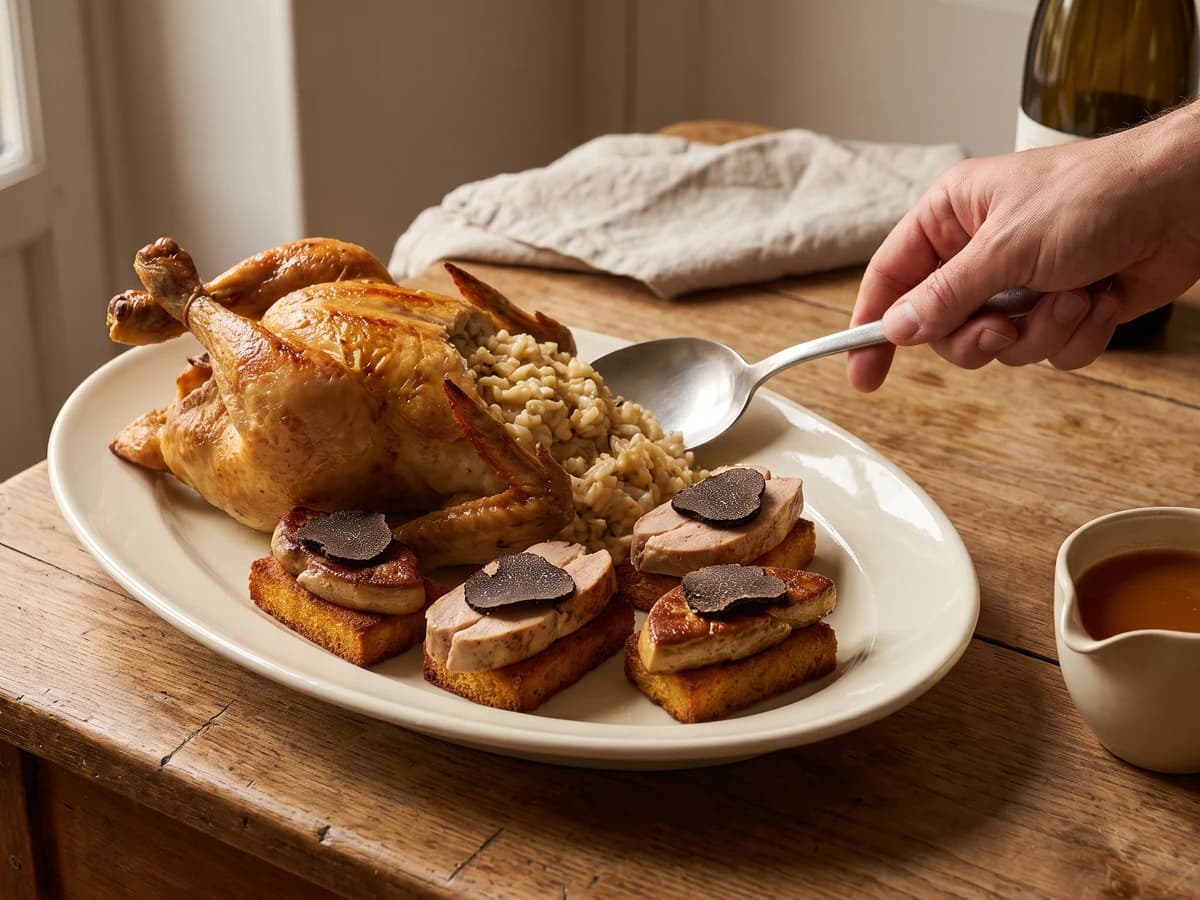
The service method that protects a grand poultry dish: carve the suprêmes in the kitchen, keep them in their liquor, rebuild the bird with pilaf, and send every guest a hot, complete plate.
Chef Juliette
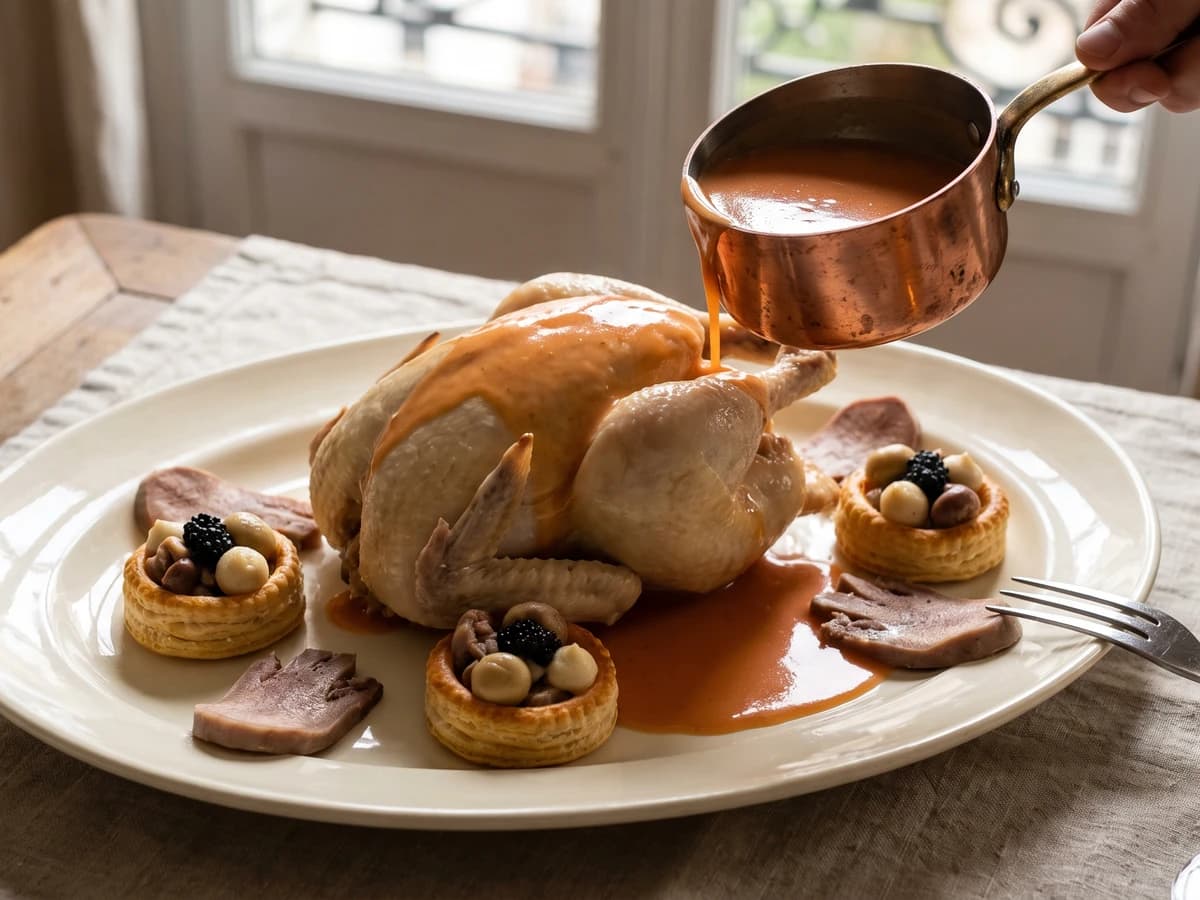
The marshal’s poularde teaches gentle poaching: a rice-stuffed bird held at a bare tremble, then cloaked in sauce Albuféra and surrounded by truffle tartlets, tiny quenelles, mushrooms, and salted tongue.
Chef Juliette
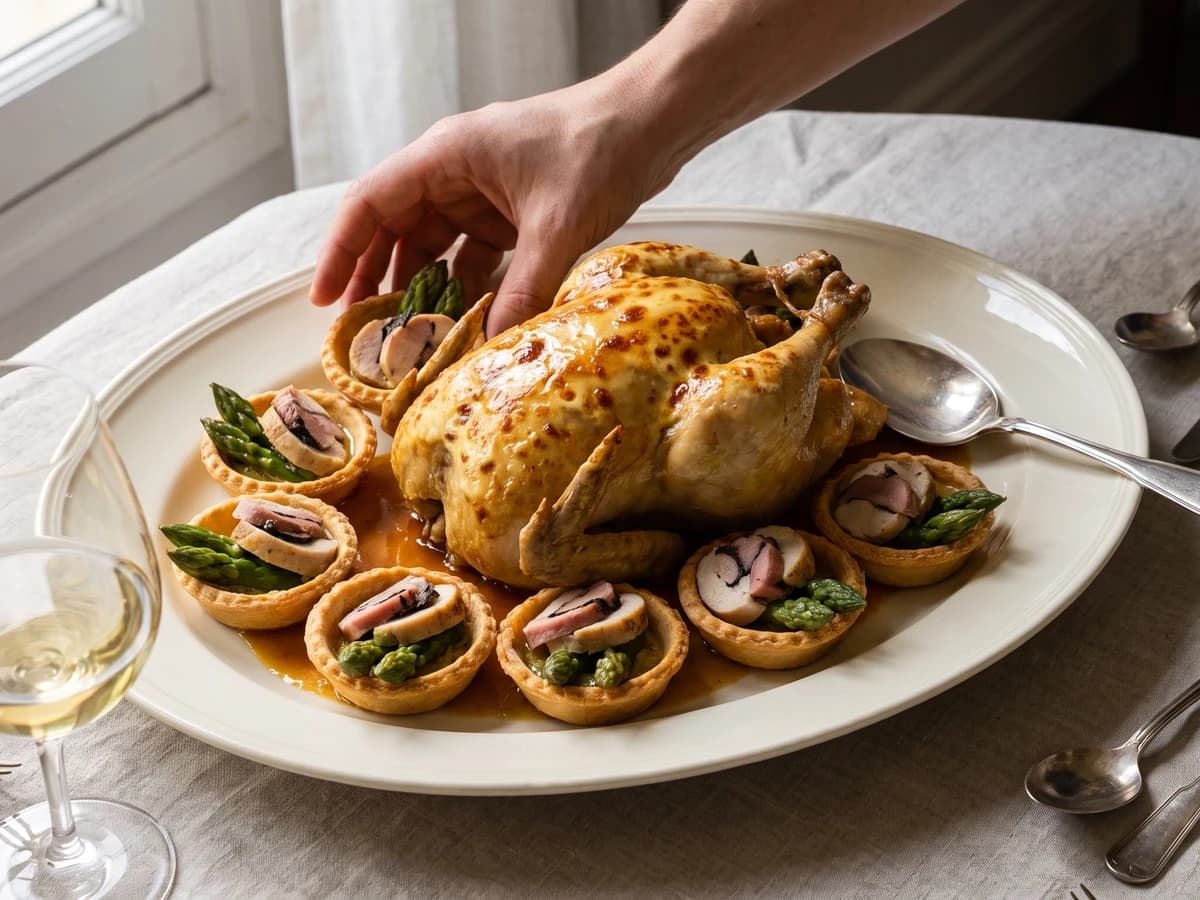
Poularde Alexandra turns one poached bird into a small ceremony: truffle and tongue in the sliced suprêmes, feather-light mousseline beneath a bronzed Mornay coat, and buttered asparagus tartlets all around.