
Chef Juliette
John Dory (St. Pierre)
John Dory has the delicacy of sole and the firmness of turbot. A light flouring, a quick butter sauté, and nut-brown beurre noisette show exactly why looks never mattered.
A cooking platform built around craft, culture, and the stories behind what we eat.
Created by Chef Juliette
Based on No. 1445, Poularde Albufera, from Le Guide Culinaire (1907) by Auguste Escoffier
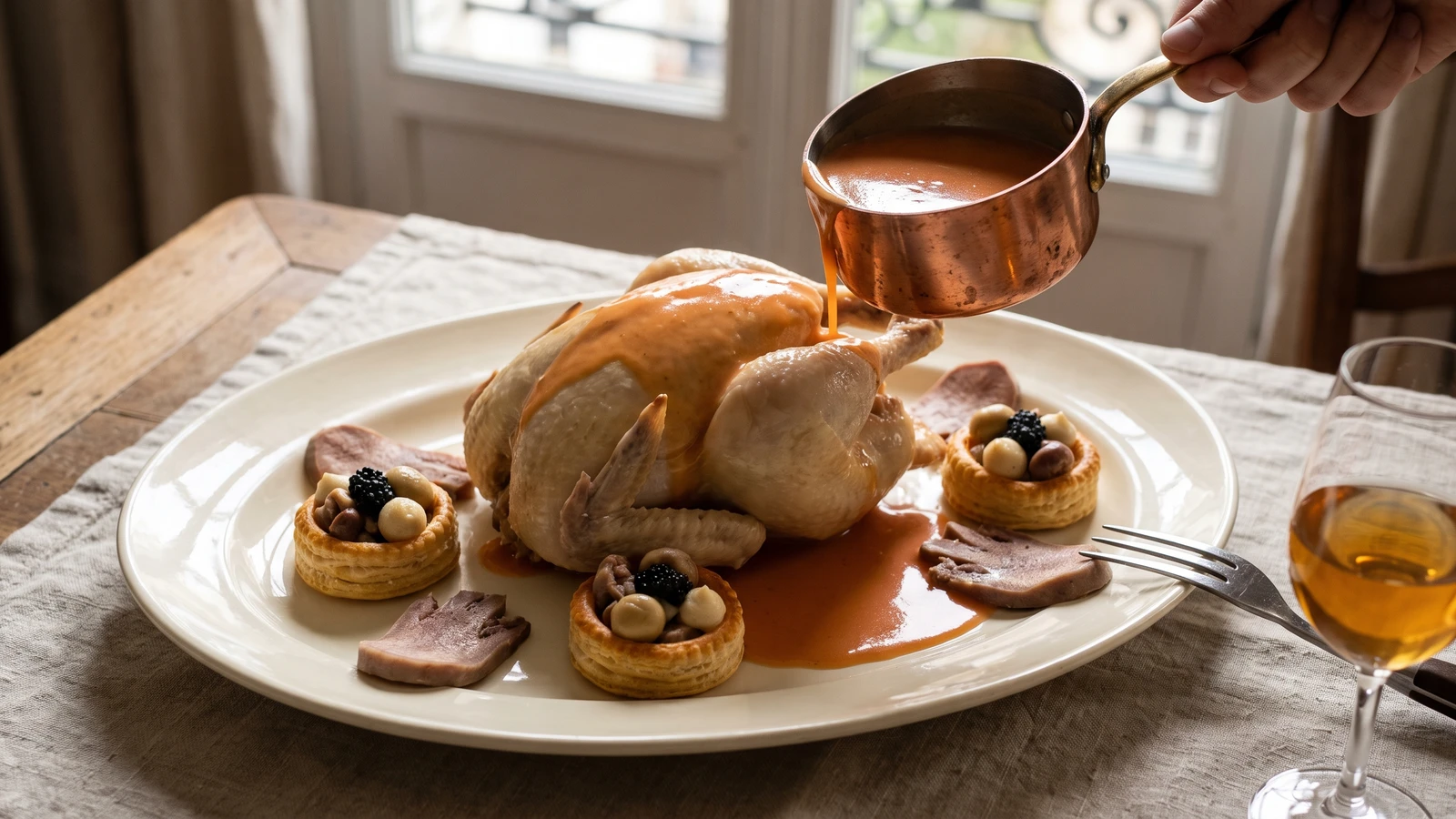
The marshal’s poularde teaches gentle poaching: a rice-stuffed bird held at a bare tremble, then cloaked in sauce Albuféra and surrounded by truffle tartlets, tiny quenelles, mushrooms, and salted tongue.
Poularde Albufera (rice-stuffed pullet coated in sauce Albuféra) teaches the discipline of poaching a filled bird. The rice must finish cooking without forcing the skin apart, the flesh must stay succulent, and the sauce must cling in a satin coat. All three depend on one quiet fact: the poaching liquid may tremble, but it must never boil.
The book’s kitchen assumed a saucier on staff, stock never off the fire, a pastry bench turning out tartlet shells, and spare hands to poach tiny garnishes while the bird rested. Your honest equivalents are rich unsalted stock, a small saucepan, prepared savory tartlet shells, and a low oven standing in for the hot cupboard. The salamander can stay cold because nothing here is gratinéed. The pastry-station labor is scaffolding and may go; the Pilaff Rice (for the Stuffing of Fowls) (No. 2256), sauce, truffle, quenelles, mushrooms, offal, and salted tongue are the dish and remain.
The finished poularde comes to the table ivory and gleaming, its tartlets crowded generously around it and the warm blush of beurre de piment just visible in the sauce. One cook, one stove, one evening. Before you touch the pot, remember the step that decides everything: stuff loosely, then poach at a bare tremble.
Poularde Albufera belongs to the ceremonial Paris canon and carries the title of Marshal Suchet, Duke of Albufera, into the classical sauce repertory. The composed platter joins a poached poularde to foie gras and truffle pilaff, sauce suprême deepened with meat glaze and pimento butter, then an exact garland of tartlets, quenelles, mushrooms, cocks’ kidneys, and salted tongue. Sauce Albuféra is sometimes mistaken for an ordinary cream sauce, but its glaze and beurre de piment give it authority and its faint warm tint.
Quantity
1 bird, 4 to 5 pounds (1.8 to 2.3 kg)
giblets removed
Quantity
2 cups (475 ml / 430 g) Pilaff Rice (for the Stuffing of Fowls) (No. 2256)
three-quarters cooked and thoroughly chilled
Quantity
10 cups (2.4 L / 2.4 kg)
Quantity
Up to 2 cups (475 ml / 475 g)
as needed to cover the bird
Quantity
1 medium (150 g)
quartered
Quantity
1 medium (100 g)
cut into large pieces
Quantity
1 stalk (50 g)
cut into large pieces
Quantity
1
Quantity
2½ teaspoons (12.5 ml / 15 g)
divided
Quantity
½ teaspoon (2.5 ml / 1 g)
divided
Quantity
¾ cup diced (180 ml / 115 g)
kept very cold
Quantity
1
Quantity
⅓ cup (80 ml / 80 g)
kept very cold
Quantity
1 pinch
Quantity
4 shells, each about 2 inches (5 cm) wide
Quantity
1 small truffle (30 g)
fresh or well-drained preserved
Quantity
8 mushrooms (85 g)
trimmed
Quantity
8 cocks’ kidneys (100 g), or ½ cup small sweetbread lobes (120 ml / 100 g)
cleaned, or soaked, blanched, peeled, and pressed
Quantity
4 thin slices (60 g)
Quantity
2 tablespoons (30 ml / 28 g)
Quantity
2 tablespoons (30 ml / 28 g)
Quantity
¼ cup (60 ml / 30 g)
Quantity
2½ cups (590 ml / 590 g)
taken from the stock used for the bird
Quantity
1 cup (240 ml / 240 g)
with 1 tablespoon reserved for rescue
Quantity
2 tablespoons (30 ml / 35 g)
Quantity
4 tablespoons (60 ml / 56 g)
softened
Quantity
1½ tablespoons (22 ml / 22 g)
Quantity
1 small pinch
| Ingredient | Quantity |
|---|---|
| whole poularde or plump roasting chickengiblets removed | 1 bird, 4 to 5 pounds (1.8 to 2.3 kg) |
| prepared stuffing ricethree-quarters cooked and thoroughly chilled | 2 cups (475 ml / 430 g) Pilaff Rice (for the Stuffing of Fowls) (No. 2256) |
| rich unsalted chicken stock | 10 cups (2.4 L / 2.4 kg) |
| cold wateras needed to cover the bird | Up to 2 cups (475 ml / 475 g) |
| yellow onionquartered | 1 medium (150 g) |
| carrotcut into large pieces | 1 medium (100 g) |
| celerycut into large pieces | 1 stalk (50 g) |
| bouquet garni | 1 |
| fine saltdivided | 2½ teaspoons (12.5 ml / 15 g) |
| ground white pepperdivided | ½ teaspoon (2.5 ml / 1 g) |
| skinless chicken breastkept very cold | ¾ cup diced (180 ml / 115 g) |
| large egg white | 1 |
| heavy cream for the quenelleskept very cold | ⅓ cup (80 ml / 80 g) |
| freshly grated nutmeg | 1 pinch |
| savory tartlet shells | 4 shells, each about 2 inches (5 cm) wide |
| whole black trufflefresh or well-drained preserved | 1 small truffle (30 g) |
| small button mushroomstrimmed | 8 mushrooms (85 g) |
| cocks’ kidneys or prepared veal sweetbreadcleaned, or soaked, blanched, peeled, and pressed | 8 cocks’ kidneys (100 g), or ½ cup small sweetbread lobes (120 ml / 100 g) |
| cooked salted ox tongue | 4 thin slices (60 g) |
| unsalted butter for the garnish | 2 tablespoons (30 ml / 28 g) |
| unsalted butter for the white roux | 2 tablespoons (30 ml / 28 g) |
| all-purpose flour | ¼ cup (60 ml / 30 g) |
| reserved strained poaching liquortaken from the stock used for the bird | 2½ cups (590 ml / 590 g) |
| heavy cream for sauce Albuférawith 1 tablespoon reserved for rescue | 1 cup (240 ml / 240 g) |
| glace de viande or concentrated unsalted demi-glace | 2 tablespoons (30 ml / 35 g) |
| unsalted butter for the beurre de pimentsoftened | 4 tablespoons (60 ml / 56 g) |
| smooth roasted red pepper purée | 1½ tablespoons (22 ml / 22 g) |
| cayenne pepper | 1 small pinch |
Chill the bowl and blade of a small processor. Add the diced chicken with ¼ teaspoon of the salt and a pinch of white pepper, then process until smooth and tacky. Add the egg white and nutmeg, process again, then pour in the cold cream in three additions, reserving the final spoonful until the mixture is smooth. This mousseline, a cream-enriched forcemeat, must remain cold enough to feel firm. If it turns loose or grainy, stop immediately, chill the bowl for 10 minutes, then process in the reserved cold cream. Ça se rattrape. Cover and refrigerate.
Season the poularde inside and out with 1½ teaspoons of the salt and a little white pepper. Spoon the cold Pilaff Rice (for the Stuffing of Fowls) (No. 2256) loosely into the body cavity, leaving a two-finger space at the opening so the rice can finish expanding. Do not force in every last spoonful if the cavity is full. Close the opening with a skewer, tie the legs together, and pass a length of kitchen twine beneath the bird to make a lifting sling. Pack the rice tightly and it will press against the skin before the bird is cooked.
Set the poularde breast-side up in a snug stockpot. Add the chicken stock, onion, carrot, celery, and bouquet garni, then enough cold water to cover the bird. Bring the liquid up slowly until it reaches 176 to 185°F (80 to 85°C), with only an occasional lazy movement at the surface. Skim, cover with a parchment cartouche, and keep the lid slightly ajar. Hold that bare tremble for 60 to 75 minutes, until the centre of the stuffing and the deepest part of the thigh both reach 165°F (74°C). If the liquid begins bubbling, lift the pot off the heat at once and lower the burner before returning it. If the skin splits, lay clean damp muslin firmly over the opening to contain the rice and continue more gently; the sauce will cloak the seam.
While the bird poaches, use a ¼-inch (6 mm) melon baller or the tip of a small spoon to raise pea-size pieces from the truffle. Save every trimming. Cut each tongue slice into a pointed cock’s-comb shape with four or five notches along one edge. Mix the softened butter, roasted pepper purée, and cayenne into a smooth beurre de piment, or pimento butter, and keep it cool but pliable. Warm the tartlet shells in a 300°F (150°C) oven for 5 minutes near serving time.
Lift the cooked poularde by its twine sling, let it drain, and transfer it to a warm platter beneath buttered parchment. Hold it in a 170°F (75°C) oven for no more than 30 minutes. Strain the poaching liquor. Bring 2 cups of it back to a bare tremble and drop in pea-size ovals of mousseline, shaping them with two small spoons. Poach the quenelles for about 2 minutes, until firm and cooked through, then drain them. Poach the cocks’ kidneys in the same liquor for 3 to 4 minutes, until opaque and just firm. If using sweetbread instead, brown its prepared lobes lightly in half the garnish butter. Cook the button mushrooms in the remaining butter until tender but still pale. Hold everything in a warm bowl with two spoonfuls of poaching liquor, adding the truffle pearls only after the heat is off.
Melt the roux butter in a saucepan, stir in the flour, and cook this roux blanc, or white roux, for 2 minutes without letting it color. Whisk in the 2½ cups of reserved hot poaching liquor a little at a time, scraping into the corners so no flour hides there. Simmer gently for 8 minutes, then add the cream, keeping 1 tablespoon aside. Reduce for 10 to 15 minutes, until this sauce suprême, a velouté enriched with cream, coats the back of a spoon. If it is lumpy, strain it. If it tightens too far, loosen it with another spoonful of poaching liquor.
Whisk the glace de viande into the sauce suprême and simmer for 2 minutes. Remove the pan from the heat, then whisk in the beurre de piment a small piece at a time. The finished sauce Albuféra should be glossy, full-bodied, and warm ivory with the faintest coral cast. Do not boil it after the butter goes in. If it separates, place the reserved tablespoon of warm cream in a clean saucepan and whisk the broken sauce into it one spoonful at a time until it returns to a smooth emulsion. Taste for salt and white pepper.
Remove the twine and parchment from the poularde. Coat the whole bird generously with sauce Albuféra, letting the sauce pool beneath it rather than smearing the platter. Divide the truffle pearls, quenelles, mushrooms, and cocks’ kidneys or sweetbread among the warm tartlet shells, including the saved truffle trimmings, then bind each filling with a spoonful of sauce. Arrange the tartlets around the poularde and place one cock’s-comb slice of salted tongue between each pair. Serve the remaining sauce in a warm saucière and carve the bird at the table. À table!
1 serving (about 700g)
Culinary guides, cultural storytelling, and the editorial depth that makes cooking meaningful.
Discover Culinary ExplorerChef Juliette
John Dory has the delicacy of sole and the firmness of turbot. A light flouring, a quick butter sauté, and nut-brown beurre noisette show exactly why looks never mattered.

Chef Juliette
Fresh haddock proves its delicacy in the meunière pan: a fine flour crust, moist pearly flakes, and beurre noisette sharpened with lemon and parsley, ready from one skillet in half an hour.

Chef Juliette
Éperlans à l’Anglaise turns small fish into a lesson in disciplined coating: boned smelts under a close, crisp crumb, pan-fried in clarified butter and finished with bright, half-melted maître d’hôtel butter.

Chef Juliette
Tiny smelts, shallot, mushrooms, white wine, gratin sauce, and fine bread raspings meet a fierce oven, where the fish must turn tender in the same breath the buttered crust bronzes.