
Chef Juliette
John Dory (St. Pierre)
John Dory has the delicacy of sole and the firmness of turbot. A light flouring, a quick butter sauté, and nut-brown beurre noisette show exactly why looks never mattered.
A cooking platform built around craft, culture, and the stories behind what we eat.
Created by Chef Juliette
Based on No. 1442, Mousselines Froides de Jambon, from Le Guide Culinaire (1907) by Auguste Escoffier
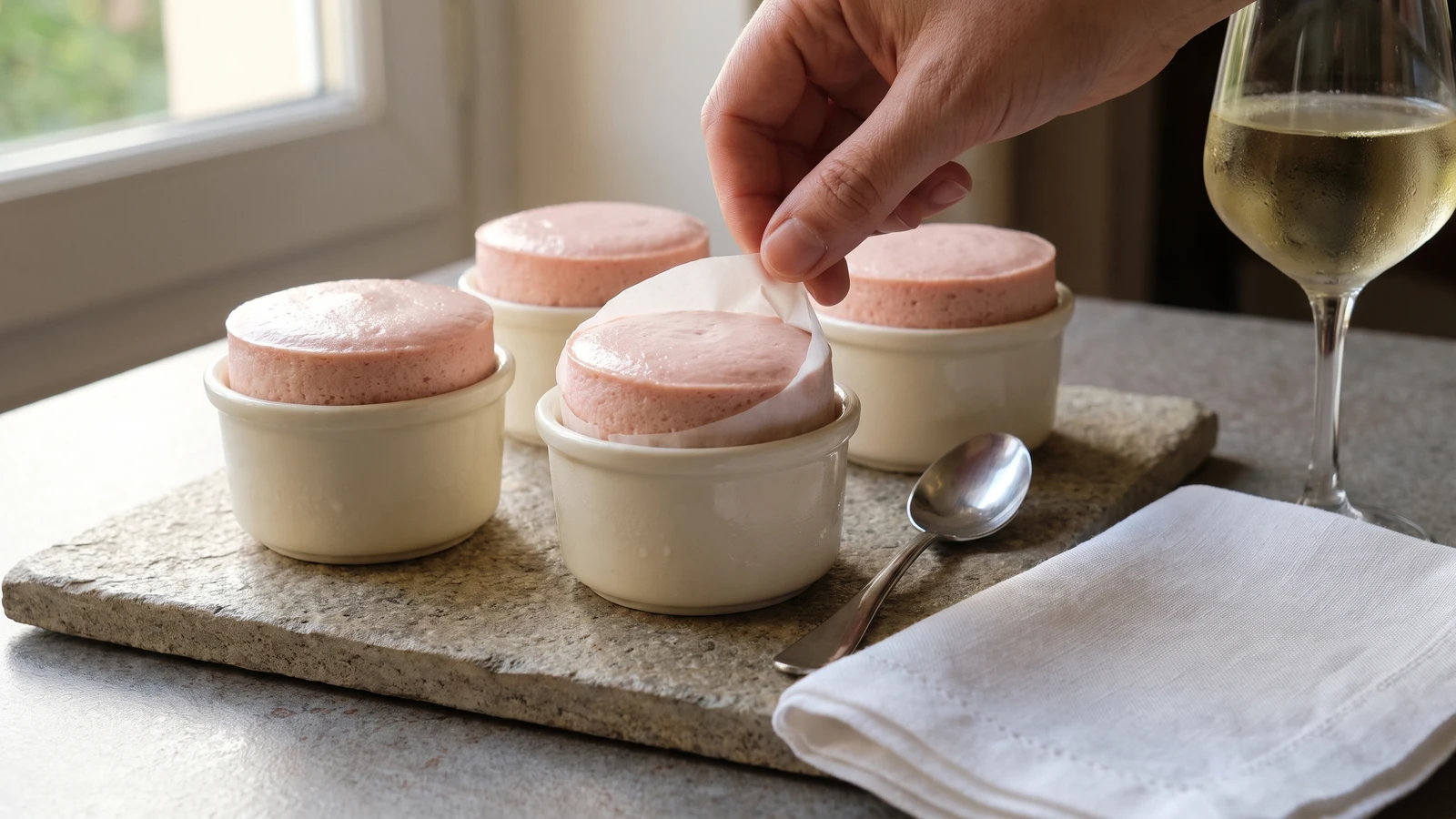
A satin ham mousse set over clear aspic in little cassolettes, its paper collar holding each portion proudly above the rim: cold, generous, and made ahead for the table.
Mousselines Froides de Jambon (individual chilled ham mousses) teach the discipline of cold setting: air gives tenderness, gelatin gives shape, and neither can rescue a layer poured at the wrong moment. Before touching a pan, know the one true thing. The aspic floor must be completely firm before the mousse meets it, or the layers blur and the little mousselines slump rather than standing proud.
The original kitchen assumed a saucier keeping clear aspic ready, ham already pounded to silk, silver timbales, and plenty of ice. At home, measured gelatin and clear chicken stock replace the stockpot that never went cold, a food processor replaces the mortar, porcelain cassolettes replace silver, and the refrigerator does the work of the ice chest. Those things are brigade scaffolding and may go. The thin aspic base and the white paper collar are the dish, so they stay. One cook, one stove, one evening.
The finished mousse should taste directly of ham, rounded by real cream, with a texture that yields under the spoon but holds cleanly above the rim. Keep the mixture cold enough to protect its air, yet fluid enough to fill without pockets. Above all, chill the aspic in every cassolette until absolutely firm before you add the mousse. That is the step that decides the dish.
Mousselines froides de jambon belong to the classical Parisian cold table, where aspic protected delicate preparations and individual cassolettes turned a larger mousse into a portion for one guest. From grand dining rooms they passed naturally to bourgeois dinner parties because they could be completed before the guests arrived. In the canon, mousse and mousseline do not describe different mixtures here: a mousse serves several people, while mousselines are moulded individually, their paper collars borrowing the proud silhouette of a soufflé.
Quantity
2 tightly packed cups (480 ml / 300 g), replacing lobster in Petites Mousses de Homard (No. 958)
chilled and diced
Quantity
1¼ cups (300 ml / 300 g)
cold
Quantity
2 teaspoons (10 ml / 6 g)
Quantity
¾ cup (180 ml / 180 g)
thoroughly chilled
Quantity
⅛ teaspoon (0.6 ml / 0.3 g)
| Ingredient | Quantity |
|---|---|
| lean, unsmoked cooked hamchilled and diced | 2 tightly packed cups (480 ml / 300 g), replacing lobster in Petites Mousses de Homard (No. 958) |
| clear, well-seasoned chicken stockcold | 1¼ cups (300 ml / 300 g) |
| unflavored powdered gelatin | 2 teaspoons (10 ml / 6 g) |
| heavy creamthoroughly chilled | ¾ cup (180 ml / 180 g) |
| freshly ground white pepper | ⅛ teaspoon (0.6 ml / 0.3 g) |
Pour ¼ cup (60 ml / 60 g) of the cold stock into a small bowl and sprinkle the gelatin evenly across its surface. Leave it for 5 minutes, until every grain has swollen and the mixture looks like a soft sponge. Heat the remaining 1 cup (240 ml / 240 g) of stock just until hot, never boiling, then whisk in the bloomed gelatin until completely dissolved. Strain through a fine sieve and cool it over an ice bath, stirring occasionally, until fluid and no longer warm. Do not let it set.
Following the moulding method of Petites Mousses de Homard (No. 958), spoon 2 tablespoons (30 ml / 30 g) of liquid aspic into the bottom of each cassolette. Set them on a level refrigerator shelf until the aspic is firm from edge to edge, about 20 to 30 minutes. Press it gently with a clean fingertip: it must resist without leaving liquid behind. If it is still tacky, give it another 10 minutes. A soft layer will mingle with the filling, but ça se rattrape before filling simply by chilling it longer.
Once the aspic bases are firm, cut four strips of white baking parchment long enough to overlap around the cassolettes and wide enough to rise 1 inch (2.5 cm) above their rims. Wrap one tightly around each vessel and secure the overlap on the outside with tape or kitchen twine. Keep tape away from the food. The silver timbales of the old service are optional ceremony; these collars are not, because they give the mousselines their characteristic soufflé height.
Put the chilled ham, white pepper, and reserved ¾ cup (180 ml / 180 g) of fluid aspic in a food processor. Petites Mousses de Homard (No. 958) supplies the individual moulding method, and the source directs ham to replace lobster here. Process in short bursts, scraping the bowl frequently, until the mixture is completely smooth. Push it through a fine sieve into a chilled bowl; the processor replaces the old pounding, but the sieve remains because it removes every stubborn fibre that would make the mousse coarse.
Set the sieved ham mixture over ice and stir until it is cold and slightly thickened, like cream beginning to coat a spoon. Whip the chilled heavy cream to soft folds that droop from the whisk, not stiff peaks. Fold one-third into the ham to lighten it, then fold in the remainder with broad strokes until no white streaks remain. If the ham mixture sets into little gelatinous grains before the cream is incorporated, stop. Ça se rattrape: hold the bowl over barely warm water and fold gently just until smooth, then return it to the ice. Do not beat it, or you will lose the air that makes the mousse tender.
Divide the mousse among the collared cassolettes, filling each vessel to about ¾ inch (2 cm) above its ceramic rim. Press the first spoonful gently into the corners so no large air pockets remain, then add the rest without packing it down. Level the tops with the back of a spoon. The mixture should hold softly within the paper; if it flows like cream, chill the bowl over ice for 5 minutes before continuing.
Refrigerate the mousselines on a level shelf for at least 4 hours, until thoroughly cold and set. Once the surfaces are firm, cover them without letting wrapping touch the mousse. At serving time, loosen the tape or twine and peel each paper collar away slowly, supporting the mousse with a small palette knife if any spot clings. Bring the cassolettes to the table cold, with their pale ham mousse standing proudly above the rims. À table!
1 serving (about 197g)
Culinary guides, cultural storytelling, and the editorial depth that makes cooking meaningful.
Discover Culinary ExplorerChef Juliette
John Dory has the delicacy of sole and the firmness of turbot. A light flouring, a quick butter sauté, and nut-brown beurre noisette show exactly why looks never mattered.

Chef Juliette
Fresh haddock proves its delicacy in the meunière pan: a fine flour crust, moist pearly flakes, and beurre noisette sharpened with lemon and parsley, ready from one skillet in half an hour.

Chef Juliette
Éperlans à l’Anglaise turns small fish into a lesson in disciplined coating: boned smelts under a close, crisp crumb, pan-fried in clarified butter and finished with bright, half-melted maître d’hôtel butter.

Chef Juliette
Tiny smelts, shallot, mushrooms, white wine, gratin sauce, and fine bread raspings meet a fierce oven, where the fish must turn tender in the same breath the buttered crust bronzes.