
Chef Juliette
John Dory (St. Pierre)
John Dory has the delicacy of sole and the firmness of turbot. A light flouring, a quick butter sauté, and nut-brown beurre noisette show exactly why looks never mattered.
A cooking platform built around craft, culture, and the stories behind what we eat.
Created by Chef Juliette
Based on No. 1419b, Jambon de Prague à la Norfolk, from Le Guide Culinaire (1907) by Auguste Escoffier
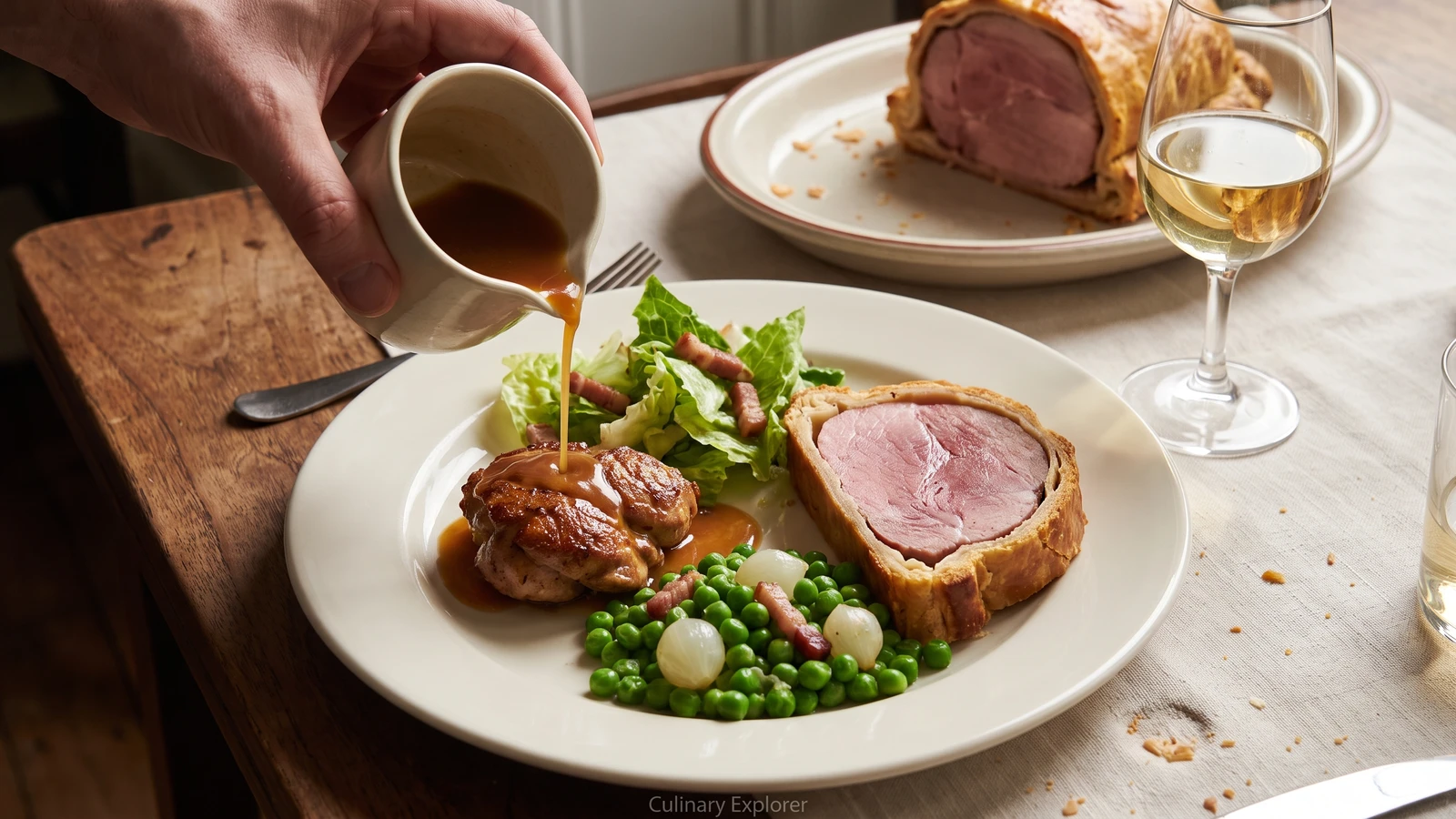
A burnished slice of Prague ham in pastry, a tender collop of veal sweetbread, peas à la paysanne, and one lucid braising liquor: a composed classical main made workable for four.
Jambon de Prague à la Norfolk (Prague ham Norfolk-style) teaches composed service: four distinct things must arrive together, yet only one of them makes the sauce. Know this before touching a pan: the sweetbread's braising liquor is not kitchen runoff. It is the adjunct, so keep the braise gentle, the liquor clear, and the final reduction light.
The original assumed Jambon à la Prague sous la Cendre (No. 1419) moving through its own station, a saucier on staff, stock never off the fire, a salamander for the ham's sugar glaze, and several hands finishing the garnish. At home, the referenced joint remains a separate finished component, the broiler stands in for the salamander there, and one covered sauté pan handles browning, braising, and reduction. The brigade garnish falls to four collops and four measured spoonfuls of peas, while two cups of good unsalted stock replace the endless stockpot. That is scaffolding removed. Pressing the sweetbread, braising it at a tremble, and sending its liquor apart must stay.
The finished plate has everything the name promises: smoky rose ham beneath burnished pastry, tender sweetbread with bronzed edges, bright peas carrying little pieces of bacon and lettuce, and a lucid buttery liquor at the cook's elbow. Keep your attention on the sweetbread's gentle braise. Boiling tightens the flesh and clouds the sauce; catch the heat early and ça se rattrape. One cook, one stove, one evening.
Prague ham belongs first to Prague and Bohemian charcuterie, where a cured, smoked joint gained a reputation grand enough to travel into French classical service and be enclosed in pastry as Jambon à la Prague sous la Cendre (No. 1419). In that repertory, à la Norfolk designates the precise garnish given here, a collop of braised veal sweetbread and peas à la paysanne beside every slice, rather than proving the whole preparation began at an English farmhouse table. Sending the sweetbread's braising liquor separately preserves the dish's classical logic: the garnish supplies its own sauce.
Quantity
1 small prepared Jambon à la Prague sous la Cendre (No. 1419), made from a 2 lb 4 oz (1 kg) ham
hot and rested for 10 minutes
Quantity
2 large, about 1 lb 4 oz (570 g) total
Quantity
8 cups (1.9 L / 1.9 kg), plus more
for soaking, blanching, and cooling
Quantity
2 tablespoons (30 ml / 30 g)
Quantity
2 teaspoons (10 ml / 12 g), divided, plus more to taste
Quantity
6 tablespoons (90 ml / 85 g), divided
Quantity
1 small, about 1/2 cup (120 ml / 70 g)
finely sliced
Quantity
1 small, about 1/2 cup (120 ml / 60 g)
finely sliced
Quantity
1 rib, about 1/3 cup (80 ml / 40 g)
finely sliced
Quantity
1/2 cup (120 ml / 120 g)
Quantity
2 cups (480 ml / 480 g), divided
Quantity
1
Quantity
1/2 teaspoon (2.5 ml / 1 g), divided
Quantity
1/4 cup (60 ml / 30 g)
cut into small lardons
Quantity
4 small, about 1/3 cup (80 ml / 60 g)
thinly sliced
Quantity
3/4 cup (180 ml / 110 g)
Quantity
1 packed cup (240 ml / 35 g)
cut into narrow ribbons
Quantity
1/4 teaspoon (1.25 ml / 1 g)
| Ingredient | Quantity |
|---|---|
| Jambon à la Prague sous la Cendrehot and rested for 10 minutes | 1 small prepared Jambon à la Prague sous la Cendre (No. 1419), made from a 2 lb 4 oz (1 kg) ham |
| veal heart sweetbreads | 2 large, about 1 lb 4 oz (570 g) total |
| ice-cold waterfor soaking, blanching, and cooling | 8 cups (1.9 L / 1.9 kg), plus more |
| white wine vinegar | 2 tablespoons (30 ml / 30 g) |
| fine sea salt | 2 teaspoons (10 ml / 12 g), divided, plus more to taste |
| unsalted butter | 6 tablespoons (90 ml / 85 g), divided |
| yellow onionfinely sliced | 1 small, about 1/2 cup (120 ml / 70 g) |
| carrotfinely sliced | 1 small, about 1/2 cup (120 ml / 60 g) |
| celeryfinely sliced | 1 rib, about 1/3 cup (80 ml / 40 g) |
| dry white wine | 1/2 cup (120 ml / 120 g) |
| light unsalted veal stock | 2 cups (480 ml / 480 g), divided |
| bouquet garni | 1 |
| ground white pepper | 1/2 teaspoon (2.5 ml / 1 g), divided |
| unsmoked slab baconcut into small lardons | 1/4 cup (60 ml / 30 g) |
| pearl onionsthinly sliced | 4 small, about 1/3 cup (80 ml / 60 g) |
| shelled fresh peas, or frozen petits pois | 3/4 cup (180 ml / 110 g) |
| butter lettucecut into narrow ribbons | 1 packed cup (240 ml / 35 g) |
| superfine sugar | 1/4 teaspoon (1.25 ml / 1 g) |
Treat Jambon à la Prague sous la Cendre (No. 1419) as the separate finished preparation the source requires; its preparation time is not included here. Arrange for the joint to finish and rest as the braising liquor reaches its final gloss. Warm four dinner plates and a small sauceboat now. This is composed service, and good pastry should not wait while you search for crockery.
Rinse the sweetbreads under cold running water, then soak them in half the ice-cold water for 25 minutes. Drain, cover with the remaining ice-cold water, and soak for another 20 minutes; this draws away blood and keeps their finished colour pale. Transfer them to a saucepan, cover generously with fresh cold water, and add the vinegar and 1 teaspoon of the salt. Bring slowly to a bare simmer and hold for 4 minutes. Drain at once and lower them into fresh ice water until cool enough to handle.
While the sweetbreads are still slightly warm, peel away the loose outer membrane, visible veins, and tough connective knobs with your fingertips and the point of a small knife. Trim conservatively; the lobes need structure. Place them between two parchment-lined trays, set a 2 lb (900 g) weight on top, and press for 20 minutes, until each lobe is evenly flattened but not crushed. If one tears, press the pieces snugly together and handle them as a single portion. Ça se rattrape.
While the sweetbreads press, put the bacon in a small saucepan over medium-low heat and render it slowly until the fat is clear and the edges turn lightly bronze. Add the pearl onions and 1 tablespoon (15 ml / 14 g) of the butter. Cook for 4 to 5 minutes, stirring, until the onions soften without darkening. Take the pan off the heat. This bacon-and-onion foundation is what makes the peas à la paysanne; the lettuce and peas wait until the last minutes so they keep their character.
Pat the pressed sweetbreads completely dry and season them with half the remaining salt and white pepper. Melt 2 tablespoons (30 ml / 28 g) of the butter in a heavy covered sauté pan over medium heat. Brown the sweetbreads for 2 to 3 minutes per side, until their surfaces are hazelnut-gold, then lift them out. Add the yellow onion, carrot, celery, and another 1 tablespoon (15 ml / 14 g) butter. Cook gently for 5 minutes without hard colour. Pour in the wine, scrape up the fond, and reduce it by half. Add 1 1/2 cups (360 ml / 360 g) of the veal stock and the bouquet garni, then return the sweetbreads. Cover them with a cartouche (a parchment lid), put on the pan lid, and hold the liquid at the barest tremble for 25 to 30 minutes. The thickest part should reach 160°F (71°C) and feel firm with a little resilience. If the liquid begins boiling hard, lower the heat and add a spoonful of the reserved cold stock immediately; ça se rattrape, but only if you stop the boil before the flesh tightens.
Lift the sweetbreads onto a warm plate and cover them loosely. Strain the braising liquor through a fine-mesh sieve into the wiped sauté pan without pressing the vegetables, since pressing clouds the sauce. Skim away surface fat, then reduce over medium heat to about 3/4 cup (180 ml / 180 g), enough to lightly coat the back of a spoon while remaining fluid. Remove the pan from the heat and monter au beurre (finish with cold butter) by whisking in 1 tablespoon (15 ml / 14 g) butter. If the liquor becomes too concentrated but has not scorched, loosen it spoonful by spoonful with reserved unsalted stock. If the butter separates, whisk 1 tablespoon of cold stock in a clean pan, then whisk the liquor back into it gradually. Ça se rattrape. Keep it warm without letting it boil again.
Return the bacon and pearl onions to medium heat. Add the peas, lettuce, sugar, 1/4 cup (60 ml / 60 g) of the reserved veal stock, and the remaining salt and white pepper. Cover and simmer gently until the peas are tender, 6 to 10 minutes for fresh peas or 3 to 5 minutes for frozen petits pois. Uncover and let the remaining liquid reduce to a buttery glaze, then fold in the final 1 tablespoon (15 ml / 14 g) butter. If the peas are tender before the liquid has reduced, lift them out briefly, reduce the liquid alone, and return them. Never boil good peas into submission.
Rest the sweetbreads for 5 to 8 minutes so their juices settle, then cut each lobe across its widest part into two thick collops, giving four portions. The cut faces should be creamy ivory, moist, and evenly cooked. Brush them with a spoonful of warm braising liquor for sheen, but keep the rest for the sauceboat.
Cut four thick slices from the hot Jambon à la Prague sous la Cendre (No. 1419), keeping its burnished pastry around each slice as neatly as the joint allows. Place one slice on every warm plate, set one sweetbread collop beside it, and add exactly 1 generous tablespoon (15 ml) of peas à la paysanne. Pour the remaining braising liquor into the warmed sauceboat and send it apart, as the source directs, so each guest can sauce the sweetbread without drowning the pastry. À table!
1 serving (about 475g)
Culinary guides, cultural storytelling, and the editorial depth that makes cooking meaningful.
Discover Culinary ExplorerChef Juliette
John Dory has the delicacy of sole and the firmness of turbot. A light flouring, a quick butter sauté, and nut-brown beurre noisette show exactly why looks never mattered.

Chef Juliette
Fresh haddock proves its delicacy in the meunière pan: a fine flour crust, moist pearly flakes, and beurre noisette sharpened with lemon and parsley, ready from one skillet in half an hour.

Chef Juliette
Éperlans à l’Anglaise turns small fish into a lesson in disciplined coating: boned smelts under a close, crisp crumb, pan-fried in clarified butter and finished with bright, half-melted maître d’hôtel butter.

Chef Juliette
Tiny smelts, shallot, mushrooms, white wine, gratin sauce, and fine bread raspings meet a fierce oven, where the fish must turn tender in the same breath the buttered crust bronzes.