
Chef Juliette
John Dory (St. Pierre)
John Dory has the delicacy of sole and the firmness of turbot. A light flouring, a quick butter sauté, and nut-brown beurre noisette show exactly why looks never mattered.
A cooking platform built around craft, culture, and the stories behind what we eat.
Created by Chef Juliette
Based on No. 1419, Jambon à la Prague sous la Cendre, from Le Guide Culinaire (1907) by Auguste Escoffier
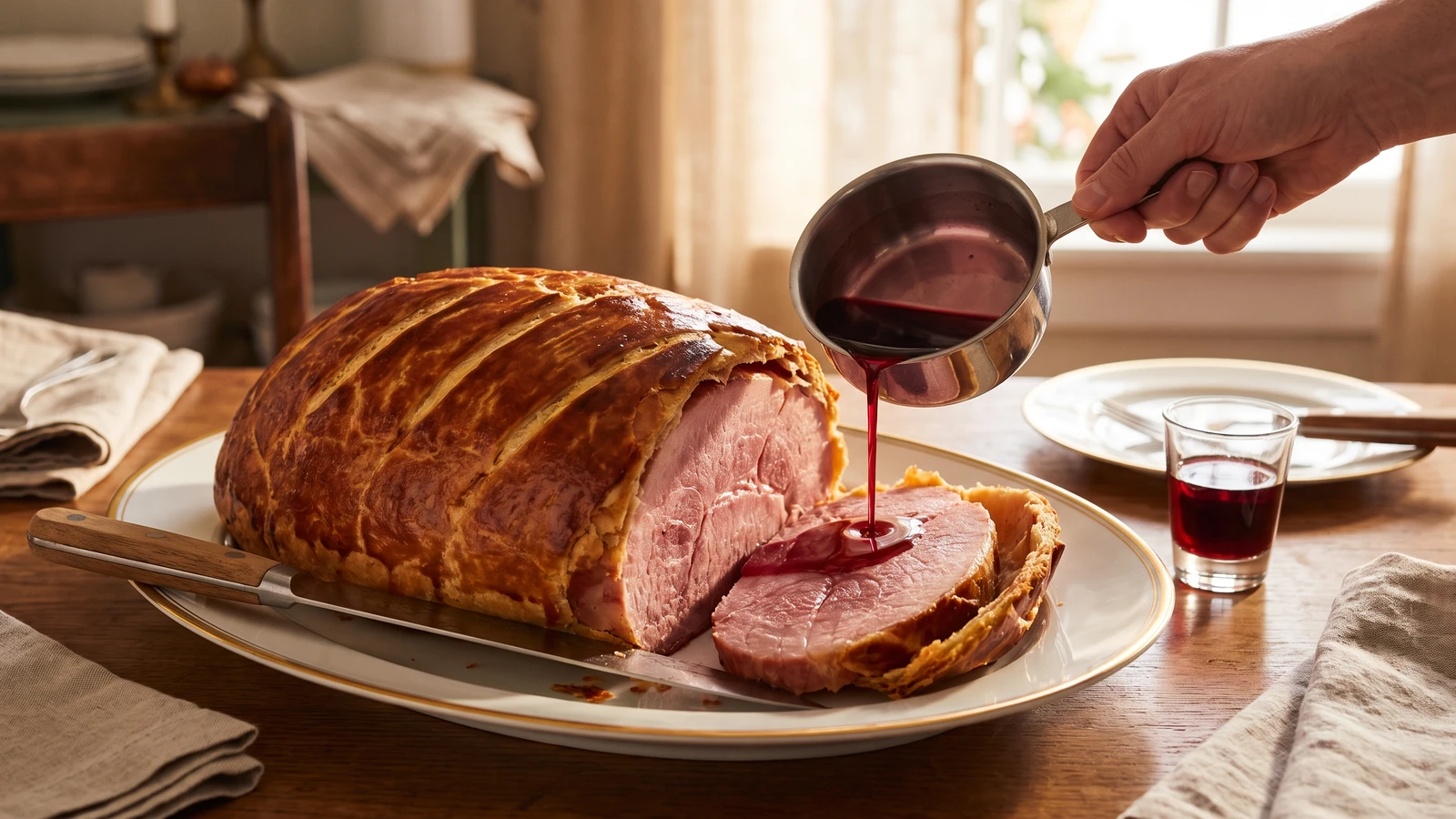
Smoked Prague ham sealed in sturdy pâte à pâté, baked until burnished, then injected with Port through the crust and served with a light buttered glaze: ceremony with sound technique beneath it.
Jambon à la Prague sous la Cendre (Prague ham baked in a sealed paste crust) teaches containment. Before you touch a pan, know this: the ham must go into the pâte à pâté dry, and the paste must close without a pinhole except for its deliberate vent. The shell traps the smoked juices, takes a coppery gilding, and gives the Port nowhere to go but into the meat.
The original assumed a full Prague ham, a salamander for the powdered-sugar glaze, a saucier beside stock never off the fire, and enough hands to decorate a parade-sized crust. At home, a 3-pound boneless smoked ham, the broiler, one saucepan of reduced unsalted stock, and a sturdy hand-mixed paste do the honest work. The brigade-sized joint and elaborate ornament are scaffolding; the gentle poach, sugar glazing, complete envelope, post-bake Port injection, and last-minute buttered glaze are the dish. One cook, one stove, one evening.
Expect a burnished oval that opens onto rosy, smoke-scented ham, with Port spreading through each hot slice and a glossy spoonful of sauce running beside it. When you wrap the joint, turn the seam underneath and patch every tear before gilding; that seal is the step that decides the dish.
Prague ham belongs first to Prague and the Bohemian curing tradition, where a whole ham is brined, smoked, and gently cooked until rosy and succulent. French classical kitchens carried that prepared ham into the ceremonial repertoire, coating it with sugar, enclosing it in paste, and adding fortified wine after baking. In this preparation, sous la cendre describes the protected cooking created by the paste shell, not a command to bury the joint in fireplace ash.
Quantity
1 small ham, 3 pounds (1.35 kg)
Quantity
About 3 quarts (2.8 L / 2.8 kg), or enough to cover the ham
Quantity
4¾ cups (1.12 L / 600 g)
Quantity
14 tablespoons (210 ml / 200 g)
cubed
Quantity
2 teaspoons (10 ml / 12 g)
Quantity
2
1 for the paste and 1 beaten for gilding
Quantity
¾ to ⅞ cup (180 to 210 ml / 180 to 210 g), plus 1 tablespoon (15 ml / 15 g) for sealing
Quantity
2 tablespoons (30 ml / 16 g)
Quantity
½ cup (120 ml / 120 g)
at room temperature
Quantity
2 cups (480 ml / 480 g)
Quantity
¼ cup (60 ml / 60 g)
Quantity
2 tablespoons (30 ml / 28 g)
cubed
Quantity
1 finished Soufflé au Parmesan (No. 2295a), prepared separately for serving
| Ingredient | Quantity |
|---|---|
| fully cooked smoked Prague ham, preferably rind-on | 1 small ham, 3 pounds (1.35 kg) |
| cold water | About 3 quarts (2.8 L / 2.8 kg), or enough to cover the ham |
| all-purpose flour | 4¾ cups (1.12 L / 600 g) |
| cold unsalted buttercubed | 14 tablespoons (210 ml / 200 g) |
| fine salt | 2 teaspoons (10 ml / 12 g) |
| large eggs1 for the paste and 1 beaten for gilding | 2 |
| ice water | ¾ to ⅞ cup (180 to 210 ml / 180 to 210 g), plus 1 tablespoon (15 ml / 15 g) for sealing |
| powdered sugar | 2 tablespoons (30 ml / 16 g) |
| ruby Port for injectingat room temperature | ½ cup (120 ml / 120 g) |
| unsalted veal stock or low-sodium beef stock | 2 cups (480 ml / 480 g) |
| ruby Port for the glaze | ¼ cup (60 ml / 60 g) |
| cold unsalted butter for the glazecubed | 2 tablespoons (30 ml / 28 g) |
| Soufflé au Parmesan | 1 finished Soufflé au Parmesan (No. 2295a), prepared separately for serving |
Mix the flour and salt, then rub in the cold butter until no piece is larger than a lentil. Add one egg and ¾ cup of the ice water, mixing until the paste gathers into a firm, pliable mass; add the remaining water a teaspoon at a time only if dry flour remains. Knead for one minute, just until smooth, then wrap and rest for 30 minutes. The pâte à pâté must bend without cracking because strength, not flakiness, is its work here. If it crumbles when folded, knead in a teaspoon of water; if it clings to your hands, dust it sparingly with flour.
Set the ham in a pot, cover it with the cold water, and bring the water slowly to a quiet poach. Hold it at 180 to 185°F (82 to 85°C), with the surface barely quivering, for 40 to 50 minutes, until the centre reaches 115 to 120°F (46 to 49°C). Lift the ham onto a tray. While it is still warm, remove the rind and trim away any hard, smoke-blackened exterior, leaving a thin covering of fat where present. Pat every surface thoroughly dry and let the joint cool for 20 minutes. A wet, hot ham softens the paste before the oven can set it.
Combine the stock and the ¼ cup of Port in a small saucepan. Bring them to a boil, then reduce at a steady simmer to about ¾ cup (180 ml), roughly 20 minutes. The reduction should coat a spoon lightly but still run from it freely; this is a light glaze, not syrup. If it becomes sticky, loosen it with a spoonful of water. Set the reduction aside without adding the butter yet.
Heat the broiler and place the dry ham with its rounded or fat side uppermost on a broiler-safe tray. Sift the powdered sugar evenly over that surface and set it 5 to 6 inches (13 to 15 cm) below the heat. Watch without leaving the oven: in 1 to 3 minutes the sugar should melt into a thin amber glaze. If one patch burns black, scrape it away while warm, dry the spot, dust it again, and return the ham farther from the heat. Ça se rattrape.
Set the oven to 400°F (200°C). Roll the rested paste on a lightly floured surface to a rectangle about 20 by 24 inches (50 by 60 cm) and ¼ inch (5 mm) thick. Place the ham in the centre with the glazed side undermost. Draw the paste over it, trim excessive bulk while leaving a 2-inch (5 cm) overlap, moisten the meeting edges, and pinch them into a complete seal. Turn the parcel seam-side down onto a parchment-lined tray. Patch every crack with a moistened scrap, reserving a walnut-sized piece to shape into a small plug. Brush the parcel and plug with the remaining beaten egg to gild them, streak the surface with shallow diagonal lines, and cut a ½-inch (1 cm) vent directly over the thickest part of the ham.
Bake the parcel until the paste is dry, firm, and deeply golden, 50 to 65 minutes. The ham should reach 140 to 145°F (60 to 63°C) at its centre. Remove the little paste plug once it is browned, usually after 15 minutes, and reserve it. If the crust colours before the ham is ready, cover it loosely with foil. If the seam begins leaking during the first part of baking, press a thin scrap of paste over the opening with the back of a spoon, brush it with egg, and continue baking.
During the final 10 minutes of baking, reheat the Port reduction to a gentle simmer. Reduce it briefly if it no longer coats a spoon, then take the pan off the heat and whisk in the cold butter a cube at a time. The glaze should shine and fall in a light ribbon. Do not boil it once the butter is incorporated. If it turns greasy, whisk a teaspoon of cold water in a clean warm pan, then work the broken glaze into it gradually until smooth.
Move the baked ham to its serving platter. Draw the room-temperature ½ cup of Port into a flavour injector, pass the needle through the prepared central vent, and inject the wine slowly in four to six directions through the meat. Pause between each press so the ham can take it; if Port backs up, wait and choose another angle. Stop the vent with the baked paste plug. Serve immediately, opening the crust and carving generous slices at the table, with the light Port glaze alongside and the separately prepared Soufflé au Parmesan (No. 2295a) brought out at the same moment. À table!
1 serving (about 730g)
Culinary guides, cultural storytelling, and the editorial depth that makes cooking meaningful.
Discover Culinary ExplorerChef Juliette
John Dory has the delicacy of sole and the firmness of turbot. A light flouring, a quick butter sauté, and nut-brown beurre noisette show exactly why looks never mattered.

Chef Juliette
Fresh haddock proves its delicacy in the meunière pan: a fine flour crust, moist pearly flakes, and beurre noisette sharpened with lemon and parsley, ready from one skillet in half an hour.

Chef Juliette
Éperlans à l’Anglaise turns small fish into a lesson in disciplined coating: boned smelts under a close, crisp crumb, pan-fried in clarified butter and finished with bright, half-melted maître d’hôtel butter.

Chef Juliette
Tiny smelts, shallot, mushrooms, white wine, gratin sauce, and fine bread raspings meet a fierce oven, where the fish must turn tender in the same breath the buttered crust bronzes.