
Chef Juliette
John Dory (St. Pierre)
John Dory has the delicacy of sole and the firmness of turbot. A light flouring, a quick butter sauté, and nut-brown beurre noisette show exactly why looks never mattered.
A cooking platform built around craft, culture, and the stories behind what we eat.
Created by Chef Juliette
Based on No. 1399, Zampino de Modène, from Le Guide Culinaire (1907) by Auguste Escoffier
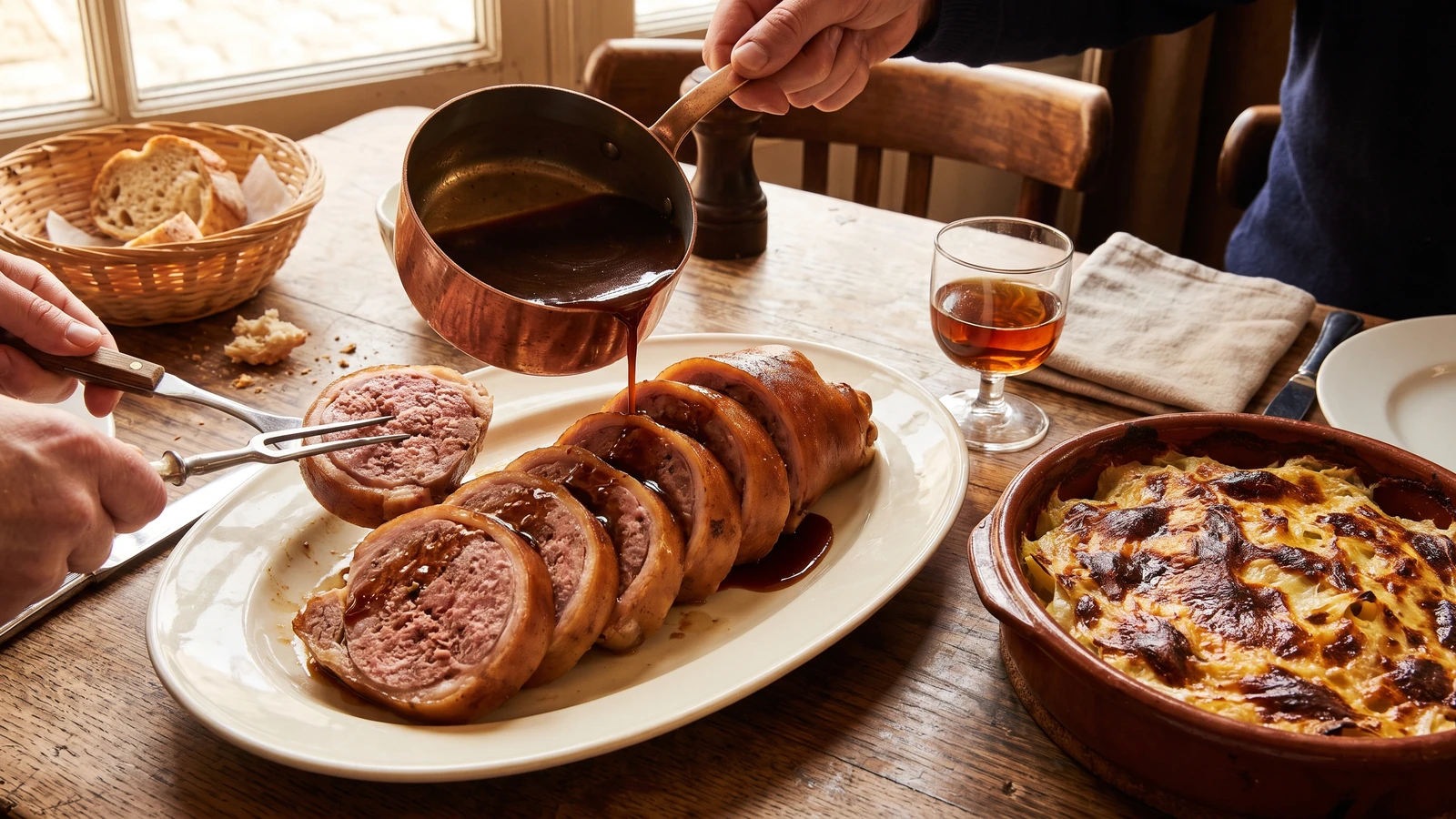
Cloth protects the stuffed trotter, patient poaching keeps it whole, and sauce madère with bronzed cabbage brings Modena’s rich charcuterie to a generous French table.
Zampino de Modène (Modena stuffed pork trotter) teaches the discipline of the quiet poach. The seasoned forcemeat is already enclosed in tender skin, so boiling accomplishes nothing except a burst casing and a pot full of regret. Wrap it closely, begin in cold water, and let the liquid barely tremble until the filling is succulent and firm enough to carve.
The classical entry assumed a charcutier supplied the zampino, a saucier stood beside a stockpot that never went cold, and a salamander waited to bronze the cabbage. At home, order one fresh uncooked zampone, reduce good gelatin-rich stock in a small saucepan for the sauce madère (Madeira wine sauce), and use the broiler for the prepared Gratins. The separate brigade stations were scaffolding and can go. The cloth wrapping, patient poach, proper reduction, and gratinated cabbage are the dish and must stay. One cook, one stove, one evening, with the zampino soaking quietly while you attend to everything else.
When it reaches the table, the skin should hold its shape around a coarse, rosy filling, the sauce should run mahogany and glossy, and the cabbage should wear a deep bronzed crust. Guard the water above all: it must never boil. That one piece of attention decides the dish.
Zampone belongs to Modena in Emilia-Romagna, where charcutiers fill the boned skin of a pig’s foreleg and trotter with seasoned pork, leaving its hoof shape unmistakable. French classical kitchens adopted the finished charcuterie product rather than claiming its manufacture, treating it like ham with cloth-wrapped poaching, a hot sauce, and a vegetable garnish. The title Zampino de Modène records that journey, but the meatwork remains Modenese; sauce madère and gratinated cabbage describe its French service, not its origin.
Quantity
1, weighing 2½ to 3 lb (1.1 to 1.3 kg)
Quantity
About 2 gal (7.6 L / 7.6 kg), divided, plus more as needed
Quantity
1½ cups (360 ml / 360 g)
Quantity
½ cup (120 ml / 120 g)
Quantity
1, about 3 tbsp (45 ml / 30 g)
finely sliced
Quantity
2 tbsp (30 ml / 28 g)
divided
Quantity
½ tsp (2.5 ml / 1.5 g)
Quantity
¼ tsp (1.25 ml / 0.6 g)
Quantity
as needed
| Ingredient | Quantity |
|---|---|
| fresh uncooked zampone | 1, weighing 2½ to 3 lb (1.1 to 1.3 kg) |
| cold water | About 2 gal (7.6 L / 7.6 kg), divided, plus more as needed |
| unsalted gelatin-rich brown veal or chicken stock | 1½ cups (360 ml / 360 g) |
| dry Madeira | ½ cup (120 ml / 120 g) |
| small shallotfinely sliced | 1, about 3 tbsp (45 ml / 30 g) |
| cold unsalted butterdivided | 2 tbsp (30 ml / 28 g) |
| powdered unflavored gelatin (optional) | ½ tsp (2.5 ml / 1.5 g) |
| freshly ground black pepper | ¼ tsp (1.25 ml / 0.6 g) |
| fine salt | as needed |
| prepared cabbage garnishready for final browning | 4 servings from Gratins (No. 268) |
Set the zampino in a nonreactive bowl or pot and cover it generously with cold water. Refrigerate for 6 to 8 hours, changing the water once halfway through. This draws excess surface salt from the cured meat and softens the skin so it expands without tearing. Lift it out, rinse it, and dry it carefully.
Prick the thickest exposed skin three or four times with a fine clean skewer, making tiny vents rather than holes large enough to release the filling. Lay the zampino on a large square of unbleached muslin or a clean lint-free cotton towel, roll it snugly, and secure the bundle with kitchen twine at 2 in (5 cm) intervals. The old instruction called for a napkin; the cloth itself is not ceremony. It supports the skin as the filling swells and contains the zampino if a small split appears.
Lay the wrapped zampino in a stockpot large enough to hold it without bending. Cover it by 2 in (5 cm) with fresh cold water, then warm the pot gradually over medium-low heat. Once the water reaches 176 to 185°F (80 to 85°C), lower the heat and maintain only an occasional lazy bubble for 2½ to 3 hours. Add hot water as needed to keep the bundle submerged. It is ready when a thermometer inserted through the cut end reaches at least 160°F (71°C) and the skin yields under gentle pressure. If the bundle begins to swell sharply or the water boils, lower the heat and add a cup of cold water at the side of the pot. Do not unwrap it. Ça se rattrape.
During the final 30 minutes of poaching, test the cold stock. If it does not set softly when chilled, sprinkle the optional gelatin over 1 tbsp (15 ml / 15 g) of the stock and leave it for 5 minutes. Melt half the butter in a small saucepan and soften the shallot over gentle heat without coloring it. Add the remaining stock and simmer until reduced by half. Pour in the Madeira, add the bloomed gelatin if using, and reduce again until about 1 cup (240 ml / 240 g) remains and the sauce lightly naps the back of a spoon. Strain it, season with pepper and only as much salt as it needs, then whisk in the remaining cold butter off the heat. If the butter leaves oily streaks, whisk in 1 tsp (5 ml / 5 g) cold water away from the heat until the gloss returns.
Bring the prepared cabbage garnish to its final bronzed state according to Gratins (No. 268), timing it for the last minutes of the poach. A home broiler is the honest equivalent of the salamander: place the dish close enough to color promptly, watch it without wandering away, and remove it when the top is deeply golden and the edges are caught mid-bubble.
Lift the zampino from the water by supporting the entire bundle, then set it on a rimmed tray for 10 minutes. Cut away the twine and peel back the cloth carefully. If the skin has split, leave it to rest for another 5 minutes before carving; the cloth has held the filling together, and thick slices will still serve handsomely. Cut crosswise into slices about ¾ in (2 cm) thick and overlap them on a warm platter. Spoon some sauce madère around the slices, keeping the rest in a warm sauceboat, and set the cabbage beside them. À table!
1 serving (about 510g)
Culinary guides, cultural storytelling, and the editorial depth that makes cooking meaningful.
Discover Culinary ExplorerChef Juliette
John Dory has the delicacy of sole and the firmness of turbot. A light flouring, a quick butter sauté, and nut-brown beurre noisette show exactly why looks never mattered.

Chef Juliette
Fresh haddock proves its delicacy in the meunière pan: a fine flour crust, moist pearly flakes, and beurre noisette sharpened with lemon and parsley, ready from one skillet in half an hour.

Chef Juliette
Éperlans à l’Anglaise turns small fish into a lesson in disciplined coating: boned smelts under a close, crisp crumb, pan-fried in clarified butter and finished with bright, half-melted maître d’hôtel butter.

Chef Juliette
Tiny smelts, shallot, mushrooms, white wine, gratin sauce, and fine bread raspings meet a fierce oven, where the fish must turn tender in the same breath the buttered crust bronzes.