
Chef Juliette
John Dory (St. Pierre)
John Dory has the delicacy of sole and the firmness of turbot. A light flouring, a quick butter sauté, and nut-brown beurre noisette show exactly why looks never mattered.
A cooking platform built around craft, culture, and the stories behind what we eat.
Created by Chef Juliette
Based on No. 1380, Sauté d’Agneau Printanier, from Le Guide Culinaire (1907) by Auguste Escoffier
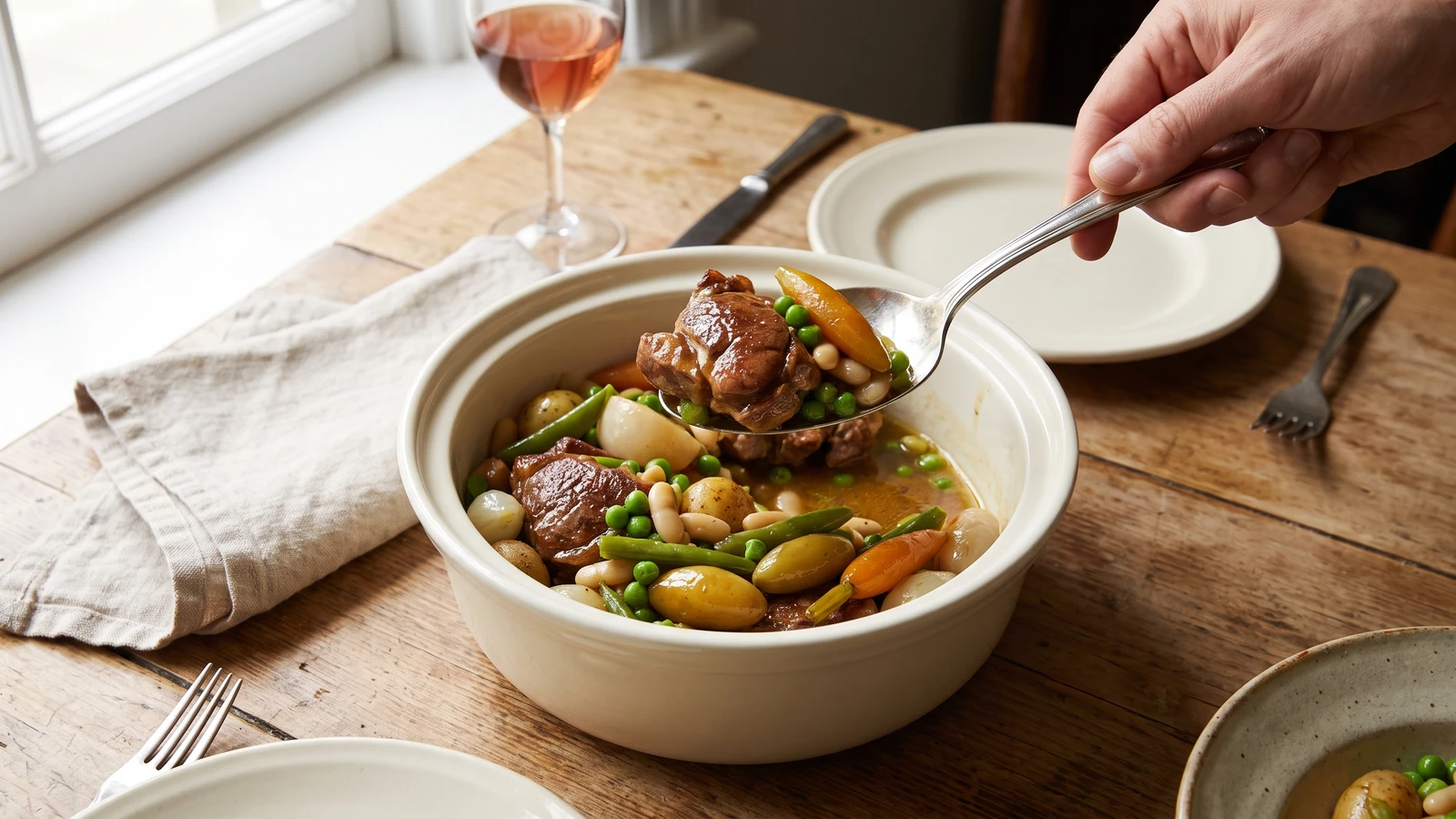
Lamb shoulder and breast cook in butter without added liquid, then meet seven spring vegetables in a pale meat glaze mounted with butter until everything gleams.
Sauté d’Agneau Printanier (butter-sautéed spring lamb) teaches the exact meaning of sauté: the lamb cooks completely in butter, without added liquid, before its fond becomes the foundation of the sauce. Add stock while the lamb cooks and you have begun a braise. Pleasant, certainly, but no longer this dish. Keep the meat dry, the pan broad, and the heat steady before you touch anything else.
The original entry assumed a saucier, pale meat glaze waiting beside a stockpot that never went cold, and a commis turning dozens of vegetables into perfect olives. At home, use a good unsalted consommé, a prepared light veal glaze, and vegetables trimmed into even large-olive pieces without chasing seven flawless sides. The book’s two pounds of lamb now feeds four as the main event rather than being divided among a long formal menu. The separate hands and perfect tournage are brigade scaffolding and can go. Cooking the lamb without moistening, preserving the vegetables separately, and mounting the glaze with real butter are the dish and must stay. A salamander never belonged to this preparation, so the home oven has no part to play. One cook, one stove, one evening.
When it is right, the lamb is browned and tender, every vegetable keeps its own shape and color, and the sauce clings in a thin butter-bright glaze rather than collecting as gravy. The decisive step comes at the end: monter au beurre, finishing with cold butter, below the boil. Keep the pan gentle there and the whole spring garden arrives at the table shining.
Sauté d’agneau printanier belongs to the Parisian grand-kitchen canon, where printanier names a formal garnish of young market vegetables rather than a particular provincial seasoning. Grand kitchens regularized the garden into counted onions, potatoes, olive-shaped roots, peas, green beans, and flageolets, then cuisine bourgeoise carried that generous arrangement back to the family table. Despite the name’s frequent misuse, this entry is not a lamb stew: the meat cooks without added liquid, and only afterward is its fond bound with meat glaze and butter.
Quantity
About 4½ cups (1½ lb / 680 g)
cut into 2 oz / 55 g pieces
Quantity
About 1½ cups (½ lb / 225 g)
cut into 2 oz / 55 g pieces
Quantity
11 tablespoons (165 ml / 156 g)
divide 3 tablespoons for the lamb, 1 for the onions, 2 for the potatoes, and 5 for finishing
Quantity
5 carrots (about 1¼ cups / 200 g)
trimmed into 20 large-olive-shaped pieces
Quantity
2 medium turnips (about 1¼ cups / 225 g)
trimmed into 20 large-olive-shaped pieces
Quantity
15 onions (about 1½ cups / 225 g)
peeled
Quantity
20 potatoes (about 2½ cups / 450 g)
scrubbed
Quantity
3 tablespoons (45 ml / 30 g)
Quantity
3 tablespoons (45 ml / 35 g)
cut diagonally into lozenges
Quantity
3 tablespoons (45 ml / 45 g)
Quantity
1½ cups (360 ml / 360 g)
divided
Quantity
2 quarts (1.9 L / 1.9 kg)
Quantity
3 tablespoons (45 ml / 45 g)
Quantity
5 tablespoons (75 ml / 90 g)
reduced beforehand to a syrupy glaze
Quantity
1½ tablespoons (22 ml / 27 g)
divided
Quantity
0 used
source cross-reference retained; this preparation is not added to the dish
| Ingredient | Quantity |
|---|---|
| boneless lamb shouldercut into 2 oz / 55 g pieces | About 4½ cups (1½ lb / 680 g) |
| boneless lamb breastcut into 2 oz / 55 g pieces | About 1½ cups (½ lb / 225 g) |
| unsalted butterdivide 3 tablespoons for the lamb, 1 for the onions, 2 for the potatoes, and 5 for finishing | 11 tablespoons (165 ml / 156 g) |
| slim new carrotstrimmed into 20 large-olive-shaped pieces | 5 carrots (about 1¼ cups / 200 g) |
| new turnipstrimmed into 20 large-olive-shaped pieces | 2 medium turnips (about 1¼ cups / 225 g) |
| small new or pearl onionspeeled | 15 onions (about 1½ cups / 225 g) |
| very small new potatoesscrubbed | 20 potatoes (about 2½ cups / 450 g) |
| fresh or frozen peas | 3 tablespoons (45 ml / 30 g) |
| French green beanscut diagonally into lozenges | 3 tablespoons (45 ml / 35 g) |
| fresh, frozen, or drained cooked flageolet beans | 3 tablespoons (45 ml / 45 g) |
| unsalted beef or veal consommédivided | 1½ cups (360 ml / 360 g) |
| water for cooking à l’anglaise | 2 quarts (1.9 L / 1.9 kg) |
| cold water for deglazing | 3 tablespoons (45 ml / 45 g) |
| pale meat glaze or unsalted light veal demi-glacereduced beforehand to a syrupy glaze | 5 tablespoons (75 ml / 90 g) |
| fine sea saltdivided | 1½ tablespoons (22 ml / 27 g) |
| Anglaise (for Egg-and-bread-crumbing) (No. 174)source cross-reference retained; this preparation is not added to the dish | 0 used |
Trim the carrots and turnips into twenty pieces each, all about the size of large olives. Perfect seven-sided tournage is unnecessary, but even size is not: irregular pieces finish at different moments. Peel the onions, scrub the potatoes, cut the green beans into lozenges, and measure every component before cooking. Pat the lamb thoroughly dry and keep it cold while the vegetables begin.
Put the carrots in a wide saucepan with half the consommé and a small pinch of salt. Simmer uncovered until tender but still holding their shape, rolling the pan occasionally as the consommé reduces to a thin glaze around them. Lift them onto a tray and repeat with the turnips and remaining consommé. If the liquid disappears before either vegetable is tender, add cold water one tablespoon at a time. Ça se rattrape: the extra water buys cooking time, then reduces away without changing the glaze.
Bring the 2 quarts of water to a lively boil and salt it well. Cook fresh or frozen flageolets first until tender but firm, then the green beans until bright and crisp under the teeth, and finally the peas just until tender. Drain each vegetable separately and spread it on a tray so residual heat does not soften it further. If using already cooked flageolets, warm them in the water for only one minute. Here à l’anglaise means plainly in water, as the glossary specifies. The separately cross-referenced Anglaise (for Egg-and-bread-crumbing) (No. 174) is not used; egg and crumbs would make an entirely different preparation.
Melt 1 tablespoon of the butter in a covered sauté pan over low heat. Add the onions with a pinch of salt and cook gently, rolling them often, until tender and lightly golden without collapsing, about 15 minutes. Set them with the other vegetables. Add 2 tablespoons butter to the pan, then the potatoes and another pinch of salt. Cover and cook over low to medium-low heat, turning frequently, until a knife enters cleanly and the skins are butter-gold, about 20 to 25 minutes. Keep every vegetable separate and slightly firm; the final rocking in the sauce completes their heating.
Season the dry lamb lightly with salt. Melt 3 tablespoons butter in a broad heavy sauté pan over medium heat, and when it foams, add the lamb in two uncrowded batches. Brown every face patiently, transferring the first batch to a plate while the second colors. Return all the lamb to the pan, lower the heat, cover, and cook without adding water, stock, or wine. Turn the pieces every few minutes until the breast has rendered, the shoulder is tender, and the centers are completely cooked, about 25 to 35 minutes after browning. If the butter darkens too quickly, lower the heat at once. Water would stop the scorching, but it would also turn the sauté into a braise.
Transfer the cooked lamb to a warm dish. Pour off excess cooking fat while leaving the brown fond attached to the pan. Add exactly 3 tablespoons cold water and scrape until every caramelized speck dissolves, then add the pale meat glaze. Heat gently without boiling until the mixture is smooth and lightly syrupy. Remove the pan from the heat and add the remaining 5 tablespoons cold butter a few pieces at a time, rocking and whisking until the sauce becomes glossy and thick enough to cling. If it separates into greasy streaks, stop. Ça se rattrape: move the pan to a cool surface and whisk in a teaspoon of cold water until the emulsion returns. Never boil it after the butter goes in.
Return the lamb, carrots, turnips, onions, potatoes, peas, green beans, and flageolets to the sauce. Hold the pan over the gentlest heat and rock it from side to side so the glaze coats everything without breaking the vegetables. Do not boil and do not churn with a spoon. Taste for salt, then transfer the sauté at once to a timbale or deep serving dish warmed with hot water and dried thoroughly. The vegetables should remain distinct inside one gleaming sauce. À table!
1 serving (about 560g)
Culinary guides, cultural storytelling, and the editorial depth that makes cooking meaningful.
Discover Culinary ExplorerChef Juliette
John Dory has the delicacy of sole and the firmness of turbot. A light flouring, a quick butter sauté, and nut-brown beurre noisette show exactly why looks never mattered.

Chef Juliette
Fresh haddock proves its delicacy in the meunière pan: a fine flour crust, moist pearly flakes, and beurre noisette sharpened with lemon and parsley, ready from one skillet in half an hour.

Chef Juliette
Éperlans à l’Anglaise turns small fish into a lesson in disciplined coating: boned smelts under a close, crisp crumb, pan-fried in clarified butter and finished with bright, half-melted maître d’hôtel butter.

Chef Juliette
Tiny smelts, shallot, mushrooms, white wine, gratin sauce, and fine bread raspings meet a fierce oven, where the fish must turn tender in the same breath the buttered crust bronzes.