
Chef Juliette
John Dory (St. Pierre)
John Dory has the delicacy of sole and the firmness of turbot. A light flouring, a quick butter sauté, and nut-brown beurre noisette show exactly why looks never mattered.
A cooking platform built around craft, culture, and the stories behind what we eat.
Created by Chef Juliette
Based on No. 1377, Côtelettes d’Agneau de Lait Farcies à la Périgueux, from Le Guide Culinaire (1907) by Auguste Escoffier
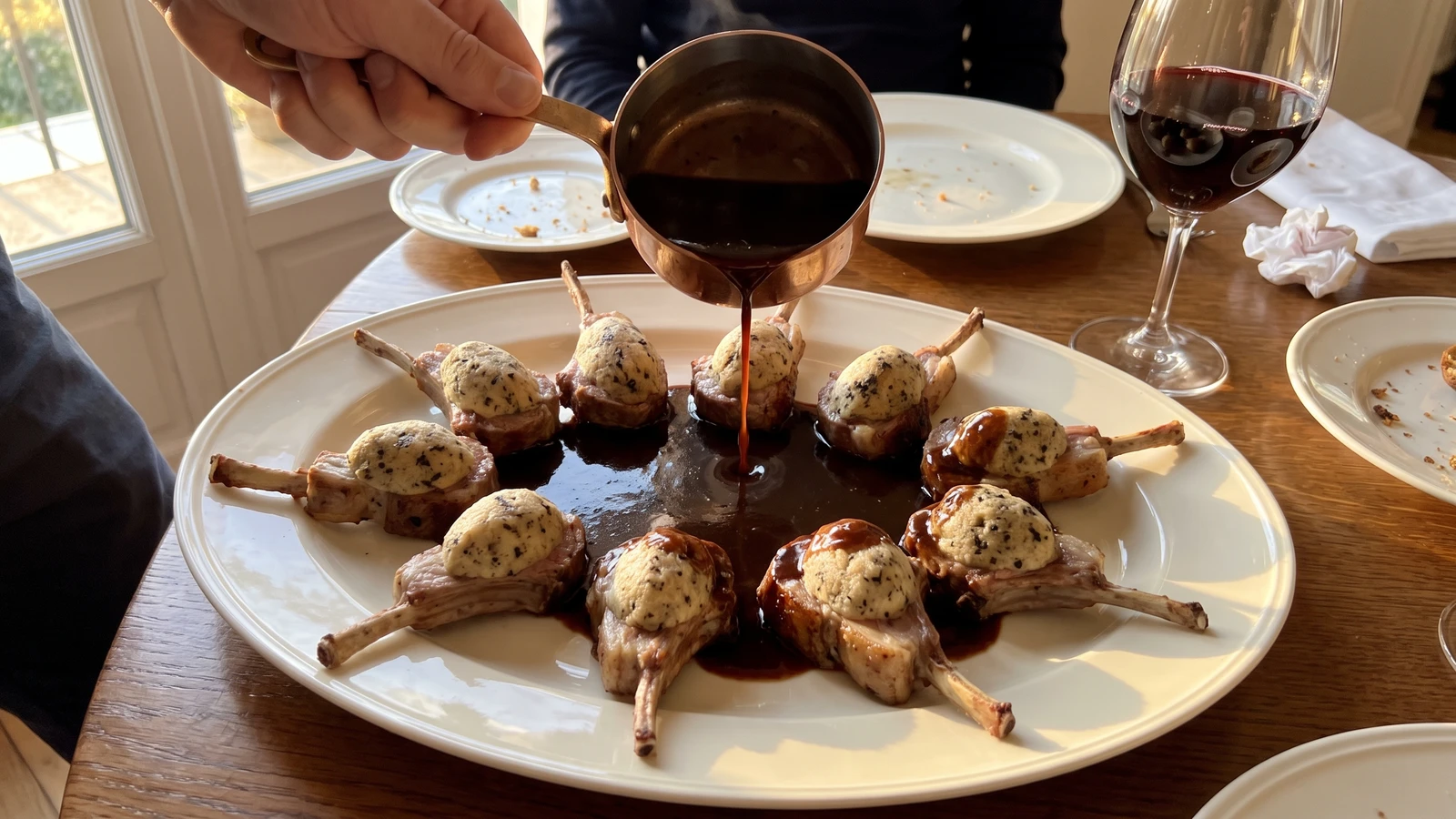
Milk-fed lamb cutlets wear domes of black-truffled chicken forcemeat, poached just until tender, then circle a pool of Périgueux sauce. The lesson is heat control: cook two proteins without drying either.
Côtelettes d’Agneau de Lait Farcies à la Périgueux (milk-fed lamb cutlets crowned with truffled forcemeat and served with Périgueux sauce, the dark truffle gravy) teaches one precise lesson: the cutlet is browned on only one side because the oven must still have something left to do. Brown both sides now and the lamb will be dry before the chicken forcemeat is safely poached. One side only. That restraint is the dish.
The original kitchen assumed a saucier holding Périgueux sauce, a stockpot never off the fire, a separate hand tending the forcemeat, and an oven whose gentler front could be judged by experience. A salamander has no work here because the forcemeat must poach, not scorch. At home, the sauce and forcemeat are finished components made ahead, an empty baking sheet supplies the slight pressure, and the centre of a steady oven replaces its old hot and cool zones. Eight small cutlets feed four. One cook, one stove, one evening.
The separate mortar, sieve, sauce, and stock work are brigade scaffolding, so they stay in their own preparations. The one-sided sear, cold truffle-rich dome, seven-to-eight-minute oven poach, circular arrangement, and pool of sauce remain because they are the dish itself. When the pan is hot, brown the presentation face and refuse the urge to flip. That one-sided sear decides everything that follows.
The name à la Périgueux points to Périgord in southwest France, whose black truffles gave the classical garnish its identity, although this composed cutlet belongs to the grand kitchen rather than the farmhouse table of Périgueux. Classical cooks used the name for preparations finished with a dark truffle-rich brown sauce, and here the truffle also runs through the chicken forcemeat so garnish and sauce speak as one. It is a clear example of regional produce traveling into formal service while keeping its defining flavor intact.
Quantity
8 cutlets, each 2 to 2½ ounces (60 to 70 g) and about ¾ inch (2 cm) thick
frenched
Quantity
1 teaspoon (5 ml / 6 g)
divided
Quantity
¼ teaspoon (1.25 ml / 0.5 g)
divided
Quantity
3 tablespoons (45 ml / 42 g)
Quantity
½ cup (120 ml / 125 g) Chicken Forcemeat with Panada and Butter (No. 193)
kept very cold
Quantity
¼ cup (60 ml / 40 g)
fresh or whole preserved, very finely chopped
Quantity
1¼ cups (300 ml / about 320 g)
Quantity
2 tablespoons (30 ml / 30 g)
for loosening the sauce only if needed
| Ingredient | Quantity |
|---|---|
| milk-fed lamb rib cutletsfrenched | 8 cutlets, each 2 to 2½ ounces (60 to 70 g) and about ¾ inch (2 cm) thick |
| fine saltdivided | 1 teaspoon (5 ml / 6 g) |
| finely ground white pepperdivided | ¼ teaspoon (1.25 ml / 0.5 g) |
| unsalted butter | 3 tablespoons (45 ml / 42 g) |
| finished Chicken Forcemeat with Panada and Butterkept very cold | ½ cup (120 ml / 125 g) Chicken Forcemeat with Panada and Butter (No. 193) |
| Périgord black trufflefresh or whole preserved, very finely chopped | ¼ cup (60 ml / 40 g) |
| finished Périgueux sauce | 1¼ cups (300 ml / about 320 g) |
| hot water (optional)for loosening the sauce only if needed | 2 tablespoons (30 ml / 30 g) |
Trim away any loose fat or scraps without exposing more of the eye of meat. Pat the cutlets completely dry, then season both sides lightly with the salt and white pepper, remembering that the forcemeat and Périgueux sauce are already seasoned. Set a rack in the centre of the oven, but wait to heat it until the cutlets are cooling. Have two rimmed baking sheets and two pieces of parchment ready.
Melt the butter in a 12-inch (30 cm) heavy skillet over medium-high heat until it foams and smells nutty but remains golden. Working in two batches, place the cutlets presentation-side down and cook for 1½ to 2 minutes, without shifting them, until that face is evenly bronzed. Do not turn them. If the butter blackens, lift out the cutlets, wipe the pan, and begin again with fresh butter. Ça se rattrape, but burnt butter cannot become the foundation of anything good.
Set the cutlets raw-side down on a parchment-lined baking sheet, leaving space between them. Cover them with the second sheet of parchment and rest the empty second baking sheet on top. Its own weight is enough; this is slight pressure, not punishment. Leave them for 10 minutes, then remove the upper sheet and chill the cutlets for another 10 minutes. Heat the oven to 400°F (200°C). If the browned surfaces still feel warm, give them 5 more minutes in the cold because warm lamb will soften the butter in the forcemeat and make the domes slide.
Fold the chopped truffle evenly through the cold Chicken Forcemeat with Panada and Butter (No. 193), working gently so it remains dense and cold. Divide it into eight portions of 1 tablespoon each. Place one portion on the browned face of every cutlet, then use the flat of a small knife dipped in tepid water to smooth it into a neat dome that reaches almost to the meat’s edge. If the forcemeat slumps or turns greasy, stop and chill the whole tray for 10 minutes before reshaping. Cold restores its body.
Arrange the cutlets raw-side down on a lightly buttered heavy baking sheet and place them in the centre of the oven for 7 to 8 minutes. The forcemeat should be softly set, pale, and flecked with black truffle, with no hard crust. Insert an instant-read thermometer sideways into the centre of the thickest dome: the chicken forcemeat must reach 165°F (74°C). Check that the lamb reaches at least 140°F (60°C), then rest it for 3 minutes so it rises to 145°F (63°C). If the domes color before their centres are ready, cover them loosely with foil and continue in 1-minute intervals.
While the cutlets cook, warm the Périgueux sauce in a small saucepan over gentle heat, stirring often. Bring it only to the first quiet movement at the surface, never a hard boil, and hold it until it coats the back of a spoon with a dark gloss. If it has tightened while waiting, whisk in the hot water a teaspoon at a time. If beads of fat appear, take the pan off the heat and whisk in one tablespoon of hot water until the sauce comes together again.
Warm an oval serving platter. Arrange the eight cutlets in a close circle with their bones pointing outward and the truffled domes facing up. Pour the hot Périgueux sauce into their midst, keeping the tops visible, and bring the platter straight to the table. Serve two cutlets per person. À table!
1 serving (about 195g)
Culinary guides, cultural storytelling, and the editorial depth that makes cooking meaningful.
Discover Culinary ExplorerChef Juliette
John Dory has the delicacy of sole and the firmness of turbot. A light flouring, a quick butter sauté, and nut-brown beurre noisette show exactly why looks never mattered.

Chef Juliette
Fresh haddock proves its delicacy in the meunière pan: a fine flour crust, moist pearly flakes, and beurre noisette sharpened with lemon and parsley, ready from one skillet in half an hour.

Chef Juliette
Éperlans à l’Anglaise turns small fish into a lesson in disciplined coating: boned smelts under a close, crisp crumb, pan-fried in clarified butter and finished with bright, half-melted maître d’hôtel butter.

Chef Juliette
Tiny smelts, shallot, mushrooms, white wine, gratin sauce, and fine bread raspings meet a fierce oven, where the fish must turn tender in the same breath the buttered crust bronzes.