
Chef Juliette
Baron (or Pair of Hind-quarters) of Lamb
A whole saddle and its two hind legs, butter-poêlé under a close cover, carved rosy beside new vegetables and clear pan gravy: grand anatomy brought within reach of one home oven.
A cooking platform built around craft, culture, and the stories behind what we eat.
Created by Chef Juliette
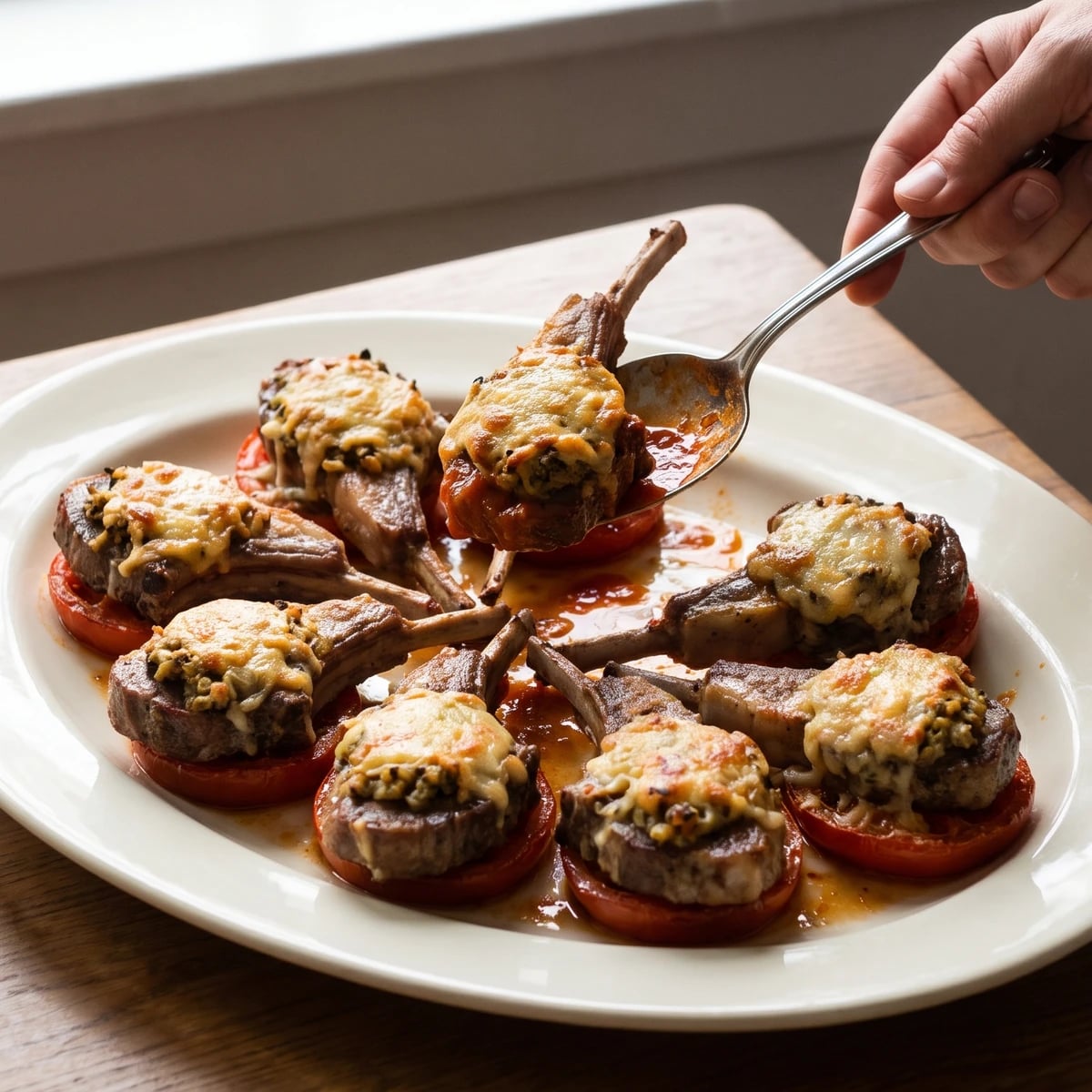
Based on No. 1375, Côtelettes d’Agneau de Lait Navarraise, from Le Guide Culinaire (1907) by Auguste Escoffier
Milk-fed lamb cutlets seared on one side, domed with ham, mushroom, red capsicum, and truffled Béchamel, then gratinéed and set over warm tomato halves with a bright thread of tomato sauce.
Côtelettes d’Agneau de Lait Navarraise (milk-fed lamb cutlets in the Navarraise manner) teaches controlled succession. The lamb is grilled on one side only, that browned face is crowned with a cohesive filling of ham, mushroom, red capsicum, and truffled Béchamel, and the oven cooks the untouched side while the top becomes a gratin. Turn the cutlets in the pan and you lose the timing that makes the whole arrangement work.
The original kitchen assumed a grill cook beside a saucier holding reduced Béchamel and tomato sauce, then a salamander waiting to color the top. At home, two small saucepans, a heavy grill pan, and the oven broiler do the same work. The held sauces and extra hands were brigade scaffolding; the very reduced Béchamel, one-sided grilling, domed garnish, and final gratin are the dish and must stay. One cook, one stove, one evening.
The source’s twelve cutlets become eight, two for each of four guests, and the ham, cooked mushrooms, and capsicum come down in the same proportion. The tomatoes and sauce remain generous because every cutlet needs its warm pedestal and bright border. Before you touch the pan, remember the one true thing: grill the lamb on one side only, garnish that browned side, and let the oven finish the other.
Navarraise points toward Navarre at the western Pyrenees, including Lower Navarre on the French side, where cured ham, sweet red peppers, tomatoes, and young lamb belong naturally to the table. In the French classical repertory, à la Navarraise is a named garnish rather than proof that this exact composed cutlet came from a Navarre farmhouse; the regional larder was translated into ham, capsicum, and tomato, then disciplined with Béchamel and gratin. The architecture of a cutlet on a tomato half, bordered with sauce, shows how the grand kitchen carried a regional name into formal service without erasing its flavors.
Quantity
8, about 1½ lb / 680 g total
trimmed
Quantity
1½ cups (360 ml / 365 g)
Quantity
4, about 1 lb / 450 g total
halved crosswise
Quantity
½ cup (120 ml / 75 g)
finely chopped
Quantity
½ cup (120 ml / 75 g) cooked, from about 2 cups (475 ml / 150 g) raw
cooled and finely chopped
Quantity
2 teaspoons (10 ml / 9 g)
very finely chopped
Quantity
4 tablespoons (60 ml / 56 g)
divided, half for Béchamel and half melted for finishing
Quantity
3 tablespoons (45 ml / 24 g)
Quantity
¾ cup (180 ml / 184 g)
Quantity
¼ teaspoon (1.25 ml / 1 g)
Quantity
½ cup (120 ml / 50 g)
finely grated
Quantity
2 tablespoons (30 ml / 27 g)
for the tomatoes
Quantity
1 teaspoon (5 ml / 4 g)
for the cutlets
Quantity
1½ teaspoons (7.5 ml / 9 g)
divided
Quantity
¼ teaspoon (1.25 ml / 0.5 g)
Quantity
½ teaspoon (2.5 ml / 1 g)
| Ingredient | Quantity |
|---|---|
| small milk-fed lamb rib cutletstrimmed | 8, about 1½ lb / 680 g total |
| smooth tomato passata | 1½ cups (360 ml / 365 g) |
| small firm plum tomatoeshalved crosswise | 4, about 1 lb / 450 g total |
| cooked hamfinely chopped | ½ cup (120 ml / 75 g) |
| cooked button mushroomscooled and finely chopped | ½ cup (120 ml / 75 g) cooked, from about 2 cups (475 ml / 150 g) raw |
| red capsicumvery finely chopped | 2 teaspoons (10 ml / 9 g) |
| unsalted butterdivided, half for Béchamel and half melted for finishing | 4 tablespoons (60 ml / 56 g) |
| all-purpose flour | 3 tablespoons (45 ml / 24 g) |
| whole milk | ¾ cup (180 ml / 184 g) |
| concentrated black-truffle essence | ¼ teaspoon (1.25 ml / 1 g) |
| Gruyèrefinely grated | ½ cup (120 ml / 50 g) |
| Gratinsusing the Gruyère and melted butter listed above | 1 application Gratins (No. 268) |
| olive oilfor the tomatoes | 2 tablespoons (30 ml / 27 g) |
| neutral oilfor the cutlets | 1 teaspoon (5 ml / 4 g) |
| fine sea saltdivided | 1½ teaspoons (7.5 ml / 9 g) |
| ground white pepper | ¼ teaspoon (1.25 ml / 0.5 g) |
| freshly ground black pepper | ½ teaspoon (2.5 ml / 1 g) |
Pour the passata into a small heavy saucepan and bring it to a quiet simmer over medium-low heat. Cook uncovered for 12 to 15 minutes, stirring often, until reduced to about 1 cup (240 ml) and glossy enough that a spoon drawn across the pan leaves a path for a moment. Season with ¼ teaspoon of the salt and a pinch of black pepper, then hold it over the lowest heat. If it tightens while waiting, loosen it with a spoonful of hot water; if it still runs like juice, reduce it further. This small saucepan is the honest home equivalent of the saucier’s ready tomato sauce.
Melt 2 tablespoons (30 ml / 28 g) of the butter in a second heavy saucepan over medium-low heat. Stir in the flour and cook the pale roux for 90 seconds without letting it color. Add the milk in three portions, whisking each addition completely smooth before the next. Simmer gently for 8 to 10 minutes, stirring into every corner, until the Béchamel has reduced to about ½ cup (120 ml) and falls from the spoon in heavy folds. Season with ¼ teaspoon salt and the white pepper.
Fold the ham, cooked mushrooms, and red capsicum into the hot Béchamel until every piece is bound in the sauce. Remove the pan from the heat and stir in the truffle essence. The mixture must hold a rounded spoonful without spreading; if it slumps, return it to low heat for another minute or two, stirring constantly, then let it cool for 5 minutes. The very reduced sauce is not brigade fuss here. It is what keeps the dome on the cutlet.
Heat the oven to 450°F (230°C), with a rack about 6 inches (15 cm) below the broiler, and set out a clean rimmed metal sheet pan. Pat the cutlets completely dry, brush them lightly with the neutral oil, and season both sides with ¾ teaspoon salt and most of the black pepper. Melt the remaining 2 tablespoons (30 ml / 28 g) butter and keep it ready beside the grated Gruyère.
Heat a heavy grill pan or cast-iron skillet over high heat until properly hot. Lay in the cutlets with their best-looking face down, working in two batches if crowding would cool the pan, and grill for 2 to 2½ minutes until that one face is deeply browned. Do not turn them. Transfer each cutlet to the sheet pan with the raw side against the metal and the grilled side facing up. This is the principle that decides the dish: the oven must still have one side of the lamb left to cook.
Divide the Navarraise topping among the grilled faces, about one generous serving tablespoon per cutlet, and shape each portion into a neat dome with the back of the spoon. Apply Gratins (No. 268): cover the domes with the grated Gruyère, spoon over the melted butter, and place the tray in the hot oven for 5 minutes. Begin the tomatoes immediately while the oven completes the lamb from beneath.
Heat the olive oil in the emptied grill pan or a clean skillet over medium-high heat. Season the tomato halves with the remaining salt and pepper, then cook them cut-side down for about 2 minutes. Turn and cook the skin side for 1 to 2 minutes, tossing the pan gently, until the tomatoes are glossy and warmed through but still firm enough to support a cutlet. Transfer them to a warm platter, cut-side up. Complete Gratins (No. 268) by switching the oven to broil and coloring the cutlets for 30 to 90 seconds, until the cheese is mottled deep gold. Check through the side of a cutlet without touching the bone; pull them at about 140°F (60°C), then rest for 3 minutes so they carry toward 145°F (63°C).
Arrange the eight tomato halves in a circle on the warm platter and set one cutlet squarely upon each. Spoon the hot tomato sauce in a narrow cordon around the arrangement, letting it gleam against the platter without flooding the tomatoes or softening the gratin. Bring the platter directly to the table, two cutlets for each guest. À table!
1 serving (about 390g)
Culinary guides, cultural storytelling, and the editorial depth that makes cooking meaningful.
Discover Culinary Explorer
Chef Juliette
A whole saddle and its two hind legs, butter-poêlé under a close cover, carved rosy beside new vegetables and clear pan gravy: grand anatomy brought within reach of one home oven.

Chef Juliette
Two lamb legs become one burnished joint under a covered butter roast, then their own drippings become a clear, peppery gravy. Gentle heat and faithful basting teach the discipline of poêler.

Chef Juliette
Quartier d’Agneau Poêlé teaches the discipline of basting: a young hindquarter slowly enclosed with butter, then uncovered to bronze, with clear lamb jus and spring vegetables carried proudly to the Sunday table.

Chef Juliette
Butter-basted lamb fillet, rosy within and bronzed outside, with new spring vegetables and a clear pan gravy. Filet d’agneau poêlé teaches the quiet heat and steady spooning that protect a tender cut.