
Chef Juliette
John Dory (St. Pierre)
John Dory has the delicacy of sole and the firmness of turbot. A light flouring, a quick butter sauté, and nut-brown beurre noisette show exactly why looks never mattered.
A cooking platform built around craft, culture, and the stories behind what we eat.
Created by Chef Juliette
Based on No. 1374, Côtelettes d’Agneau de Lait Morland, from Le Guide Culinaire (1907) by Auguste Escoffier
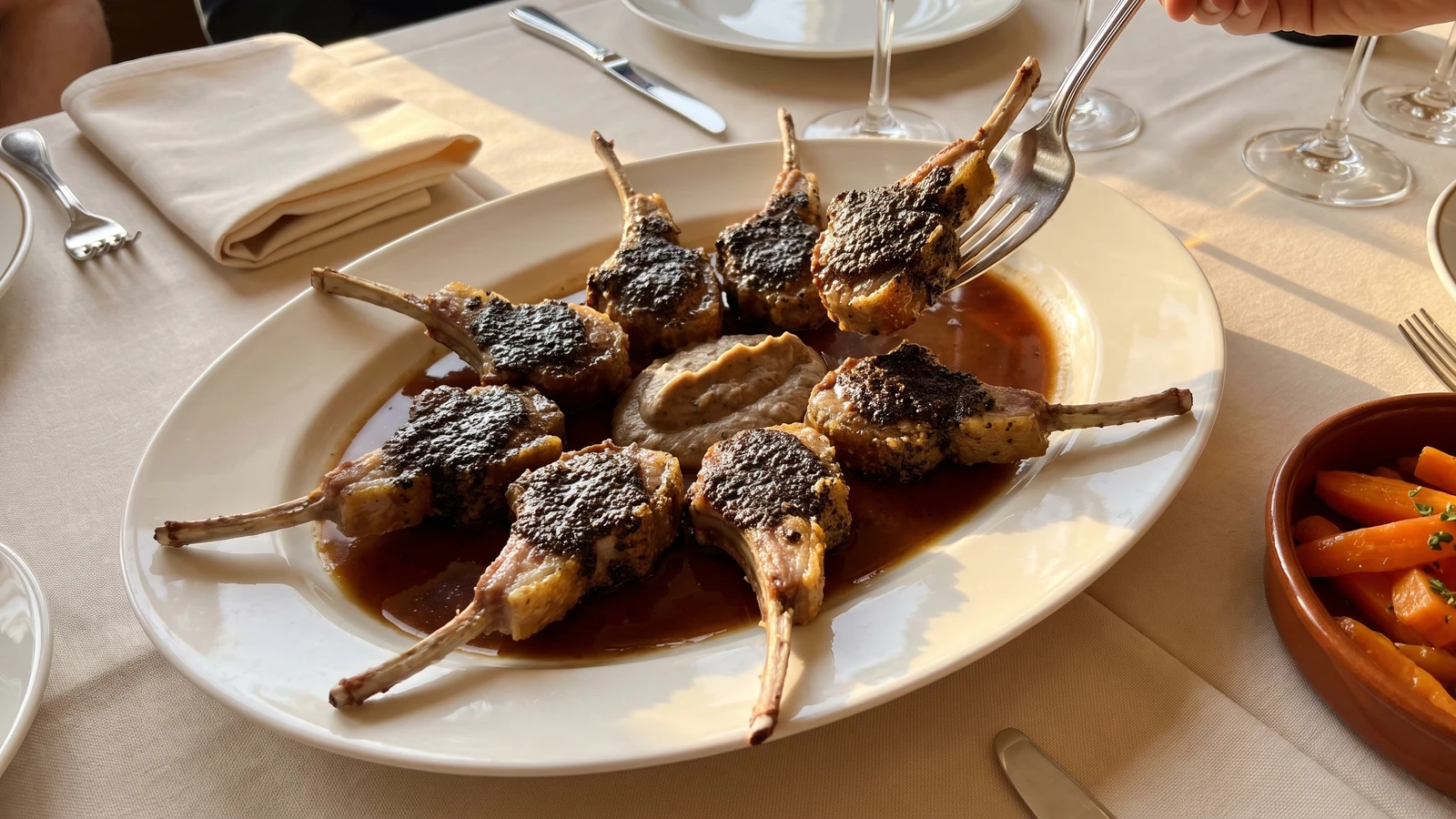
Côtelettes d’Agneau de Lait Morland sets delicate lamb beneath a truffle crust, then balances it with earthy mushroom purée and a fine thread of glossy meat glaze.
Côtelettes d’Agneau de Lait Morland (suckling lamb cutlets Morland) teaches one extravagant but exact lesson: here the truffle is the crumb, not a garnish. It must be chopped finely, kept dry, and pressed firmly into the beaten egg, because loose truffle burns in the butter while bare lamb loses the character of the dish.
The grand kitchen assumed a saucier on staff, a stockpot never off the fire for meat glaze, brigade platters, and a salamander nearby for other finishes. Morland itself does not need that overhead heat. At home, one heavy skillet, two small pans, prepared mushroom purée, and a modest measure of good meat glaze do the work for four. The brigade’s holding and service choreography are scaffolding and can go; the truffle coating, clarified butter, mushroom centre, and thread of buttered glaze are the dish and must stay. One cook, one stove, one evening.
When it is right, the lamb remains pale pink and tender beneath a dark, aromatic crust, the mushroom purée sits softly at the centre, and the meat glaze catches the light without flooding the truffle. The coating decides everything: dry cutlet, thin veil of egg, firm press of the knife.
Morland belongs to the named-garniture vocabulary of the Parisian grand kitchen rather than to the cooking of a particular lamb-raising region. Its title describes a composed treatment: suckling lamb, chopped truffle used in place of breadcrumbs, a central purée, and meat glaze applied with restraint. The circular platter carried that formal service onto bourgeois dinner tables, though the essential technique remains the familiar work of a skillet.
Quantity
8 cutlets (about 2 lb / 900 g total)
French-trimmed
Quantity
1 1/4 teaspoons (6 ml / 7 g)
Quantity
1/2 teaspoon (2.5 ml / 1 g)
Quantity
2
beaten until uniform but not frothy
Quantity
1 cup (240 ml / 150 g)
finely chopped to a coarse crumb
Quantity
1/2 cup (120 ml / 110 g)
Quantity
2 cups (475 ml / 450 g)
kept hot
Quantity
1/3 cup (80 ml / 95 g)
Quantity
2 tablespoons (30 ml / 28 g)
diced
Quantity
2 cups (475 ml / 450 g) Carottes Glacées pour Garnitures (No. 2059)
finished and kept hot
| Ingredient | Quantity |
|---|---|
| suckling lamb rib cutletsFrench-trimmed | 8 cutlets (about 2 lb / 900 g total) |
| fine salt | 1 1/4 teaspoons (6 ml / 7 g) |
| freshly ground white pepper | 1/2 teaspoon (2.5 ml / 1 g) |
| large eggsbeaten until uniform but not frothy | 2 |
| fresh black trufflefinely chopped to a coarse crumb | 1 cup (240 ml / 150 g) |
| clarified butter | 1/2 cup (120 ml / 110 g) |
| finished mushroom puréekept hot | 2 cups (475 ml / 450 g) |
| prepared meat glaze | 1/3 cup (80 ml / 95 g) |
| cold unsalted butterdiced | 2 tablespoons (30 ml / 28 g) |
| Carottes Glacées pour Garnituresfinished and kept hot | 2 cups (475 ml / 450 g) Carottes Glacées pour Garnitures (No. 2059) |
Warm the finished mushroom purée over the gentlest heat, stirring often so its edges do not catch. Warm the Carottes Glacées pour Garnitures (No. 2059) separately, then cover and hold them off the heat. Put a large serving platter in a low oven or rinse it with very hot water and dry it well; the cutlets cook quickly and must not wait while cold crockery steals their heat.
Bring the meat glaze to a bare simmer in a small saucepan and reduce it only until it coats a spoon in a thin, glossy film. Take it completely off the heat and monter au beurre, whisk in the cold butter a few pieces at a time, until the glaze gleams. If it separates into oily beads, stop adding butter and whisk in 1 teaspoon of cold water off the heat. Ça se rattrape. Keep it barely warm, never simmering, while the lamb cooks.
Lay each cutlet between two sheets of parchment and tap the fleshy eye gently with the flat side of a meat mallet or a rolling pin. Even it to about 3/4 inch (2 cm) thick without striking the rib bone or pounding the meat thin. Pat every surface dry, then season evenly with the salt and white pepper. Suckling lamb is tender already; the flattening gives even cooking, not tenderness.
Spread the beaten egg in one shallow dish and the chopped truffle in another. Dip each cutlet in egg, let the excess fall away until only a thin veil remains, then roll it through the truffle. Lay it flat and press the coating firmly with the broad side of a knife so the truffle and egg combine into one close crust. If bare patches appear, dab them with a fingertip of egg, add more truffle, and press again. Do not bury the cutlet beneath wet egg; the truffle is replacing breadcrumbs and must behave like a dry coating.
Heat half the clarified butter in a heavy 12-inch (30 cm) skillet over medium heat until it shimmers without smoking. Lay in four cutlets with room between them and cook without moving for about 2 minutes, until the egg has set and the truffle crust clings. Turn once with a thin spatula and cook the second side for 2 to 3 minutes, adjusting the heat so the truffle smells deep and earthy but never burnt. If loose coating drops into the pan, lower the heat, collect it with the spatula, and press it onto the still-tacky upper surface before turning. If the butter darkens too quickly, lift out the cutlets, wipe away the burnt truffle, and continue with fresh clarified butter. Repeat with the remaining cutlets. Rest them for 3 to 5 minutes, until the centres finish near 145°F (63°C).
Spoon the hot mushroom purée into a generous mound at the centre of the warmed platter. Arrange the cutlets in a close circle around it, bones pointing outward and the truffle crust left fully visible. Draw the buttered meat glaze in a narrow thread around the feet of the cutlets, never over their crust. Serve the Carottes Glacées pour Garnitures (No. 2059) in a warm dish alongside. Bring everything to the table at once. À table!
1 serving (about 480g)
Culinary guides, cultural storytelling, and the editorial depth that makes cooking meaningful.
Discover Culinary ExplorerChef Juliette
John Dory has the delicacy of sole and the firmness of turbot. A light flouring, a quick butter sauté, and nut-brown beurre noisette show exactly why looks never mattered.

Chef Juliette
Fresh haddock proves its delicacy in the meunière pan: a fine flour crust, moist pearly flakes, and beurre noisette sharpened with lemon and parsley, ready from one skillet in half an hour.

Chef Juliette
Éperlans à l’Anglaise turns small fish into a lesson in disciplined coating: boned smelts under a close, crisp crumb, pan-fried in clarified butter and finished with bright, half-melted maître d’hôtel butter.

Chef Juliette
Tiny smelts, shallot, mushrooms, white wine, gratin sauce, and fine bread raspings meet a fierce oven, where the fish must turn tender in the same breath the buttered crust bronzes.