
Chef Juliette
John Dory (St. Pierre)
John Dory has the delicacy of sole and the firmness of turbot. A light flouring, a quick butter sauté, and nut-brown beurre noisette show exactly why looks never mattered.
A cooking platform built around craft, culture, and the stories behind what we eat.
Created by Chef Juliette
Based on No. 1371, Côtelettes d’Agneau de Lait à la Buloz, from Le Guide Culinaire (1907) by Auguste Escoffier
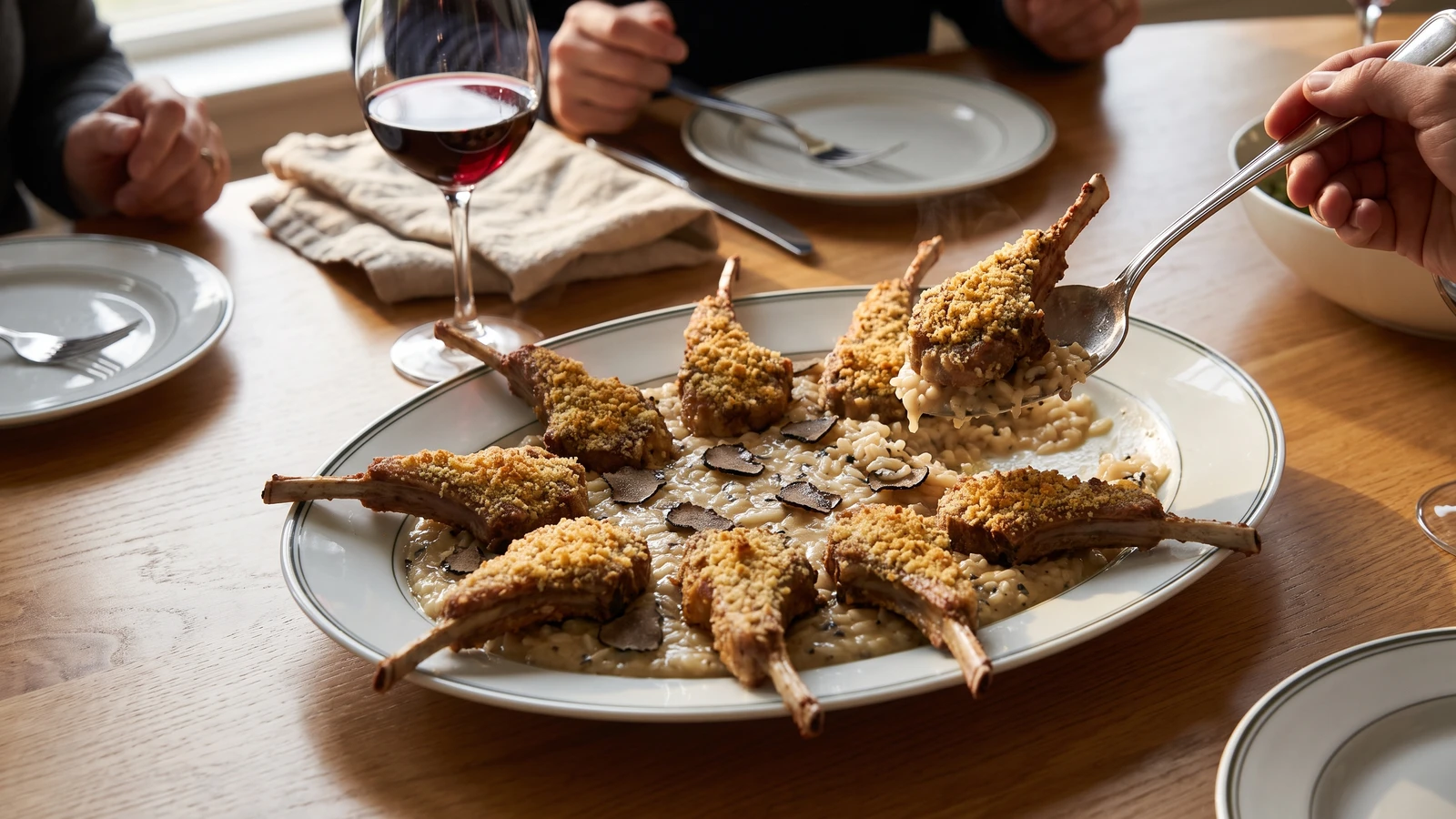
Tender milk-fed lamb cutlets wear a close Parmesan Béchamel coat and crisp crumb, then stand around truffled risotto, a lesson in setting one crust without overcooking the meat beneath.
Côtelettes d’Agneau de Lait à la Buloz (milk-fed lamb cutlets Buloz-style) teaches the discipline of double cooking: the first grilling gives the lamb its head start, and the second browning sets a Parmesan crust without driving the meat dry. Before you touch a pan, know this one truth: the Béchamel must be reduced until it clings. If it flows, every layer added afterward will slide with it.
The brigade version assumed a saucier holding dense Béchamel, a stockpot feeding the rizotto, and enough hands to grill, coat, crumb, and fry in quick succession. At home, a small saucepan, a covered pan of finished rice, and a wire rack divide the labor without changing the sequence. No salamander is needed; the source itself gives the final color in hot clarified butter. The extra hands and paper bone frills are service scaffolding and can go, but half-grilling, sauce-coating, anglaise, pressing the crumb, and the second browning are the dish.
Done properly, each cutlet arrives butter-gold and crisp outside, tender within, with ivory rizotto and black truffle beneath it. One cook, one stove, one evening. Reduce the Béchamel until a spoon leaves a clean track and the sauce grips the cutlet without running; that consistency decides the dish.
Côtelettes d’Agneau de Lait à la Buloz belongs to the Parisian grand-service repertoire, and its name honors François Buloz, the literary editor of the Revue des Deux Mondes. Its Parmesan, truffle, and rizotto do not claim a regional Italian origin; classical French kitchens brought those preparations into their own service grammar and arranged them around the delicate flavor of milk-fed lamb. Paper frills marked the formal table, while the dish’s enduring identity lies in its double cooking and close Béchamel crumb coat.
Quantity
8 small cutlets (about 2 lb / 900 g total)
neatly trimmed
Quantity
1 teaspoon (5 ml / 6 g)
divided
Quantity
½ teaspoon (2.5 ml / 1 g)
divided
Quantity
1½ tablespoons (22 ml / 21 g)
Quantity
2 tablespoons (30 ml / 16 g)
Quantity
¾ cup (180 ml / 185 g)
Quantity
1 thin slice (about ½ oz / 15 g)
Quantity
1 small leaf
Quantity
⅛ teaspoon (0.6 ml / 0.25 g)
Quantity
2 tablespoons (30 ml / 14 g)
Quantity
2
Quantity
1 tablespoon (15 ml / 14 g)
Quantity
1 cup (240 ml / 100 g)
Quantity
⅓ cup (80 ml / 30 g)
Quantity
½ cup (120 ml / 110 g)
Quantity
3 cups (720 ml / about 750 g), linked as Pommes de Terre Parmesane (No. 2238)
Quantity
1 small truffle (about 1 oz / 28 g)
sliced very thinly, with any packing juice reserved
| Ingredient | Quantity |
|---|---|
| bone-in milk-fed lamb rib cutletsneatly trimmed | 8 small cutlets (about 2 lb / 900 g total) |
| fine saltdivided | 1 teaspoon (5 ml / 6 g) |
| finely ground white pepperdivided | ½ teaspoon (2.5 ml / 1 g) |
| unsalted butter | 1½ tablespoons (22 ml / 21 g) |
| all-purpose flour | 2 tablespoons (30 ml / 16 g) |
| whole milk | ¾ cup (180 ml / 185 g) |
| yellow onion | 1 thin slice (about ½ oz / 15 g) |
| bay leaf | 1 small leaf |
| freshly grated nutmeg | ⅛ teaspoon (0.6 ml / 0.25 g) |
| finely grated Parmesan for the Béchamel | 2 tablespoons (30 ml / 14 g) |
| large eggs | 2 |
| neutral oil | 1 tablespoon (15 ml / 14 g) |
| very fine dry breadcrumbs | 1 cup (240 ml / 100 g) |
| finely grated Parmesan for the crumb coating | ⅓ cup (80 ml / 30 g) |
| clarified butter | ½ cup (120 ml / 110 g) |
| finished rizotto, as ordered by the Buloz entry | 3 cups (720 ml / about 750 g), linked as Pommes de Terre Parmesane (No. 2238) |
| black truffle, fresh or preservedsliced very thinly, with any packing juice reserved | 1 small truffle (about 1 oz / 28 g) |
Warm the milk with the onion and bay leaf until small bubbles gather at the edge, then cover and infuse for 5 minutes. Melt the butter in a small heavy saucepan, stir in the flour, and cook the roux gently for 90 seconds without letting it color. Strain in the warm milk a little at a time, whisking each addition smooth before the next. Add the nutmeg, ¼ teaspoon of the salt, and a pinch of white pepper, then simmer gently, stirring constantly, until reduced to ½ cup and thick enough that the spoon leaves a clean track across the pan. Take it off the heat and stir in the 2 tablespoons of Parmesan. Let it cool until lukewarm. If it still runs from the spoon, reduce it again; if it has become a paste, whisk in a teaspoon of milk. Ça se rattrape.
Reach for the finished rizotto linked in the supplied material as Pommes de Terre Parmesane (No. 2238). The Buloz entry itself explicitly orders rizotto with truffles, so use its rice garnish while retaining the supplied title and formula number for the book’s link. Fold in the truffle packing juice, if present, and all but eight of the truffle slices. Cover and keep it barely warm, not bubbling; if it begins to stiffen, take it off the heat rather than stirring it into paste.
Dry the cutlets thoroughly and season both sides with half the remaining salt and pepper. Heat a heavy grill pan or skillet until strongly hot, brush the lamb very lightly with a little of the clarified butter, and grill for 60 to 90 seconds per side. You want light browning and a cooked outer rim, while the centers remain distinctly underdone. Lift the cutlets onto a wire rack, blot away surface fat, and let them stand for 3 minutes. This first cooking must remain incomplete because the clarified-butter browning still lies ahead.
Whisk the anglaise (egg coating) by beating the eggs with the neutral oil and the remaining salt and pepper. Mix the breadcrumbs with the ⅓ cup of Parmesan in a second shallow dish. Working one cutlet at a time, spread one small tablespoon of reduced Béchamel thinly over both sides, lower it immediately into the anglaise without swishing, and then cover it completely with the Parmesan crumbs. Press the coating firmly with the flat of a knife so it becomes close and even. If the Béchamel slides off before the egg catches it, scrape it back into the saucepan, reduce it for another minute, cool it, and coat again. Don’t bury a loose sauce under more crumbs; the crust will leave the meat with it.
Heat the clarified butter in a wide sauté pan until a dropped breadcrumb sizzles immediately and turns gold within several seconds. Brown the cutlets in two uncrowded batches, about 2 minutes on the first side and 1½ to 2 minutes on the second, spooning butter around the bone so the crust colors evenly. Skim loose crumbs from the butter between batches before they scorch. The lamb is ready when the crust is deep butter-gold and the center registers 145°F / 63°C near, but not against, the bone. If the crumb darkens before the meat is ready, move the pan off the heat, lower the flame, and finish with frequent turns. Rest the cutlets on the rack for 3 minutes so the underside stays crisp.
Warm a broad oval platter and spread the truffled rizotto over it in a smooth, even layer. Arrange the eight cutlets in a close circle over the rice, with the bones pointing outward, and lay one reserved truffle slice against each cutlet. Paper frills may be fixed to the bones if you want the source’s formal finish, but they are service ornament, not technique. Carry the platter straight to the table while the crust still holds its butter sheen. À table!
1 serving (about 410g)
Culinary guides, cultural storytelling, and the editorial depth that makes cooking meaningful.
Discover Culinary ExplorerChef Juliette
John Dory has the delicacy of sole and the firmness of turbot. A light flouring, a quick butter sauté, and nut-brown beurre noisette show exactly why looks never mattered.

Chef Juliette
Fresh haddock proves its delicacy in the meunière pan: a fine flour crust, moist pearly flakes, and beurre noisette sharpened with lemon and parsley, ready from one skillet in half an hour.

Chef Juliette
Éperlans à l’Anglaise turns small fish into a lesson in disciplined coating: boned smelts under a close, crisp crumb, pan-fried in clarified butter and finished with bright, half-melted maître d’hôtel butter.

Chef Juliette
Tiny smelts, shallot, mushrooms, white wine, gratin sauce, and fine bread raspings meet a fierce oven, where the fish must turn tender in the same breath the buttered crust bronzes.