
Chef Juliette
John Dory (St. Pierre)
John Dory has the delicacy of sole and the firmness of turbot. A light flouring, a quick butter sauté, and nut-brown beurre noisette show exactly why looks never mattered.
A cooking platform built around craft, culture, and the stories behind what we eat.
Created by Chef Juliette
Based on No. 1367, Carré d’Agneau Soubise, from Le Guide Culinaire (1907) by Auguste Escoffier
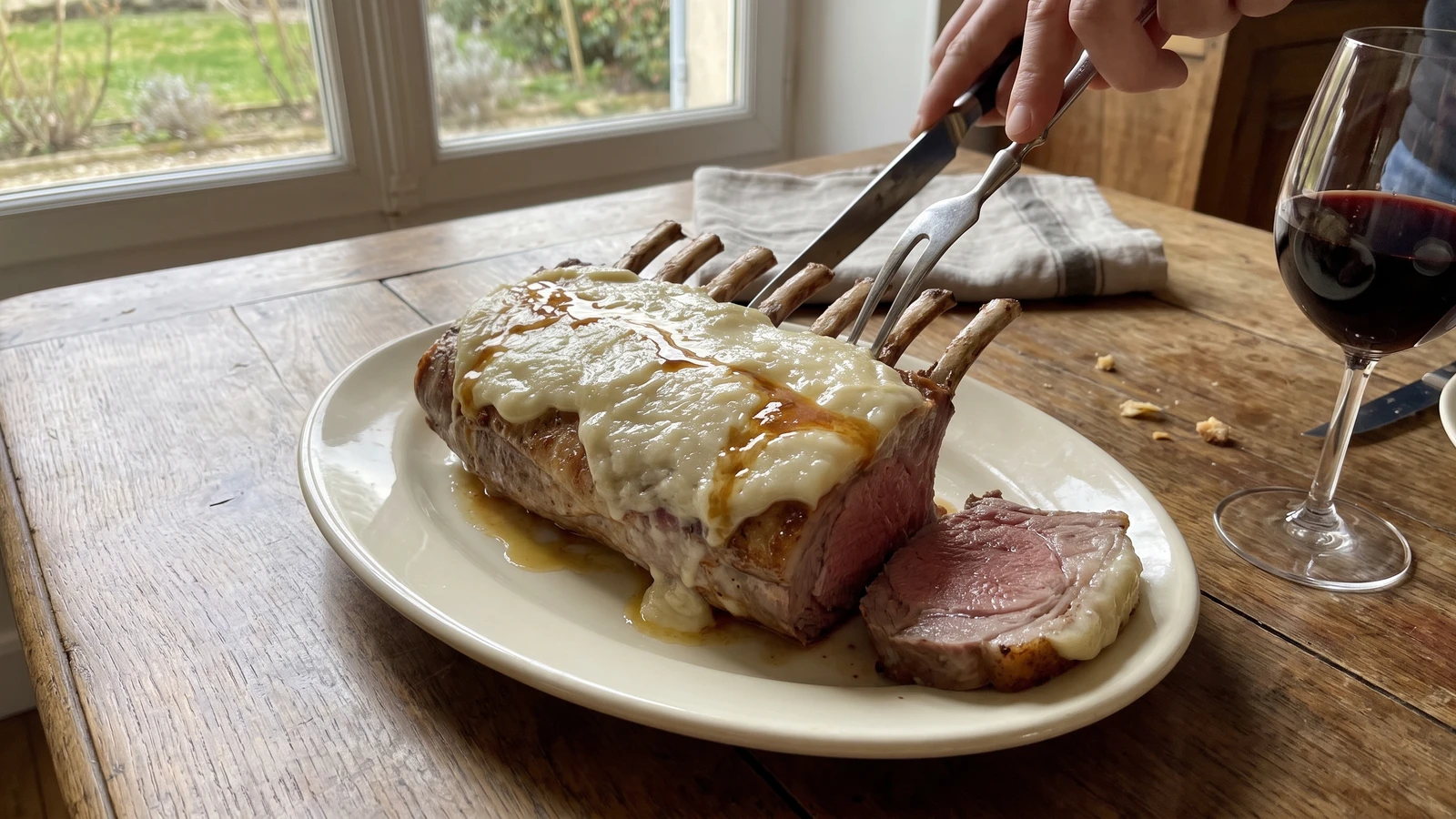
Carré d’agneau Soubise proves that onion can become silk: a gently stewed rack, a pale purée passed through a fine sieve, and a last butter finish that makes the sauce gleam.
Carré d’agneau Soubise (rack of lamb with silken onion purée) teaches restraint. The one true thing to know before touching the pan is this: Soubise must remain pale. The onions are softened without caramelizing, passed through a fine sieve with Béchamel, then enriched with butter until they become ivory silk around the lamb.
The original kitchen assumed a saucier with boiling Béchamel ready, a stock never off the fire reduced into meat glaze, a tammy for sieving, and a hot cupboard while the joint waited. The salamander has no work in this dish. At home, a lidded sauté pan, a fine-mesh sieve, two small finished sauce components, and the lamb’s natural resting time do the same work. One cook, one stove, one evening.
Here, one trimmed eight-rib rack replaces the brigade joint and feeds four generously. The separate hot holding and sauce station were service scaffolding, so they go. Blanching the onions, stewing them beside the lamb, sieving them, and mounting the Soubise with real butter are the dish itself, so every one stays. Watch the onions during the covered cooking: tenderness without colour is the step that decides everything.
Carré d’agneau Soubise belongs to the Parisian classical table, where a named garnish could define the entire treatment of a joint. In the source’s butchery language, “neck” means the shortened and trimmed best end, the rib rack, not loose stewing neck. Soubise carries an aristocratic name, but it traveled into bourgeois dining rooms because blanching, gentle stewing, and sieving could turn an ordinary onion into a formal accompaniment for roast meat.
Quantity
1 rack (about 2 lb / 900 g)
chine bone removed
Quantity
1½ cups (360 ml / 225 g), prepared through Blanchings (No. 273)
finely minced and thoroughly drained
Quantity
5 tablespoons (75 ml / 70 g)
2 tablespoons for the lamb and 3 tablespoons for finishing the Soubise
Quantity
½ cup plus 1½ tablespoons (142 ml / 145 g)
kept as a finished component
Quantity
1½ tablespoons (22 ml / 25 g)
warmed
Quantity
1 teaspoon (5 ml / 6 g)
Quantity
¼ teaspoon (1.25 ml / 0.5 g)
| Ingredient | Quantity |
|---|---|
| French-trimmed 8-rib rack of lambchine bone removed | 1 rack (about 2 lb / 900 g) |
| yellow onions prepared through Blanchingsfinely minced and thoroughly drained | 1½ cups (360 ml / 225 g), prepared through Blanchings (No. 273) |
| unsalted butter2 tablespoons for the lamb and 3 tablespoons for finishing the Soubise | 5 tablespoons (75 ml / 70 g) |
| Béchamel saucekept as a finished component | ½ cup plus 1½ tablespoons (142 ml / 145 g) |
| rather light meat glazewarmed | 1½ tablespoons (22 ml / 25 g) |
| fine salt | 1 teaspoon (5 ml / 6 g) |
| finely ground white pepper | ¼ teaspoon (1.25 ml / 0.5 g) |
Heat the oven to 325°F (165°C). Pat the rack dry, then season every meaty surface with the salt and white pepper. Leave the onions prepared through Blanchings (No. 273) in a sieve until the last water has drained away; excess water dilutes the butter and makes the covered cooking uneven. Set the finished Béchamel and meat glaze beside the stove, each in its own small saucepan, but don't heat them yet.
Melt 2 tablespoons (30 ml / 28 g) of the butter in a heavy lidded ovenproof sauté pan over medium heat. Raidir, meaning to set the surface gently in butter, by laying in the rack fat-side down and turning it until the exterior feels firm and becomes lightly golden, 6 to 8 minutes. Don't chase a dark crust here. Deeply browned butter and fond would stain the pale Soubise, so lower the heat at once if the milk solids begin turning brown.
Arrange the drained onions around the rack and turn them through the butter without letting them fry. Cover the pan tightly and transfer it to the oven. Cook for 20 to 30 minutes, stirring only the onions halfway through, until they are completely soft and still ivory. Begin checking the lamb at 18 minutes: remove it around 130°F (54°C) for a rosy centre, or nearer 140°F (60°C) if you want carryover cooking to bring it to the food-safety benchmark of 145°F (63°C). If the onions begin catching, lower the oven and work 1 tablespoon of hot water around the edge; if a patch has browned, move the pale onions to a clean pan and leave the dark layer behind. Don't scrape it into the sauce.
Transfer the carré to a warmed oval platter and cover it loosely with foil for 10 to 12 minutes. Loose covering keeps it warm without trapping enough heat to soften the exterior or drive the centre far past its mark. Leave the onions and their pale cooking butter in the pan.
Bring the finished Béchamel sauce to a boil, then add it to the onions exactly as the source directs. Stir briskly over low heat until the mixture is thoroughly hot, scraping up only the pale cooking juices. Immediately press it through a fine-mesh sieve into a clean warm saucepan, working quickly with a flexible spatula until only dry onion fibres remain. The sieve is not brigade scaffolding: it is what changes softened onion into Soubise. If the onions resist and remain grainy, return them to the covered pan with a spoonful of hot water for 5 minutes, then sieve again.
Warm the sieved Soubise over gentle heat until it barely trembles. Take it off the heat and monter au beurre, whisking in the remaining 3 tablespoons (45 ml / 42 g) of butter a small piece at a time until the sauce is glossy, soft, and just thick enough to cloak a spoon. Never boil it after the butter goes in. If it turns oily, stop adding butter and whisk in 1 teaspoon of cold water off the heat; ça se rattrape. If it is too stiff, loosen it with a spoonful of hot Béchamel.
Taste the Soubise and correct the seasoning, then pour it generously over the meaty portion of the whole carré, leaving the rib bones visible. Draw a thin thread of the warmed light meat glaze around the edge of the platter, keeping it distinct from the pale purée. Carry the joint to the table whole and carve between the ribs there, giving each guest lamb, Soubise, and a little glaze. À table!
1 serving (about 210g)
Culinary guides, cultural storytelling, and the editorial depth that makes cooking meaningful.
Discover Culinary ExplorerChef Juliette
John Dory has the delicacy of sole and the firmness of turbot. A light flouring, a quick butter sauté, and nut-brown beurre noisette show exactly why looks never mattered.

Chef Juliette
Fresh haddock proves its delicacy in the meunière pan: a fine flour crust, moist pearly flakes, and beurre noisette sharpened with lemon and parsley, ready from one skillet in half an hour.

Chef Juliette
Éperlans à l’Anglaise turns small fish into a lesson in disciplined coating: boned smelts under a close, crisp crumb, pan-fried in clarified butter and finished with bright, half-melted maître d’hôtel butter.

Chef Juliette
Tiny smelts, shallot, mushrooms, white wine, gratin sauce, and fine bread raspings meet a fierce oven, where the fish must turn tender in the same breath the buttered crust bronzes.