
Chef Juliette
John Dory (St. Pierre)
John Dory has the delicacy of sole and the firmness of turbot. A light flouring, a quick butter sauté, and nut-brown beurre noisette show exactly why looks never mattered.
A cooking platform built around craft, culture, and the stories behind what we eat.
Created by Chef Juliette
Based on No. 1362, Carré d’Agneau en Cocotte à la Bonne Femme, from Le Guide Culinaire (1907) by Auguste Escoffier
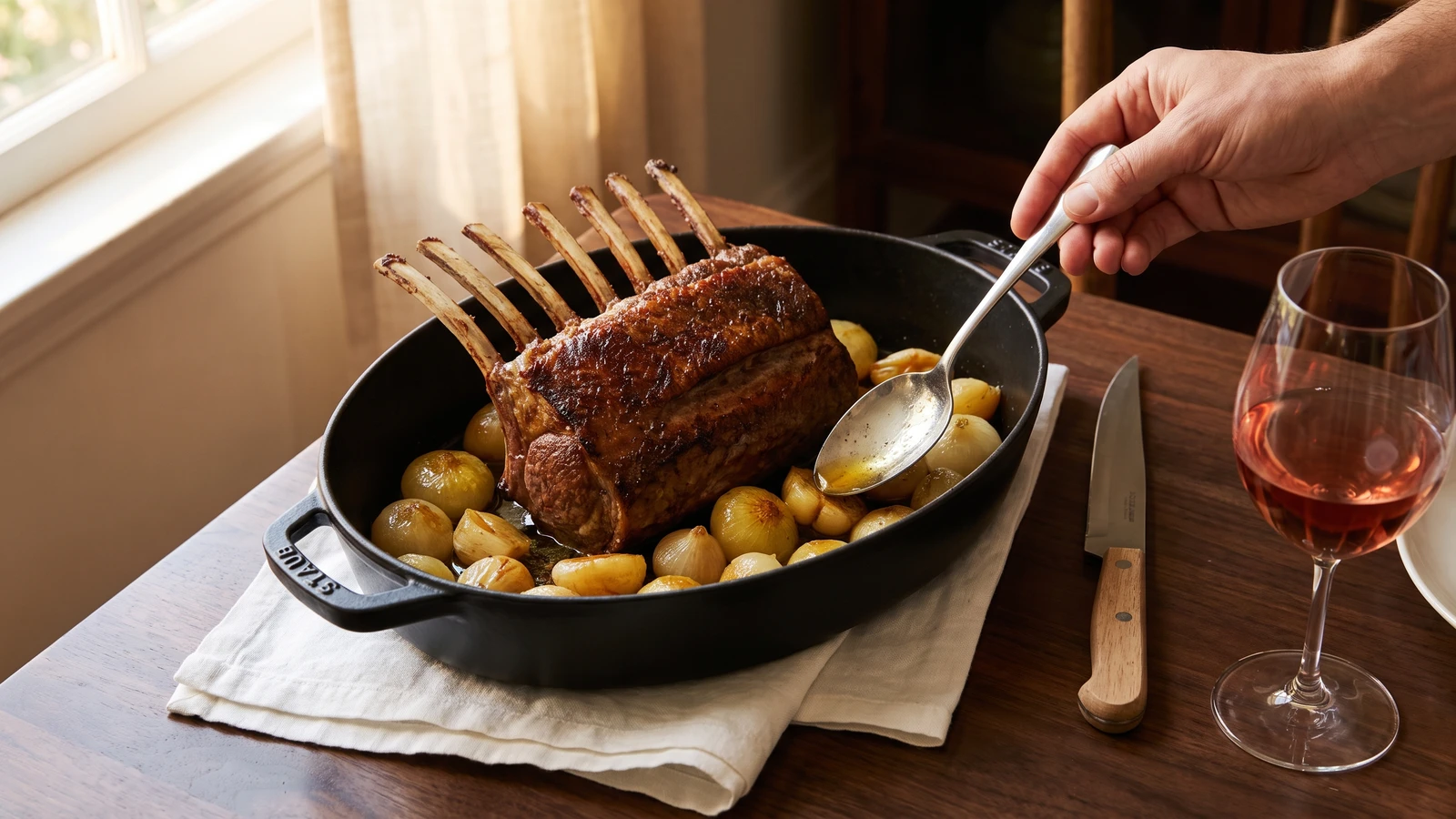
Carré d’agneau teaches the quiet art of timing one pot: butter-bronzed lamb, sweet small onions, and shaped potatoes all arriving tender together, glossy with their own juices.
Carré d’agneau teaches one true thing: ingredients sharing a cocotte don't necessarily share a clock. The lamb wants a short, gentle roast, while the potatoes need a head start. Give them that, and the whole pot arrives together, the rack rosy, the onions sweet, the potatoes tender, everything gleaming with butter and lamb juices.
The brigade entry assumed a butcher-trimmed, shortened carré, a separate pan for browning, an oval cocotte waiting nearby, and potatoes already shaped and partially cooked by another pair of hands. It needed no saucier, standing stockpot, or salamander because there is no built sauce here. At home, one eight-bone rack feeds four, and the same heavy cocotte handles the potatoes, the browning, the oven, and the table. The extra sauté pan was scaffolding, so it goes. The shaping, Blanchings (No. 273), butter browning, gentle covered roast, and service in the cocotte remain because they are the dish. One cook, one stove, one evening.
Before the carré touches butter, shape and prepare the potatoes according to Blanchings (No. 273). That partial cooking is the step that brings meat and vegetables to the table at the same moment. Skip it and the rack waits while the potatoes catch up, which is a poor bargain for good lamb.
Carré d’agneau en cocotte à la bonne femme belongs to cuisine bourgeoise, the well-run French household table, rather than to one region’s larder. The domestic practice of cooking a joint and its vegetable garnish together in a cocotte traveled into the grand repertoire, which preserved even the instruction to carry the pot to the table on a folded napkin. À la bonne femme is not one universal sauce: here it means a complete household treatment of lamb with small onions, potatoes, and butter.
Quantity
1 rack (about 1¾ to 2 lb / 800 to 900 g)
chine bone removed, rib bones shortened to fit the cocotte, and fat cap trimmed to ⅛ inch / 3 mm
Quantity
10 onions (about 1½ cups / 250 g)
peeled
Quantity
2 medium (about 2¾ cups / 450 g), prepared according to Blanchings (No. 273)
cut into large dice and pared into plump garlic-clove shapes
Quantity
7 tablespoons (105 ml / 100 g)
divided
Quantity
1¼ teaspoons (6.25 ml / 7 g)
divided
Quantity
½ teaspoon (2.5 ml / 1 g)
| Ingredient | Quantity |
|---|---|
| shortened eight-bone rack of lambchine bone removed, rib bones shortened to fit the cocotte, and fat cap trimmed to ⅛ inch / 3 mm | 1 rack (about 1¾ to 2 lb / 800 to 900 g) |
| small pearl or boiling onionspeeled | 10 onions (about 1½ cups / 250 g) |
| waxy potatoescut into large dice and pared into plump garlic-clove shapes | 2 medium (about 2¾ cups / 450 g), prepared according to Blanchings (No. 273) |
| unsalted butterdivided | 7 tablespoons (105 ml / 100 g) |
| fine sea saltdivided | 1¼ teaspoons (6.25 ml / 7 g) |
| freshly ground black pepper | ½ teaspoon (2.5 ml / 1 g) |
Heat the oven to 350°F / 175°C. Pat the rack completely dry, especially over the fat cap, then season it all over with about half the salt and all the pepper. Let it stand while you prepare the potatoes. A wet surface fights the butter and leaves the lamb pale; dryness gives the cocotte something worth building on.
Cut the potatoes into large, even pieces, then pare away the sharp corners so each resembles a plump garlic clove. Carry out Blanchings (No. 273) exactly as its own entry directs, using the cocotte itself. Drain the potatoes, dry them thoroughly, and wipe the cocotte dry. The shaping isn't decoration: rounded, even pieces cook without fragile corners breaking into the butter, while the partial cooking brings their timing into step with the lamb.
Set the dry cocotte over medium heat and melt 2 tablespoons of the butter. When the foam subsides, lay in the carré fat-side down. Brown it patiently for 3 to 4 minutes, then turn it across the other fleshy surfaces until it carries a deep hazelnut-bronze crust, about 8 minutes in all. If the butter turns black before the lamb is properly browned, lift out the meat, wipe away the bitter solids, lower the heat, and continue with 1 tablespoon taken from the remaining butter. Never build a dish on burnt milk solids. Transfer the carré to a plate.
Add 2 tablespoons of butter to the cocotte, followed by the peeled onions. Roll them through the butter over medium heat for 7 to 9 minutes, until they are golden in patches and beginning to soften but still hold their shape. Season the onions and dried potatoes with the remaining salt. If the onions colour too quickly, lower the heat and keep them moving; sugar and extra flavourings have no business here.
Return the carré to the cocotte, fat-side up, and arrange the onions and potatoes snugly around it. Melt the remaining butter and spoon it over everything. Cover the cocotte and roast gently for 18 to 25 minutes, opening it once to baste the lamb and turn the vegetables through the buttery juices. Begin checking early: remove the rack at 125 to 130°F / 52 to 54°C in its thickest part for a rosy centre after resting. A knife should enter the potatoes without resistance. If the lamb is ready while the potatoes remain firm, lift out the rack and let it rest while the covered cocotte returns to the oven for 5 to 10 minutes. Ça se rattrape. Never overcook the meat to punish a slow potato.
Rest the carré loosely covered for 10 minutes. Keep the vegetables covered off the heat, or in the oven if they needed extra time. Pour the lamb’s resting juices back into the cocotte, return the whole rack to the centre, and spoon the glossy butter and juices over it. Set the cocotte on a thickly folded napkin and carry it straight to the table. Carve two ribs per person there, with onions and potatoes alongside. No separate gravy is needed. À table!
1 serving (about 305g)
Culinary guides, cultural storytelling, and the editorial depth that makes cooking meaningful.
Discover Culinary ExplorerChef Juliette
John Dory has the delicacy of sole and the firmness of turbot. A light flouring, a quick butter sauté, and nut-brown beurre noisette show exactly why looks never mattered.

Chef Juliette
Fresh haddock proves its delicacy in the meunière pan: a fine flour crust, moist pearly flakes, and beurre noisette sharpened with lemon and parsley, ready from one skillet in half an hour.

Chef Juliette
Éperlans à l’Anglaise turns small fish into a lesson in disciplined coating: boned smelts under a close, crisp crumb, pan-fried in clarified butter and finished with bright, half-melted maître d’hôtel butter.

Chef Juliette
Tiny smelts, shallot, mushrooms, white wine, gratin sauce, and fine bread raspings meet a fierce oven, where the fish must turn tender in the same breath the buttered crust bronzes.