Culinary Explorer

A cooking platform built around craft, culture, and the stories behind what we eat.
Discover Culinary Explorer
Brochettes de Rognons

Brochettes de Rognons

Created by Chef Juliette

Based on No. 1343, Brochettes de Rognons, from Le Guide Culinaire (1907) by Auguste Escoffier

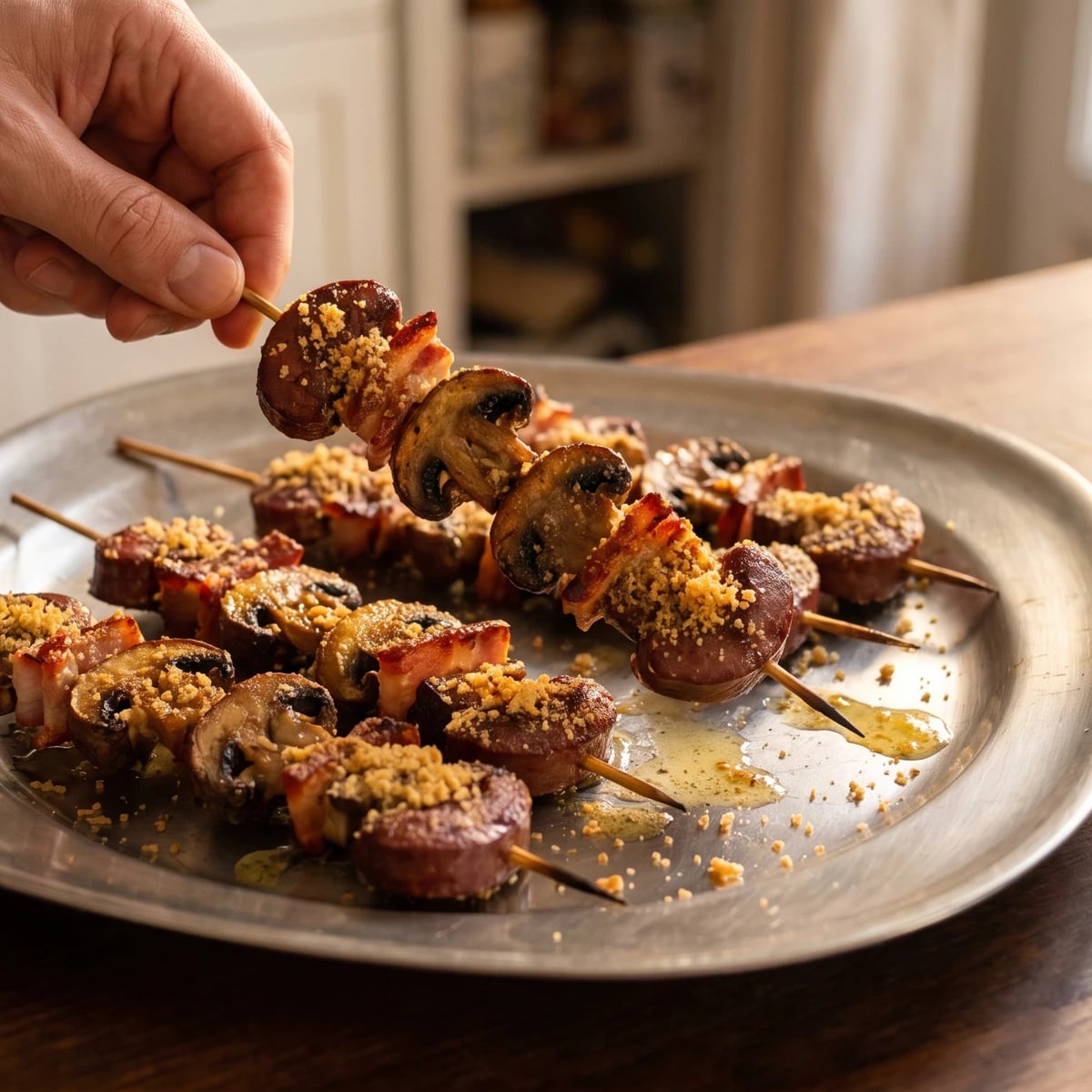
Fierce heat sets lamb kidney before bacon, mushrooms, butter, and crumbs meet the broiler, producing bronzed skewers with tender centers and teaching the discipline of two brief cooks.

Main Dishes
French
Weeknight
BBQ
Quick Meal
35 min
Active Time
15 min cook50 min total
Yield4 servings

Brochettes de rognons (skewers of kidney) teach control through two brief cooks. Kidney wants fierce heat and almost no time. The first pass is raidir, to stiffen the surface in butter while leaving the center barely touched; the second bronzes the crumbed brochette and finishes the meat. Linger during either pass and tenderness leaves the room.

The source assumed bacon already prepared by Blanchings (No. 273), mushrooms sautéed at another station, and a salamander blazing overhead. It needed no saucier on staff and no stockpot kept simmering, because these brochettes are served as they stand. At home, one heavy skillet handles the mushrooms and kidneys in sequence, while the broiler supplies the salamander's fierce top heat. The brigade choreography is scaffolding and can go. The two-stage cooking, alternating bacon and mushroom, butter, and bread raspings are the dish and must stay. One cook, one stove, one evening.

The book calls for mutton kidney, which has a deeper mineral character. When mutton isn't available, the same weight of smaller, milder lamb kidneys preserves the cut and method honestly. Before the pan, dry every roundel until the towel comes away clean. A wet kidney simmers in its own liquid, and no amount of broiling afterward can give back that first clean sear.

Brochettes de rognons belong to Parisian grill rooms and the bourgeois French supper table rather than to one provincial larder; kidneys were butcher's cuts made for a fast, last-minute fire. Classical kitchens turned them into neat individual portions by alternating the roundels with bacon and mushrooms, then using radiant heat to bronze a buttered coat of bread raspings. The common association of brochettes with outdoor barbecue can mislead here: this preparation was often finished beneath fierce overhead heat and served without sauce.

The technique, the tradition, and the story behind every dish.

Discover Culinary Explorer

Ingredients

mutton kidneys or lamb kidneys

Quantity

6 mutton kidneys or 8 lamb kidneys (about 1 lb / 450 g total)

outer skins removed and cut crosswise into ⅓-inch (8 mm) roundels

thick-cut lean unsmoked bacon

Quantity

about 1 cup (240 ml / 150 g), prepared by Blanchings (No. 273)

rind removed and cut into 1-inch (2.5 cm) squares

firm white button mushrooms

Quantity

3 cups (720 ml / 225 g)

wiped clean and sliced ⅓ inch (8 mm) thick

unsalted butter

Quantity

6 tablespoons (90 ml / 85 g)

divided

fine dry breadcrumbs

Quantity

½ cup (120 ml / 35 g)

used as the home equivalent of bread raspings

fine sea salt

Quantity

¾ teaspoon (3.75 ml / 4.5 g)

divided

freshly ground black pepper

Quantity

½ teaspoon (2.5 ml / 1 g)

Equipment Needed

  • 12-inch (30 cm) heavy skillet
  • 8 flat metal skewers, about 10 inches (25 cm) long
  • Rimmed sheet pan with wire rack
  • Instant-read thermometer
  • Pastry brush

Instructions

  1. 1

    Prepare the roundels

    Set the broiler to high with a rack about 4 inches (10 cm) below the element, and let it heat thoroughly. Place a wire rack over a rimmed sheet pan. Slip the thin outer skin from each kidney with the point of a small knife, keeping the flesh intact, then cut crosswise into roundels exactly ⅓ inch (8 mm) thick. Blot every surface dry with clean towels. Hold back the seasoning until just before the kidneys meet the pan, since salt draws moisture to the surface.

    The slices must be even. Thin pieces become hard before the crumbs color, while thick ones remain undercooked when their neighbors are ready.
  2. 2

    Sauté the mushrooms

    Heat 2 tablespoons (30 ml / 28 g) of the butter in a wide, heavy skillet over medium-high heat. When the foam subsides, add the mushrooms in one uncrowded layer with a small pinch of the salt. Sauté them, tossing only after their undersides have colored, until deeply golden at the edges and dry on the surface, about 4 minutes. Transfer them to a plate. Any liquid left in the pan must evaporate before the kidneys go in.

  3. 3

    Raidir the kidneys

    Wipe the skillet clean and set it over the fiercest heat your stove gives. Season the kidney roundels with the remaining salt and all the pepper. Divide 2 tablespoons (30 ml / 28 g) of butter between two batches, waiting each time until the foam nearly subsides, then lay in the kidneys without crowding. Sear for 30 to 40 seconds per side, just until the surfaces brown and stiffen while the centers remain barely touched, then lift them out immediately. If liquid floods the pan and the kidneys turn gray, stop. Ça se rattrape: remove them, pour away the liquid, wipe and reheat the skillet with fresh butter, then return the pieces for only a few seconds per side. Do not cook them through at this stage.

    Raidir is a preliminary stiffening, not the final cooking. The broiler still has work to do.
  4. 4

    Thread and crumb

    Thread the kidneys onto 8 flat metal skewers, alternating them with the lean bacon prepared by Blanchings (No. 273) and the sautéed mushroom slices. Leave a thread of space between pieces so the heat can reach their edges, but no broad gaps. Melt the remaining 2 tablespoons (30 ml / 28 g) of butter and brush every surface generously. Sprinkle the brochettes with the fine breadcrumbs, turning and pressing lightly until they wear a thin, even coat rather than a heavy casing. Arrange them on the prepared rack.

  5. 5

    Broil the brochettes

    Broil the skewers for about 2 minutes, turn them, and broil the second side for 1½ to 2 minutes. They are ready when the crumbs are deep butter-gold, the bacon is bronzed at its edges, and the kidney feels firm but still springy. Check the thickest roundel from the side with an instant-read thermometer; it should reach 160°F (71°C). If the crumbs darken before the kidney reaches temperature, move the pan down one rack and continue more gently. If the kidney is ready but the crumbs remain pale, lift the skewers closer to the element for 15 seconds. Both failures can be corrected, but only if you watch.

  6. 6

    Serve as they stand

    Rest the brochettes for 1 minute, no longer, then carry them to the table on their skewers. Do not add a sauce or bury them under garnish. The browned crumbs, butter, bacon, and mushroom are the finish the source intended, generous enough without ornament. À table!

Chef Tips

  • Buy kidneys that are plump and glossy with a clean, mild mineral smell. An ammoniac or sharply sour odor means they are tired, and soaking won't repair them. Change the plan, not the standard.
  • Mutton kidney gives the fullest flavor, while lamb kidney is smaller and milder. Beef kidney is too large and strongly flavored for these little roundels, so it isn't an honest substitute.
  • Bread raspings were made by rubbing a dry loaf into fine crumbs. Plain fine dry breadcrumbs are their direct home equivalent; coarse panko makes a separate crust and changes the dish.
  • For an outdoor barbecue, use flat metal skewers over fierce direct heat and close the lid between turns so radiant heat reaches the crumbs. Keep a cooler zone ready in case the butter causes flare-ups.
  • A lively Gamay or light Cabernet Franc has enough freshness for the kidney and bacon without overpowering the mushrooms. Serve the brochettes immediately, because reheating toughens them.

Advance Preparation

  • Complete the bacon preparation through Blanchings (No. 273) before beginning; the recipe time assumes this referenced component is ready. It can be chilled for up to 1 day before being cut into squares.
  • The mushrooms may be sautéed up to 4 hours ahead and kept chilled. Bring them back toward room temperature before threading so they do not cool the kidneys.
  • The kidneys may be skinned and sliced up to 2 hours ahead. Lay them on clean towels in a covered container in the refrigerator, then blot them again immediately before seasoning.
  • Do not sear, assemble, or crumb the brochettes far in advance. The first cook should flow directly into threading and broiling, or the kidneys tighten and the crumb coat becomes damp.

Frequently Asked Questions

Nutrition Information

1 serving (about 175g)

Calories
360 calories
Total Fat
24 g
Saturated Fat
12 g
Trans Fat
1 g
Unsaturated Fat
10 g
Cholesterol
400 mg
Sodium
970 mg
Total Carbohydrates
9 g
Dietary Fiber
1 g
Sugars
2 g
Protein
27 g

Note: Chef personas and recipes are created with AI assistance. Cook with care: follow safe food-handling practices, check doneness with a thermometer when needed, and adapt for allergies and your kitchen.

Where cooking meets culture.

Culinary guides, cultural storytelling, and the editorial depth that makes cooking meaningful.

Discover Culinary Explorer

More from Relevés and Entrées - MUTTON, GRASS LAMB AND HOUSE LAMB

Browse the full collection