
Chef Juliette
John Dory (St. Pierre)
John Dory has the delicacy of sole and the firmness of turbot. A light flouring, a quick butter sauté, and nut-brown beurre noisette show exactly why looks never mattered.
A cooking platform built around craft, culture, and the stories behind what we eat.
Created by Chef Juliette
Based on No. 1320, Côtelettes en Chaudfroid, from Le Guide Culinaire (1907) by Auguste Escoffier
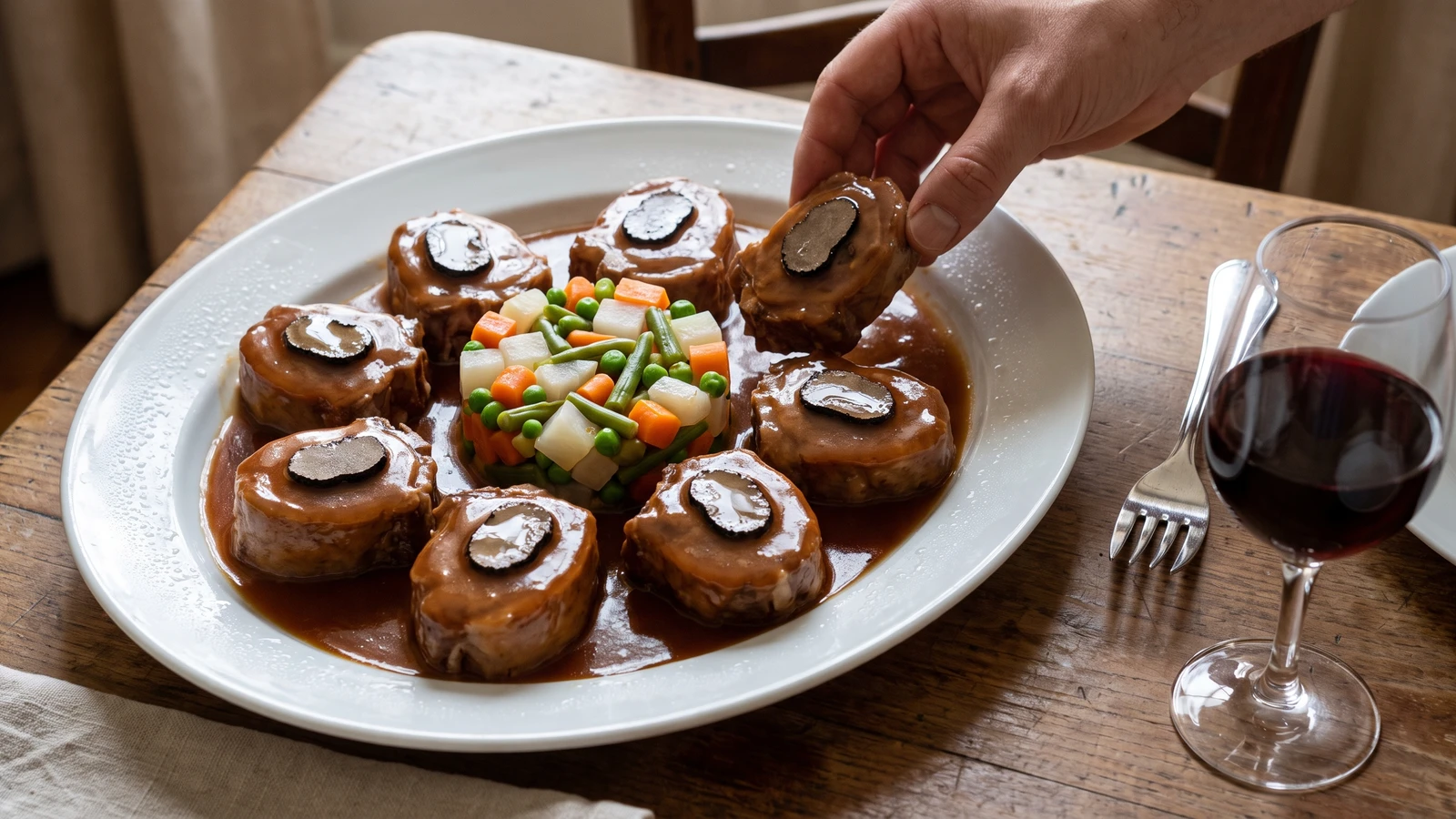
Cold lamb in a mahogany glaze, each tender neck cutlet carrying black truffle beneath clear aspic: a lesson in braise, reduction, and the exact moment a chaud-froid sauce coats without running.
Côtelettes en chaudfroid (braised lamb neck cutlets glazed and served cold) teach the discipline of temperature. The meat is cooked hot, but everything that finishes it happens on the edge of setting: lamb fully chilled, brown sauce almost cold but still fluid, aspic liquid enough to veil. Know this before touching a pan: a chaud-froid coating is controlled gelatin, not gravy. Too warm and it runs away; too cold and it clumps.
The original recipe assumed a saucier on staff, a stock never off the fire, a larder cook trimming ranks of identical cutlets, and enough Brown Chaud-froid Sauce (No. 34) to fill a deep dipping pan. The home equivalent is honest and smaller: eight butcher-sawn neck cutlets, one covered braise, prepared sauce and aspic, a fine sieve, and a narrow bowl for dipping. The banquet quantities and elaborate centerpiece are brigade scaffolding, so they go. Cooling the meat in its liquor, reducing that liquor into the sauce, coating near-cold, and setting truffle beneath aspic are the dish itself, so they stay. One cook, one stove, one evening.
The finished cutlets should be tender yet intact beneath a smooth mahogany glaze, with the black truffle visible through a clear final sheen. Test the coating on one cold spoon before committing a cutlet. If it runs, chill it briefly; if it drags in ropes, warm it by a breath. Ça se rattrape. That test is the step that matters most.
The chaud-froid family belongs to the Parisian repertoire of cold service, where meats cooked hot were transformed into polished buffet dishes with sauces strengthened by jelly. Côtelettes en chaudfroid carried that method from grand household kitchens to the bourgeois dinner table, turning inexpensive neck into a formal dish through braising, truffle, and aspic. The name does not describe a sauce served half hot and half cold; it records the method's turn from hot cooking to cold service.
Quantity
8 evenly sawn cutlets (about 3 lb / 1.35 kg)
cut 1¼ inches / 3 cm thick
Quantity
2 teaspoons (10 ml / 12 g)
Quantity
1 teaspoon (5 ml / 2 g)
Quantity
2 tablespoons (30 ml / 28 g)
Quantity
1 medium carrot (about 4 oz / 115 g)
cut into small dice
Quantity
1 medium onion (about 5 oz / 140 g)
cut into small dice
Quantity
1 stalk (about 1½ oz / 40 g)
cut into small dice
Quantity
4 cups (960 ml / 960 g)
Quantity
1
Quantity
1½ cups (360 ml / 360 g)
prepared
Quantity
1 small truffle (about ½ oz / 15 g)
cut into 8 fine slices
Quantity
½ cup (120 ml / 75 g)
cut into ¼-inch / 6-mm dice
Quantity
½ cup (120 ml / 75 g)
cut into ¼-inch / 6-mm dice
Quantity
½ cup (120 ml / 65 g)
cut into ¼-inch / 6-mm pieces
Quantity
½ cup (120 ml / 70 g)
Quantity
⅓ cup (80 ml / 75 g)
| Ingredient | Quantity |
|---|---|
| lamb neck cutletscut 1¼ inches / 3 cm thick | 8 evenly sawn cutlets (about 3 lb / 1.35 kg) |
| fine sea salt | 2 teaspoons (10 ml / 12 g) |
| freshly ground black pepper | 1 teaspoon (5 ml / 2 g) |
| clarified butter | 2 tablespoons (30 ml / 28 g) |
| carrot for the braisecut into small dice | 1 medium carrot (about 4 oz / 115 g) |
| yellow onioncut into small dice | 1 medium onion (about 5 oz / 140 g) |
| celerycut into small dice | 1 stalk (about 1½ oz / 40 g) |
| unsalted brown lamb or beef stock | 4 cups (960 ml / 960 g) |
| bouquet garni of parsley stems, thyme, and bay | 1 |
| Brown Chaud-froid Sauceprepared | 1½ cups (360 ml / 380 g) Brown Chaud-froid Sauce (No. 34) |
| clear meat aspicprepared | 1½ cups (360 ml / 360 g) |
| black trufflecut into 8 fine slices | 1 small truffle (about ½ oz / 15 g) |
| carrot for the macédoinecut into ¼-inch / 6-mm dice | ½ cup (120 ml / 75 g) |
| turnipcut into ¼-inch / 6-mm dice | ½ cup (120 ml / 75 g) |
| green beanscut into ¼-inch / 6-mm pieces | ½ cup (120 ml / 65 g) |
| frozen peas | ½ cup (120 ml / 70 g) |
| mayonnaise | ⅓ cup (80 ml / 75 g) |
Heat the oven to 325°F / 160°C. Pat the neck cutlets dry, trim away loose fragments and excessive surface fat, then season them with the salt and pepper. Heat the clarified butter in a wide, heavy cocotte and brown the cutlets in batches until both faces are a deep hazelnut color. Do not crowd them. Lift the cutlets out, add the diced carrot, onion, and celery, and cook until their edges color. The brown film on the pot floor is the fond, and it must stay in the dish.
Pour in a little of the stock and scrape the pot floor until every browned trace dissolves. Return the cutlets in one snug layer, add the remaining stock and bouquet garni, and bring the liquid just to a simmer. Cover and braise in the oven for 1 hour 45 minutes to 2 hours 15 minutes, turning once, until a thin knife enters the meat easily but the cutlets still hold firmly around their bones. Begin checking early. This is not a stew to cook until it falls apart; the cold glaze needs a complete piece beneath it.
Let the cutlets settle in their braising liquor for 20 minutes. Transfer them in one layer to a shallow metal or glass dish, pour the liquor and vegetables over them, and set the dish over an ice bath until no longer hot. Cover and refrigerate for at least 2½ hours, until the meat is cold and the fat has solidified on the liquor. Cooling in the liquor keeps the neck succulent; chilling it bare would dry and darken the surface.
Lift out the cold cutlets and keep them refrigerated. Remove every trace of hardened fat from the braising liquor, discard the bouquet garni, and strain the liquor through a fine sieve into a wide saucepan. Boil steadily until reduced to ¾ cup / 180 ml, about 25 to 40 minutes. It should taste concentrated and lamb-rich without becoming salty. If the seasoning reaches its limit before the volume does, stop reducing and measure out ¾ cup / 180 ml; salt cannot be reduced away. Cool the liquor until barely lukewarm.
Blanch the diced carrot and turnip in salted water until tender but still neat, about 4 minutes. Add the beans for the final 2 minutes and the peas for the final minute. Drain, chill in cold water, and dry thoroughly. Melt 2 tablespoons / 30 ml of the aspic over very gentle heat, then cool it until fluid but no longer warm. Stir it into the mayonnaise, fold in the vegetables, and pack the macédoine firmly into a cold-water-rinsed 2-cup mold. Cover and refrigerate until set.
Combine the reduced braising liquor with the prepared Brown Chaud-froid Sauce (No. 34) over the lowest heat, stirring only until the two become smooth and fluid. Do not boil. Strain the mixture into a narrow bowl, then stir it occasionally as it cools to about 68°F / 20°C, when it should coat a cold spoon in an even, opaque film. If it runs off transparently, set the bowl over ice and keep stirring. If it becomes ropey or begins setting at the rim, place the bowl over lukewarm water for a few seconds. Ça se rattrape.
Dry the chilled cutlets carefully. Holding each by its bone, dip the meat completely into the almost-cold chaud-froid coating, let the excess fall back into the bowl, and set it on a cold tray. Place one fine truffle slice over the kernel of meat while the coating is still tacky. Melt the remaining aspic gently, cool it until cold but still liquid, then spoon or brush a thin clear veil over every cutlet. If a truffle slice slides, the coating is too loose; chill that cutlet for 3 minutes, reset the truffle, and cover it with aspic.
Refrigerate the coated cutlets for 45 minutes, until both the chaud-froid and aspic are fully set. Pass the point of a small sharp knife around each cutlet and lift away the skirt of surplus sauce, leaving a clean outline. Unmold the macédoine in the center of a cold platter and arrange the cutlets around it in a close circle, bones pointing outward. Let the platter stand for 10 minutes before serving so the lamb loses its refrigerator chill without softening the glaze. À table!
1 serving (about 460g)
Culinary guides, cultural storytelling, and the editorial depth that makes cooking meaningful.
Discover Culinary ExplorerChef Juliette
John Dory has the delicacy of sole and the firmness of turbot. A light flouring, a quick butter sauté, and nut-brown beurre noisette show exactly why looks never mattered.

Chef Juliette
Fresh haddock proves its delicacy in the meunière pan: a fine flour crust, moist pearly flakes, and beurre noisette sharpened with lemon and parsley, ready from one skillet in half an hour.

Chef Juliette
Éperlans à l’Anglaise turns small fish into a lesson in disciplined coating: boned smelts under a close, crisp crumb, pan-fried in clarified butter and finished with bright, half-melted maître d’hôtel butter.

Chef Juliette
Tiny smelts, shallot, mushrooms, white wine, gratin sauce, and fine bread raspings meet a fierce oven, where the fish must turn tender in the same breath the buttered crust bronzes.