
Chef Juliette
John Dory (St. Pierre)
John Dory has the delicacy of sole and the firmness of turbot. A light flouring, a quick butter sauté, and nut-brown beurre noisette show exactly why looks never mattered.
A cooking platform built around craft, culture, and the stories behind what we eat.
Created by Chef Juliette
Based on No. 1300, Double or Pair of Legs of Mutton, from Le Guide Culinaire (1907) by Auguste Escoffier
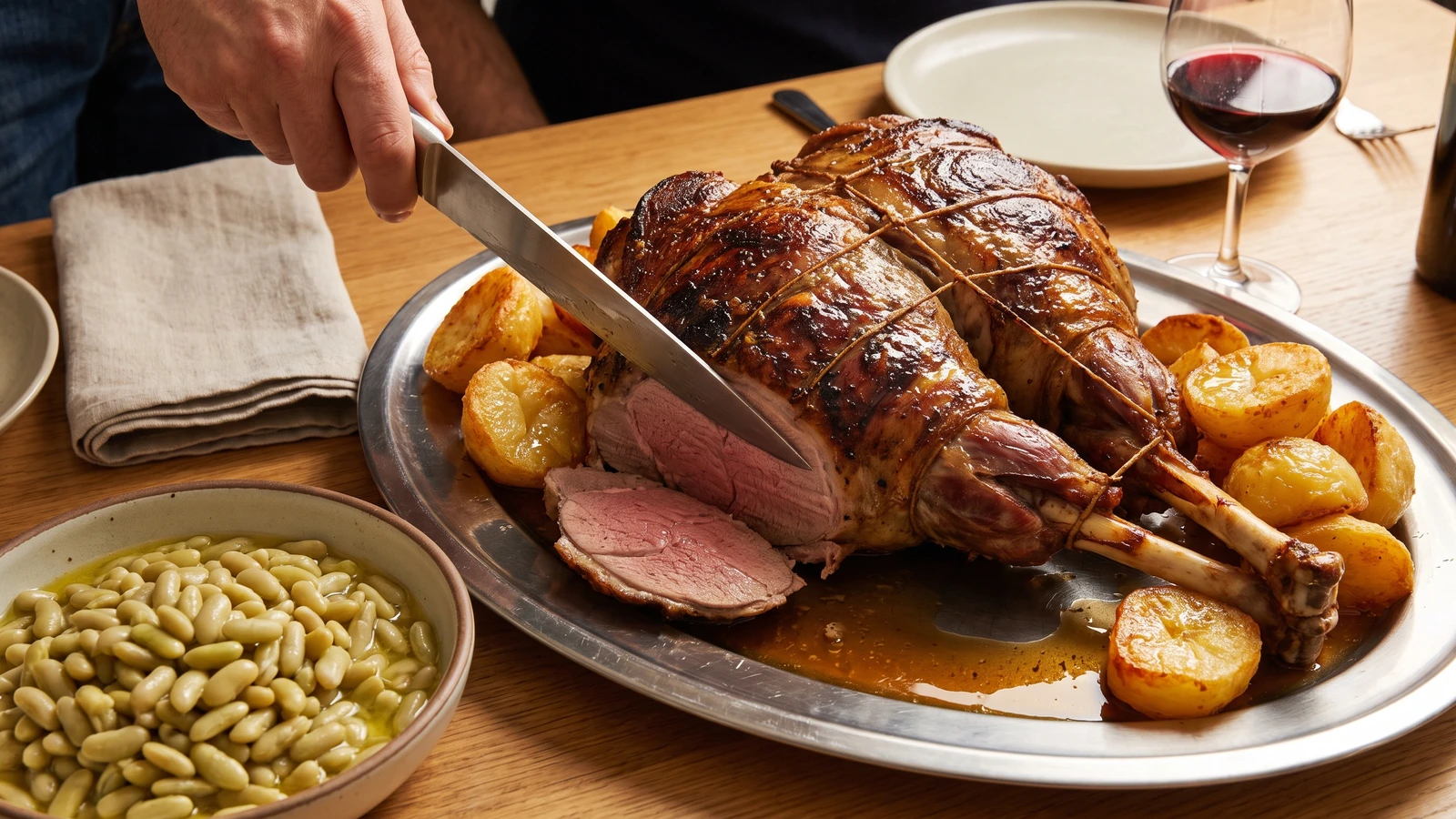
Two lamb legs left joined, trussed into one even roast and cooked slowly over their own fond, with butter-bound flageolets and bronze potatoes for a generous French table.
Double de mouton rôti (a pair of joined mutton legs roasted whole) teaches the geometry of roasting. Two legs can meet the same heat and still finish apart unless the joint is compact, balanced, and tied before it enters the oven. The one true thing is this: shape decides doneness.
The original entry assumed a butcher who understood the double, a broad roasting oven, several hands for turning and carving, and a relevé large enough to feed a dining room. It did not require a saucier or a stockpot, because the source plainly favors vegetable and rice garnishes over composed sauces. For one cook, one stove, one evening, ask for the smallest lamb double your butcher can prepare, use a rack and a probe thermometer, and let the browned pan fond make a short jus with water. A fierce opening oven supplies the first bronze, then the same oven roasts gently and crisps the potatoes, with no salamander needed.
The procession and brigade portions are scaffolding, so they go. The joined cut, its careful trussing, the slow whole roast, and the vegetable garnish stay because they are the dish. When it is right, the outside is deep Maillard bronze, the carved meat remains rosy, and the potatoes shine with the roast's own fat. Tie the double into an even, compact shape before it meets the heat; that is the step that decides everything afterward.
On the formal French table, the double appeared as a relevé (large roast course), accompanied by vegetables or rice rather than covered with a composed sauce. Butchers distinguished it precisely from the baron: a baron contains the saddle and both legs, while a double is the two hind legs left joined after the saddle has been removed, and lamb is far more common than mature mutton. As the joint traveled from grand service to the home table, its essential discipline remained unchanged: butcher it cleanly, truss it evenly, roast it whole, and carve both legs across the grain.
Quantity
1 joint, 7 to 8½ lb (3.2 to 3.8 kg)
legs left joined, saddle removed, thick hard fat trimmed
Quantity
2 tablespoons (30 ml / 36 g)
divided
Quantity
2 teaspoons (10 ml / 5 g)
divided
Quantity
6 tablespoons (90 ml / 85 g)
softened and divided
Quantity
6 cups (1.4 L / 900 g)
scrubbed
Quantity
3 cups (710 ml / 510 g)
well drained
Quantity
2½ cups (590 ml / 590 g)
divided
| Ingredient | Quantity |
|---|---|
| small butcher-prepared double of lamb or young muttonlegs left joined, saddle removed, thick hard fat trimmed | 1 joint, 7 to 8½ lb (3.2 to 3.8 kg) |
| fine sea saltdivided | 2 tablespoons (30 ml / 36 g) |
| freshly ground black pepperdivided | 2 teaspoons (10 ml / 5 g) |
| unsalted buttersoftened and divided | 6 tablespoons (90 ml / 85 g) |
| small waxy potatoesscrubbed | 6 cups (1.4 L / 900 g) |
| cooked flageolet or small white beanswell drained | 3 cups (710 ml / 510 g) |
| hot waterdivided | 2½ cups (590 ml / 590 g) |
Ask the butcher for a true double: both hind legs left connected at the haunch, with the saddle removed. Two detached legs lashed beside one another are not the same cut and will not roast as one. Request the smallest joint that will fit diagonally inside an 18 by 13-inch (46 by 33 cm) roasting pan, with heavy internal fat and loose membrane removed but a thin outer covering of fat left intact.
Pat the joint completely dry. Set both legs in the most compact, symmetrical position they naturally accept, then tie each leg at 2-inch (5 cm) intervals and add two crosswise loops to steady the pair. The two thickest parts should sit at roughly the same height. Season all over and underneath with 1½ tablespoons (27 g) of the salt and 1½ teaspoons (4 g) of the pepper, then leave the joint uncovered for 45 minutes while the oven heats. Loose shaping gives you one cooked leg and one laggard; trussing is the dish, not decoration.
Heat the oven to 450°F (230°C). Set a sturdy rack inside the roasting pan and place the double on it with its best-covered side uppermost. Rub the exposed surface with 4 tablespoons (60 g) of the softened butter. Roast for 20 minutes, until the fat has begun to bronze, then lower the oven to 300°F (150°C). Pour 1 cup (240 ml / 240 g) of the hot water into the pan beneath the rack, keeping it away from the meat.
Continue roasting for 1½ hours, turning the pan front to back once and spooning the clear pan fat lightly over any pale areas. Keep a shallow film of liquid beneath the rack. If the pan dries and the fond begins smelling sharp rather than richly roasted, add hot water a few spoonfuls at a time. Ça se rattrape. Water arrests the scorching without washing the crust from the meat; blackened fond cannot become a good jus.
While the joint roasts, cover the potatoes with cold water in a saucepan, bring them to a boil, and cook for 8 minutes. Drain well and shake them in the pan to roughen their edges. Lift the roasting rack briefly, arrange the potatoes in the rendered fat beneath and around it, then return the joint and roast for another 75 to 90 minutes. Begin checking both legs after an hour, placing the thermometer into the thickest meat without touching bone. If one leg runs ahead, shield it loosely with foil and turn the cooler side toward the back of the oven. Remove the double when the coolest reading is 144°F (62°C); carryover should take it past 145°F (63°C) within several minutes. Verify this before carving, and if it stalls below that point, return the joint to the 300°F (150°C) oven until it reaches it.
Transfer the double to a large carving board, leave every string in place, and cover it loosely with foil. Rest for 40 to 45 minutes. This is not idle time: the juices settle, the heat evens between the two legs, and the trussing holds the joint while it relaxes. If the potatoes need more colour, raise the oven to 425°F (220°C), turn them through the pan fat, and roast them for 15 to 20 minutes while the meat rests.
Put the drained flageolets into a wide saucepan with ½ cup (120 ml / 120 g) of the hot water, the remaining 2 tablespoons (25 g) butter, 1 teaspoon (6 g) salt, and the remaining pepper. Warm gently, shaking the pan rather than stirring hard, until the water and butter emulsify into a light glaze. These are haricots liés au beurre (beans bound with butter), not beans swimming in liquid. If the glaze separates, add one spoonful of hot water and shake again. It will come together.
Move the potatoes to a warm dish and pour off the excess fat from the roasting pan, leaving the brown fond untouched. Set the pan across two burners over medium heat, add ½ to 1 cup (120 to 240 ml / 120 to 240 g) of the remaining hot water, and scrape with a wooden spoon until the fond dissolves. Simmer briefly until the jus tastes concentrated but remains pourable, then strain it and skim away any excess surface fat. This is the roast's own jus, not a composed sauce, and it should taste chiefly of the meat.
Carry the double whole to the table if the table has room, then return it to the stable carving board. Cut away the strings. Carve thin slices from the broad outside face of each leg, always cutting across the grain, then free the remaining meat by following the leg bones with the knife. Arrange the slices generously on a warmed platter, spoon a little jus beneath them so the browned edges stay proud, and serve the potatoes and butter-bound flageolets alongside. À table!
1 serving (about 920g)
Culinary guides, cultural storytelling, and the editorial depth that makes cooking meaningful.
Discover Culinary ExplorerChef Juliette
John Dory has the delicacy of sole and the firmness of turbot. A light flouring, a quick butter sauté, and nut-brown beurre noisette show exactly why looks never mattered.

Chef Juliette
Fresh haddock proves its delicacy in the meunière pan: a fine flour crust, moist pearly flakes, and beurre noisette sharpened with lemon and parsley, ready from one skillet in half an hour.

Chef Juliette
Éperlans à l’Anglaise turns small fish into a lesson in disciplined coating: boned smelts under a close, crisp crumb, pan-fried in clarified butter and finished with bright, half-melted maître d’hôtel butter.

Chef Juliette
Tiny smelts, shallot, mushrooms, white wine, gratin sauce, and fine bread raspings meet a fierce oven, where the fish must turn tender in the same breath the buttered crust bronzes.