
Chef Juliette
Selle de Veau (Relevé)
A half saddle of veal, bacon-barded and braised by short moistening, emerges bronze and succulent, with the concentrated veal glaze that makes this grand relevé worthy of the home table.
A cooking platform built around craft, culture, and the stories behind what we eat.
Created by Chef Juliette
Based on No. 1297, Amourettes à la Tosca, from Le Guide Culinaire (1907) by Auguste Escoffier
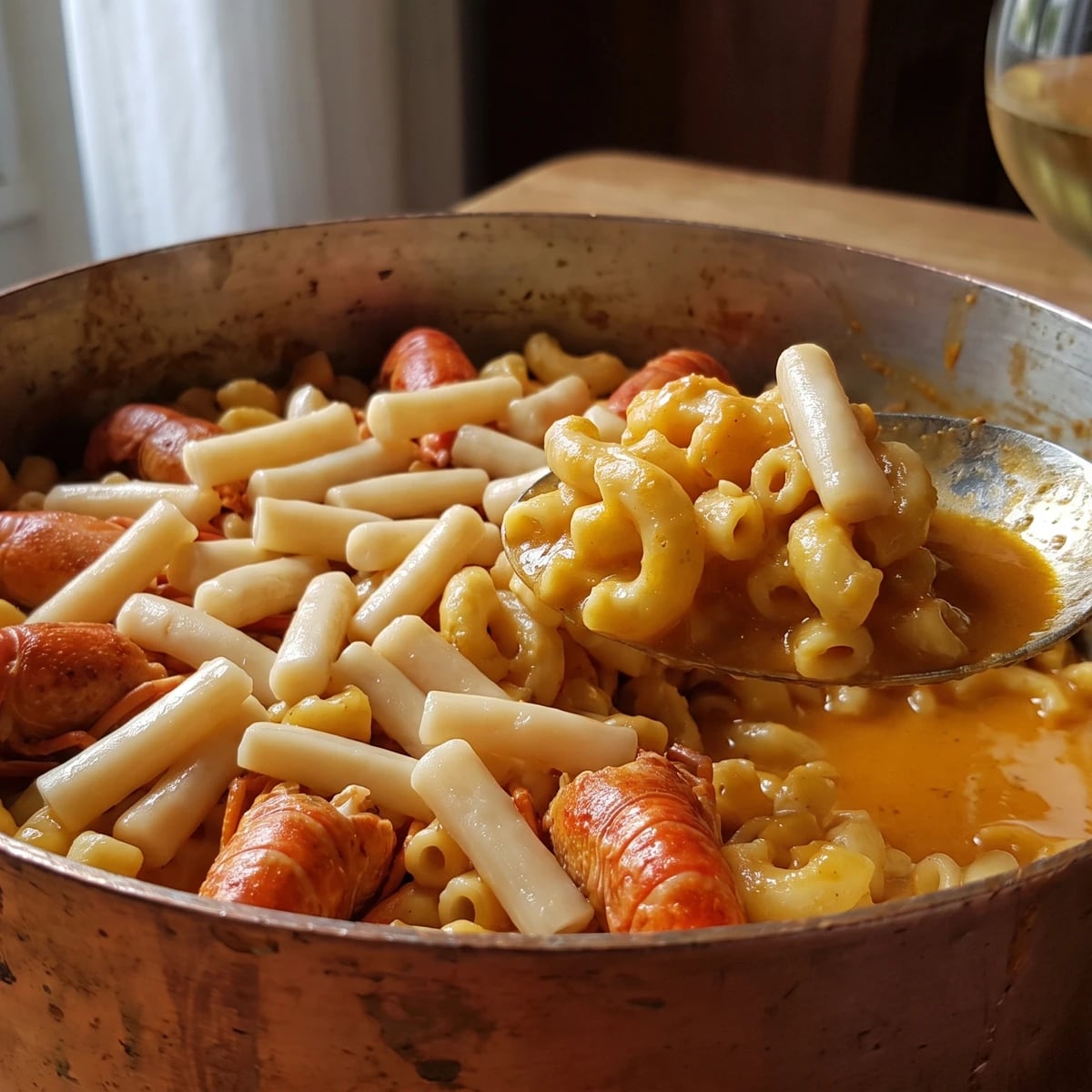
Amourettes à la Tosca brings the butcher's most delicate cut to the table with Parmesan macaroni, crayfish tails, and shell-bright coulis, all folded into one glossy, generous timbale.
Amourettes à la Tosca (poached veal spinal cord, traditionally called spinal marrow, with Parmesan macaroni and crayfish) teaches one true thing: delicacy comes from handling, not fuss. The amourettes are tender enough to break under an impatient spoon, so every other element must be ready before they enter the pan.
The original entry assumed a component kitchen: amourettes already poached, a saucier with crayfish coulis at hand, crayfish tails picked for service, a stockpot never allowed to go cold, and a metal timbale waiting warm. At home, twelve plain-cooked whole crayfish provide the required three tails per person and the shells for one small, honest coulis; good unsalted fish stock replaces the perpetual stockpot, and a warmed deep serving bowl replaces the service timbale. The brigade's advance work is scaffolding, so we compress it. The exact coulis ratio, the Parmesan-bound macaroni, and the division of two-thirds amourettes within and one-third over the top are the dish, so they stay.
You'll bring it to the table coral-gold and glossy, with pale pieces of amourette resting above the macaroni and crayfish tails tucked through it. One cook, one stove, one evening. The step that decides everything is the final toss: fold from beneath, stop the moment the pieces are coated, and never ask fragile amourettes to survive enthusiasm.
Amourettes is the French butchers’ name for the spinal cord of calf or ox, an offal cut often prepared beside brains but distinct from both brain and bone marrow. À la Tosca belongs to the Parisian classical grand-kitchen table rather than to a regional farmhouse canon: Parmesan-bound macaroni meets crayfish coulis, whole tails, and carefully poached amourettes in a formal timbale. The preparation turns a difficult, fragile butcher's cut into composed service, proof that luxury in the canon often came from handling and sauce rather than a grand joint of meat.
Quantity
12 (about 1 pound / 454 g)
chilled
Quantity
4 tablespoons (60 ml / 57 g)
divided
Quantity
1 small (about 1/4 cup / 30 g)
finely chopped
Quantity
2 tablespoons (30 ml / 16 g)
finely diced
Quantity
1 teaspoon (5 ml / 6 g)
Quantity
2 tablespoons (30 ml / 28 g)
Quantity
1/4 cup (60 ml / 60 g)
Quantity
1 1/4 cups (300 ml / 300 g), plus a little for correcting the coulis
Quantity
4 ounces (113 g)
Quantity
1/2 cup (120 ml / 45 g)
finely grated
Quantity
1 tablespoon (15 ml / 18 g), plus more to taste
mostly for the macaroni water
Quantity
1/4 teaspoon (1.25 ml / 0.6 g)
| Ingredient | Quantity |
|---|---|
| poached amourettesthoroughly chilled | 1 pound (454 g) Calf’s Brains and Amourettes (No. 1288) |
| whole plain-cooked crayfishchilled | 12 (about 1 pound / 454 g) |
| unsalted butterdivided | 4 tablespoons (60 ml / 57 g) |
| shallotfinely chopped | 1 small (about 1/4 cup / 30 g) |
| carrotfinely diced | 2 tablespoons (30 ml / 16 g) |
| tomato paste | 1 teaspoon (5 ml / 6 g) |
| Cognac | 2 tablespoons (30 ml / 28 g) |
| dry white wine | 1/4 cup (60 ml / 60 g) |
| unsalted fish stock | 1 1/4 cups (300 ml / 300 g), plus a little for correcting the coulis |
| dry short macaroni | 4 ounces (113 g) |
| Parmesanfinely grated | 1/2 cup (120 ml / 45 g) |
| fine saltmostly for the macaroni water | 1 tablespoon (15 ml / 18 g), plus more to taste |
| ground white pepper | 1/4 teaspoon (1.25 ml / 0.6 g) |
Begin with the fully poached, thoroughly chilled amourettes from Calf’s Brains and Amourettes (No. 1288). Cut them crosswise with a thin, sharp knife into 1-inch (2.5 cm) lengths, wiping the blade rather than sawing through the delicate pieces. Divide them visually into thirds, reserving one-third for the top and keeping the remaining two-thirds ready for the final fold. Return both portions to the cold while you make the coulis.
Twist the tails from the crayfish and peel them carefully, keeping all twelve tails whole. That is exactly three tails per person. Cover and chill the meat, then crush the shells and heads inside a folded kitchen towel with a rolling pin. Break them enough to expose their flavour, but don't grind them into fragments that will slip through the sieve.
Melt 1 tablespoon of the butter in a small heavy saucepan over medium heat. Add the crushed crayfish shells and cook for 4 to 5 minutes, stirring, until the butter turns coral and smells deeply of shellfish. Add the shallot and carrot, cook until softened, then stir in the tomato paste for 1 minute. Pour in the Cognac without igniting it, add the wine, and reduce until the pan is nearly dry. Add the fish stock and simmer gently for 20 minutes. Strain through a fine-mesh sieve, pressing firmly, then return the liquid to the clean pan and reduce it to a scant 1/3 cup (75 ml). Off the heat, whisk in 1 tablespoon butter to make about 6 tablespoons (90 ml) of glossy crayfish coulis; season lightly with salt and white pepper. If the butter beads on the surface, whisk in a teaspoon of cold stock off the heat. Ça se rattrape.
Bring a pot of water to the boil, season it with most of the salt, and cook the macaroni until tender but still holding its shape. Reserve 1/4 cup (60 ml) of the cooking water, then drain well. Return the macaroni to the warm pot off the heat and add the remaining 2 tablespoons butter and the Parmesan, tossing until the cheese and butter form a close coating. If the Parmesan gathers into strings or clumps, add the reserved water one tablespoon at a time and toss off the heat until the coating relaxes.
Measure exactly 4 tablespoons (60 ml) of warm crayfish coulis into the macaroni, preserving the source ratio of four tablespoons coulis for four ounces macaroni. Add the twelve crayfish tails and the two-thirds portion of amourettes. Lift and turn everything with two broad spoons until evenly coated, using the original toss without battering the fragile pieces. If an amourette breaks, stop tossing and spoon the mixture into the dish; the smaller pieces will enrich the binding, and the reserved third still gives you a handsome top.
Warm a deep 1 1/2-quart (1.4-liter) serving bowl with hot water, then dry it thoroughly. Spoon in the macaroni mixture, arrange the reserved one-third of the amourettes over the surface, and warm the remaining 2 tablespoons (30 ml) coulis just enough to restore its gloss. If it has tightened, loosen it with a teaspoon of stock. Spoon it lightly over the amourettes rather than drowning them, and serve at once. À table!
1 serving (about 275g)
Culinary guides, cultural storytelling, and the editorial depth that makes cooking meaningful.
Discover Culinary Explorer
Chef Juliette
A half saddle of veal, bacon-barded and braised by short moistening, emerges bronze and succulent, with the concentrated veal glaze that makes this grand relevé worthy of the home table.

Chef Juliette
A bronzed saddle of veal between two patterned vegetable domes, with clear, glossy braising jus passed at the table: classical structure translated for four, patient enough for a celebration and possible on one stove.

Chef Juliette
A veal saddle braised until tender, its fillets cut into collops and rebuilt with paprika Béchamel and truffle, then flashed beneath fierce heat until the ivory sauce glazes.

Chef Juliette
A veal saddle becomes edible architecture: Soubise and ham tucked into the carved loin, truffled Parmesan soufflé rising above it, and reduced braising liquor served alongside.