
Chef Juliette
John Dory (St. Pierre)
John Dory has the delicacy of sole and the firmness of turbot. A light flouring, a quick butter sauté, and nut-brown beurre noisette show exactly why looks never mattered.
A cooking platform built around craft, culture, and the stories behind what we eat.
Created by Chef Juliette
Based on No. 1295, Cervelle à la Villeroy, from Le Guide Culinaire (1907) by Auguste Escoffier
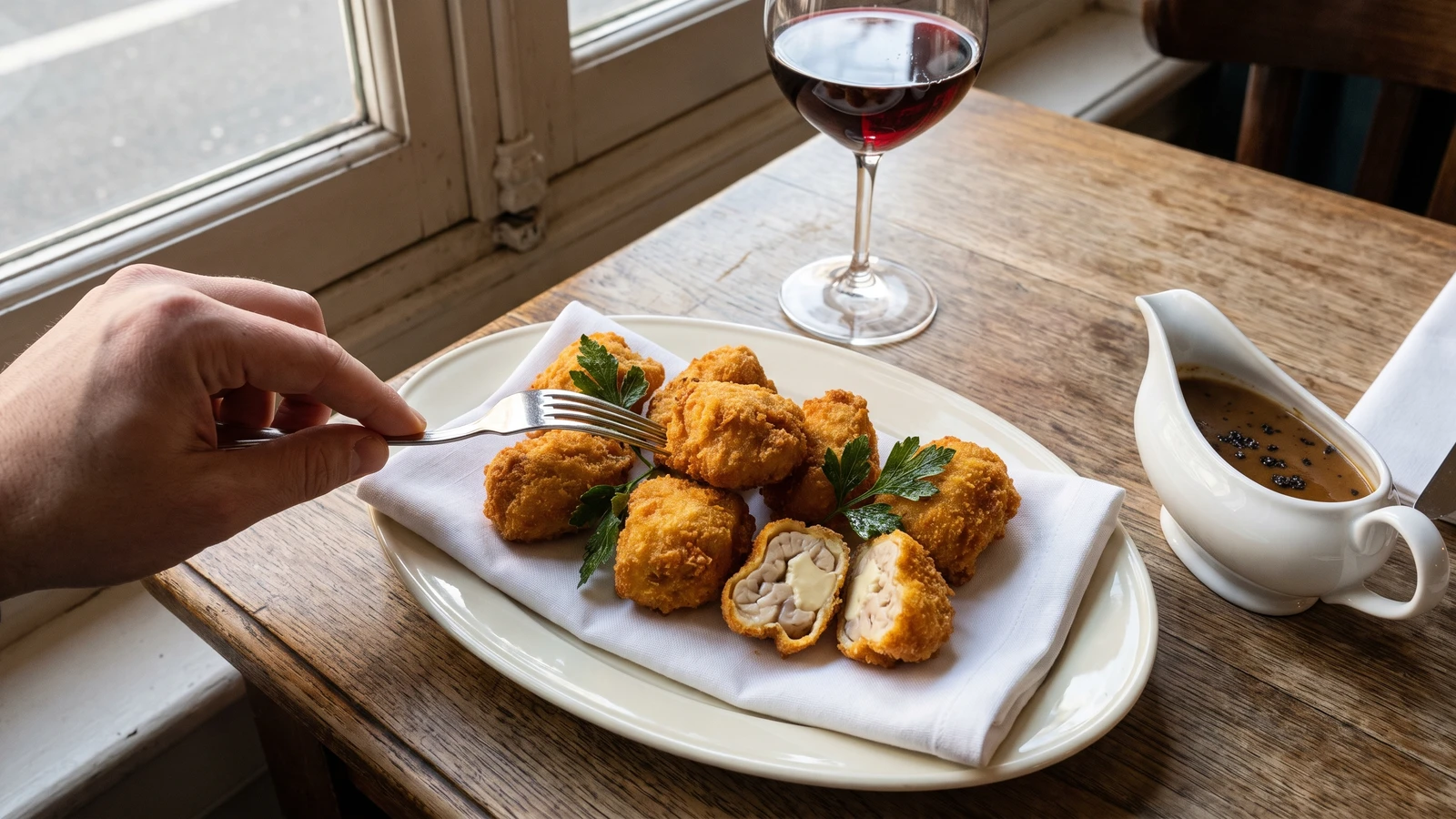
Cervelle à la Villeroy turns delicate calf's brains into a study in contrast: a butter-poached centre, a firm sauce mantle, a crisp anglaise shell, and light Périgueux served apart.
Cervelle à la Villeroy (calf's brains masked in Villeroy sauce, crumbed, and fried) teaches the architecture of a proper coated fry: a delicate centre, a firm sauce mantle, and a crust strong enough to protect both. The one true thing to know before touching a pan is this: the masked portions must become completely cold and solid before they're breaded. Fry them soft and the coating escapes into the fat; chill them firmly and the shell closes around them at once.
The source entry assumes a saucier on staff, a stockpot never off the fire, Villeroy and light Périgueux ready for service, a cold room, and frying fat held at temperature. Your honest equivalents are prepared sauces made from their own entries, a refrigerator, a wire rack, and a heavy saucepan with a thermometer. The quantities here serve four, and the frying happens in small batches. One cook, one stove, one evening.
The brigade's holding routine is scaffolding and can go. The butter-poach, the almost-cold Villeroy mask, the firm chill, the anglaise coating, and the plunge into properly hot fat are the dish and must stay. Chill until the coating can be lifted without taking a fingerprint. That is the step that decides everything.
Cervelle à la Villeroy belongs to the Parisian classical service, where Villeroy names a method more than a place: a delicate cooked item is masked in reduced sauce, chilled, pané à l'anglaise, and fried. Brains suited the method because the sauce and crust protect their fragile, creamy texture while giving the diner a clean, crisp exterior. The light Périgueux served apart brings the black-truffle larder of Périgord into the grand-kitchen sauce family, but it does not make this a Périgord dish.
Quantity
2, about 1½ pounds (680 g) total
Quantity
8 cups (1.9 L / 1.9 kg), plus more for rinsing
Quantity
2 tablespoons (30 ml / 30 g)
for cleaning
Quantity
2 teaspoons (10 ml / 12 g)
divided
Quantity
½ teaspoon (2.5 ml / 1 g)
Quantity
8 tablespoons (120 ml / 113 g)
Quantity
2 cups (480 ml / 500 g)
cooled until almost cold
Quantity
¾ cup (180 ml / 95 g)
Quantity
1 cup (240 ml / 240 g) Anglaise (for Egg-and-bread-crumbing) (No. 174)
prepared
Quantity
2 cups (480 ml / 200 g)
Quantity
2 quarts (1.9 L / 1.75 kg)
Quantity
1 small bunch (1 oz / 30 g)
divided into sprigs and dried thoroughly
Quantity
1½ cups (360 ml / 370 g)
| Ingredient | Quantity |
|---|---|
| cleaned calf's brains | 2, about 1½ pounds (680 g) total |
| very cold water | 8 cups (1.9 L / 1.9 kg), plus more for rinsing |
| white wine vinegarfor cleaning | 2 tablespoons (30 ml / 30 g) |
| fine sea saltdivided | 2 teaspoons (10 ml / 12 g) |
| freshly ground white pepper | ½ teaspoon (2.5 ml / 1 g) |
| unsalted butter | 8 tablespoons (120 ml / 113 g) |
| prepared Villeroy saucecooled until almost cold | 2 cups (480 ml / 500 g) |
| plain flour | ¾ cup (180 ml / 95 g) |
| Anglaise (for Egg-and-bread-crumbing)prepared | 1 cup (240 ml / 240 g) Anglaise (for Egg-and-bread-crumbing) (No. 174) |
| fine dry breadcrumbs | 2 cups (480 ml / 200 g) |
| neutral frying oil | 2 quarts (1.9 L / 1.75 kg) |
| flat-leaf parsleydivided into sprigs and dried thoroughly | 1 small bunch (1 oz / 30 g) |
| prepared light Périgueux sauce | 1½ cups (360 ml / 370 g) |
Combine the cold water, vinegar, and half the salt in a nonreactive bowl. Add the brains and refrigerate for 1 hour, changing the water once if it becomes cloudy. Working with the brains submerged, gently pull away the thin outer membrane, loose blood vessels, and any dark clots without crushing the lobes. Rinse under cold water, drain, and pat completely dry.
Cut the cleaned brains into 8 to 10 slices about ¾ inch (2 cm) thick. Season both sides with the remaining salt and white pepper. Melt the butter in a wide sauté pan over low heat, then lay in the slices without crowding. Poach gently for 3 to 4 minutes per side, spooning butter over their tops, until opaque and cooked through to 160°F (71°C). They should remain ivory, not brown. If the butter begins taking colour, lift the pan from the heat until the foaming settles, then continue more gently. Transfer the slices to a wire rack and cool completely.
Cool the prepared Villeroy sauce until almost cold but still fluid enough to fall heavily from a spoon. It should sit on the brain in a thick layer instead of running away. If it flows like cream, refrigerate it for 10 minutes and test again; if it has set too firmly, stand its bowl over barely warm water and stir just until supple. Ça se rattrape. Temperature, not added flour, is the correction.
Set parchment on a chilled tray. Dip each cooled brain slice into the Villeroy sauce, or spoon the sauce over it, turning carefully until every surface carries a generous, even coating. Lift with two forks and place on the parchment without letting the pieces touch. Patch any exposed spots with more sauce, then refrigerate uncovered for at least 2 hours, until the coating is solid enough to handle without denting. This chill is not brigade ceremony. It is the dish.
Arrange the flour, prepared Anglaise (for Egg-and-bread-crumbing) (No. 174), and breadcrumbs in three shallow dishes. Lift each cold portion with a thin spatula, roll it lightly in flour, coat it completely in the Anglaise, then press breadcrumbs over every side. Keep the layers even and pay particular attention to seams and corners, where sauce is most likely to escape. If the coating tears, return the piece to the cold for 10 minutes, patch it with a little Villeroy sauce, and bread that spot again. Rest all the breaded portions in the refrigerator for 20 minutes.
Pour the oil into a heavy, deep saucepan, leaving at least 3 inches (7.5 cm) of empty space above it, and heat to 350°F (175°C). Make certain the parsley is completely dry. Lower a few sprigs into the oil with a spider and cover the pot loosely with a splatter screen as they crackle. Fry for 8 to 12 seconds, just until crisp and deep green, then drain on the rack and season with a pinch of salt. Repeat in small batches.
Raise the oil to 360°F (182°C). Lower in two or three chilled portions at a time and fry for 2 to 3 minutes, turning once, until the crust is evenly deep gold and the centre is hot, reaching 165°F (74°C). Drain on the wire rack, never directly on top of another piece. Let the oil return to temperature before the next batch. If the first portion leaks, stop and chill the remaining pieces for 15 minutes; patch any thin spots with fresh crumbs before continuing. Hot fat seals the crust, while cool fat soaks it and loosens the sauce.
Warm the light Périgueux sauce gently until glossy and pourable, without letting it boil or reduce heavily. Line a warm oval platter with a freshly laundered, unscented white napkin and arrange the fried portions on top, with the fried parsley tucked between them. Bring the Périgueux separately in a warm sauceboat so each diner can spoon it beside the crisp crust, not over it. À table!
1 serving (about 510g)
Culinary guides, cultural storytelling, and the editorial depth that makes cooking meaningful.
Discover Culinary ExplorerChef Juliette
John Dory has the delicacy of sole and the firmness of turbot. A light flouring, a quick butter sauté, and nut-brown beurre noisette show exactly why looks never mattered.

Chef Juliette
Fresh haddock proves its delicacy in the meunière pan: a fine flour crust, moist pearly flakes, and beurre noisette sharpened with lemon and parsley, ready from one skillet in half an hour.

Chef Juliette
Éperlans à l’Anglaise turns small fish into a lesson in disciplined coating: boned smelts under a close, crisp crumb, pan-fried in clarified butter and finished with bright, half-melted maître d’hôtel butter.

Chef Juliette
Tiny smelts, shallot, mushrooms, white wine, gratin sauce, and fine bread raspings meet a fierce oven, where the fish must turn tender in the same breath the buttered crust bronzes.