Culinary Explorer

A cooking platform built around craft, culture, and the stories behind what we eat.
Discover Culinary Explorer
Cervelle à la Beaumont

Cervelle à la Beaumont

Created by Chef Juliette

Based on No. 1290, Cervelle à la Beaumont, from Le Guide Culinaire (1907) by Auguste Escoffier

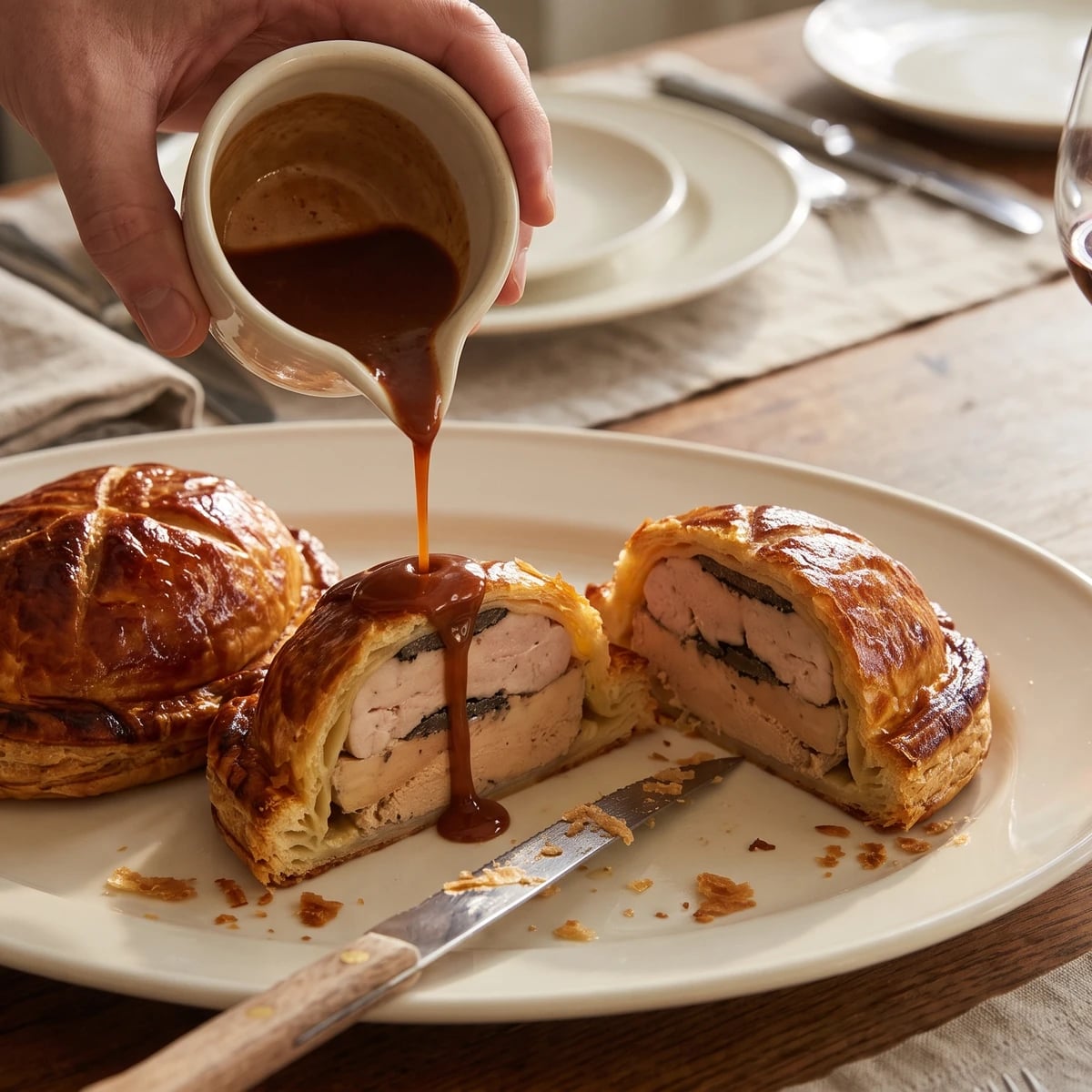
Calf's brain, foie gras forcemeat, truffle, and puff pastry become one burnished parcel, then Périgueux sauce enters through the vent: a grand-kitchen construction made workable for four at home.

Main Dishes
French
Dinner Party
Special Occasion
1 hr 15 min
Active Time
40 min cook3 hr total
Yield4 servings

Cervelle à la Beaumont (calf's brain layered with foie gras forcemeat and truffle, enclosed in puff pastry) teaches one true thing before you touch a pan: cold is structure. The brain must be firm enough to slice, the filling must stand where you spread it, and the pastry must remain cold enough to rise around both. Lose that discipline and the parcel slumps. Keep it, and this extravagant construction behaves beautifully.

The original entry assumed a saucier on staff, a stockpot never cold, prepared brown and Périgueux sauces, the finished Gratin Forcemeat for Ordinary Hot, Raised Pies (No. 202), and puff-paste trimmings left from other work. At home, make or obtain those finished components in advance and use good all-butter puff pastry. A salamander might have stood ready for other dishes, but this one asks for a hot oven, so a thoroughly preheated home oven and heated baking sheet are the honest equivalents.

I have scaled the brigade quantity to two calf brains, enclosed as two parcels and halved for four diners. Pounding and sieving a large forcemeat batch belongs to its separate formula, and the folded service napkin is presentation scaffolding we can lose. The layered reconstruction, foie gras variation, truffle, complete pastry enclosure, open vent, and final addition of Périgueux sauce are the dish itself. They stay.

Chill the reconstructed brains until they hold together before wrapping them. That is the step that matters most. If the forcemeat softens or the pastry turns limp, stop and return it to the cold. Ça se rattrape. One cook, one stove, one evening.

Cervelle à la Beaumont belongs to the codified Parisian grand-kitchen repertoire, where familiar butcher's offal was carried into formal service with foie gras, pastry, and black truffle. Its Périgueux finish points precisely to Périgord and its truffles, while the enclosing method follows the grammar of pâté en croûte rather than any regional brain preparation. The Beaumont name functions as a classical appellation; the surviving formula does not establish the dish as a local specialty of any one of France's several places called Beaumont.

The technique, the tradition, and the story behind every dish.

Discover Culinary Explorer

Ingredients

whole calf brains

Quantity

2 (about 1¼ lb / 560 g total)

from a licensed inspected source

cold water

Quantity

8 cups (1.9 L / 1.9 kg)

plus more for soaking

white wine vinegar

Quantity

¼ cup (60 ml / 60 g)

fine sea salt

Quantity

2 teaspoons (10 ml / 12 g)

Gratin Forcemeat for Ordinary Hot, Raised Pies

Quantity

1¼ cups (300 ml / 300 g) Gratin Forcemeat for Ordinary Hot, Raised Pies (No. 202)

prepared with foie gras as directed for this dish and chilled

cold reduced brown sauce

Quantity

3 tablespoons (45 ml / 45 g)

fresh black truffle

Quantity

1 small truffle (about 1¼ oz / 35 g)

brushed clean, half thinly sliced and half finely chopped

all-butter puff pastry

Quantity

18 oz (510 g)

thoroughly chilled

plain flour

Quantity

2 tablespoons (30 ml / 16 g)

for rolling

large egg

Quantity

1

beaten

cold water for gilding

Quantity

1 teaspoon (5 ml / 5 g)

Périgueux sauce

Quantity

½ cup (120 ml / 125 g)

warmed

Equipment Needed

  • 3-quart saucepan
  • Thin sharp slicing knife
  • Rolling pin
  • Heavy rimmed baking sheet
  • Pastry brush
  • Instant-read thermometer
  • Small funnel or narrow teaspoon

Instructions

  1. 1

    Prepare and chill brains

    Place the brains in a bowl, cover generously with cold water, and soak for 1 hour, changing the water twice, until it remains nearly clear. Working under cold water, gently pull away the surface membrane and visible blood vessels without separating the lobes. Put the brains in a saucepan with the 8 cups of fresh water, vinegar, and salt. Bring slowly to the barest tremble, lower the heat, and poach for 12 to 15 minutes, never allowing a boil, until the brains are set and their centres reach at least 160°F (71°C). Lift them out carefully, cool, then refrigerate for 45 minutes. If a lobe tears during trimming, keep every piece and chill it in its natural position; the forcemeat will bind it during reconstruction. Ça se rattrape.

    A hard boil makes brains granular and encourages them to break. The poaching water should barely move around them.
  2. 2

    Layer and reconstruct

    Stir 2 tablespoons of the cold brown sauce into the chilled Gratin Forcemeat for Ordinary Hot, Raised Pies (No. 202), prepared with foie gras as this entry requires. Add the final tablespoon only if needed: the forcemeat should spread easily but still hold the ridge of a spoon. If it becomes loose, chill it for 15 minutes rather than adding another thickener. Cut each cold brain crosswise into three or four thick slices, keeping the pieces in order. Spread each cut face with a thin layer of forcemeat, lay on a slice of truffle, and rebuild the brain in its original shape. Reserve about half the forcemeat for the outside, then chill the reconstructed brains for 20 minutes.

    Use a thin, very sharp knife and a gentle sawing motion. Pressure from a blunt blade crushes the delicate slices.
  3. 3

    Wrap the galettes

    Divide the puff pastry in two. On a lightly floured surface, roll each piece into a galette, the book's word for a large round of paste, about 10 to 11 inches (25 to 28 cm) across and one-fifth inch (5 mm) thick. Set one reconstructed brain in the centre of each galette. Cover the brains evenly with the remaining Gratin Forcemeat for Ordinary Hot, Raised Pies (No. 202), then sprinkle over the chopped truffle. Moisten the pastry edges lightly with water, draw them up and over the filling, and pinch them together so each brain is enclosed completely. Trim only very bulky overlaps and turn the parcels seam-side down. If the pastry tears, patch it with a thin cold scrap moistened at the edges; if it turns soft, refrigerate the parcel before continuing.

    Keep the layer of pastry even. A heavy knot underneath remains doughy while the rest of the parcel browns.
  4. 4

    Gild vent and bake

    Heat the oven to 425°F (220°C) with a heavy baking sheet on the middle rack. Refrigerate the wrapped parcels for 20 minutes while the oven heats. Mix the beaten egg with the teaspoon of water, then gild the pastry, meaning brush it with a thin, even coat of egg. Cut a clean ¾-inch (2 cm) slit through the top of each parcel without driving the knife into the filling. Transfer the parcels on parchment to the heated sheet and bake for 15 minutes. Inspect them, rotate the sheet, and continue for 3 to 7 minutes if needed, until the pastry is deeply golden, the vent remains open, and the centre reaches 160°F (71°C). If the top colours before the centre is ready, cover it loosely with foil. The slit is not decoration; it releases moisture that would otherwise burst the seam and soften the crust.

    If the vent seals as the pastry rises, reopen it gently with the tip of a small knife after the first 10 minutes.
  5. 5

    Add Périgueux sauce

    Warm the Périgueux sauce only until glossy and fluid, without boiling it. Let the baked parcels stand for 3 minutes, then use a small funnel or teaspoon to pour 3 tablespoons of sauce through each slit. Wait 30 seconds and add the remaining tablespoon to each parcel as it is absorbed. If sauce flows back through the opening, stop; spoon that portion beside the cut parcel rather than forcing it into the crust. Transfer the parcels to a warm platter, cut each one in half with a serrated knife, and serve immediately. À table!

Chef Tips

  • Calf brains are restricted in some places under specified-risk material rules. Buy them only from a licensed butcher who can confirm an inspected source. Cooking cannot make an unsuitable source safe.
  • The Gratin Forcemeat for Ordinary Hot, Raised Pies (No. 202) is a separate finished component, exactly as the source treats it. Prepare its foie gras variation ahead and chill it completely; ordinary liver mousse is too soft and cannot support the reconstructed brain.
  • Fresh black truffle is part of the structure and flavour of Cervelle à la Beaumont, not an optional flourish. Truffle oil gives perfume without the earthy slices the formula requires. If fresh truffle isn't available, choose another evening for this dish.
  • All-butter puff pastry is the honest home equivalent of the original kitchen's puff-paste remains. Keep it cold, roll it to the stated thickness, and give the oven time to heat fully.
  • Serve with a restrained red Bordeaux whose tannin has softened, or a dry white with enough body to meet the foie gras and Périgueux sauce. Keep the rest of the plate plain.
  • Leftovers lose some crispness but remain good for one day under refrigeration. Reheat uncovered at 375°F (190°C) until the centre is hot, then add a little freshly warmed Périgueux sauce.

Advance Preparation

  • Prepare the Gratin Forcemeat for Ordinary Hot, Raised Pies (No. 202), its cold brown sauce, and the Périgueux sauce up to 2 days ahead. Keep each covered and refrigerated separately.
  • The brains may be soaked, trimmed, poached, and chilled 1 day ahead. Refrigerate them in a covered container and handle them gently.
  • The brains can be layered, reconstructed, and wrapped in pastry up to 4 hours before baking. Keep the parcels cold and wait to gild and vent them until the oven is hot.
  • Warm the Périgueux sauce while the parcels bake. Do not pour it into the pastry early, or the crisp interior layers will soften.

Frequently Asked Questions

Nutrition Information

1 serving (about 375g)

Calories
1225 calories
Total Fat
87 g
Saturated Fat
44 g
Trans Fat
2 g
Unsaturated Fat
41 g
Cholesterol
4300 mg
Sodium
1390 mg
Total Carbohydrates
67 g
Dietary Fiber
3 g
Sugars
2 g
Protein
40 g

Note: Chef personas and recipes are created with AI assistance. Cook with care: follow safe food-handling practices, check doneness with a thermometer when needed, and adapt for allergies and your kitchen.

Where cooking meets culture.

Culinary guides, cultural storytelling, and the editorial depth that makes cooking meaningful.

Discover Culinary Explorer

More from Relevés and Entrées - VEAL

Browse the full collection