
Chef Juliette
John Dory (St. Pierre)
John Dory has the delicacy of sole and the firmness of turbot. A light flouring, a quick butter sauté, and nut-brown beurre noisette show exactly why looks never mattered.
A cooking platform built around craft, culture, and the stories behind what we eat.
Created by Chef Juliette
Based on No. 1285, Pain de Veau, from Le Guide Culinaire (1907) by Auguste Escoffier
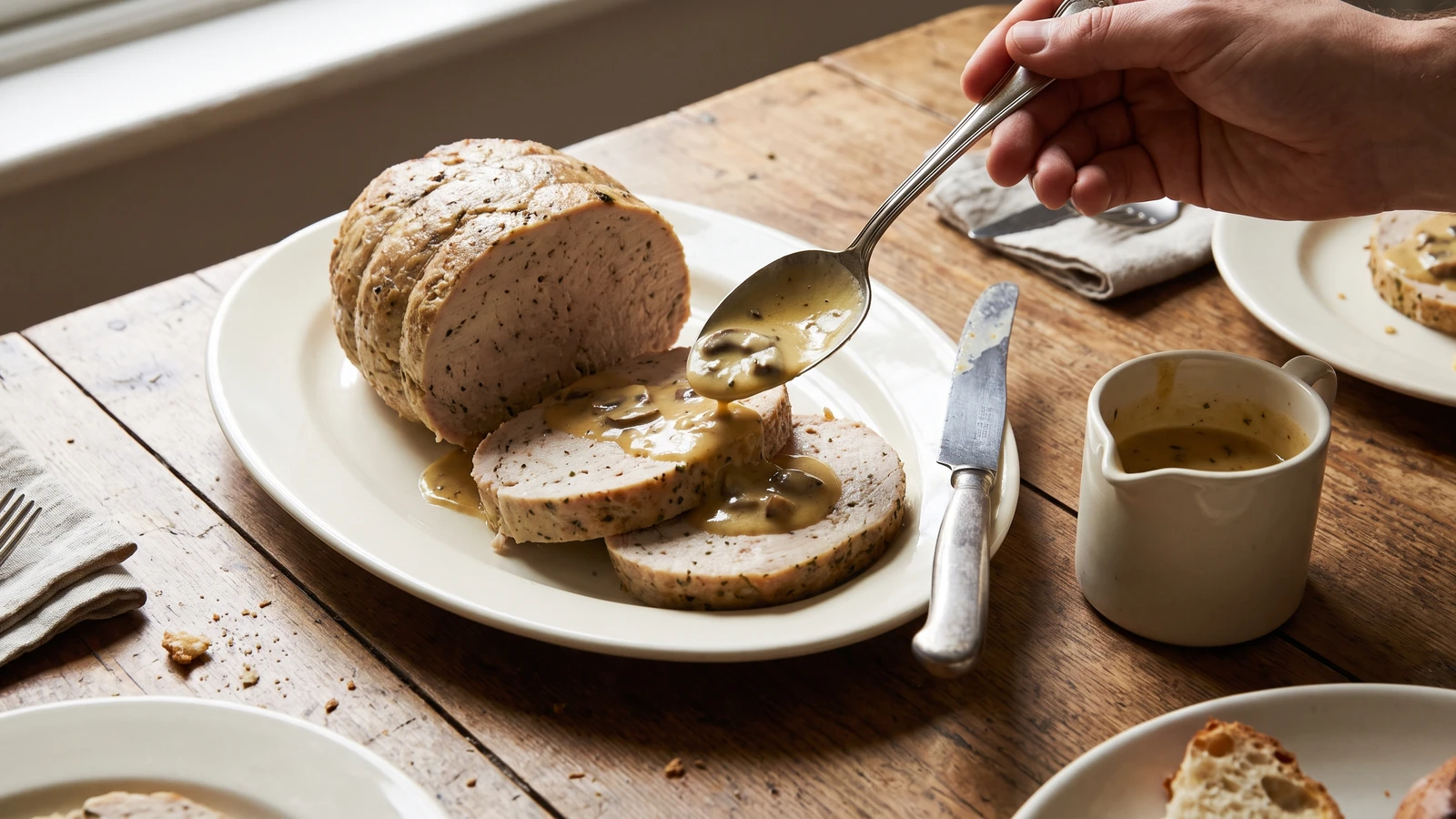
Pain de Veau turns a cold, carefully bound veal forcemeat into a tender ivory loaf, poached gently in its mould and carried to the table under a glossy mushroom velouté.
Pain de Veau (poached veal loaf) teaches the central law of a delicate forcemeat: temperature is structure. Keep the veal, eggs, cream, panada, bowl, and blade cold, and they bind into a close, tender emulsion. Let the mixture warm while you work, and the cream slips away from the meat, leaving a grainy loaf where there should be silk.
The source assumes a mortar, a drum sieve, very cold frangipan panada already waiting, and a saucier with pale stock never off the fire. Your honest equivalents are a chilled food processor, a sturdy fine-mesh sieve, a one-quart mould set in a roasting-pan bain-marie (a hot-water bath), and a small saucepan of mushroom-infused chicken stock. The quart mould already feeds four generously, so the veal proportions remain intact; only the panada and velouté are brought down to the smallest sensible home batches. The pounding is scaffolding and can go. The exact panada ratio, the sieve, the gradual cream, and the gentle poach are the dish and must stay. One cook, one stove, one evening.
Done properly, the Pain de Veau turns out pale and smooth, with a fine slice that yields under the fork while mushroom velouté gleams over its rounded sides. Before you touch the processor, chill everything and prepare the ice bath. That one act protects every step that follows.
Pain de Veau belongs to the French classical dining room and the table of cuisine bourgeoise rather than to a single province: a finely sieved forcemeat poached in a mould and served whole beneath sauce. The word pain describes its loaf shape, not bread, and its panada supplies tenderness and structure rather than the coarse crumb of an ordinary meat loaf. The preparation passed readily from staffed kitchens to home tables because its essential apparatus is only a mould and bain-marie; what changed was the labor, not the method.
Quantity
½ cup plus 1 teaspoon (125 ml / 129 g)
Quantity
¼ cup (60 ml / 31 g)
Quantity
1
Quantity
1½ tablespoons (22 ml / 21 g)
melted
Quantity
5 ounces (142 g)
Quantity
1 pound (454 g), replacing the liver in Pain de Foie de Veau (No. 1252)
cut into 1-inch pieces and thoroughly chilled
Quantity
1½ teaspoons (7.5 ml / 9.5 g)
Quantity
1 pinch
Quantity
1 pinch
Quantity
2
cold
Quantity
2 tablespoons (30 ml / 20 g)
finely chopped
Quantity
1 tablespoon (15 ml / 14 g)
Quantity
2
cold
Quantity
½ cup (120 ml / 120 g)
cold
Quantity
1 tablespoon (15 ml / 14 g)
softened
Quantity
1½ cups (360 ml / 115 g)
thinly sliced
Quantity
2 cups (480 ml / 480 g)
Quantity
2 tablespoons (30 ml / 28 g)
Quantity
2 tablespoons (30 ml / 16 g)
Quantity
½ cup (120 ml / 120 g)
Quantity
1 teaspoon (5 ml / 5 g)
Quantity
¼ teaspoon (1.25 ml / 1.5 g), plus more only if needed
Quantity
1 pinch
| Ingredient | Quantity |
|---|---|
| whole milk, for the frangipan panada | ½ cup plus 1 teaspoon (125 ml / 129 g) |
| all-purpose flour, for the frangipan panada | ¼ cup (60 ml / 31 g) |
| large egg yolk, for the frangipan panada | 1 |
| unsalted butter, for the frangipan panadamelted | 1½ tablespoons (22 ml / 21 g) |
| very cold frangipan panada, weighed from the prepared batch | 5 ounces (142 g) |
| very white veal, preferably lean leg meatcut into 1-inch pieces and thoroughly chilled | 1 pound (454 g), replacing the liver in Pain de Foie de Veau (No. 1252) |
| fine salt | 1½ teaspoons (7.5 ml / 9.5 g) |
| ground white pepper | 1 pinch |
| freshly grated nutmeg | 1 pinch |
| large eggscold | 2 |
| yellow onionfinely chopped | 2 tablespoons (30 ml / 20 g) |
| unsalted butter, for cooking the onion | 1 tablespoon (15 ml / 14 g) |
| large egg yolkscold | 2 |
| heavy cream, for the forcemeatcold | ½ cup (120 ml / 120 g) |
| unsalted butter, for the mouldsoftened | 1 tablespoon (15 ml / 14 g) |
| white button mushroomsthinly sliced | 1½ cups (360 ml / 115 g) |
| unsalted chicken stock | 2 cups (480 ml / 480 g) |
| unsalted butter, for the velouté | 2 tablespoons (30 ml / 28 g) |
| all-purpose flour, for the velouté | 2 tablespoons (30 ml / 16 g) |
| heavy cream, for the velouté | ½ cup (120 ml / 120 g) |
| fresh lemon juice | 1 teaspoon (5 ml / 5 g) |
| fine salt, for the velouté | ¼ teaspoon (1.25 ml / 1.5 g), plus more only if needed |
| ground white pepper, for the velouté | 1 pinch |
Stir the flour, egg yolk, and melted butter together in a small saucepan until perfectly smooth. Bring the milk just to a simmer, then whisk it into the flour mixture a little at a time. Cook over low heat, stirring continuously, until the panada becomes a thick, satiny paste and the spoon leaves a clean path across the pan, about 3 minutes. If it forms lumps, lift it from the heat, whisk firmly, and pass it through the sieve while warm. Spread it thinly on a plate, cover its surface, and chill until cold throughout, about 30 minutes. Weigh out exactly 5 ounces (142 g); the small batch makes a spoonful extra because dividing one yolk would be brigade arithmetic with no purpose at home.
Combine the mushrooms and chicken stock in a wide saucepan. Bring them to a bare simmer and cook uncovered for 15 minutes, letting the mushrooms perfume the stock without coloring it. Strain gently into a measuring jug. Reduce the liquid until 1½ cups (360 ml) remain; if it has reduced too far, restore the measure with a little stock. This is the mushroom essence that gives the pale sauce depth without filling it with pieces.
Melt the butter for the onion over low heat, add the chopped onion, and cook for 5 to 7 minutes until tender and translucent without a trace of browning. Spread it on a cold plate and let it cool completely. Butter a 1-quart (950 ml) Charlotte mould or straight-sided heatproof dish thoroughly. Heat the oven to 325°F (160°C) and bring a kettle of water nearly to the boil.
Chill the food-processor bowl and blade for 10 minutes. Add the veal, salt, white pepper, and nutmeg, then process in short bursts until the meat is very fine and tacky. Add the 5 ounces (142 g) of cold panada in four additions, followed by the 2 whole eggs one at a time, processing only until each addition disappears. This follows Pain de Foie de Veau (No. 1252), with very white veal substituted for liver exactly as the entry directs. The processor replaces the mortar and pestle, which were brigade scaffolding; the proportions and the cold emulsion remain the dish.
Rub the forcemeat through a sturdy fine-mesh sieve with a flexible scraper, discarding any sinew that refuses to pass. Do not skip this. The sieve is what turns minced veal into Pain de Veau. Set the bowl over ice and work in the cooled onion, then the 2 egg yolks, and finally the cold cream in four gradual additions. Stir firmly without whipping in air. If the mixture becomes loose, greasy, or warm, stop at once and set it directly over the ice for 10 minutes before adding the next spoonful of cream. Ça se rattrape. Finished forcemeat should be pale, glossy, and cohesive enough to hold a soft mound.
Spoon the forcemeat into the buttered mould, pressing it into the edges so no air pockets remain. Smooth the top, then tap the mould gently several times on a folded kitchen towel, exactly as the source directs, to settle the contents. Set it in a deep roasting pan and pour in enough near-boiling water to reach halfway up the mould. Poach in the oven for about 45 minutes. The water should barely quiver, never boil; if it becomes lively, replace a little with cool water. The loaf is ready when the surface feels set, a skewer shows no raw paste, and the center reaches 160°F (71°C).
While the loaf poaches, melt the butter for the sauce in a clean saucepan. Stir in the flour and cook the roux blanc, a white roux, over low heat for 2 minutes without letting it color. Gradually whisk in the 1½ cups (360 ml) mushroom essence, then simmer gently for 10 minutes, whisking along the bottom and corners. Add the cream and simmer until the velouté is nappé, thick enough to coat the back of a spoon while still flowing generously. Finish with the lemon juice, measured salt, and white pepper. If it is lumpy, strain it; if too thick, loosen it with stock; if too thin, simmer a little longer.
Lift the mould from the bain-marie and let the loaf stand for exactly 5 minutes so the forcemeat settles. Run a thin knife around the edge, invert a warmed round platter over the mould, and turn both over decisively. If the loaf resists, dip the base of the mould in hot water for 10 seconds and try again. Spoon enough mushroom velouté over the Pain de Veau to coat it and pool around the base, serving the remainder alongside. Cut it into thick wedges while the sauce still gleams. À table!
1 serving (about 385g)
Culinary guides, cultural storytelling, and the editorial depth that makes cooking meaningful.
Discover Culinary ExplorerChef Juliette
John Dory has the delicacy of sole and the firmness of turbot. A light flouring, a quick butter sauté, and nut-brown beurre noisette show exactly why looks never mattered.

Chef Juliette
Fresh haddock proves its delicacy in the meunière pan: a fine flour crust, moist pearly flakes, and beurre noisette sharpened with lemon and parsley, ready from one skillet in half an hour.

Chef Juliette
Éperlans à l’Anglaise turns small fish into a lesson in disciplined coating: boned smelts under a close, crisp crumb, pan-fried in clarified butter and finished with bright, half-melted maître d’hôtel butter.

Chef Juliette
Tiny smelts, shallot, mushrooms, white wine, gratin sauce, and fine bread raspings meet a fierce oven, where the fish must turn tender in the same breath the buttered crust bronzes.