
Chef Juliette
Selle de Veau (Relevé)
A half saddle of veal, bacon-barded and braised by short moistening, emerges bronze and succulent, with the concentrated veal glaze that makes this grand relevé worthy of the home table.
A cooking platform built around craft, culture, and the stories behind what we eat.
Created by Chef Juliette
Based on No. 1256, Côte de Veau en Cocotte à la Paysanne, from Le Guide Culinaire (1907) by Auguste Escoffier
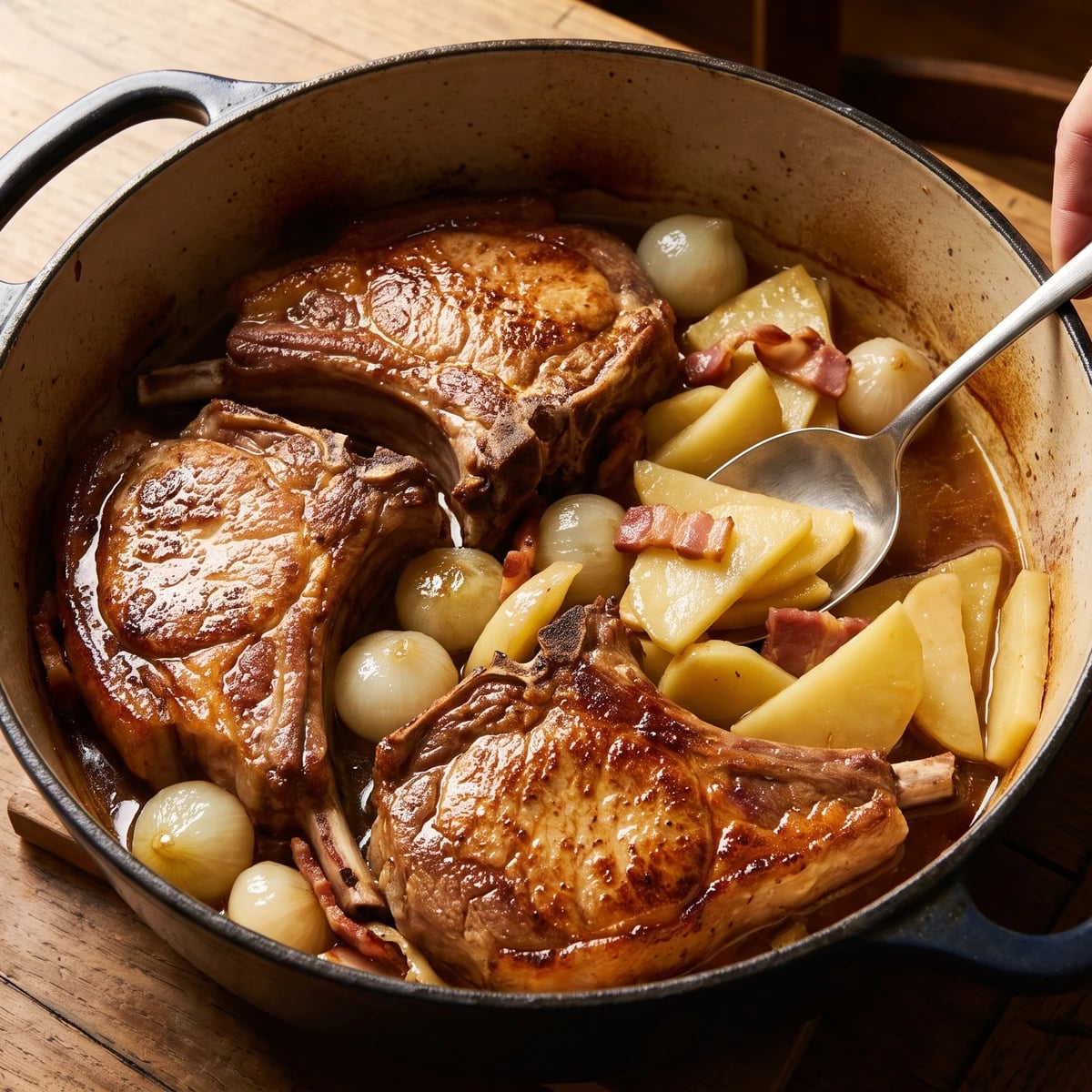
Côte de Veau en Cocotte à la Paysanne teaches the quiet art of browning first and cooking gently after: veal, salt pork, onions, and potato triangles sharing butter and their own juices in one pot.
Côte de Veau en Cocotte à la Paysanne (veal rib chops with salt pork, small onions, and triangular potatoes cooked in a covered pot) teaches one true thing: colour first, gentleness after. Brown the veal well enough to establish its fond (the browned glaze on the cocotte floor), then lower the temperature and let meat and garnish finish quietly in their own juices. Fierce heat throughout gives you dry veal beside stubborn potatoes.
The original entry assumed a small cocotte fitted to one cutlet and a brigade ready to repeat that portion to order. It calls for neither a saucier, a stockpot never off the fire, nor a salamander. Its scaffolding was the battery of portion pots and the hands watching them. At home, one wide cocotte holds four chops, and brief batch browning replaces four separate pans. The individual service pots can go; the butter browning, exact paysanne cut, gentle covered oven, and service from the cocotte must stay. One cook, one stove, one evening.
The potato cut decides whether the timing works. Make the triangles thin and even before you touch the pan, and they will soften as the thick veal chops reach their proper temperature. That uniform paysanne cut is the step that matters most.
Côte de veau en cocotte belongs to French cuisine bourgeoise, the well-disciplined family table where a good cut of meat and its vegetables cooked together in one covered pot. À la paysanne does not claim a particular province here; it names the plain vegetable garnish and, in this entry, the triangular cut of the potatoes. The household method passed naturally into the classical repertoire, but retained its original generosity: the cooking vessel goes straight to the table, carrying every drop of butter and juice with it.
Quantity
4 chops, 1¼ to 1½ inches (3 to 4 cm) thick, about 2½ pounds (1.1 kg) total
Quantity
8 small slices, about ½ cup (120 ml / 120 g), prepared according to Blanchings (No. 273)
drained and patted dry
Quantity
16, about 2 cups (475 ml / 240 g)
peeled
Quantity
8, about 4 cups (950 ml / 680 g)
peeled and cut paysanne-fashion into ⅛-inch (3 mm) triangles
Quantity
4 tablespoons (60 ml / 57 g)
divided
Quantity
¾ teaspoon (3.75 ml / 4 g)
divided
| Ingredient | Quantity |
|---|---|
| bone-in veal rib chops | 4 chops, 1¼ to 1½ inches (3 to 4 cm) thick, about 2½ pounds (1.1 kg) total |
| unsmoked salted pork breastdrained and patted dry | 8 small slices, about ½ cup (120 ml / 120 g), prepared according to Blanchings (No. 273) |
| pearl onionspeeled | 16, about 2 cups (475 ml / 240 g) |
| small long waxy potatoespeeled and cut paysanne-fashion into ⅛-inch (3 mm) triangles | 8, about 4 cups (950 ml / 680 g) |
| unsalted butterdivided | 4 tablespoons (60 ml / 57 g) |
| fine sea saltdivided | ¾ teaspoon (3.75 ml / 4 g) |
Heat the oven to 325°F (165°C). Begin with the salted pork breast already prepared according to Blanchings (No. 273), then drain and dry it thoroughly. Cut the peeled potatoes lengthwise into even ⅛-inch (3 mm) slices, then cut those slices into small triangles. Paysanne-fashion means triangles in this entry, not irregular chunks. Keep them uniform so the potatoes become tender at the same moment as the veal.
Set a wide cocotte over medium heat and melt 3 tablespoons (45 ml / 43 g) of the butter. Season the chops with half the salt, then lay them in the foaming butter with the salt pork. Brown the veal for 3 to 4 minutes on each side, turning once, until the surface is a confident butter-gold and the cocotte floor carries a brown fond. If the chops cannot lie flat, work in two batches and rest the first pair on the upturned cocotte lid. If the butter darkens rapidly, pull the cocotte off the heat and lower the burner; if it smells acrid, wipe the pot and restart with fresh butter, because burnt milk solids will not mellow in the oven.
Lift the chops briefly onto the cocotte lid. Add the remaining tablespoon (15 ml / 14 g) of butter, the pearl onions, the paysanne potatoes, and the remaining salt. Turn the garnish gently through the butter, pork fat, and fond for 3 minutes, letting a few potato edges take pale colour. Spread the potatoes across the bottom, nestle the onions and salt pork among them, and return the chops on top with any juices from the lid.
Cover the cocotte tightly and place it on the middle oven rack. After 18 minutes, turn the potatoes and onions from the edge toward the centre and spoon the buttery juices over the chops. Cover again and cook for another 5 to 12 minutes, until a knife enters the potatoes without resistance, the onions are tender, and the veal registers 145°F (63°C) at the thickest part away from the bone. If the veal reaches temperature before the garnish is tender, lift the chops onto the warm lid and give the vegetables another 5 minutes covered. Ça se rattrape. Rest the cooked veal for at least 3 minutes.
The juices should lightly glaze the potatoes rather than sit as a watery pool. If they are thin, keep the chops on the lid and set the uncovered cocotte over medium heat for 1 to 2 minutes, turning the garnish until the butter, fond, pork fat, and veal juices cohere and gleam. Taste before adding any more salt. There is no stock, wine, flour, cream, or herb here; the concentrated cooking juices are the finish.
Return the chops to the cocotte and arrange the salt pork, pearl onions, and paysanne potatoes generously around them. Spoon the glossy juices over everything and carry the preparation directly to the table in its cooking pot, exactly as the dish intends. Cooking well is not cooking fancy. À table!
1 serving (about 420g)
Culinary guides, cultural storytelling, and the editorial depth that makes cooking meaningful.
Discover Culinary Explorer
Chef Juliette
A half saddle of veal, bacon-barded and braised by short moistening, emerges bronze and succulent, with the concentrated veal glaze that makes this grand relevé worthy of the home table.

Chef Juliette
A bronzed saddle of veal between two patterned vegetable domes, with clear, glossy braising jus passed at the table: classical structure translated for four, patient enough for a celebration and possible on one stove.

Chef Juliette
A veal saddle braised until tender, its fillets cut into collops and rebuilt with paprika Béchamel and truffle, then flashed beneath fierce heat until the ivory sauce glazes.

Chef Juliette
A veal saddle becomes edible architecture: Soubise and ham tucked into the carved loin, truffled Parmesan soufflé rising above it, and reduced braising liquor served alongside.