
Chef Juliette
John Dory (St. Pierre)
John Dory has the delicacy of sole and the firmness of turbot. A light flouring, a quick butter sauté, and nut-brown beurre noisette show exactly why looks never mattered.
A cooking platform built around craft, culture, and the stories behind what we eat.
Created by Chef Juliette
Based on No. 1240, Croustade de Ris de Veau à la Financière, from Le Guide Culinaire (1907) by Auguste Escoffier
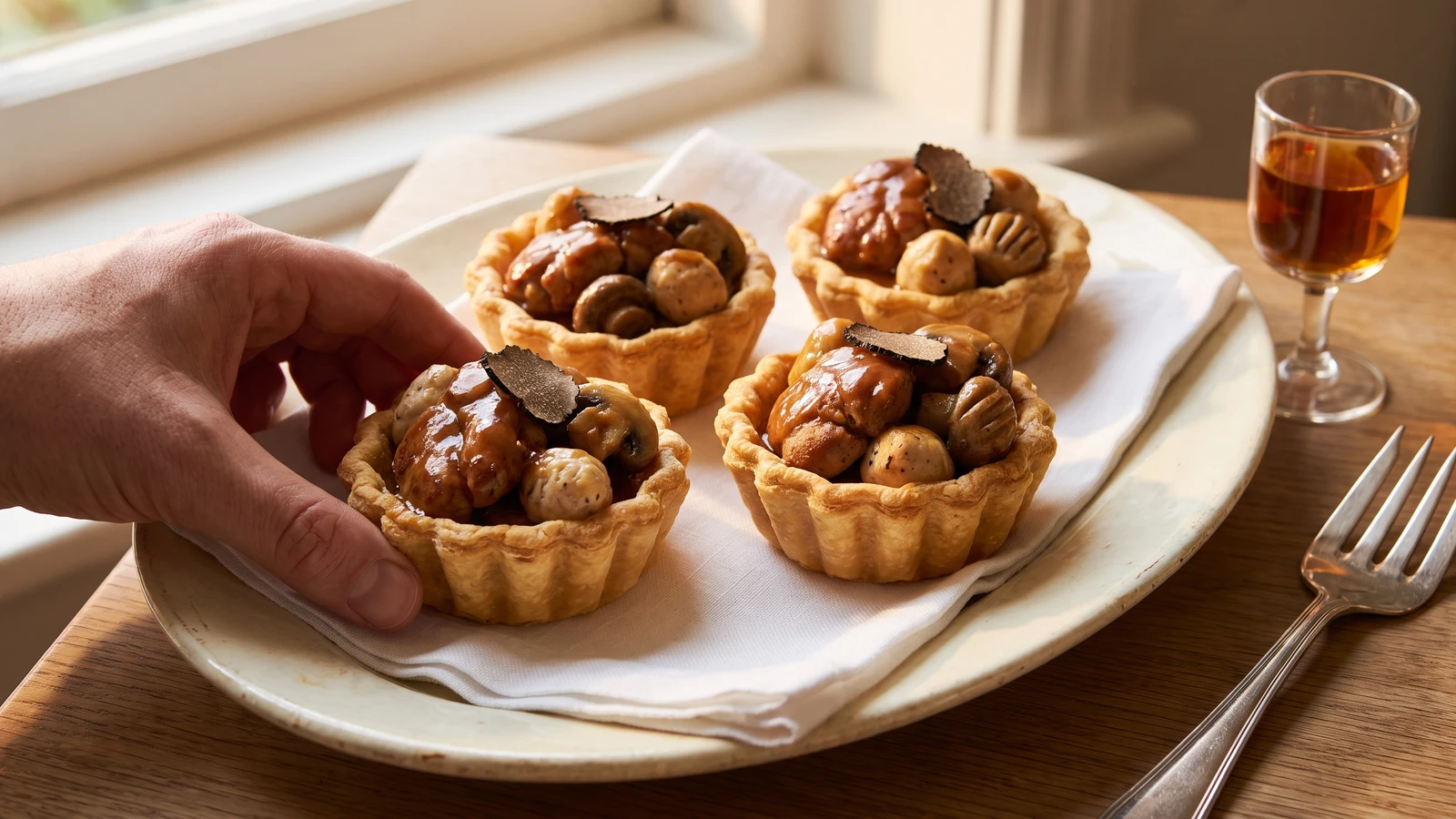
Four pale, fluted croustades cradle tiny chicken quenelles, grooved mushrooms, Madeira half-glaze, and tender braised sweetbread under black truffle, a lesson in timing, contrast, and grand French generosity scaled for home.
Croustade de Ris de Veau à la Financière (fluted pastry with veal sweetbread and a Madeira-glazed garnish of tiny chicken dumplings, mushrooms, and truffle) teaches coordination. Know one thing before touching a pan: its luxury depends on contrast, not abundance. The croustade must remain crisp, the sweetbread tender, and the sauce glossy enough to cling without soaking the pastry.
The original kitchen assumed a pastry cook, a saucier on staff, stock never off the fire, a drying-box for the croustades, and a salamander waiting for last-minute service. Your equivalents are a low conventional oven, good prepared veal demi-glace, and a sequence that lets one pair of hands finish everything hot. One cook, one stove, one evening.
The brigade scaffolding can go: separate cooks, service holding, and, when no specialist butcher can obtain cocks' combs and cocks' kidneys, those rare morsels become pressed sweetbread trimmings because they preserve the tender offal character. What stays is the dish itself: pale dry croustades, braised sweetbread, tiny chicken quenelles, grooved mushrooms, demi-glace au Madère, and one fine truffle slice on each. The final assembly matters most, so have every component ready before the croustades leave the oven.
Croustade de ris de veau à la financière belongs to the Parisian grand-kitchen and banquet repertoire, where individual pastry cases turned a composed garnish into a neat entrée served before the roast. Garniture financière gathered costly, delicate morsels such as cocks' combs, cocks' kidneys, poultry quenelles, mushrooms, Madeira, and truffle under a glossy brown sauce. The popular explanation that its name celebrates financiers and expensive ingredients is plausible but not securely settled; the composition has always mattered more than the tale.
Quantity
4 from Croûtes et Croustades (No. 2393), each 3¼ inches (8 cm) wide
Quantity
1 large lobe (about 1 lb 2 oz / 500 g)
Quantity
1
halved
Quantity
2 teaspoons (10 ml / 12 g)
divided
Quantity
½ teaspoon (2.5 ml / 1 g)
divided
Quantity
3 tablespoons (45 ml / 43 g)
divided
Quantity
1 (about 3 oz / 85 g)
sliced
Quantity
1 (about 1½ oz / 40 g)
sliced
Quantity
1 (about 1½ oz / 40 g)
sliced
Quantity
1 small
Quantity
3 cups (710 ml / 710 g)
divided
Quantity
½ cup (120 ml / 120 g)
divided
Quantity
½ cup (120 ml / 120 g)
Quantity
2 tablespoons (30 ml / 25 g)
diced and very cold
Quantity
1 teaspoon (5 ml / 5 g)
Quantity
2 teaspoons (10 ml / 10 g)
Quantity
1 pinch
Quantity
4 (about 1½ oz / 40 g)
wiped clean
Quantity
2 tablespoons (30 ml / 25 g)
thinly sliced
Quantity
1 (about ¾ oz / 20 g)
cut into 4 fine slices
| Ingredient | Quantity |
|---|---|
| baked small fluted croustades, pale and dry | 4 from Croûtes et Croustades (No. 2393), each 3¼ inches (8 cm) wide |
| veal heart sweetbread | 1 large lobe (about 1 lb 2 oz / 500 g) |
| lemonhalved | 1 |
| fine sea saltdivided | 2 teaspoons (10 ml / 12 g) |
| ground white pepperdivided | ½ teaspoon (2.5 ml / 1 g) |
| unsalted butterdivided | 3 tablespoons (45 ml / 43 g) |
| small carrotsliced | 1 (about 3 oz / 85 g) |
| medium shallotsliced | 1 (about 1½ oz / 40 g) |
| celery ribsliced | 1 (about 1½ oz / 40 g) |
| bouquet garni of parsley stems, thyme, and bay | 1 small |
| unsalted veal or chicken stockdivided | 3 cups (710 ml / 710 g) |
| dry Madeiradivided | ½ cup (120 ml / 120 g) |
| prepared veal demi-glace | ½ cup (120 ml / 120 g) |
| skinless chicken breastdiced and very cold | 2 tablespoons (30 ml / 25 g) |
| beaten egg white | 1 teaspoon (5 ml / 5 g) |
| cold heavy cream | 2 teaspoons (10 ml / 10 g) |
| freshly grated nutmeg | 1 pinch |
| extra-small button mushroomswiped clean | 4 (about 1½ oz / 40 g) |
| prepared cocks' combs and cocks' kidneys, or pressed sweetbread trimmingsthinly sliced | 2 tablespoons (30 ml / 25 g) |
| small black truffle, fresh or whole preservedcut into 4 fine slices | 1 (about ¾ oz / 20 g) |
Cover the sweetbread with plenty of cold water and soak it for 1 hour, changing the water two or three times, until the water stays clear and the flesh looks pale. Put it in a saucepan, cover again with cold water, squeeze in the lemon, add the spent halves and 1 teaspoon of the salt, then bring the water slowly to a bare simmer. Cook for 5 minutes, never at a hard boil, and transfer the sweetbread to ice water. This blanching firms the delicate flesh so it can be trimmed without turning to paste.
Drain the cooled sweetbread and peel away the thick outer membrane, loose fat, and visible tubes with a small knife. Work patiently and leave the fine membrane that clings tightly, since digging after it tears the lobe. Place the trimmed sweetbread between two trays, set a 4-pound (1.8 kg) weight on top, and press for 30 minutes in the cold. If a corner tears, keep it; the pressed irregular pieces can join the financière garnish when cocks' combs and cocks' kidneys aren't available.
Season the pressed sweetbread with ½ teaspoon salt and ¼ teaspoon white pepper. Melt 2 tablespoons of the butter in a lidded sauté pan over medium heat and colour the sweetbread lightly on both sides, about 3 minutes per side. Add the carrot, shallot, and celery; cook for 3 minutes without scorching them. Pour in ¼ cup (60 ml) Madeira and reduce it by half, then add 2 cups (475 ml) stock and the bouquet garni. Cover and hold at the faintest simmer for 20 to 25 minutes, until the centre reaches 160°F (71°C) and feels tender but resilient. Lift out the sweetbread, strain and reserve the braising liquid, and rest the lobe for 10 minutes. Cut four slices about ½ inch (1.25 cm) thick and trim them into rounds matching the inner diameter of the croustades, about 2¾ inches (7 cm); reserve the trimmings.
Mince the cold chicken repeatedly under a sharp knife until it becomes a paste, then press it through a fine sieve into a chilled bowl. At this scale, a full food processor loses more forcemeat around its blade than it mixes. Stir in a small pinch each of salt, white pepper, and nutmeg, then beat in the egg white followed by the cold cream until the mixture is smooth and slightly springy. Bring the remaining 1 cup (235 ml) stock to a bare tremble. Shape 8 hazelnut-size quenelles between two small spoons and poach them for 3 to 4 minutes, until firm and 165°F (74°C) at the centre. Use the four neatest in the croustades; the others cover the test piece and the inevitable first awkward spoonful.
Cut four shallow V-shaped grooves from the crown to the edge of each mushroom cap, rotating the mushroom between cuts. Melt the remaining tablespoon of butter in a small pan, add the mushrooms, 2 tablespoons of reserved braising liquid, and a pinch of salt, then cover and cook gently for 4 minutes. Uncover and roll the mushrooms through the butter until the liquid has nearly vanished, keeping them pale. Add the sliced prepared cocks' combs and cocks' kidneys, or the measured sweetbread trimmings, and warm them through without frying. Set aside with four selected quenelles.
Pour the remaining ¼ cup (60 ml) Madeira into a small saucepan and boil until reduced to about 1 tablespoon. Add the veal demi-glace and simmer gently until you have exactly ¼ cup (60 ml) of demi-glace au Madère, the Madeira half-glaze, with a nappant consistency that coats the back of a spoon. If it becomes sticky before reaching that measure, whisk in reserved braising liquid a teaspoon at a time. If it remains thin, reduce it a little longer. Ça se rattrape.
Heat the oven to 300°F (150°C). Set the Croûtes et Croustades (No. 2393) on a baking sheet and warm them for 6 to 8 minutes, until their interiors feel dry and crisp but remain pale. This low oven replaces the drying-box; no broiler is needed because colour on the pastry is not the aim. Meanwhile, warm the sweetbread rounds in a shallow pool of their strained braising liquid over very gentle heat, then drain them thoroughly. Rewarm the financière solids and the demi-glace au Madère separately.
Combine one quenelle, one grooved mushroom, and one-fourth of the sliced offal garnish for each serving, making four level tablespoon portions. Coat each portion with 1 tablespoon (15 ml) demi-glace au Madère and spoon it into a hot croustade. Set a drained sweetbread round squarely on each garnish and lay one fine truffle slice on top. Arrange the four croustades on a warm platter lined with a folded white napkin and serve immediately, before the sauce has time to soften the pastry. À table!
1 serving (about 210g)
Culinary guides, cultural storytelling, and the editorial depth that makes cooking meaningful.
Discover Culinary ExplorerChef Juliette
John Dory has the delicacy of sole and the firmness of turbot. A light flouring, a quick butter sauté, and nut-brown beurre noisette show exactly why looks never mattered.

Chef Juliette
Fresh haddock proves its delicacy in the meunière pan: a fine flour crust, moist pearly flakes, and beurre noisette sharpened with lemon and parsley, ready from one skillet in half an hour.

Chef Juliette
Éperlans à l’Anglaise turns small fish into a lesson in disciplined coating: boned smelts under a close, crisp crumb, pan-fried in clarified butter and finished with bright, half-melted maître d’hôtel butter.

Chef Juliette
Tiny smelts, shallot, mushrooms, white wine, gratin sauce, and fine bread raspings meet a fierce oven, where the fish must turn tender in the same breath the buttered crust bronzes.