
Chef Juliette
John Dory (St. Pierre)
John Dory has the delicacy of sole and the firmness of turbot. A light flouring, a quick butter sauté, and nut-brown beurre noisette show exactly why looks never mattered.
A cooking platform built around craft, culture, and the stories behind what we eat.
Created by Chef Juliette
Based on No. 1234, Ris de Veau Grillés Saint-Germain, from Le Guide Culinaire (1907) by Auguste Escoffier
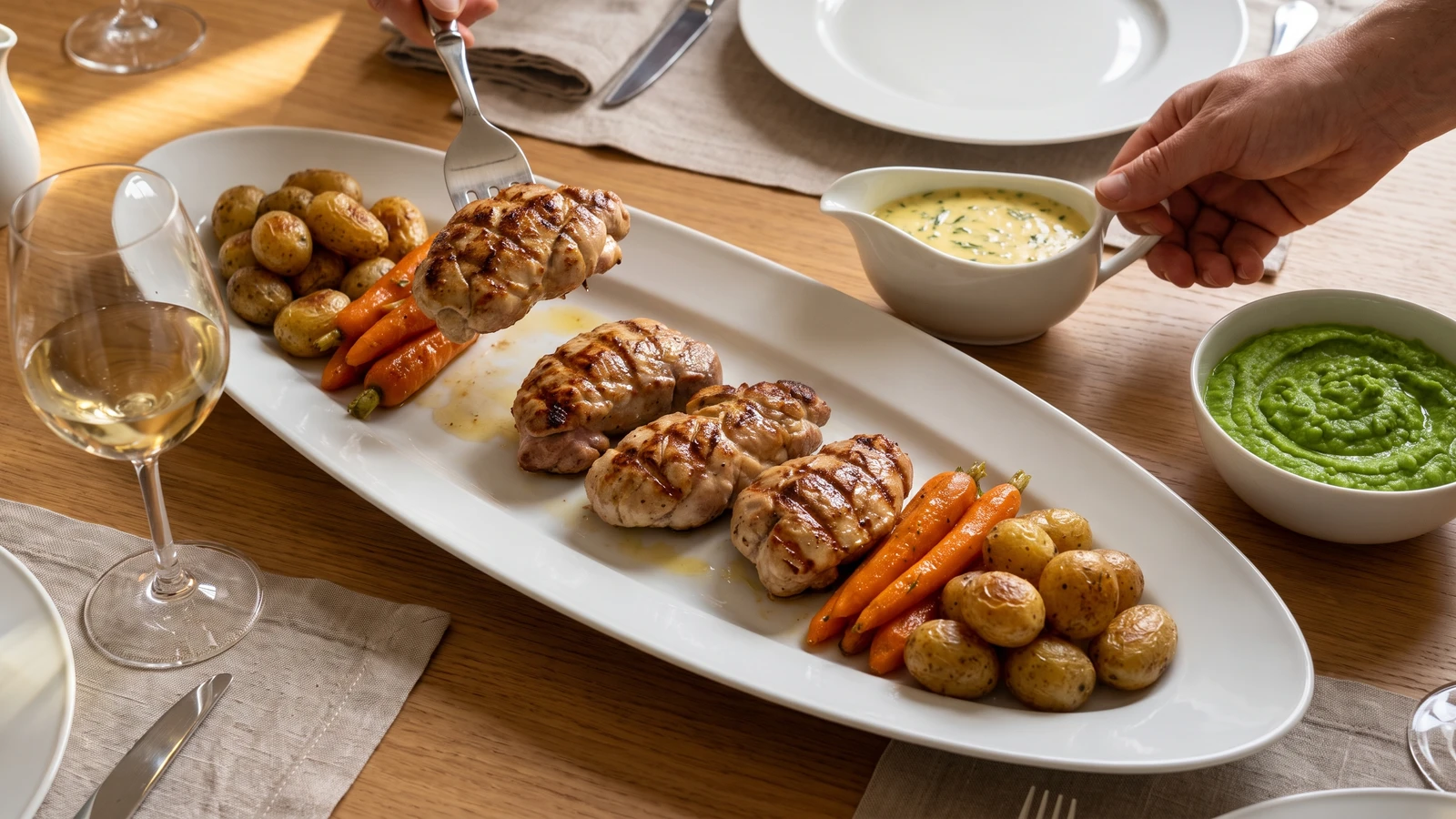
Grilled sweetbreads, butter-gold potatoes, consommé-glazed carrots, bright pea purée, and Béarnaise served apart: a grand platter made workable for one cook, with crisp edges and a tender heart.
Ris de Veau Grillés Saint-Germain (grilled veal sweetbreads with peas) teaches one uncompromising lesson: the sweetbreads must be blanched, pressed, and thoroughly dried before they touch fierce heat. Do that well and they grill to a deep bronze outside while remaining tender within. Leave them damp or uneven, and no handsome grill mark can rescue the texture.
The original recipe assumed a saucier on staff, a stock never off the fire, and a salamander ready to color each portion at command. At home, a bowl over a small saucepan makes the Béarnaise, good prepared consommé glazes the carrots, and a heavy ridged grill pan supplies the concentrated heat. The brigade's separate stations are scaffolding and can go. The Blanchings, pressing, grilling, butter cookery, fresh-pea purée, and warm emulsion are the dish, so they stay. This version serves four from one stove without changing the platter's composition or its sauces.
The finished platter should be generous and precise: bronzed sweetbreads down the center, alternate heaps of butter-gold potatoes and lacquered carrots around them, with the green purée and herb-flecked Béarnaise passed separately. Press the sweetbreads until their thickness is even, then dry them with real attention. That is the step that decides everything.
Ris de veau belong to the Parisian grand-kitchen repertoire, where veal sweetbreads were refined through soaking, blanching, pressing, and exact last-minute cooking. In classical menu French, Saint-Germain signals green peas, not a sauce, and here it points specifically to the fresh-pea purée served apart. The long-platter arrangement preserves the dish's formal service, while Béarnaise supplies the sharp herb-and-butter counterpoint to the grill.
Quantity
4, 5 to 6 ounces each (600 to 680 g total)
Quantity
1 preparation Blanchings (No. 273), sufficient for 4 veal sweetbreads
Quantity
3 tablespoons (45 ml / 54 g)
divided
Quantity
1 teaspoon (5 ml / 2 g)
divided
Quantity
3 tablespoons (45 ml / 42 g)
for grilling
Quantity
24, about 1½ pounds (680 g total)
peeled
Quantity
4 tablespoons (60 ml / 57 g)
for the potatoes
Quantity
½ cup (120 ml / 120 g)
for the potatoes
Quantity
8, about 1¼ pounds (570 g total)
peeled and cut into elongated olive shapes
Quantity
1½ cups (360 ml / 360 g)
Quantity
2 tablespoons (30 ml / 28 g)
for the carrots
Quantity
4 cups (960 ml / 570 g)
Quantity
8 cups (1.9 L / 1.9 kg)
for cooking the peas
Quantity
3 tablespoons (45 ml / 43 g)
for the pea purée
Quantity
¼ cup (60 ml / 60 g)
Quantity
¼ cup (60 ml / 60 g)
Quantity
¼ cup (60 ml / 35 g)
finely minced
Quantity
1 teaspoon (5 ml / 2 g)
lightly crushed
Quantity
4 sprigs
Quantity
2 tablespoons (30 ml / 6 g)
finely chopped
Quantity
1 tablespoon (15 ml / 3 g)
finely chopped
Quantity
3
Quantity
1 tablespoon (15 ml / 15 g)
for the Béarnaise
Quantity
¾ cup (180 ml / 170 g)
clarified and kept warm for the Béarnaise
| Ingredient | Quantity |
|---|---|
| veal heart sweetbreads | 4, 5 to 6 ounces each (600 to 680 g total) |
| Blanchings | 1 preparation Blanchings (No. 273), sufficient for 4 veal sweetbreads |
| fine sea saltdivided | 3 tablespoons (45 ml / 54 g) |
| freshly ground black pepperdivided | 1 teaspoon (5 ml / 2 g) |
| clarified butterfor grilling | 3 tablespoons (45 ml / 42 g) |
| small waxy potatoespeeled | 24, about 1½ pounds (680 g total) |
| unsalted butterfor the potatoes | 4 tablespoons (60 ml / 57 g) |
| waterfor the potatoes | ½ cup (120 ml / 120 g) |
| medium slender carrotspeeled and cut into elongated olive shapes | 8, about 1¼ pounds (570 g total) |
| prepared veal or beef consommé | 1½ cups (360 ml / 360 g) |
| unsalted butterfor the carrots | 2 tablespoons (30 ml / 28 g) |
| freshly shelled green peas | 4 cups (960 ml / 570 g) |
| waterfor cooking the peas | 8 cups (1.9 L / 1.9 kg) |
| unsalted butterfor the pea purée | 3 tablespoons (45 ml / 43 g) |
| white wine vinegar | ¼ cup (60 ml / 60 g) |
| dry white wine | ¼ cup (60 ml / 60 g) |
| shallotfinely minced | ¼ cup (60 ml / 35 g) |
| black peppercornslightly crushed | 1 teaspoon (5 ml / 2 g) |
| fresh tarragon | 4 sprigs |
| fresh tarragonfinely chopped | 2 tablespoons (30 ml / 6 g) |
| fresh chervilfinely chopped | 1 tablespoon (15 ml / 3 g) |
| large egg yolks | 3 |
| cold waterfor the Béarnaise | 1 tablespoon (15 ml / 15 g) |
| unsalted butterclarified and kept warm for the Béarnaise | ¾ cup (180 ml / 170 g) |
Complete the Blanchings (No. 273) exactly as that preparation directs, using it to soak, blanch, cool, and drain the sweetbreads. They should feel firm enough to handle but remain supple at the center. This preliminary work removes blood, sets the delicate flesh, and makes clean trimming possible; it is technique, not ceremony.
Remove the thick outer membrane and any obvious cords with a small sharp knife, working gently so the lobes stay intact. Do not chase every fine filament and tear the sweetbreads to pieces. Set them between two lined trays, place a 4 to 5 pound weight on top, and chill for 45 to 60 minutes, until evenly flattened to about ¾ inch. Pat every surface thoroughly dry afterward. Damp sweetbreads stick and color poorly; if they still feel wet, leave them uncovered in the cold for another 15 minutes.
While the sweetbreads press, combine the vinegar, wine, shallot, crushed peppercorns, and tarragon sprigs in a small saucepan. Boil steadily until only about 2 tablespoons remain, then strain into a heatproof bowl, pressing firmly on the shallot and herbs. This concentrated reduction is the backbone of Béarnaise. It may wait at room temperature while you prepare the vegetables.
Lay the olive-shaped carrots in a wide saucepan in a single layer. Add the consommé, 2 tablespoons butter, and a small pinch of salt, then cover with a parchment round or a lid set slightly ajar. Simmer gently until the carrots are tender but still hold their shape, 12 to 18 minutes. Uncover and roll them through the reducing liquid until it clings as a glossy glaze. If the carrots soften before the consommé reduces, lift them out, reduce the liquid alone, then return them. Ça se rattrape.
Put the peeled potatoes in a lidded sauté pan with 4 tablespoons butter, the ½ cup water, and ½ teaspoon salt. Cover and cook over medium-low heat until nearly tender, 12 to 15 minutes, shaking the pan occasionally. Remove the lid and continue cooking as the water evaporates, turning the potatoes through the butter until every side is a handsome gold. If the butter colors before the centers are tender, add 2 tablespoons water, cover again, and finish gently.
Bring the 8 cups water to a strong boil and season it with 2 tablespoons salt. Add the fresh peas and cook just until tender and vivid green, 3 to 5 minutes depending on their maturity. Reserve 1 cup cooking water, drain the peas, and blend them at once with 3 tablespoons butter and enough reserved water to make a smooth, spoonable purée. Pass it through a fine sieve, then season. If it is loose, stir it over gentle heat until it holds a soft mound; if too thick, loosen it one spoonful at a time with the pea water.
Whisk the egg yolks and 1 tablespoon cold water into the strained reduction. Set the bowl over barely simmering water and whisk continuously until the yolks become pale, thick, and able to hold the trace of the whisk. Remove the bowl from the heat and add the warm clarified butter first by droplets, then in a thin stream, whisking without pause. Fold in the chopped tarragon and chervil, then season with salt and pepper. Hold the Béarnaise over warm water, never direct heat. If it turns greasy or separates, stop adding butter. Ça se rattrape: whisk a teaspoon of cold water in a clean warm bowl, then beat in the broken sauce a teaspoon at a time until it gathers again.
Heat a heavy ridged grill pan over medium-high heat until thoroughly hot. Season the dry sweetbreads with salt and pepper and brush them generously with the clarified butter. Lay them in the pan without crowding and leave them untouched for 4 to 5 minutes, until the ridges are deep Maillard bronze and the meat releases willingly. Turn and cook the second side for another 4 to 5 minutes, brushing with more butter as needed, until the centers reach 160°F (71°C). If they cling, do not tear them loose; give the crust another minute. If the exterior colors before the center is hot, lower the heat and cover the pan briefly.
Rewarm the carrots in their glaze, roll the potatoes once more through their butter, and bring the pea purée gently back to serving temperature. Arrange the grilled sweetbreads in a line down the center of a long warm platter. Surround them with alternate compact heaps of golden potatoes and glazed carrots, preserving the original service rather than scattering everything together. Send the Béarnaise and fresh-pea purée to the table separately in warm serving bowls. À table!
1 serving (about 655g)
Culinary guides, cultural storytelling, and the editorial depth that makes cooking meaningful.
Discover Culinary ExplorerChef Juliette
John Dory has the delicacy of sole and the firmness of turbot. A light flouring, a quick butter sauté, and nut-brown beurre noisette show exactly why looks never mattered.

Chef Juliette
Fresh haddock proves its delicacy in the meunière pan: a fine flour crust, moist pearly flakes, and beurre noisette sharpened with lemon and parsley, ready from one skillet in half an hour.

Chef Juliette
Éperlans à l’Anglaise turns small fish into a lesson in disciplined coating: boned smelts under a close, crisp crumb, pan-fried in clarified butter and finished with bright, half-melted maître d’hôtel butter.

Chef Juliette
Tiny smelts, shallot, mushrooms, white wine, gratin sauce, and fine bread raspings meet a fierce oven, where the fish must turn tender in the same breath the buttered crust bronzes.