Culinary Explorer

A cooking platform built around craft, culture, and the stories behind what we eat.
Discover Culinary Explorer
Ris de Veau Grillé Gismonda

Ris de Veau Grillé Gismonda

Created by Chef Juliette

Based on No. 1232, Ris de Veau Grillé Gismonda, from Le Guide Culinaire (1907) by Auguste Escoffier

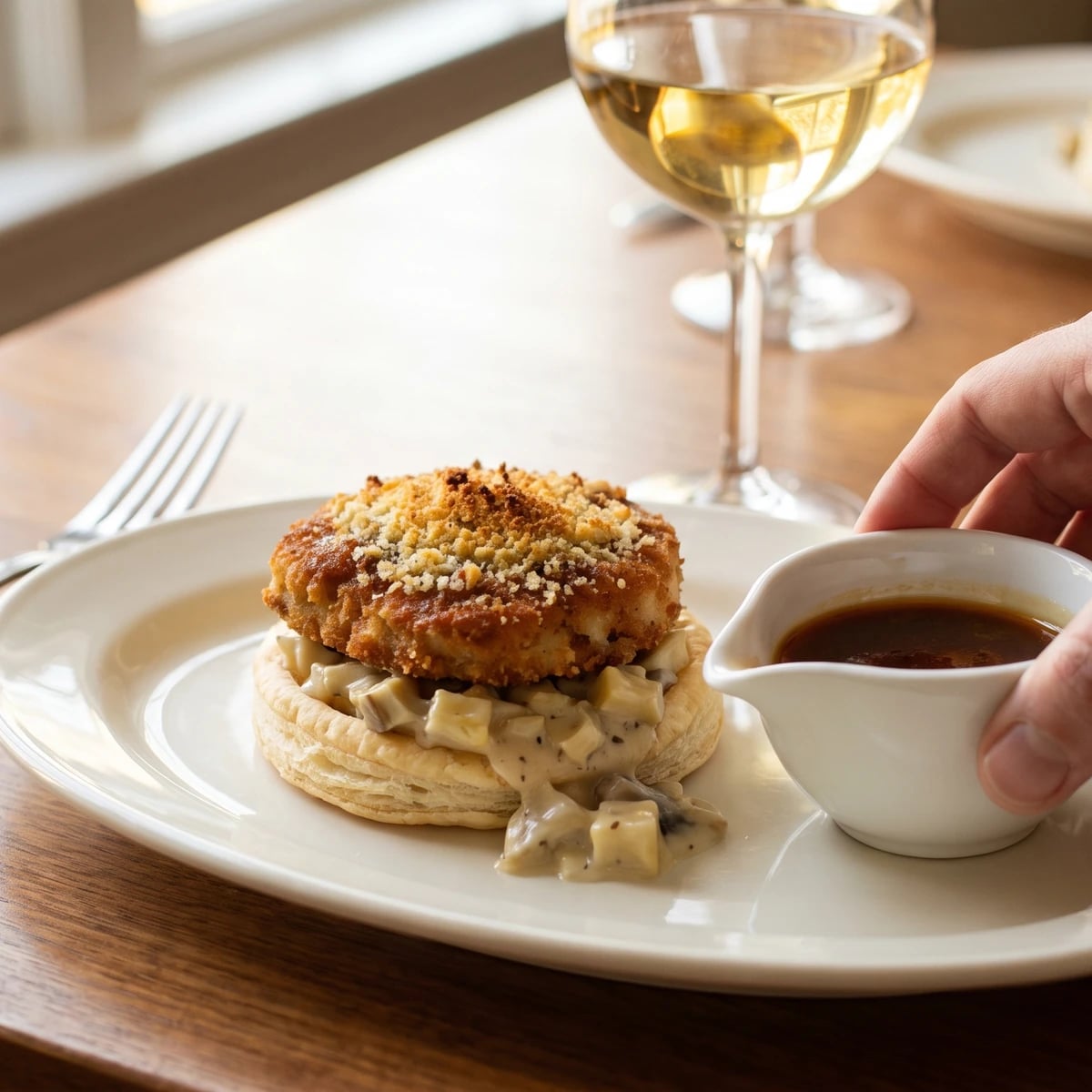
Ris de Veau Grillé Gismonda sets a bronzed sweetbread over a pale croustade of artichoke and mushroom bound with cream, then keeps its buttered meat glaze apart so pastry stays crisp.

Main Dishes
French
Dinner Party
Special Occasion
45 min
Active Time
1 hr 15 min cook4 hr total
Yield4 servings

Ris de Veau Grillé Gismonda (grilled veal sweetbread on a filled croustade) teaches separation. The sweetbread must be bronzed and tender, the pastry pale but crisp, the artichoke and mushroom held together by cream rather than drowned in it, and the meat glaze kept apart until the eater chooses it. The one true thing is moisture control. Let any component become wet and the whole construction loses its purpose.

The original kitchen assumed a pâtissier turning out oval croustades, a saucier on staff, a stock never off the fire, and a salamander waiting to grill each sweetbread for service. At home, four finished croustades replace the pastry station, a small saucepan reduces good unsalted stock, and the oven broiler does the salamander's work. The drying-box and folded service napkin were brigade scaffolding, so a low oven and warmed plates take their places. What remains is the dish itself: equal quantities of artichoke and mushroom, real cream, grilled sweetbread, and buttered meat glaze served separately. One cook, one stove, one evening.

The decisive step comes after blanching. Press the sweetbreads until they are cold and compact, then dry them thoroughly before butter and crumbs touch them. An unpressed, damp lobe cannot grill cleanly; a firm dry one takes a fine bronze crust while staying tender within.

Ris de Veau Grillé Gismonda belongs to the formal Parisian repertoire, whose named garnitures often borrowed the language of the theatre while remaining exact formulas at the stove. Gismonda is not a general sauce or flavoring: here it means the precise assembly of grilled veal sweetbread, a pale oval croustade, equal quantities of artichoke bottom and mushroom bound with cream, and buttered meat glaze served apart. The composition carried delicate sweetbreads onto the grand dinner table without disguising them, using pastry and sauce to frame their texture rather than bury it.

The technique, the tradition, and the story behind every dish.

Discover Culinary Explorer

Ingredients

veal heart sweetbreads

Quantity

4, about 1½ pounds (680 g) total

cold water

Quantity

2 quarts (1.9 L / 1.9 kg), plus more for blanching

white wine vinegar

Quantity

2 tablespoons (30 ml / 30 g)

fine sea salt

Quantity

1 tablespoon (15 ml / 18 g)

divided

ground white pepper

Quantity

½ teaspoon (2.5 ml / 1 g)

divided

shallow oval croustades

Quantity

4 shallow oval croustades from Croûtes et Croustades (No. 2393), about 5 inches (12 cm) long

baked pale and thoroughly dried

raw globe artichoke bottoms

Quantity

4, about 1 cup (240 ml / 170 g)

finely diced

button mushrooms

Quantity

1 packed cup (240 ml / 170 g)

finely diced

unsalted butter

Quantity

½ cup (120 ml / 113 g)

divided

all-purpose flour

Quantity

1 tablespoon (15 ml / 8 g)

whole milk

Quantity

¾ cup (180 ml / 185 g)

warmed

heavy cream

Quantity

½ cup (120 ml / 120 g)

fine fresh white breadcrumbs

Quantity

1 cup (240 ml / 60 g)

unsalted, gelatin-rich veal or beef stock

Quantity

3 cups (720 ml / 720 g)

Equipment Needed

  • Large nonreactive bowl
  • Heavy medium saucepan
  • Two rimmed trays and a 2 to 3 pound (900 g to 1.4 kg) weight
  • Wide skillet
  • Small whisk
  • Broiler rack set over a baking sheet
  • Instant-read thermometer
  • Small warmed sauceboat

Instructions

  1. 1

    Soak the sweetbreads

    Place the sweetbreads in a nonreactive bowl with the 2 quarts (1.9 L) cold water and the vinegar. Refrigerate for 1 to 2 hours, changing the water once if it becomes cloudy. The lobes should become noticeably paler as the blood is drawn out. Drain and rinse them gently.

    Keep the sweetbreads cold throughout the soak. Warm water softens their delicate tissue and makes clean trimming much harder.
  2. 2

    Blanch and press

    Put the sweetbreads in a saucepan, cover them generously with fresh cold water, and add 2 teaspoons of the salt. Bring the water slowly to a bare simmer, then cook for 5 minutes without letting it boil hard. Transfer the lobes to cold water. While they are cool enough to handle but still supple, peel away the thick outer membrane and remove any obvious tubes, fat, and tough connective tissue without digging into the flesh. Arrange the trimmed lobes between two parchment-lined trays, set a 2 to 3 pound (900 g to 1.4 kg) weight on top, and refrigerate for 1 hour, until cold and compact. If a lobe divides while trimming, keep the pieces together under the press and grill them side by side later; the croustade will support them. Ça se rattrape.

    Remove only the tough opaque membrane. Chasing every fine translucent strand tears away good sweetbread and gains you nothing.
  3. 3

    Reduce the meat glaze

    While the sweetbreads press, put the stock in a wide small saucepan and bring it to a lively simmer. Skim away any foam and reduce it to about ½ cup (120 ml), 35 to 50 minutes. It should be glossy, concentrated, and able to coat a spoon lightly, but it must remain pourable. Set it aside without adding butter yet. If it becomes sticky or reduces too far, whisk in hot water a teaspoon at a time until it flows again. Unsalted stock matters here because reduction magnifies every grain of salt.

  4. 4

    Build the cream sauce

    Melt 1 tablespoon (15 ml / 14 g) of the butter in a small saucepan over gentle heat. Stir in the flour and cook this pale roux for 2 minutes without allowing it to color. Add the warm milk gradually, whisking after each addition, then simmer gently for 8 minutes. Stir in the cream and reduce until the sauce coats the back of a spoon, about 5 minutes more. Season lightly with salt and white pepper. If the sauce lumps, take it off the heat and whisk in a tablespoon of cold milk; strain it if necessary. If it tightens too far, loosen it with another spoonful of milk.

  5. 5

    Bind the garnish

    Melt 2 tablespoons (30 ml / 28 g) of the butter in a wide skillet over medium-low heat. Add the raw diced artichoke bottoms and toss them for 4 minutes, keeping them pale. Add the mushrooms and cook for another 7 to 9 minutes, tossing often, until the artichoke is tender and the moisture released by the mushrooms has evaporated. Fold in the cream sauce by spoonfuls, using only enough to cohere the equal quantities of artichoke and mushroom. The mixture should hold a clean track when the spoon crosses the pan. If liquid gathers around it, keep stirring over moderate heat until that moisture cooks away; flour would make it pasty and is not the answer. Taste for salt and white pepper, then keep the garnish warm.

  6. 6

    Dry the croustades

    Heat the oven to 300°F (150°C). Set the shallow oval croustades from Croûtes et Croustades (No. 2393) on a baking sheet and warm them for 6 to 8 minutes, just until dry and crisp throughout. They must remain pale. Turn off the oven and leave the door slightly open while they wait; this replaces the drying-box without recoloring the pastry. Warm four serving plates at the same time.

  7. 7

    Crumb and grill

    Heat the broiler and position a rack about 8 inches (20 cm) below it. Remove the pressed sweetbreads from the refrigerator, blot every surface thoroughly, and season with the remaining salt and white pepper. Melt 4 tablespoons (60 ml / 57 g) of the butter. Brush the lobes generously with it, coat them evenly in the fresh breadcrumbs, and place them on a rack over a baking sheet. Broil for 5 to 6 minutes per side, brushing bare spots with more butter, until the crumb is deeply golden and the centers reach 160°F (71°C). If the crumb darkens before the centers are ready, lower the oven rack and finish them at 375°F (190°C). The browning stays; only the distance from the heat changes.

  8. 8

    Assemble and serve

    Reheat the meat glaze gently, then remove it from the heat and whisk in the final 1 tablespoon (15 ml / 14 g) butter until glossy. If the butter floats rather than emulsifies, whisk in 1 teaspoon of hot water and it will come together. Divide the artichoke and mushroom garnish among the hot croustades, filling each neatly without overflowing, and set one grilled sweetbread on top. Place each croustade on a warm plate and carry the buttered meat glaze to the table in a warmed sauceboat, separately, exactly as the dish intends. À table!

Chef Tips

  • Order veal heart sweetbreads from a butcher. Heart sweetbread means the plump thoracic thymus lobe, not the animal's heart; its compact shape suits the oval croustade and survives pressing better than small ragged pieces.
  • Fresh raw artichoke bottoms preserve the source method and its firm texture. When they are unavailable, use the same weight of thawed frozen artichoke bottoms, dry them thoroughly, cook the mushrooms first, and add the artichokes for only the final 3 minutes.
  • Use stock that tastes rich but distinctly under-salted before reduction. Thin salty carton stock becomes punishing when reduced sixfold; good frozen veal stock or a gelatin-rich homemade beef stock gives the meat glaze the body this service requires.
  • Fill the croustades only at the last moment. Cream sauce softens pastry with remarkable efficiency, and no amount of reheating restores a shell that has sat filled through the first course.
  • Serve with a dry Champagne or a firm white Burgundy. Both have enough acidity for the cream and sweetbread, while the wine remains composed beside the artichoke.

Advance Preparation

  • The sweetbreads can be soaked, blanched, trimmed, and pressed up to 24 hours ahead. Keep them covered and refrigerated under a light weight, then dry and crumb them only shortly before grilling.
  • The meat glaze reduction can be prepared up to 3 days ahead and refrigerated. Reheat it gently and whisk in its finishing butter only when the plates are ready.
  • The cream sauce can be made 1 day ahead. Press parchment directly against its surface, chill it promptly, and reheat it with a spoonful of milk before binding the vegetables.
  • The shallow oval croustades from Croûtes et Croustades (No. 2393) can be baked a day ahead and stored airtight once completely cool. Return them to the low oven before filling so every surface is dry.

Frequently Asked Questions

Nutrition Information

1 serving (about 390g)

Calories
805 calories
Total Fat
53 g
Saturated Fat
32 g
Trans Fat
2 g
Unsaturated Fat
18 g
Cholesterol
760 mg
Sodium
1300 mg
Total Carbohydrates
38 g
Dietary Fiber
4 g
Sugars
5 g
Protein
44 g

Note: Chef personas and recipes are created with AI assistance. Cook with care: follow safe food-handling practices, check doneness with a thermometer when needed, and adapt for allergies and your kitchen.

Where cooking meets culture.

Culinary guides, cultural storytelling, and the editorial depth that makes cooking meaningful.

Discover Culinary Explorer

More from Relevés and Entrées - VEAL

Browse the full collection