
Chef Juliette
John Dory (St. Pierre)
John Dory has the delicacy of sole and the firmness of turbot. A light flouring, a quick butter sauté, and nut-brown beurre noisette show exactly why looks never mattered.
A cooking platform built around craft, culture, and the stories behind what we eat.
Created by Chef Juliette
Based on No. 1230, Ris de Veau Grillés, from Le Guide Culinaire (1907) by Auguste Escoffier
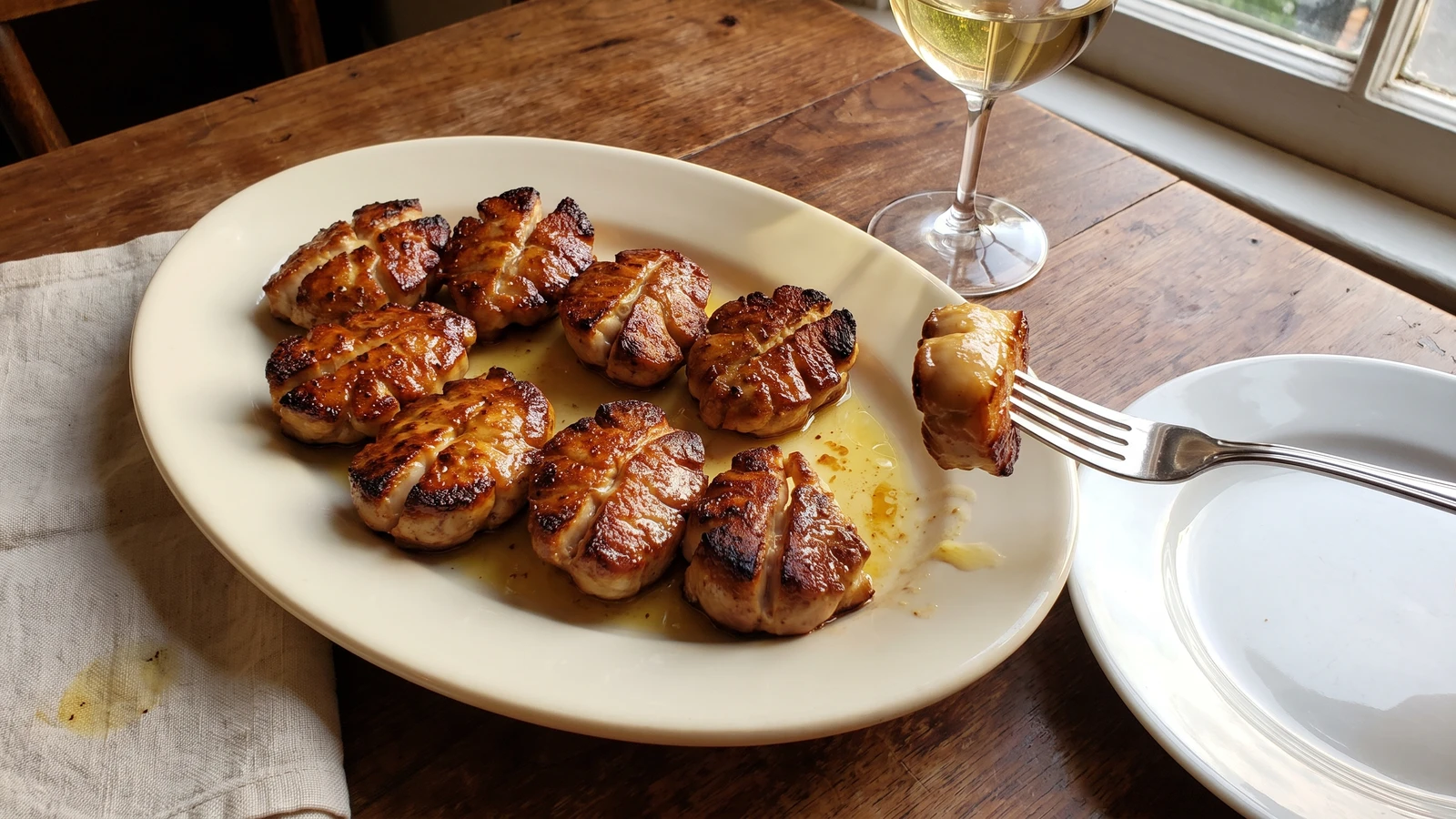
Ris de veau grillés teach controlled heat: press them firm, split them cleanly, then grill gently under a faithful rain of butter until bronzed outside and tender within.
Ris de veau grillés (grilled veal sweetbreads) teach controlled heat. The one true thing to know before touching the pan is this: butter basting is not decoration. It shields the already-cooked sweetbreads while the ridged heat bronzes them, so the surface crisps rather than dries and the center warms without tightening.
The source begins after the sweetbreads have gone through Blanchings (No. 273), been fully cooked and trimmed, then set to grow cold under pressure. The original line assumed a prep cook, a cold press, and a live-fire grill. It needed neither saucier nor stockpot, and a salamander's fierce top heat would miss the source's gentle grilling. At home, two quarter-sheet pans and a few heavy cans make the press, while a cast-iron grill pan gives steady heat for four servings. The equipment and quantity change because one cook needs no brigade; the method does not.
The grill station and brigade batch are scaffolding, so they can go. Cold pressure, the lateral split at the thickest point, the dip in melted butter, gentle grilling, and frequent basting are the dish itself. Keep every one. Baste well and don't walk away, because the outside must stay glossy until the center is thoroughly hot.
Ris de veau grillés belong less to one province than to the Parisian classical grill repertory, where carefully prepared veal offal moved between cuisine bourgeoise tables and grand kitchens. The name sweetbread misleads twice: there is no bread, and the preferred noix is the rounded thymus gland near the heart, prized for its delicate flesh and fine texture. Grilling followed blanching, trimming, and pressing because that preliminary work gave the fragile gland a clean shape sturdy enough to bronze over live heat without falling apart.
Quantity
4 (about 2 lb / 900 g total), prepared through Blanchings (No. 273)
Quantity
½ cup (120 ml / 113 g)
melted
Quantity
1 teaspoon (5 ml / 6 g)
Quantity
½ teaspoon (2.5 ml / 1 g)
| Ingredient | Quantity |
|---|---|
| veal heart sweetbreads, fully cooked and trimmed | 4 (about 2 lb / 900 g total), prepared through Blanchings (No. 273) |
| unsalted buttermelted | ½ cup (120 ml / 113 g) |
| fine salt | 1 teaspoon (5 ml / 6 g) |
| finely ground white pepper | ½ teaspoon (2.5 ml / 1 g) |
Set the sweetbreads, already prepared through Blanchings (No. 273), fully cooked and trimmed, between two parchment-lined quarter-sheet pans or flat plates. Place 4 to 5 lb (1.8 to 2.3 kg) of evenly distributed weight on top and refrigerate for at least 2 hours, until thoroughly cold and firm. Pressure gives the delicate lobes an even thickness and enough structure to meet the grill, but don't crush them into wafers.
Melt the butter over low heat and keep it warm beside the stove. Set a 12-inch (30 cm) cast-iron grill pan over medium-low heat for 5 minutes. The pan is ready when a drop of butter sizzles softly without turning dark at once; fierce heat bronzes the outside before the cold center can warm.
Remove the weights and dry the sweetbreads carefully. Cut each one laterally through its thickest point, holding the knife parallel to the board, to make 8 broad pieces of even thickness. Season both sides with the salt and white pepper, then dip every piece completely in the melted butter and let the excess fall back into the bowl.
Lay the sweetbreads cut-side down on the grill pan, leaving space between them. Grill gently for 4 to 5 minutes without shifting them, brushing the upper surfaces with melted butter every minute. When a piece has formed a proper bronze crust, it will release with little resistance; if it clings, wait another 30 seconds rather than tearing it.
Turn the sweetbreads and grill for another 4 to 6 minutes, basting every minute, until both sides are deeply golden and the centers reach 165°F (74°C). If the surfaces look dry while the centers are still cool, lower the heat, brush them generously with butter, and turn them every 30 seconds until glossy and hot. Ça se rattrape. If the butter specks turn black, move the sweetbreads to a plate, take the pan off the heat, wipe away the burnt solids, and continue over lower heat with fresh melted butter.
Transfer the sweetbreads to a warm platter and brush them once more with melted butter. Rest for 2 minutes without covering them, since a cover softens the crust, then serve immediately while the broad faces remain crisp and the centers are tender. À table!
1 serving (about 250g)
Culinary guides, cultural storytelling, and the editorial depth that makes cooking meaningful.
Discover Culinary ExplorerChef Juliette
John Dory has the delicacy of sole and the firmness of turbot. A light flouring, a quick butter sauté, and nut-brown beurre noisette show exactly why looks never mattered.

Chef Juliette
Fresh haddock proves its delicacy in the meunière pan: a fine flour crust, moist pearly flakes, and beurre noisette sharpened with lemon and parsley, ready from one skillet in half an hour.

Chef Juliette
Éperlans à l’Anglaise turns small fish into a lesson in disciplined coating: boned smelts under a close, crisp crumb, pan-fried in clarified butter and finished with bright, half-melted maître d’hôtel butter.

Chef Juliette
Tiny smelts, shallot, mushrooms, white wine, gratin sauce, and fine bread raspings meet a fierce oven, where the fish must turn tender in the same breath the buttered crust bronzes.